Staying on the path and letting someone pass are one shared task
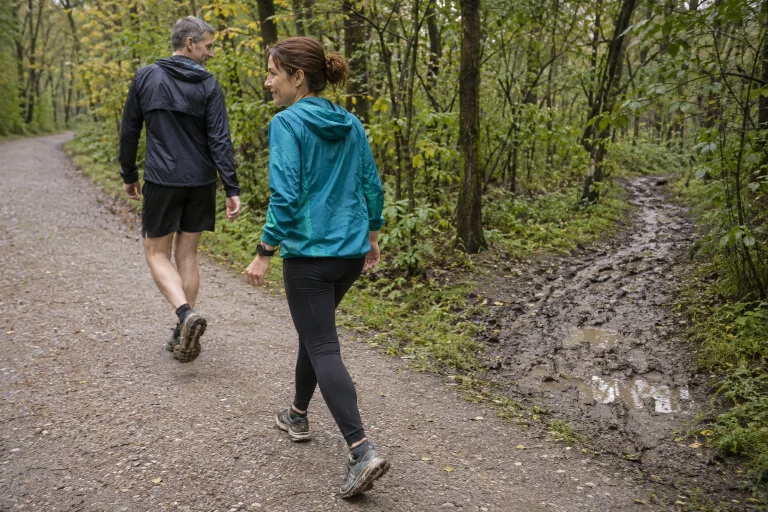
You are running on a narrow hiking trail with walkers ahead. You want to pass, but sensitive vegetation or uncertain terrain lies on both sides. Prioritising your pace or automatically expecting the other person to step off does not resolve it. First find a way and place for the encounter that suit people and environment alike.
Predictability, communication and patience are concrete tools for moving together in woodland. Every encounter need not become a long conversation. Giving timely notice and waiting for an appropriate place is often simpler than a last-moment pass. Other users’ movement forms part of the real route during your run too.
You can choose a less crowded outing beforehand
A popular walking destination’s narrowest path at a busy time may not suit uninterrupted training at your own rhythm. If your task needs few interruptions, consider another checked route or time. Plan the space’s actual use into the session.
This does not mean runners have no place on hiking trails. Rather, expected encounters belong to the chosen loop’s task. A narrow route to an impressive viewpoint may create a different situation as a shared walking outing from a wider, suitably usable circuit.
Always check access and local arrangements separately. The MTSZ warnings can reveal route changes or restrictions. A closure may alter traffic on the remaining path and your planned connection too.
Do not transfer the encounter’s cost to both trail edges
The Duna–Ipoly National Park visitor guide emphasises the conservation role of following designated paths. Letting another visitor pass therefore must not automatically require someone to go around through protected vegetation.
The Leave No Trace principle on consideration for other visitors highlights shared use and mutual regard. This is international guidance; interpret its situations alongside local rules and surroundings. The same step-aside solution is not appropriate everywhere.
If there is not enough room for an orderly encounter here, wait for a better place or adapt movement to the actual surroundings. Your time target does not create extra trail width. Calm handling of the situation can form part of the run.
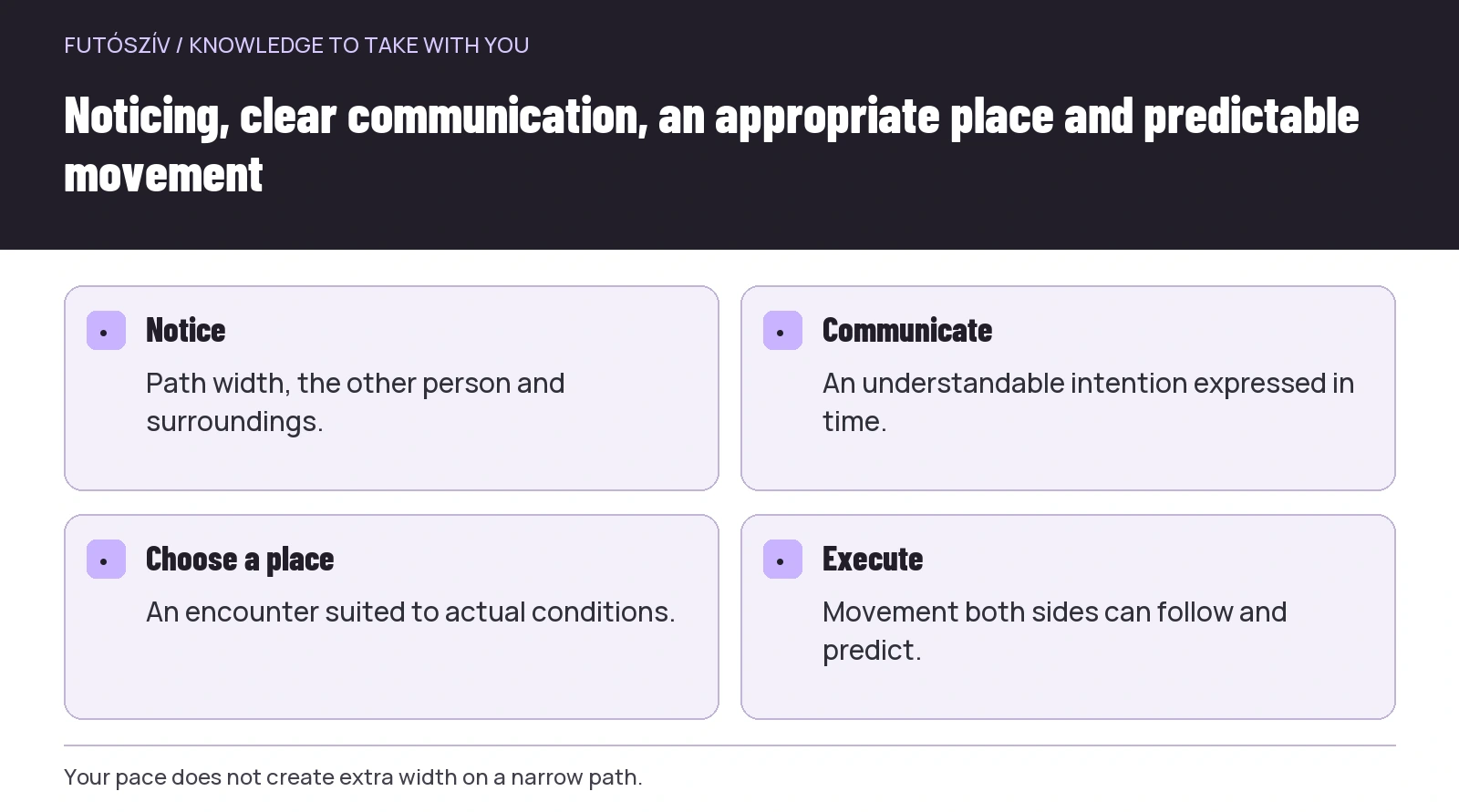 Enlarge diagram
Text version of the illustration
- Notice
- Path width, the other person and surroundings.
- Communicate
- An understandable intention expressed in time.
- Choose a place
- An encounter suited to actual conditions.
- Execute
- Movement both sides can follow and predict.
Express your intention clearly and early
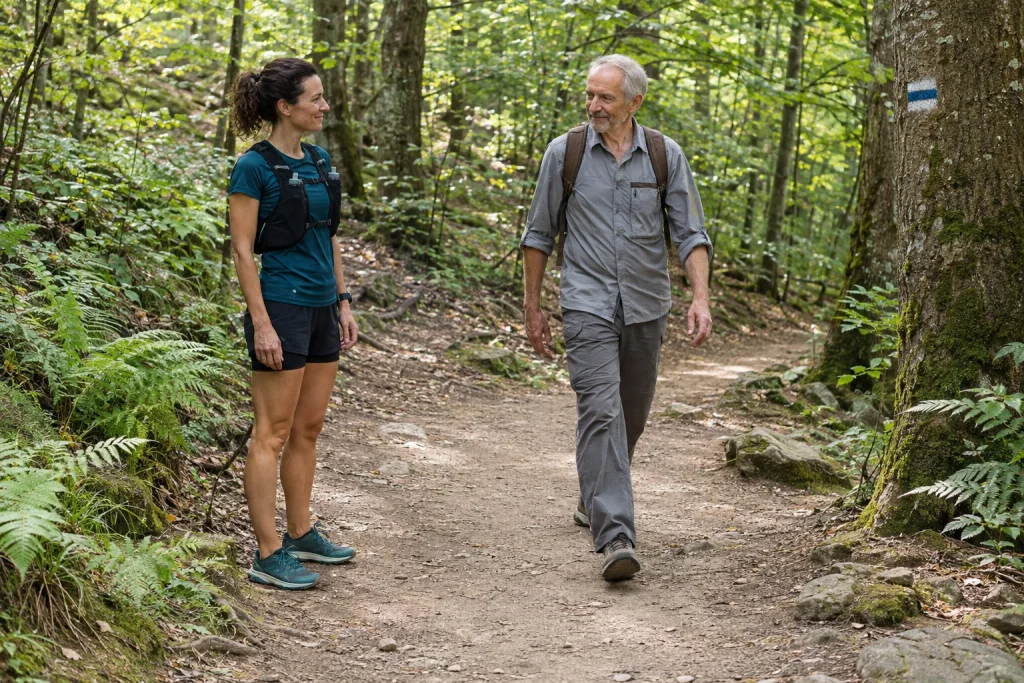
When you approach from behind, the other person may not hear your steps or judge your distance accurately. Do not wait until the final step to demand space with a loud shout. Communicate in a way that gives them time to understand and respond, while preparing to slow or stop yourself.
A brief polite request is more useful than a command. You might ask whether you can pass at the next wider section. Mutual understanding matters more than exact wording. A lack of response is not automatically deliberate obstruction; they may not have heard or understood.
Use right and left only when clear to both of you. A sudden sideways movement can create more uncertainty than a few more steps together. The aim is an orderly encounter, not forcing a pass with the fewest possible words.
Four common situations with different tasks
| Situation | First focus | Assumption to avoid |
|---|---|---|
| Catching walkers from behind | Clear notice and a suitable place | They certainly already know you are there |
| Another group approaching | Movement both sides can follow | The other group must leave the path |
| Reaching a narrow passage | Clarifying actual room and order | Running pace gives priority |
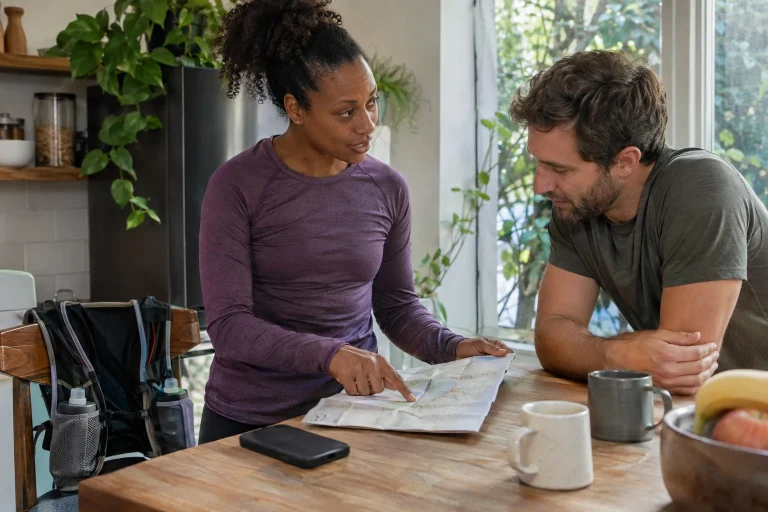
| Someone stopped to read a map | Understanding the situation and approaching considerately | They are deliberately occupying the route |
The table is not a legal priority order. Local rules and signs apply, and each encounter needs handling according to the actual situation. Do not use a general online ranking to compel others to move on unfamiliar terrain.
In a group, consider the full length
A substantial gap can separate a running group’s first and last members. If only the first communicates, walkers may not know how many more runners are coming. Agree a followable movement pattern beforehand, particularly on narrow sections.
Do not form a wide, continuous line where others need room too. Staying together does not mean everyone running side by side. Conversation and shared pace should fit path width and surrounding use.
After an encounter, regroup somewhere appropriate. Do not stop across the full width in the middle of a junction or at a narrow passage’s exit. Where to talk and read maps is as much a planning question as the route itself.
Do not turn speed differences into judgements about people
A slower visitor may have a different goal, experience and circumstances. You need not judge these from a few glances. They may be walking with a child, learning a map or simply enjoying a relaxed stroll. Shared trail use is not a performance ranking.
The same consideration is needed between runners. If someone slows before a difficult section, do not assume passing at any cost is necessary. Waiting for a suitable place and communicating intention turn a pace difference into an orderly encounter.
Plan your session so expected encounters do not become continuous irritation. If a format works at the chosen location only by repeatedly making others stand aside, reconsider the route or time.
Local arrangements underpin encounters with other users
Some routes also involve cyclists, dog walkers or horse riders. Check area designations and usage rules in advance. Do not assume an order given in another country’s guidance applies unchanged at every Hungarian location.
Communication and predictable movement still matter. Do not touch an animal, another person’s equipment or vehicle without asking. If it is unclear how to pass, briefly agree in an appropriate situation. A surprise approach does not simplify the encounter.
Running with your own dog requires separate preparation and knowledge of local rules. Calling the animal friendly does not resolve the relationship between lead, group and path width. Shared use includes other visitors’ and nature’s needs too.
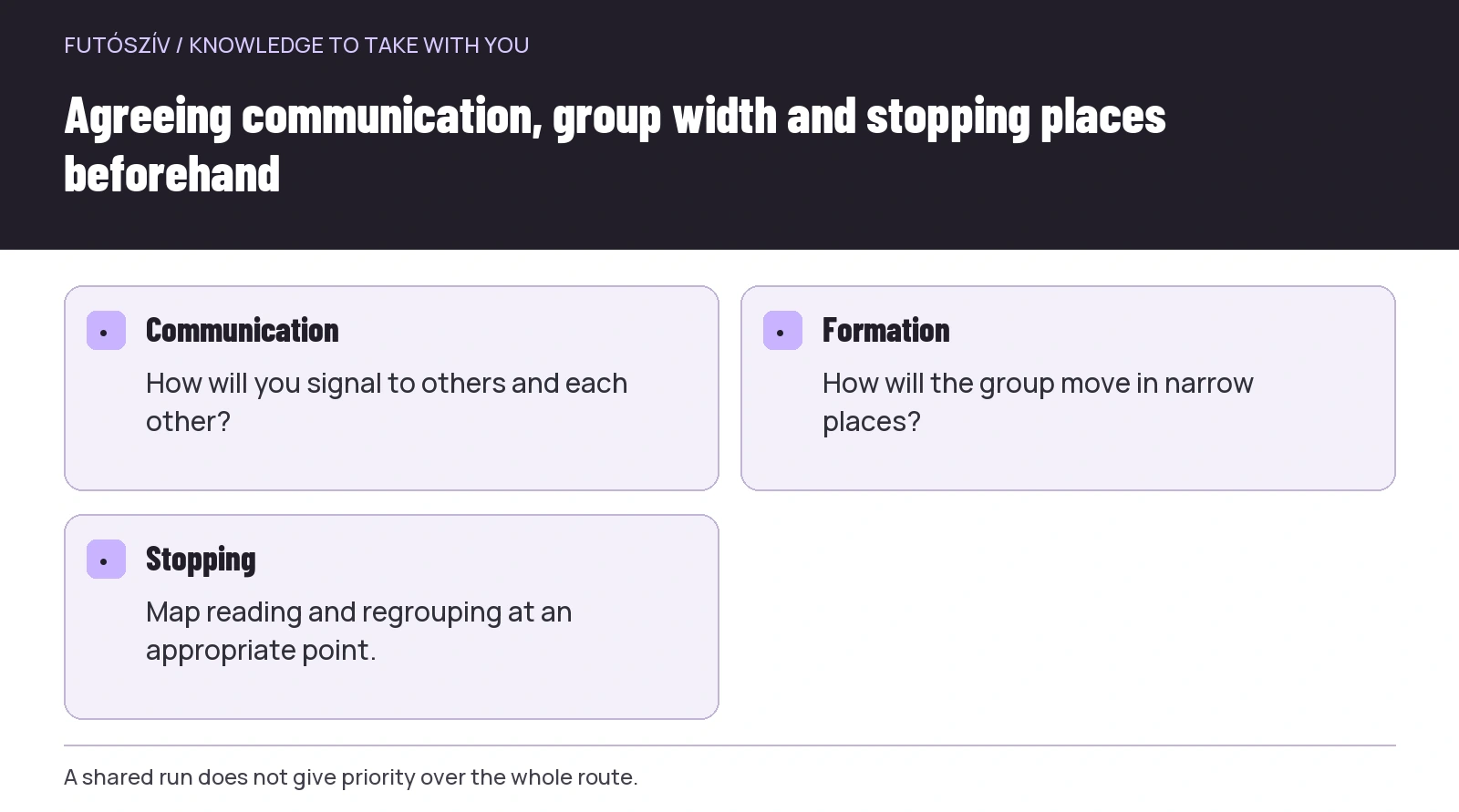 Enlarge diagram
Text version of the illustration
- Communication
- How will you signal to others and each other?
- Formation
- How will the group move in narrow places?
- Stopping
- Map reading and regrouping at an appropriate point.
Do not let music mask information about shared movement
If listening to audio, choose an approach compatible with perceiving your surroundings and local rules. Others’ signals, group communication and watching terrain remain real tasks. Running being personal relaxation does not remove this information.
An external speaker imposes your music choice on others too. Quiet and environmental sounds can be part of the countryside experience. Discuss this beforehand within a group, especially in popular or sensitive areas.
Consideration is more than quietness. A short timely signal may be needed, while unnecessary shouting disturbs. Seek communication suited to the situation rather than a rigid rule that nobody may ever speak in the forest.
An illustrative example on a narrow section
A runner catches two walkers. This part of the path is narrow, with vegetation and uneven terrain beside it. The runner notices, signals in time that they would like to pass later and does not immediately squeeze between or alongside them. At the next more suitable point, they manage the encounter in an orderly way.
In the runner’s notes, the section is not a ruined pace but one real task of a busy route. If the next session needs fewer interruptions, they choose another checked place or time.
The example gives no compulsory distance or universal direction for stepping aside. Judge those from the specific site. The lesson is the sequence: notice, clear communication, appropriate place and predictable execution.
If conflict arises, aim to resolve the situation
After a misunderstood signal or unexpected movement, continuing an argument is easy. While running, the immediate aim is orderly shared movement and a safe situation. Judging the other person or citing online priority arguments rarely makes the trail more usable.
If you encounter a specific breach or persistent problem, record it factually in appropriate circumstances and report it to the relevant manager. Date, location and observation are more useful than a general complaint against an entire visitor group.
Review your own part too. Did you signal in time, wait for a suitable place and choose an outing suited to the route? This is not accepting sole responsibility for every conflict, but evaluating what informs your next decision.
Choose places within the marked route that suit the surroundings
Not every apparently wider patch is an appropriate stopping place. It may be protected vegetation, soft ground or sensitive for another reason. Look at signs and actual surroundings, not merely where the group would fit for a photograph.
Choose places for map reading, arranging flasks and waiting together in the same way. If the right point is farther away, adapt the rhythm. A few minutes of organisation need not come at the expense of others’ passage or neighbouring habitat.
If a chosen loop repeatedly lacks appropriate places for your intended large group, reconsider numbers or location. A route successful with a small group may not work identically with many participants. Pressure on the area and number of encounters are part of the programme.
A short group agreement before departure
Agree how to signal to others, arrange yourselves on narrow sections and stop for maps or regrouping. New members should receive the same information as returning participants. They should not have to discover unspoken habits at the first encounter.
Keep the agreement simple and actionable. Following local rules, clear communication and waiting for a suitable place are three memorable principles. The precise situation still needs judgement on the ground rather than a memorised sentence.
After running, keep one concrete lesson: which section was busy, where passing worked well and where another place was needed. This can improve route or timing next time. Protecting the marked path and letting others pass then remain two jointly handled parts of the same shared-use task.
How Futószív articles are prepared: our editorial guidelines.