
A fortieth birthday does not flip the same recovery switch for every runner. Some begin regular movement then, others arrive with years of training and others return after a long break. Calendar age is important background, but alone it cannot tell you how many rest days or which workouts to put into next week.
Good planning tries to understand your own changes. After which tasks, and how long afterwards, does running feel settled again? What roles do work, sleep and new loads play? The aim is a routine that works and can develop now, rather than copying a younger self’s system at all costs.
Consider three different backgrounds together
The first is calendar age. The second is running history: experience, training consistency and recent changes. The third is current life circumstances. Together these say much more than belonging to a general age category.
Of two forty-five-year-old runners, one is learning new movement while the other has followed a stable programme for years. The same longer run or strength task can therefore represent very different novelty. Previous endurance experience cannot replace every new skill either.
Do not treat life circumstances as peripheral. Late work, family caring responsibilities and frequent travel influence opportunities for rest. Not every difficult morning should be attributed exclusively to age.
What do recovery experiments show?
Research involving twenty-eight active men compared younger and middle-aged groups after a specified downhill treadmill task. No meaningful group difference appeared in the studied outcomes over the following forty-eight hours. The experiment does not establish that age never matters; it applies to the participants and particular task.
Another follow-up of twenty-three trained runners after a fifty-five-kilometre trail race described slower recovery in certain measures among the masters group. The study examined a different task and different groups. Do not simplify the two findings into one rule applied to every workout.
The practical conclusion is individual planning. A usual easy run, new strength session and long trail race are different situations. Link recovery needs to the specific task and your response, not solely your birth year.
Do not endlessly patch up the old plan
If a previously effective week now regularly feels too demanding, revisit the basics. How many sessions fit, what is the main goal and where is genuine rest possible? Simplifying the whole structure can sometimes help more than adding another recovery device to every workout.
The clash may be with a changed schedule rather than age. An old afternoon run may now fit only late at night, or a weekend long outing may no longer be followed by a quiet day. These are concrete organisational questions allowing concrete changes.
Previous results can remain valuable memories and references without becoming compulsory minimums for every current session. A task chosen from today’s foundation allows more consistent work. Improvement need not mean replaying the past exactly.
Observe the space between demanding sessions
Look at where intense runs, longer outings and strength training fall. If they sit consecutively, the next easy day begins with accumulated demands. Weekly mileage alone does not describe this.
You need not prescribe identical compulsory recovery time for everyone. Look in your diary for when the next main workout usually feels controlled. If unusual fatigue regularly remains, adjust order, volume or difficulty.
The calendar does not require every important session on the same weekday either. If life circumstances and the coaching plan allow, tasks can be arranged more flexibly. The weekday matters less than placing the next load appropriately.
 Enlarge diagram
Text version of the illustration
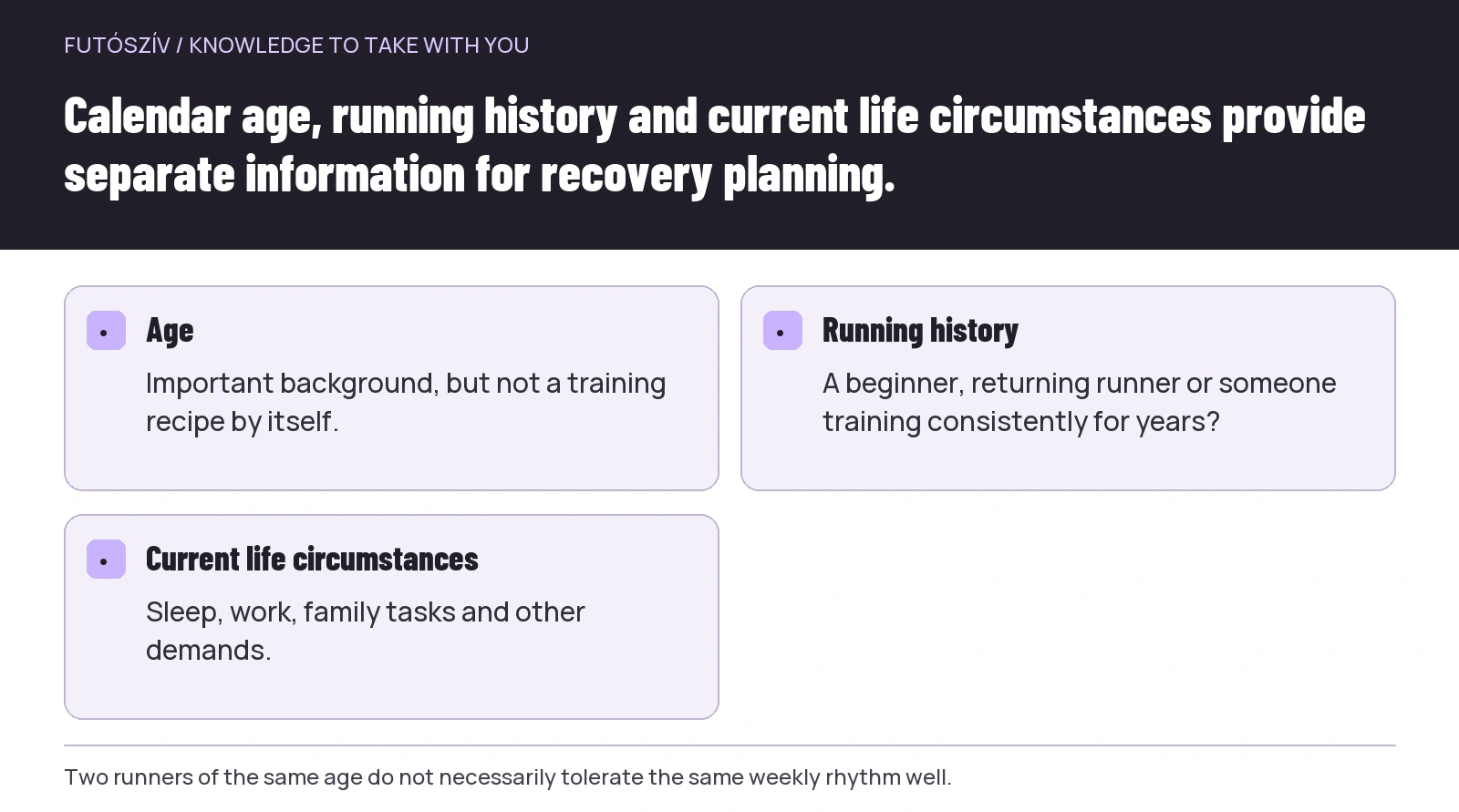
- Age
- Important background, but not a training recipe by itself.
- Running history
- A beginner, returning runner or someone training consistently for years?
- Current life circumstances
- Sleep, work, family tasks and other demands.
Do not make an easy run a hidden fitness test
An easy day’s task is not necessarily checking whether the old pace remains. If every session becomes proof-seeking, differences between loads disappear. Running adapted to current effort should remain genuinely manageable.
Record a harder-than-usual feeling, but do not make every day a final judgement. Environment and preceding days matter too. A persistent pattern provides more information than one weaker kilometre.
If your condition calls for rest, leaving out running can be appropriate execution of the plan. You need not immediately replace missing movement with another sport. The goal is regulating load, not filling every box.
Give new strength training time for learning
Strength work is a separate skill, whether you are new or returning after a long gap. Appropriate execution, a manageable starting task and integration into the whole week are needed. Running history does not automatically make heavy-resistance or jumping tasks familiar.
If strength work regularly spoils the next important run, the method itself is not necessarily wrong. Initial load may be excessive or placement unsuitable. Knowledgeable help can refine task selection and progression.
General activity recommendations for older age groups are not limited to endurance movement either. The CDC guide for adults over sixty-five also discusses strength and balance activity. This is a public-health framework for that age group, not a ready-made plan for forty-year-old competitive runners.
Plan available sleep time too
If training regularly pushes bedtime later or waking earlier, the programme’s full cost exceeds its running minutes. Examine this situation in recovery planning before seeking a new product or metric.
A better schedule is not a simple choice for everyone. With shifts, caring or other commitments, the running programme must adapt to available opportunities. You need not follow the same system as someone whose life differs.
If sleep difficulties persist or substantially disrupt daytime functioning, seek appropriate professional help. Reducing training volume is not every solution, and not every problem should be managed independently with supplements.
General well-being and local fatigue are different information
You may feel cheerful and energetic generally while one area remains unusually fatigued. At other times, your legs feel fine but overall well-being is poor. Do not collapse these into one “ready” or “not ready” label.
A short diary comment is enough: how familiar movement felt, whether unusual stiffness or discomfort remained and how manageable the day seemed. The aim is recognising recurring patterns, not another daily scoring competition.
New or worsening pain, numbness and other concerning symptoms may need separate assessment. Do not automatically treat them as natural ageing. “That is normal after forty” does not replace healthcare assessment.
The sports watch should not decide alone
Resting heart rate, heart-rate variability or a readiness score can supplement information. A single measurement is not a comprehensive health and exercise-tolerance assessment. Symptoms can exist despite a favourable display, while several circumstances can underlie an unfavourable number.
If collecting data, evaluate under similar conditions alongside your own history. Comparing with another runner’s numbers is often less useful. In particular, do not draw conclusions from who has the prettier graph at the same age.
A runner without a device is not without feedback. Consistent well-being notes, training actually completed and sensations during familiar tasks can also inform planning. Every decision need not require a new instrument.
 Enlarge diagram
Text version of the illustration
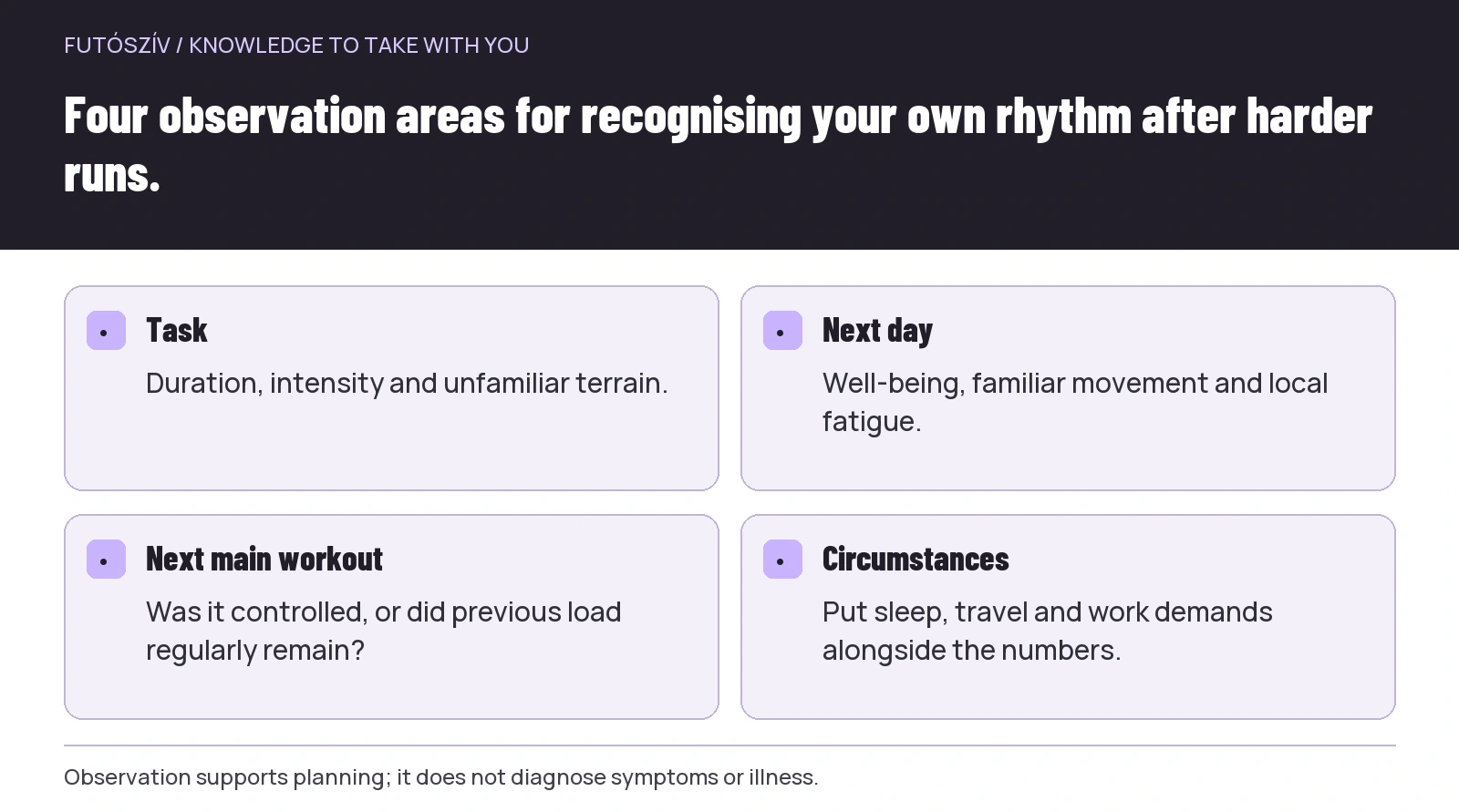
- Task
- Duration, intensity and unfamiliar terrain.
- Next day
- Well-being, familiar movement and local fatigue.
- Next main workout
- Was it controlled, or did previous load regularly remain?
- Circumstances
- Put sleep, travel and work demands alongside the numbers.
Do not explain every slowdown through age
A different route, wind, heat, irregular weeks and changed effort can all influence pace. Compare similar situations first. One workout cannot reveal precisely how much change the passage of time caused.
Conversely, you need not deny every change or assume willpower can reverse it. Goals can evolve: better pacing, a new distance, group running or results suited to the present period can all provide meaning. Running has more than one absolute personal best as a measure.
If a performance goal matters, choose a current, realistic starting point and allow time for consistency. Daily comparison with your best day twenty years ago rarely supplies useful training instructions.
Persistent change is worth having assessed
With prolonged unusual exhaustion, recurring illness or a marked decline in exercise tolerance, do not rely only on more rest days and personal guesswork. Several health and life circumstances can produce similar experiences. Appropriate help can clarify further planning.
The American Heart Association statement considers regular movement’s benefits alongside individual risks. Health, symptoms and previous preparation matter more to assessing load than a general age-group label used alone.
For chest symptoms, feeling close to fainting or severe illness, appropriate healthcare assistance takes priority over the running plan. Years of sport are no reason to ignore a new symptom. A sudden severe condition needs urgent care.
Two life situations, two different adjustments
One runner begins regular movement after forty and immediately adds demanding strength work to new running sessions. Gradual learning and smaller, traceable changes may matter for them. Age alone does not explain several new tasks arriving simultaneously.
Another has trained for years but now works more intensely and sleeps less. Changing weekly order and goal size may create room. Keeping a previously successful plan is not necessarily consistency when circumstances have fundamentally changed.
In both cases, observation guides the next step. Change one variable and examine its consequences. If symptoms or health uncertainty are also present, continue planning with appropriate professional help.
Make recovery part of the plan
First choose the week’s genuinely important tasks, then leave manageable days around them. Include work and other sports, and look for your own responses over the next period. If a difficulty repeats, adjust the plan rather than demanding ever stronger discipline.
Success can mean more controlled running over several weeks, less rushing to sessions and the week continuing to function after hard work. These support a performance goal remaining meaningful over time.
After forty, experience can be one of your best planning tools when applied to today’s situation. You need no universal rest formula. Seek a rhythm in which load, recovery opportunities and enjoyment of running fit together.
Primary and official sources
- Age Differences in Recovery Rate Following an Aerobic-Based Exercise Protocol Inducing Muscle Damage Among Amateur, Male Athletes – a specified downhill treadmill protocol with male participants.
- Effects of a trail running competition on muscular performance and efficiency in well-trained young and master athletes – follow-up after a fifty-five-kilometre trail race.
- American Heart Association scientific statement on interpreting exercise risk.
- CDC: general activity recommendations for adults over sixty-five – not an individual programme for competitive runners.
How Futószív articles are prepared: our editorial guidelines.