Ground conditions matter when choosing today’s run
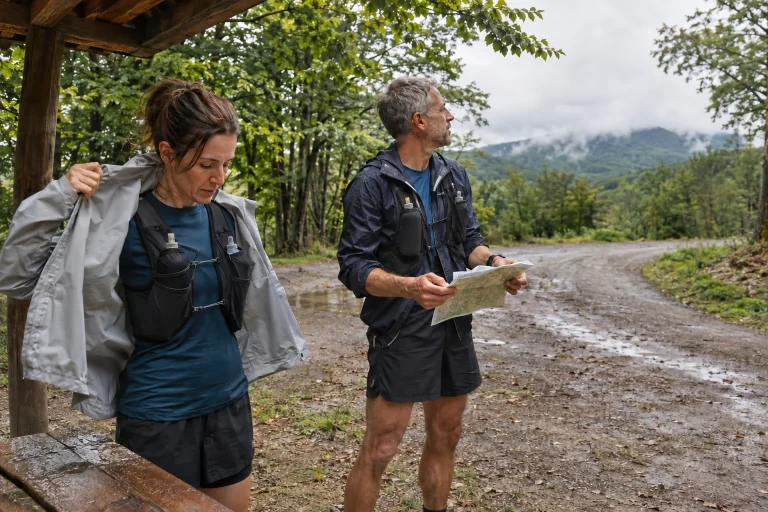
After rain, your usual forest loop may be tempting: attractive scenery and a route known by heart. The ground may not present the same task as in dry weather, however. Alongside your own movement, trail condition, access rules and the outing’s purpose matter. A paved or otherwise genuinely suitable alternative can be a deliberate route choice.
This article does not teach muddy-running technique or decide remotely which puddle you can cross. It frames the pre-departure decision: which information to use, what not to solve through improvised on-site detours and how to preserve the run’s purpose on another route.
Ask more than whether your shoes will get dirty
It is easy to reduce a muddy loop to equipment cleanliness. Other questions matter: can you follow the route, what is the ground like, does the outing fit your experience and how does use affect the trail? An appropriate answer combines these.
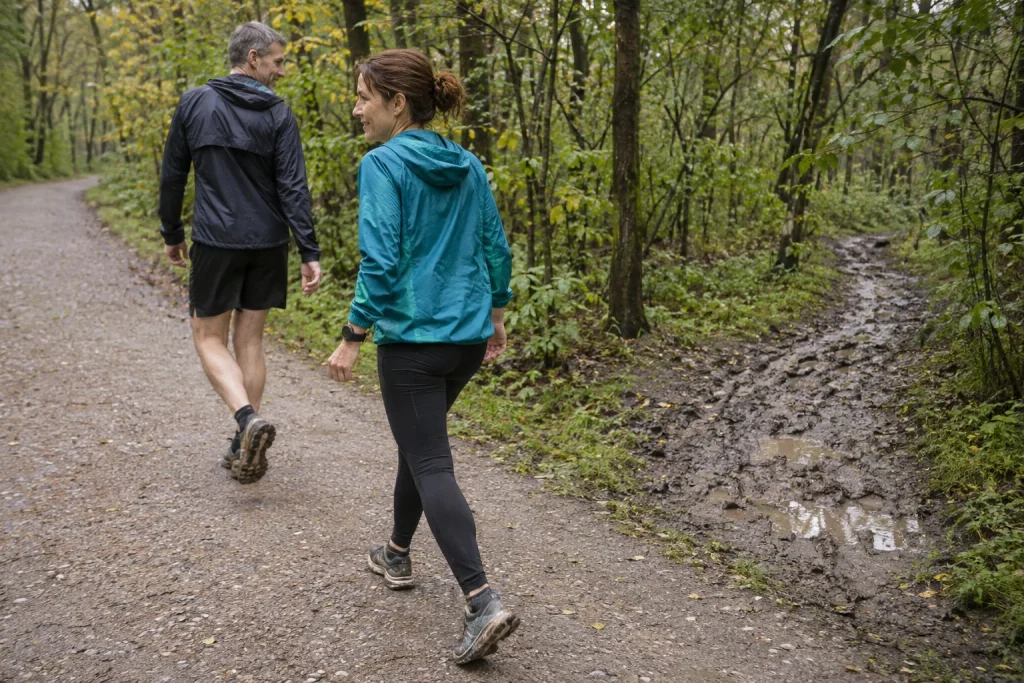
The Leave No Trace guide to mud season notes that going around mud at the sides can widen trails and create new tracks. It offers a conservation principle from a North American setting. Interpret it alongside local rules and actual conditions on your own Hungarian route.
This does not mean you must cross every uncertain stretch of standing water. Resolve the decision when choosing the route. If a planned section’s condition or management makes it inappropriate, choose another outing rather than creating a new detour through vegetation.
Three questions for today’s route
| Question | Which information helps? | What is not a sufficient answer? |
|---|---|---|
| Can the area be used? | Land-manager notices and current on-site arrangements | An old GPX or last year’s photograph |
| Does the task suit you? | Your experience and understood terrain character | Only kilometres and total ascent |
| Can the trail be protected? | Local information and actual condition | An arbitrary sideways detour |
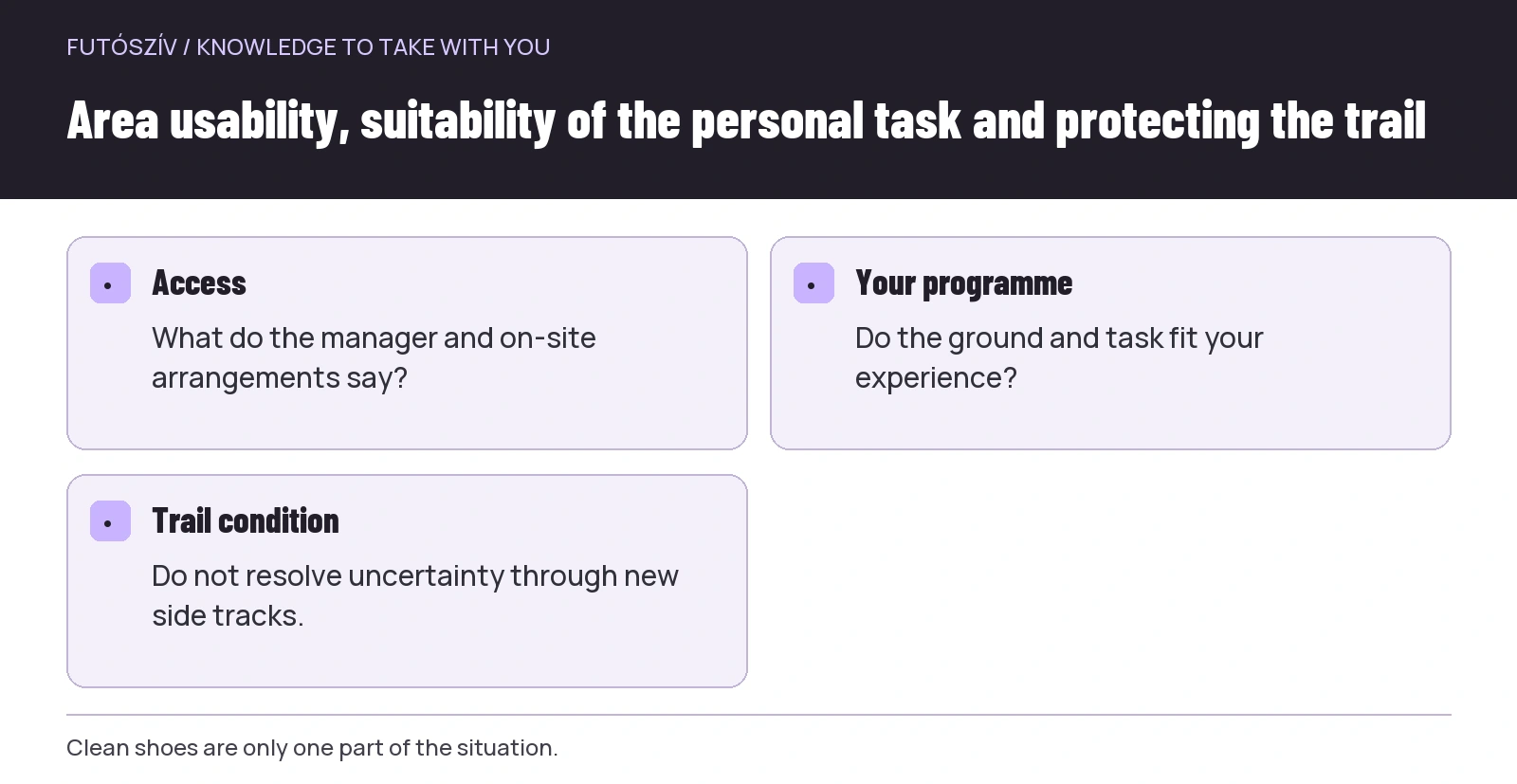
These questions serve different roles. A route can be open yet unsuitable for today’s personal programme. A short section can be in a condition where use or making new detours presents a separate problem. Planning should do more than search for a prohibition; it must also understand the chosen task.
 Enlarge diagram
Text version of the illustration
- Access
- What do the manager and on-site arrangements say?
- Your programme
- Do the ground and task fit your experience?
- Trail condition
- Do not resolve uncertainty through new side tracks.
Find current information from the appropriate source
Check the MTSZ hiking-trail warnings and relevant land-manager notices before departure. Do not ignore a restriction, work operation or accessibility notice merely because the map line remains unchanged.
Community reports can supplement information, but check date and exact location. Someone running nearby does not necessarily mean they visited the same branch. A ground-condition photograph shows one moment and point, not the full distance.
Your previous experience is date-specific too. A note saying the loop was easy to follow does not automatically promise the same during a later wet period. Local knowledge helps but does not remove the need to check current condition.
Give the alternative a specific name too
“I will run on some pavement instead” is useful only if you actually know a suitable route. Check surface, traffic, lighting and access. A nearby road is not a good alternative merely because it is not muddy.
Keep two or three checked options in your route collection beforehand. These might be a familiar urban loop, a path in a suitable public park or a firmer-surfaced section you are permitted to use. Choosing needs concrete local information; this article does not declare every gravel road or running track appropriate.
Calculate the alternative’s time requirement too. If reaching it takes longer, the run itself may need shortening. Organising the whole outing matters more than preserving original kilometres at all costs.
Translate the run’s purpose into the new environment
If the session was intended as an easy, familiar routine, another route may often retain its organisational role. But a specific trail task is not necessarily equivalent to a paved loop. Discuss changes to the training programme with your coach if necessary.
Do not automatically compensate for missing trails with faster pace. Surface change and training-load purpose are different questions. This article prescribes no new intensity; it emphasises naming the programme change and fitting it deliberately into your plan.
Clarify the new purpose for a group outing too. If originally advertised as learning a route, an urban loop may be a different task. Before departure, participants should receive one current message with the new place, time frame and preparation needed.
Do not increase unknowns on site
Even after checking all accessible information before leaving, you may encounter different conditions. Decide from your situation and environment how to end or change the outing. Do not treat an unfamiliar path looking nearby on the map as an automatic detour.
The Duna–Ipoly National Park visitor guide also emphasises the conservation importance of staying on designated paths. Avoiding mud does not justify cutting through protected vegetation or prohibited ground. Local rules and actual usability matter together.
If continuing a section is uncertain, preserving clean shoes should not be the only basis for deciding. An appropriate finish, understood return and necessary help take priority over saving the planned line.
Agree changes with the group in advance
A named alternative beforehand is particularly useful when several people’s plans are involved. You then need not renegotiate at the meeting place with differing equipment and time frames. The leader or organiser should clearly state which route applies and why.
Participants may have different experience. Someone regularly running similar terrain may perceive the situation differently from a newcomer. Do not let social pressure determine the joint choice. If the outing is intended to stay together, route and communication should fit that.
Explain access alongside the venue change. A new start may mean a different bus stop or parking arrangement. Organising a shared run does not end with posting another map link in the chat; actual arrival and finish need review too.
 Enlarge diagram
Text version of the illustration
- Today’s aim
- What can remain from the original outing?
- Another loop
- Known surface, access and usage rules.
- The whole day
- New meeting point, access and finish.
An illustrative weekend-loop example
A small group plans a familiar forest loop. Fresh local information and previous experience indicate that one section does not currently suit the shared outing. Rather than drawing another unknown forest shortcut, the organiser uses a previously checked alternative location. Today’s goal remains a sociable, orderly running session.
The new message gives the exact meeting place, chosen route and time frame. Learning the trail route waits until later. The group does not judge the day less worthwhile because it missed the original viewpoint. They adapted their agreed outing to actual conditions.
Before the next forest departure, they check condition and access again. Today’s venue change is not a permanent ban on that loop. The lesson is that a pre-existing, understood alternative makes weather-related adjustments easier.
The paved loop has its own tasks too
Moving a run from trails to a town or park is not automatically problem-free. Check shared-path use, crossings and traffic at the intended time. Fit the run to its new surroundings rather than simply redrawing the same GPX length elsewhere.
When sharing a route with people moving in several directions, group width and predictable movement matter too. Moving because of mud should not create disorganised group running somewhere else. Check the meeting point and suitable stopping places as well.
The surface’s actual condition is a separate question. Rain, frost or other contamination can affect use here too. Do not turn the decision into a simple rule that all asphalt must be suitable instead of mud. Checking the specific route remains the task.
Cleaning equipment also serves the next outing
After running, care for equipment and clothing according to manufacturer guidance. Do not automatically apply washing or heat treatment heard about for another product to muddy gear. The actual material and model’s care requirements provide the basis.
The organisation of cleaning matters too. If shoes or clothing will not be usable for the next planned outing, reflect that in the calendar. Equipment rotation and drying do not necessarily require buying more; first review timing and existing items.
Do not try to shake dirt brought from the trails off at another running location, or leave cleaning waste outdoors. Choose an orderly solution suited to your surroundings. Equipment care can form part of the full outing just like travel there and home.
What should you record after deciding?
Record the information prompting the change, the alternative chosen and how it worked. This reveals whether the backup route was genuinely useful or created another organisational question. Evaluate more than average pace.
If you encountered an on-site problem, record its date and exact location. Ground conditions can change quickly, so do not pass your observation on as a definitive route rating. A precise, dated report is more useful to another runner and, when appropriate, the manager.
Choose one task to improve next time: earlier condition checks, a more detailed alternative or a clearer group message. The decision then leaves concrete organisational knowledge. You need not create an entirely new route library after every wet outing.
Match the choice to the purpose and place
Choosing between a muddy path and another surface is not a comparison of runners’ determination. Coordinate today’s task, your experience and the area’s conditions of use. A suitable alternative is usable because it has real information and an orderly finish.
Before leaving, check current access, name the loop’s purpose and know another option. On site, do not try to preserve the old drawing at all costs through new detours. Protecting the trail and sensibly organising your outing belong to the same route-choice task.
How Futószív articles are prepared: our editorial guidelines.