In winter, fit the whole running outing into your chosen window
Your calendar shows a one-hour gap and the planned run is fifty minutes. At first it seems suitable. But getting there, changing and returning are missing, and daylight does not follow your work calendar. During short winter days, a usable plan considers the entire outing’s time requirement and includes a shorter, simpler version in advance.
This guide concerns organising daylight time. It does not prescribe switching to night running or give everyone the same winter programme. Actual conditions, experience and available time together shape a suitable route. If you want a daytime run, specify the return place and time too.
Sunset is information, not your personal visibility boundary
The HungaroMet Sun–Moon page provides sunrise and sunset times. Read which location and time system the table uses. Consider your route’s actual geographical position too; another settlement’s or day’s information is not automatically appropriate for your outing.
Sunset time does not mean every forest detail will be sufficiently visible to you until then. Surroundings, cloud cover and route character are separate questions. Do not plan to reach the end of a complex path at precisely the moment shown in the table.
Fit your finishing boundary to the full outing and conditions. You need not copy a general number of minutes from an article. What matters is retaining an orderly return and not building the time frame around one ideal average pace.
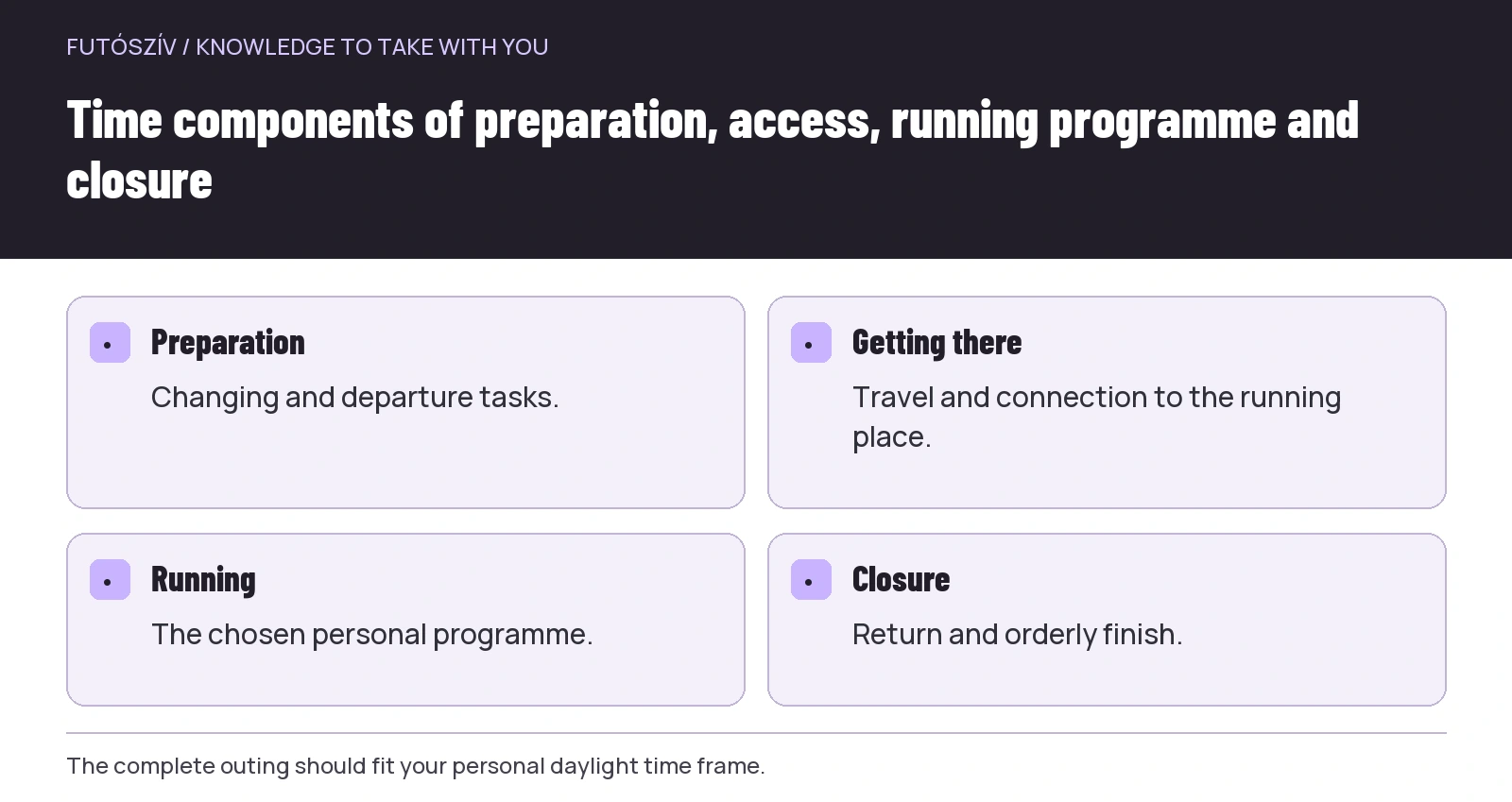
Four parts reveal the real time requirement
| Part | What might it include? | What should you check? |
|---|---|---|
| Preparation | Changing, equipment and departure tasks | A realistic personal routine or optimistic estimate? |
| Access | Travel and reaching the running location | Current route and on-site access |
| Running programme | The chosen, tried format | A route and time frame suited to that day |
| Closure | Return, communication and onward travel | The precise place and manner of finishing |
If your calendar includes only the part measured by the watch, the outing can regularly overrun. Do not size the window from your best day. Review actual organisational time from a few outings and use it for your own adjustable estimate.
 Enlarge diagram
Text version of the illustration
- Preparation
- Changing and departure tasks.
- Getting there
- Travel and connection to the running place.
- Running
- The chosen personal programme.
- Closure
- Return and orderly finish.
Count backwards from the intended finish
An illustrative example: in their own circumstances, a runner wants to reach the agreed finishing point by 15:40. The running part takes 40 minutes, with necessary walking connections before and afterwards totalling 20. They therefore allow at least an hour from starting on site, with departure preparation and travel additional.
These are invented example numbers, not general winter deadlines or sunset data. The method makes time components visible. Subtracting only the 40-minute run from the finishing boundary would leave the walking connection to be squeezed into the day’s end.
Mark which times are checked information and which estimates. A service departure may be current timetable data; the path from car park to trail may be estimated from experience. Treating these separately reveals where extra margin or a simpler outing is needed.
Prepare two versions of the same outing
Alongside the full version, keep a short programme understood in its own right. Do not merely write that you will turn back earlier. Identify where that can clearly happen and which route returns. A shorter loop is usable when it does not need first drawing on site.
The structures may match: a short and longer loop from the same base, for example, or a checked out-and-back with different turnarounds. Distance and character should suit your routine. Shape alone does not make a route appropriate.
Do not treat the short version as punishment or a sign of failure. If departure moves later, an orderly shorter outing suits the situation better than rushing the original distance. Changed available time is a planning reason in itself.
In the weekly view, daylight is a resource too
Look at next week’s actual calendar. Which days have a daylight window accommodating the whole outing? You need not aim at the same time every day if work or family tasks vary. An agreed, realistic window is worth more than an ideal plan repeatedly disrupted.
If only a short daytime slot is free, choose a matching location. More distant trails may be a worse choice because of access time, even if the loop itself is short. A checked route near home or work may create a simpler organisational task.
Do not automatically fill weekend daylight with every weekday run missed. Your training-load programme is a professional planning question, while organising the calendar is logistical. Limited time need not be compensated for by promising tightly crammed sessions.
Do not copy summer timing onto winter terrain
The same route can present a different task under different conditions. Surface, navigability and current access may change. The Mountaineering Scotland winter-planning guide also emphasises considering route and conditions together. It concerns Scottish mountain environments; plan your own Hungarian outing from local information.
A summer lap time is therefore previous experience at most, not a winter timetable. If conditions are unknown, do not build a minute-precise return around your fastest earlier visit. A simpler route or another day is an option.
Check the current MTSZ warnings and relevant manager’s notices for a short winter outing too. A closure can change even a previously familiar return. Limited running time does not resolve access questions.
 Enlarge diagram
Text version of the illustration
- New time frame
- Does the complete outing still fit?
- Short version
- A loop understood beforehand and a specific finish.
- Another solution
- Change the outing if the conditions do not come together.
Write your response to a late departure beforehand
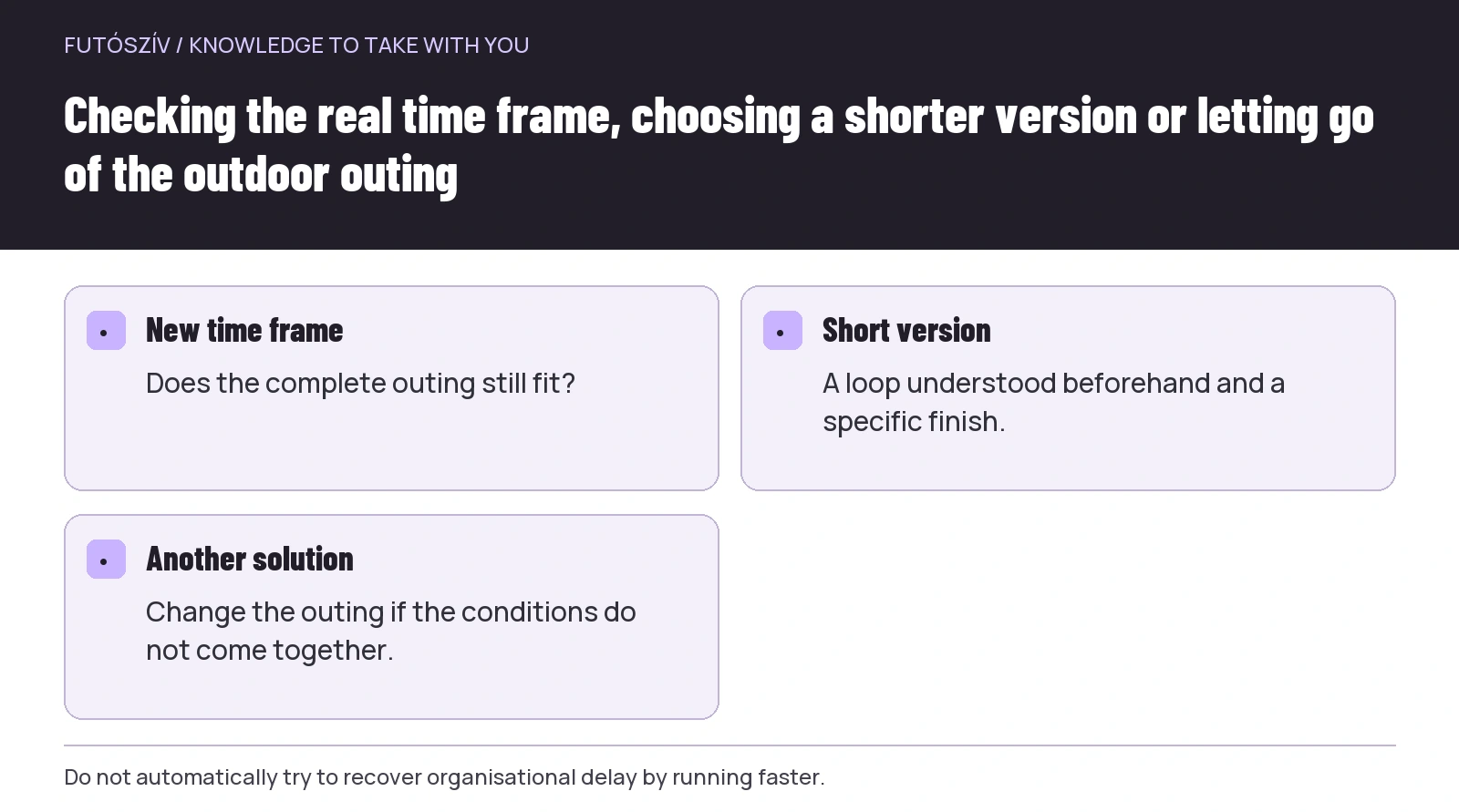
Work overruns, a bus is late or preparation takes longer. Renegotiating with your original loop every time can quickly consume your finishing margin. Write beforehand which checked version you choose for which time frame and when you let go of that day’s outdoor outing.
Your full programme and conditions set the specific boundary, not this article. The important point is that each passing minute should not make the decision less clear. A preselected nearby short loop or another suitable option may help when travel to the original location no longer fits.
Do not automatically try to recover delay by accelerating the run. Route, programme and personal condition do not necessarily change in a way that makes this appropriate. An organisational time shortage needs an organisational response.
Lighting and visibility require separate preparation
If movement in reduced light becomes a possibility, plan necessary equipment and knowledge separately. Merely carrying a light does not automatically turn a daytime route into an appropriate night outing. Consider device use, area rules and your experience together.
The NHS guide for beginner runners also mentions well-lit routes and visibility. On your own urban loop, examine where lighting actually exists, where surfaces change and which other users share the route.
If you planned and prepared for daylight, a delay cannot automatically force continuation in darkness. Orderly shortening and deciding not to complete the outing can belong to planning too. Equipment supports an appropriately chosen programme, not disregard for conditions.
An illustrative weekday example
A runner wants to go out between work and an evening family task. Their original idea is a more distant forest-edge loop. Breaking down the full outing shows that travel and returning consume much of the window. The proposed running time fits only if every connection works perfectly.
The improved plan puts a nearer, familiar loop on the weekday and gives the distant location another genuinely free daylight window. The nearby outing has a short version, and the runner knows beforehand when to choose it. Family discussion covers the whole absence, not only planned activity duration.
Neither the closer place nor shorter programme is a universal solution for everyone. The point is choosing from real time components. An outing that can actually happen replaces the attractive original plan in the calendar.
Make the return point specific
“I will finish in daylight” can mean several things: stopping the watch at the path’s end, reaching the car park or arriving at the stop? Choose where the daylight part ends organisationally and fit your time frame to it.
If a companion or person at home knows your plan, agree the same point and update arrangements. An earlier finish or different location should be communicable too. An ambiguous place name should not complicate an otherwise simple loop.
Check current journey-home conditions as well. In a winter schedule, a later service or another stop involves more than a few calendar minutes: waiting and the connecting walk create separate tasks. Understand the complete outing together.
Refine timing from two weeks of actual information
For a short observation period, record preparation, access and closure time. Do not turn changing clothes into a performance competition; collect realistic organisational information. If one part regularly takes longer, reflect that in the next plan.
Look up sunrise and sunset for the next date again. Do not use a figure recorded at the start of one month for the entire winter. Route and weather conditions can change too, so a good routine is both repeatable and updateable.
Within short winter daylight, a usable running plan handles the whole outing. A suitable location, realistic time components and a shorter version understood beforehand can together create an orderly programme. The gap in your calendar then becomes a run whose return fits the chosen framework too.
How Futószív articles are prepared: our editorial guidelines.