
Check two kinds of information before making a weather-based decision
Before running, you look at a map and see no alert. Yet another view shows a warning for the same day. This is not necessarily a contradiction. The two kinds of information may serve different roles, and some phenomena have no alert stage at all. The useful first question is not which screen feels more reassuring, but exactly what you are looking at.
Checking the weather is not obtaining general permission to run. Interpret official information together with your planned route, time period and current on-site conditions. This article helps you read different signals and organise your own decision sheet; it gives no departure threshold valid for every runner and area.
Warning forecasts and alerts
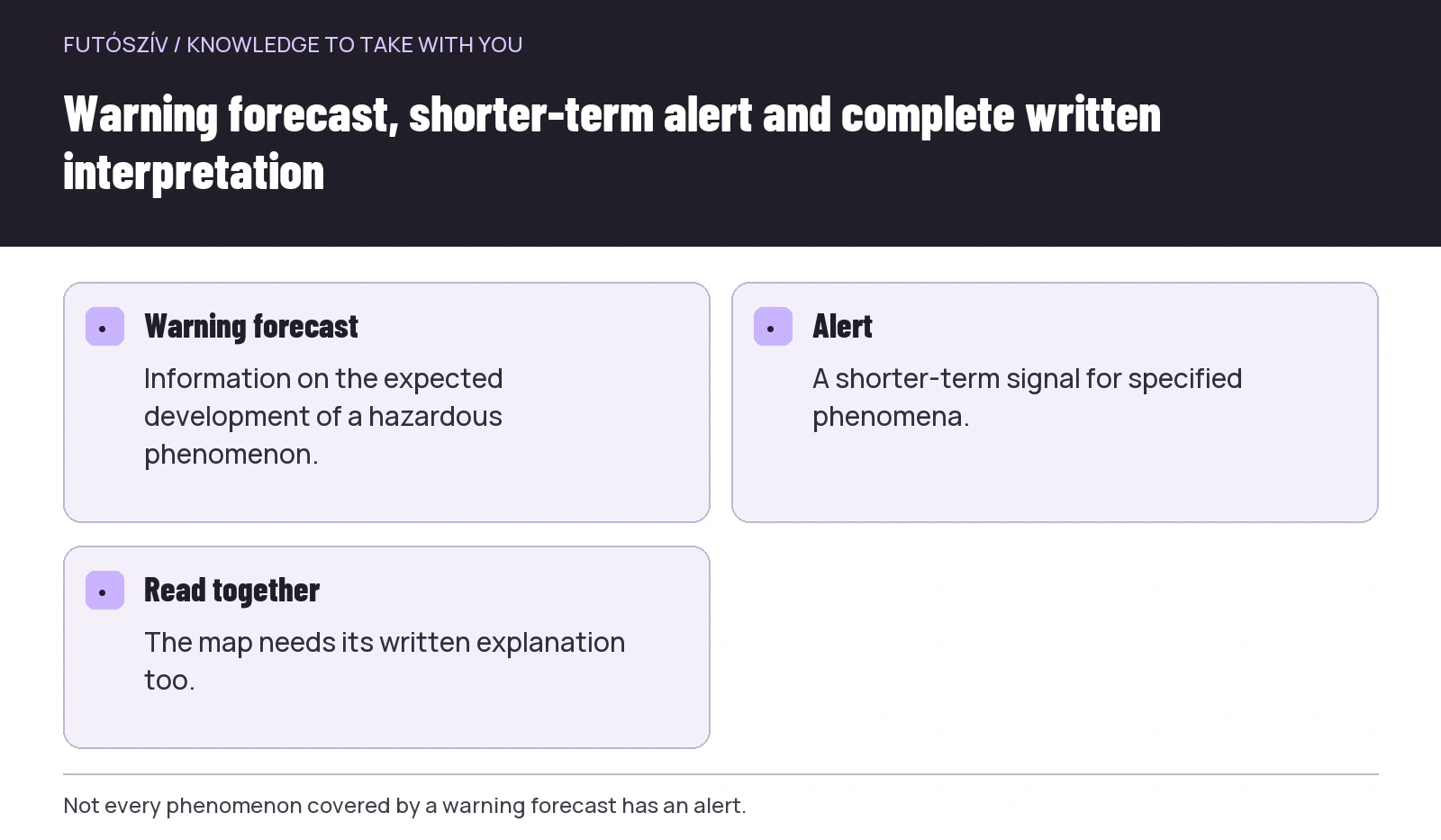
According to the HungaroMet explanation of its warning system , a warning forecast describes the expected spatial and temporal development of hazardous phenomena. For specified phenomena, an alert draws attention to a shorter time frame when the conditions for development are already present. Not every phenomenon has an alert: prolonged heavy rain, snowfall and certain special phenomena, for example, receive warning forecasts.
For a runner, this creates a brief checking task: open the warning forecast and written explanation alongside the alert view. A seemingly empty alert map alone cannot describe the weather conditions to expect throughout the outing.
Do not confuse these terms with a sporting event’s own status either. A meteorological alert, organiser programme change and restriction on using an area are separate information. They may relate, but do not automatically infer one from another. Find the appropriate official channel for each.
Five details without which a screenshot is incomplete
| Detail | What do you need to understand? | Common misunderstanding |
|---|---|---|
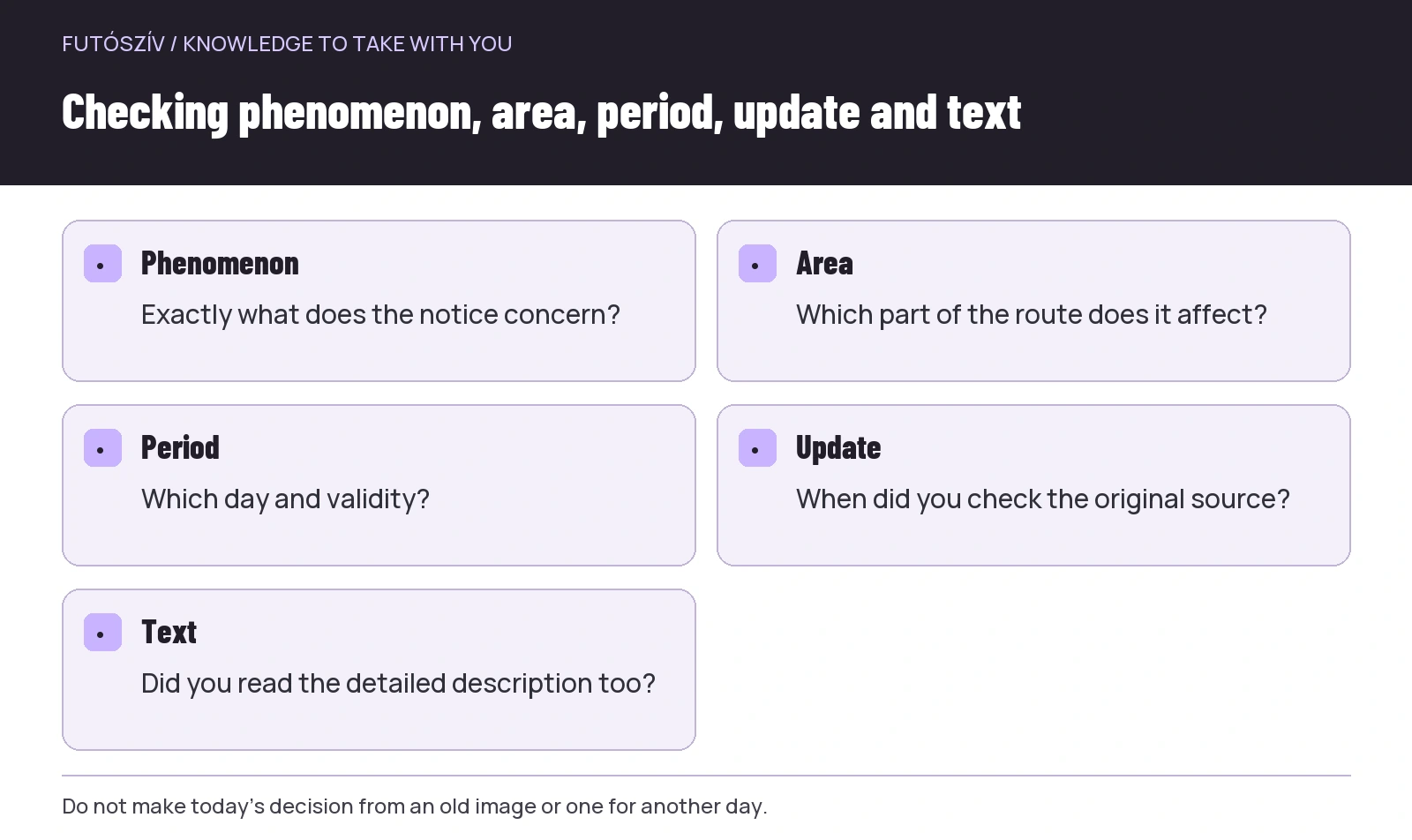
| Phenomenon | What does the notice concern? | Treating every yellow colour as the same situation |
| Area | Which region does it cover? | Extending one settlement point to the entire loop |
| Period | Which day or validity period are you viewing? | Looking at tomorrow’s map for today’s departure |
| Update | How old is the information? | Treating an old screenshot as current |
| Text | What circumstances does the detailed notice describe? | Stopping at the colour and missing the explanation |
This is our reading framework, not a separate meteorological classification. It helps you identify the information received. If a shared image lacks several fields, find the original page. A map forwarded in a group chat is usable when you know what it concerned.
 Enlarge diagram
Text version of the illustration
- Warning forecast
- Information on the expected development of a hazardous phenomenon.
- Alert
- A shorter-term signal for specified phenomena.
- Read together
- The map needs its written explanation too.
A colour goes with the phenomenon’s name
A warning colour is a short summary, not a full description. The same colour can appear for different phenomena under different circumstances. Record the phenomenon and affected period in your running plan, not merely “yellow”.
HungaroMet’s explanation uses three hazard levels and describes their meanings in detail. A higher level calls for greater attention and following official instructions. Green indicates that no hazardous phenomenon meeting the system’s specified criteria is expected; it does not assess every detail of your personal running route.
You need not turn this into a new colour-based mileage table. Rather than automatically assigning a shorter distance to one level, examine the situation described, associated instructions and the outing’s particular exposures.
Your route may cover several places and a longer period
A loop may start in town, follow open waterfront and then enter woodland or higher ground. A forecast for the starting settlement may not explain the whole structure. Connect the information to your route’s geographical frame.
Include reaching the route and returning in the period considered. If the run ends before a lengthy journey to the stop, do not restrict the weather check to running time on your watch. Conditions for companions and transport may change too.
This does not mean collecting a separate forecast for every map point. First identify important route differences: exposed area, longer forest section, return connection. Then examine which official information to interpret for them. More data helps only when you know which decision question it serves.
The signal is a forecast, not complete certainty on site
On its hazard-warning platform , HungaroMet also states forecasting limitations. An affected region does not mean the phenomenon will certainly occur at every point within it. Suitable advance notice cannot be assured in every situation either.
Avoid two extremes in your decision. One is concluding that warnings need not be taken seriously because calm weather occurred during a previous warning. The other is believing the map colour tells you precisely what will happen at the next junction. Use the information’s actual meaning, including its uncertainty.
If on-site conditions differ from expectations, that is new information. Adapt the outing to the actual environment too. A previously saved map is not a promise that lets you abandon every later decision.
Do not choose the outing through a contest between two apps
Different services may display different icons, time intervals or text. First check whether they refer to the same place and period. An hourly general forecast and a hazard warning for a larger area may answer different questions.
Do not keep searching for another screen until one supports your original plan. Write your decision question first. For example: should I replace the long exposed section with another outing, and what do the official warning, local information and my own requirements say? Information seeking then has a clear purpose.
Viewing more graphs cannot resolve every uncertainty. Another time, a simpler outing or deciding not to set out may be appropriate. You need not replace that choice with trying to extract a personal guarantee from an increasingly detailed app.
 Enlarge diagram
Text version of the illustration
- Phenomenon
- Exactly what does the notice concern?
- Area
- Which part of the route does it affect?
- Period
- Which day and validity?
- Update
- When did you check the original source?
- Text
- Did you read the detailed description too?
Three checking points within your day
First seek information when deciding the outing’s main structure. Check again before departure while fresher information can still guide changes. Third, recheck when a change in conditions or official information warrants it and you can create an orderly situation to do so.
Updating should not mean constantly watching a screen in a running lane or on a path. Choose a suitable way and place to read information. Maintain attention to terrain and others around you too.
Link the next meaningful check on your sheet to a decision. For example: before starting the journey, I will check current conditions and programme changes. This is a concrete task. “I will keep an eye on the weather” does not say when or on what basis your idea will change.
For a race, open organiser information separately too
An event going ahead is not a personal fitness declaration for every runner. However, current organiser notices can explain programme changes, starting arrangements and on-site measures. Do not infer these from other participants’ comments.
Include the event’s official page and notification channel in the pre-start plan. When a new notice arrives, check that year and distance match too. An old event post or forwarded screenshot can mislead just like a meteorological image for another day.
Adjusting target time and assessing the outing’s safety are different tasks. Understand current participation conditions first; only then can you sensibly discuss the pace plan. Slower running alone does not necessarily resolve an unfavourable condition.
An illustrative example: no alert, yet more to read
Before an afternoon loop, a runner opens only the alert map and interprets it as settling every weather question. The complete warning-forecast view, however, contains another kind of notice for that day. The improved check opens the text, examines period and area, then compares them with the route’s task.
The example identifies no current phenomenon or real location because the decision always requires fresh information. The lesson is the reading sequence: no alert and no warning forecast are different statements. Decide about the outing only after understanding what the information used means.
In another version, the runner views a coloured image sent yesterday. The original page now shows a different situation for today. The main error here concerns information handling, not meteorology: update time was omitted. The personal sheet therefore includes source and checking time too.
Access to the area remains a separate question
Better weather does not automatically lift a forest-access restriction, construction closure or event diversion. Check the MTSZ hiking-trail warnings and relevant manager’s notice separately if the loop enters such an area.
Equally, a usable mapped route is not weather approval. Your outing combines several conditions: access, navigability, circumstances, personal preparation and finish. One green signal in any system does not automatically settle all the others.
The final checklist is therefore short but treats different sources separately. Meteorological information, local access and event notices can have their own rows. You can see what you checked, when and which decision you drew from it.
Keep a reading routine for the next outing
After the day, you need not retrospectively prove or disprove the entire warning system through your own loop. Instead, examine whether you opened the appropriate view, understood the period and linked information to decisions. These are improvable parts of your routine.
At the next departure, identify five things: phenomenon, area, validity, update and written content. Then review the route’s other conditions. If substantial uncertainty remains, let it remain visible in the decision too.
Distinguishing warning forecasts from alerts is more than learning terminology. It helps you use on-screen information according to its real meaning. A running outing becomes better considered when you begin with current, properly understood information rather than attachment to the original plan.
How Futószív articles are prepared: our editorial guidelines.