Race pace seems familiar: the speed at which you want to run your chosen distance. In training, however, it can mean many things. The same figure may be easy to reach over a short section, require serious attention over a longer stretch, or be too demanding on a more tired day.
Specific practice is useful when you know what you want to learn. Starting, maintaining rhythm, managing conditions or part of your fuelling routine? You need not prove every time that you could already complete the entire race. Preparation does not have to stage the main event in advance every week.
Which race pace do you mean?
Three different figures can become confused: your last race’s average pace, a pace estimated to be realistic now, and the speed required for a dream result. Sometimes they are close; sometimes substantially different. Make clear which one the plan uses.
A previous personal best alone does not describe today’s condition. Training volume, life circumstances, environment or health may have changed since. A dream goal can provide a longer-term direction without already determining the pace of every specific section next week.
Name the task precisely: for example, manageable sections aligned with your current ten-kilometre goal. If working with a coach, discuss what data and experience support the choice. A pace does not become realistic because you enter it in an app often enough.
An estimate is a reference, not a result guarantee
A study using a large dataset estimated critical speed from training data for more than twenty-five thousand recreational runners and examined its relationship with marathon performance. The study shows that previous data can carry useful information; it does not establish that one model gives every runner an accurate finishing time.
A measure calculated from training depends on the available data and method. If the history lacks suitably interpretable runs, the model’s information is limited too. Evaluate an app prediction alongside your own experience and the circumstances.
The same applies to simple race-time conversion tables. Results over another distance can support an estimate, but preparation for the longer distance and the specific race day do not disappear from the equation. Leave room for adjustment when choosing pace.
Choose one main learning goal
One session might aim at starting calmly. Another might help you recognise the rhythm with little watch checking. Later, a race-like route or practice of a familiar fuelling routine can be included. Trying everything at once makes identifying what worked harder.
A statement of purpose helps regulate the session: “Today I am practising settling into target pace in a controlled way, not a record on the final repetition.” That means energy left at the end is not necessarily an invitation to another hard section.
Keep the learning goal in the review too. If starting was the task, examine whether you overshot in the first minute. One faster average is not necessarily a better outcome if the intended execution was lost.
Dividing the work is more than a convenience
Practising race pace in shorter parts lets you organise movement and collect feedback. Section length, number and recovery between them together form the session. Do not treat them as separate decorative features.
Completing a pace in a few short repetitions does not prove that it is sustainable continuously for the whole race distance. Recovery breaks and less total work specifically make execution easier. This does not devalue the training; it defines the conclusions you can draw.
Fit the specific volume to your background and the rest of the week. Do not adopt a ready-made example simply because its target pace resembles yours. Two runners preparing for the same result may have different sustainable weekly systems.
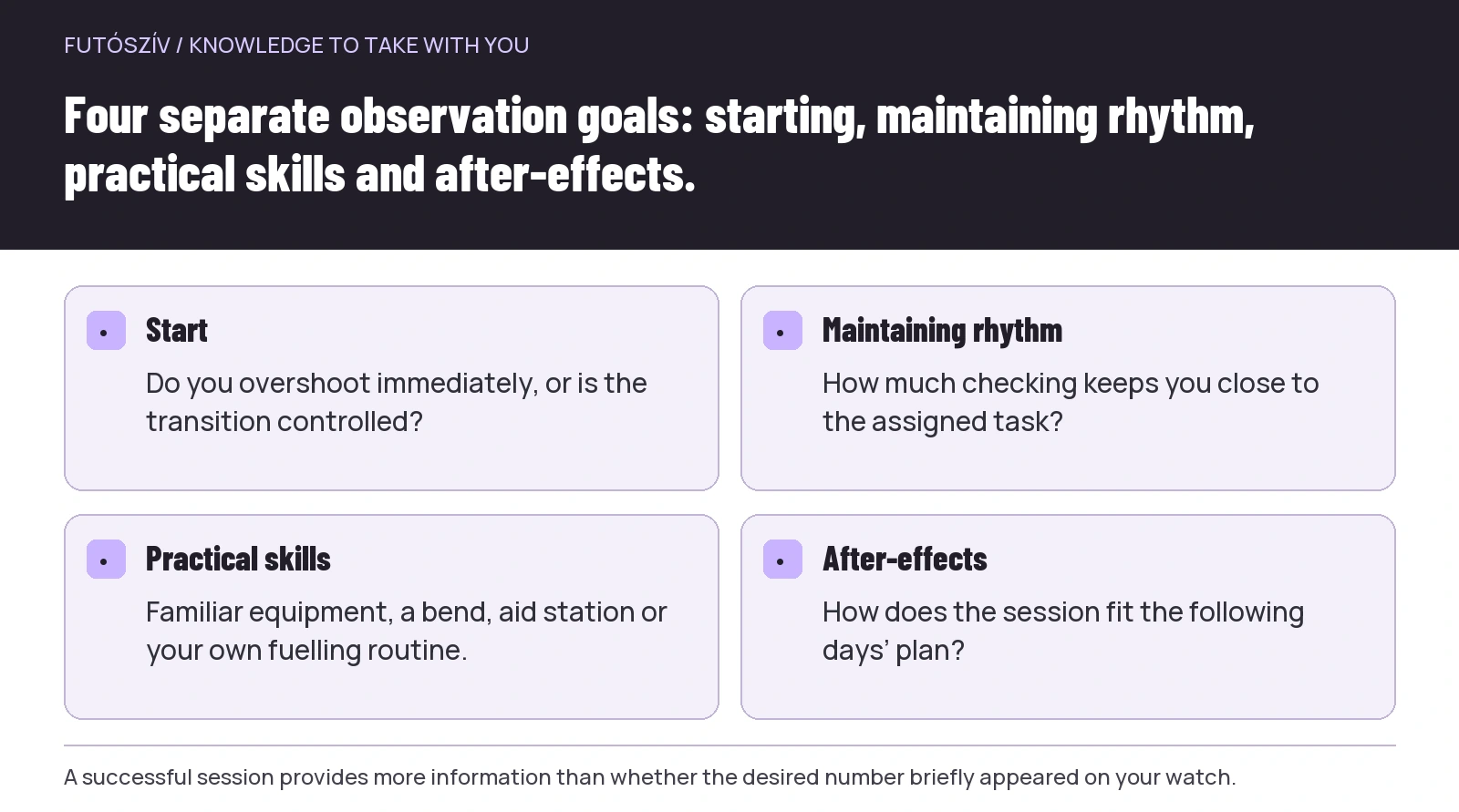 Enlarge diagram
Text version of the illustration
- Start
- Do you overshoot immediately, or is the transition controlled?
- Maintaining rhythm
- How much checking keeps you close to the assigned task?
- Practical skills
- Familiar equipment, a bend, aid station or your own fuelling routine.
- After-effects
- How does the session fit the following days’ plan?
Recovery changes the task
In a small experiment with eight trained male runners, passive and active recovery affected how many intense repetitions they could complete differently. The study used a specific protocol continued to exhaustion; it is not an instruction for every runner to repeat until unable to continue.
The practical lesson is that recovery belongs in the description too. Identical split times in two workouts do not mean identical tasks if one involved much longer stops between them. Include this when comparing.
Do not retrospectively shorten or lengthen recovery simply to make the fast-section numbers look better. If an adjustment is necessary, record it. An honestly recorded modified task is better information than a workout perfect on paper but actually performed differently.
A continuous section can have its own role
A longer continuous section offers a different experience of maintaining rhythm from short repetitions. This does not mean that the longest possible continuous race-pace running is required at every stage of preparation. The task’s place and size depend on the current programme.
Frequent full-distance trials can easily turn training into racing, particularly when every outing carries a result expectation. Afterwards, the rest of the week begins from a different load too. Do not treat it as a harmless check.
If planning a test, call it a test and make room for it in the programme. If planning training, judge success by appropriate task execution. Confusing the roles can create constant pressure to prove yourself.
The route is part of practice
A flat track, road loop and hilly route do not necessarily require the same effort at the same displayed pace. Decide beforehand whether precise speed practice or managing a race-like environment matters more. Sometimes both cannot be achieved together.
If the race route includes many bends, bridges or narrow sections, orderly movement is a separate skill. Learn this in an appropriate, safe environment. In traffic and on shared routes, however, the transport situation matters more than a target time.
Wind or other difficult conditions may require adjusting pace. The goal is not to force the watch to display the same number in every session. Effort suited to the race task and deliberate management of the environment often provide more valuable experience.
Put the watch in service of the task
Choose beforehand which data you want to see: split time, lap average or total task time. Constantly following instantaneous pace can easily cause rushing. On a known section, a well-timed check often offers more meaning than watching the display every second.
In a submaximal experiment with recreational runners, external pace feedback did not clearly change the chosen rhythm. The study does not validate a race-pace programme or generalise to every runner; it reminds us that more data does not automatically mean better execution.
For learning, estimate by feel whether you are on target, then check the number. If the two differ, consider the circumstances. A device can help, but you need not respond to every unusual value by accelerating immediately.
Make an equipment trial a genuine trial
Use the already familiar clothing and carrying system intended for racing on a suitable run beforehand. Notice whether drink or other necessary equipment is accessible, whether anything interferes with movement and how simple operation is. These practical questions do not necessarily require a hard pace.
Change only a few new things at once. If new shoes, clothing, fuelling and a new pace task all arrive on one day, the cause of discomfort becomes difficult to separate. Gradual trials can provide more usable feedback.
A race-pace workout alone does not prove equipment will suit every distance and weather condition. Record duration and circumstances of use too. These matter at least as much to the next decision as the fast sections’ pace.
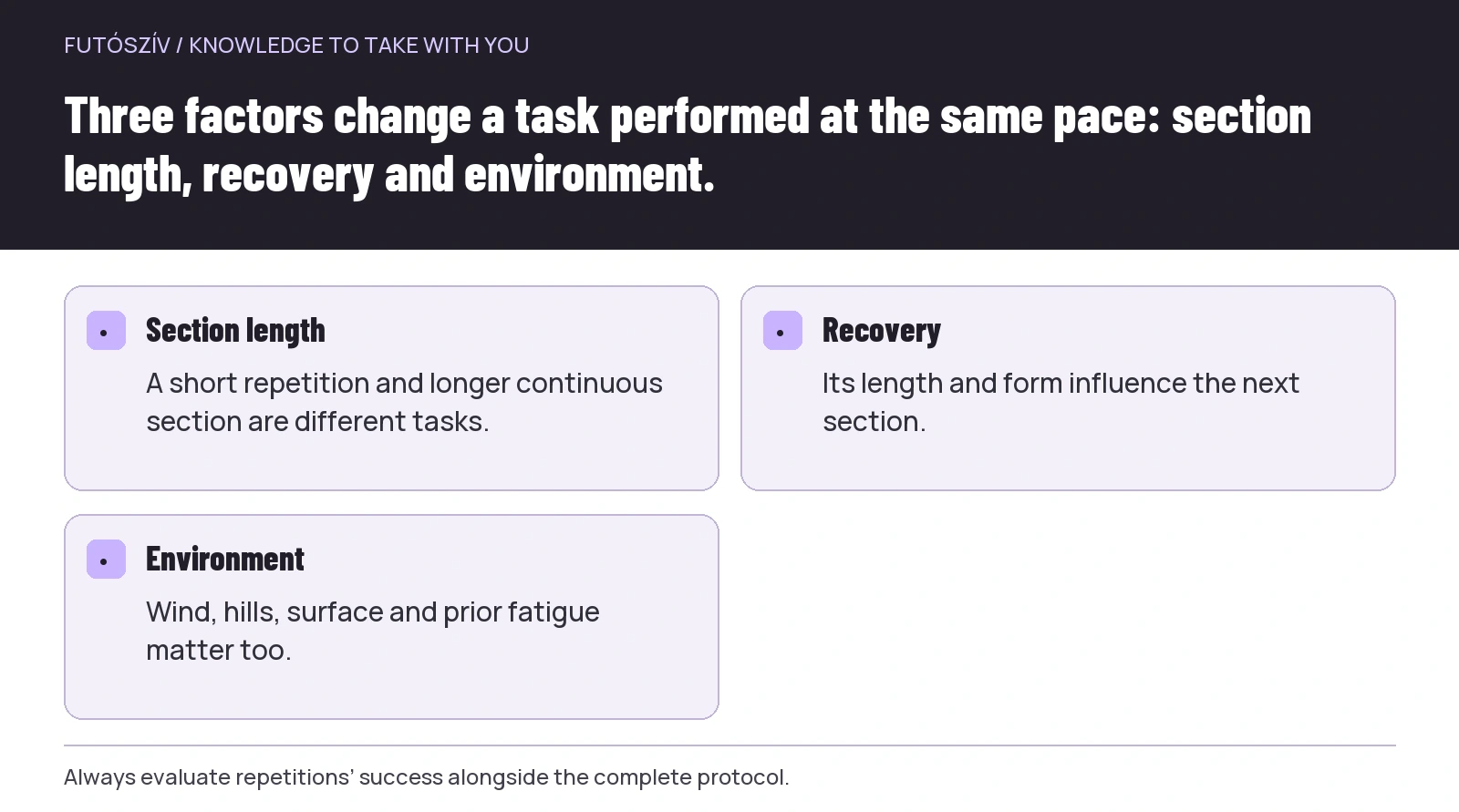 Enlarge diagram
Text version of the illustration
- Section length
- A short repetition and longer continuous section are different tasks.
- Recovery
- Its length and form influence the next section.
- Environment
- Wind, hills, surface and prior fatigue matter too.
Define the possibility of adjustment in advance
Be clear about when to ease back: if the planned task feels disproportionately hard compared with usual, movement loses control or new symptoms appear. Assessing specific health symptoms may require appropriate professional help. A general training article is not a fitness assessment.
Starting a session does not oblige you to finish the entire original plan. A shorter main set, easy finish or stopping may be justified. Record why you changed it, rather than immediately adding another demanding task to make the day seem serious enough.
If a pace can regularly be completed only with great strain and constant adjustment, review whether the goal is realistic too. More willpower cannot solve every problem. Preparation and race planning inform each other.
Evaluate the task from several perspectives
Look at differences between sections, changes in effort and how recovery actually happened. Add environmental conditions and prior fatigue. A successful session then reveals more than whether the average matched the target time.
The next day’s experience belongs in the evaluation too. If the session repeatedly disrupts the week’s other runs, the task may be too large or poorly placed. Its specific nature does not justify unlimited after-effects.
The best conclusion is usually a concrete decision: retain the task, change one element or postpone the next trial. You need not automatically set a new target time after every successful session.
Two runners, two different learning needs
One runner starts every short race-pace section too fast, then slows. Their main task may be a controlled opening with small watch-based checkpoints. They do not necessarily need more or longer repetitions to make the session more useful.
Another maintains pace steadily but regularly rushes at aid stations and bends in races. Safe advance practice of practical skills may give them new information. Faster splits alone do not resolve that difficulty.
Specificity is therefore not one workout list. It is appropriately sized practice of situations important to your goal. It works well when it provides enough experience for the start while leaving room for the other parts of preparation.
Do not try to remove every uncertainty before the start
Before an important race, wondering whether you have done enough is natural. Repeated proof-seeking runs, however, cannot make race day entirely predictable. They may instead add new load and new questions of interpretation.
Make a realistic plan from the overall picture of previous sessions, preparation actually completed and current conditions. Leave an alternative for changes needed on race day too. Confidence need not come from completing the whole distance beforehand.
Race-pace practice has achieved its purpose when you recognise your chosen rhythm better, handle the task more smoothly and understand more precisely what to expect from yourself. This does not require finishing the full future race time at all costs in training too.
Primary sources
- Calculation of Critical Speed from Raw Training Data in Recreational Marathon Runners – the relationship between training data and performance estimation, with model-dependent limitations.
- Influence of Recovery Mode on the Maximum Number of Intervals Until Exhaustion During an Aerobic Interval Training Session – a specific intense protocol and recovery’s role.
- External Feedback Does Not Affect Running Pace in Recreational Runners – a submaximal feedback experiment.
How Futószív articles are prepared: our editorial guidelines.