
An easier week can produce a familiar contradiction: a runner logs fewer kilometres yet ends the week more tired. The shorter runs became faster, a freed-up evening filled with strength training, and a big weekend hike fitted in too. Distance fell; the total task probably did not.
Deliberately easing back concerns the whole week. It is neither a compulsory percentage reduction nor a reward for earlier hard work. It is a planning decision: identify why you are reducing the load, exactly what you will cut back, and the signs you will use when continuing your preparation later.
How does an easier week differ from a pre-race taper?
Before a race, adjusting training load may directly aim to time performance for an important start. An easier week during the season may instead support the longer programme, manage fatigue or accommodate a more demanding period of life. These situations do not automatically call for identical schedules.
Easing back does not necessarily mean stopping training completely, but neither must you preserve some demanding work at all costs. Your current condition and the reason matter. A planned, quieter week when you feel well calls for a different decision from a change prompted by symptoms or illness.
Write the aim in one sentence: “This week I will reduce my sporting workload so that I can start the next block in a manageable condition.” This already helps rule out ideas that would add another difficulty to your days. A label alone does not regulate load.
A popular pattern is not a universal law
You will find many ready-made formulas online: after a few progressively heavier weeks, always reduce by a specified percentage for a fixed period. These can be planning examples, but they are not proven prescriptions for every runner. Judge whether a system fits by your background and actual response.
A questionnaire study involving 246 strength and physique athletes described varied deloading practices. These were self-reported habits in other sports, not a running experiment establishing the ideal frequency of easier weeks. Widespread use and a proven optimal method are different claims.
Your own rhythm should therefore allow both planned changes and adjustments when needed. If the calendar says you should ease back next week but your current situation warrants doing so now, you need not wait for the box on the schedule. If you already do only a few easy runs, the same formula may not produce a meaningful change.
Calculate from reality, not from the plan
First look at what actually happened over the preceding weeks. Which runs took place, how long did they last, how demanding were they, and what other sports did you do? If several sessions disappeared from what was originally planned as a big week, its mileage on paper is not a sound starting point.
Add the circumstances of your life. Moving house, several night shifts, travel or a period caring for a sick child will not automatically appear in your watch’s summary. They still influence how much you can comfortably take on.
You do not need a complex score for this review. A short list may suffice: time spent on sport, demanding sessions, unfamiliar loads, sleep and how you feel. The aim is to recognise your starting point, not turn every week into a workload equation calculated to a decimal place.
 Enlarge diagram
Text version of the illustration
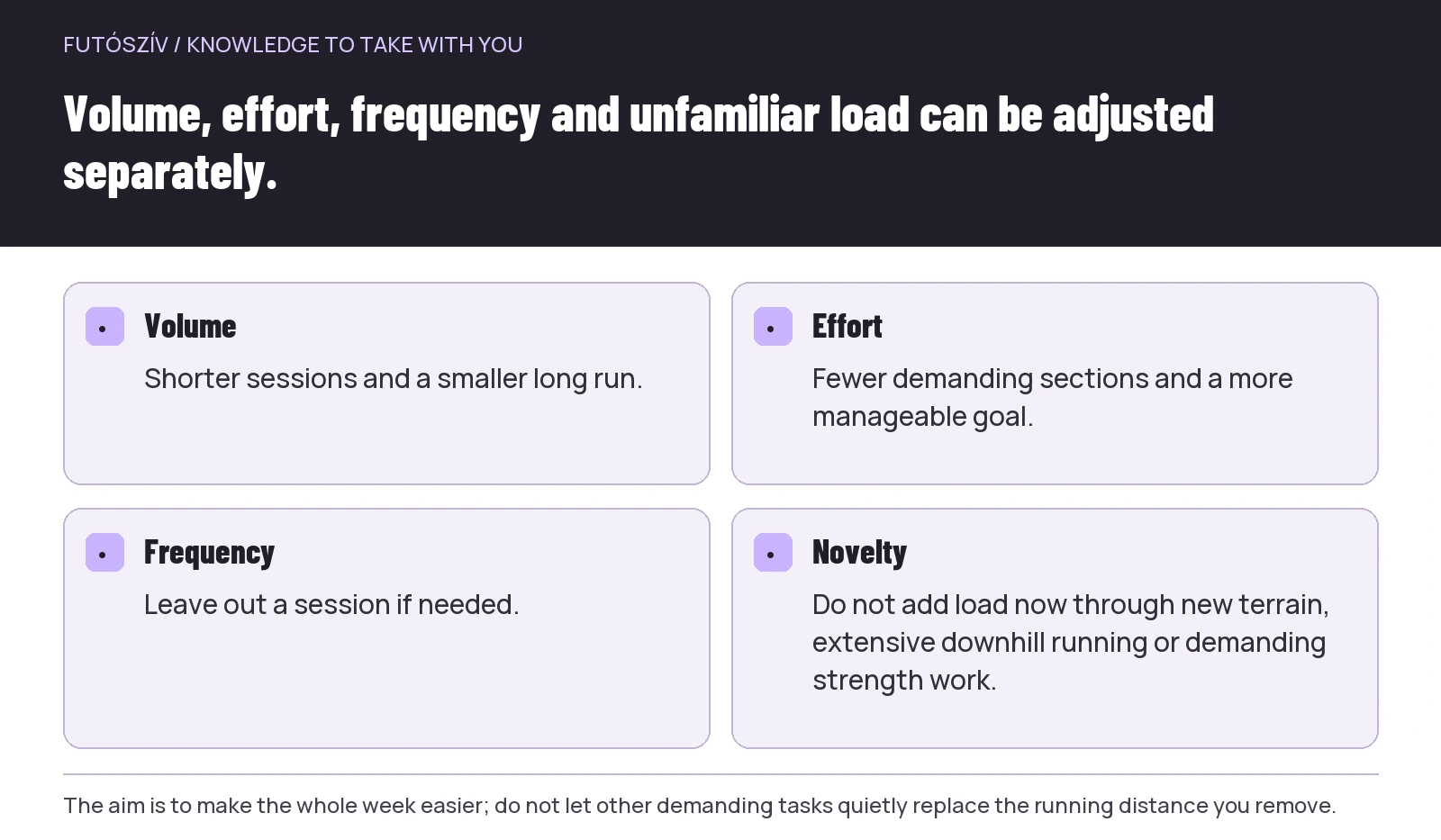
- Volume
- Shorter sessions and a smaller long run.
- Effort
- Fewer demanding sections and a more manageable goal.
- Frequency
- Leave out a session if needed.
- Novelty
- Do not add load now through new terrain, extensive downhill running or demanding strength work.
You can reduce volume in several places
You can shorten individual runs, scale back the long session or remove a workout. These choices affect scheduling and the experience of training differently. If rushing around on weekdays is the main problem, a decision that gives you an entire free evening may help more than trimming a few minutes from every run.
If a very long weekend run created the greatest demand, keeping it unchanged while reducing total mileage may do less to address the week’s main difficulty. Look beyond the final total. The distribution of load and the size of a single session matter too.
Make your chosen reduction visible in the plan. “I will do a little less by feel” can easily turn into completing the original loop when habit carries you onwards. Selecting a shorter route or deciding your finishing time in advance may help.
Do not hide intensity behind a shorter distance
Fewer running minutes can still contain plenty of hard work. If you speed up every short session to a demanding pace, the easier week may drift away from its original purpose. A shorter route is not an automatic invitation to chase a record.
Check the number and length of the demanding sections you plan as well. Fewer repetitions, a shorter main set or an entirely easy task may suit the situation. Do not let a single general statement guide the decision, such as “intensity always stays during a deload”. This is an especially inappropriate automatic rule when symptoms or illness are involved.
If you feel well and some livelier work remains consistent with the programme’s purpose, keep it controlled and defined in advance too. Do not accumulate spontaneous “I will just go a bit faster today” sessions that together create another demanding block by the end of the week.
You do not have to become deeply fatigued to improve later
In a study involving thirty-three trained male triathletes, participants responded differently to an overload period. The group characterised by reduced performance and substantial fatigue did not gain more later simply because they had become more deeply fatigued. The research is not a prescription for running weeks, but it does not support chasing the greatest possible exhaustion.
Do not therefore measure an easier week’s value by how badly you felt beforehand. You do not have to prove that you were completely depleted. An earlier, reasonable adjustment may fit a sustainable recreational programme much better than insisting on reaching a low point first.
The most successful week in a training diary need not be the one with the biggest number. Consistent, manageable runs and timely adjustments are part of preparation too. Easing back is not a lack of discipline when it means consistently following a plan suited to your situation.
Include strength training and other sports in the discussion
If you regularly lift weights or cycle alongside running, make decisions about these activities too. You need not remove everything at once, but the whole week becomes easier only if other workouts do not automatically fill the space left by reduced running.
An “easier” week may be a particularly poor time to introduce many new exercises, unfamiliar downhill running or a long outing on unknown terrain. Running kilometres do not describe the load of novelty. If you plan technical learning, make it a genuinely small task with appropriate help, rather than an exhausting challenge.
If you work with a coach, mention your other sports too. Easing back based on the running plan can be misleading if gym work rises substantially in the background. A shared decision needs the full picture, rather than only activities synced to one app.
Fit the easier week around your life
When you can foresee a major work deadline or travel, it often makes sense to schedule lower sporting demands around it. You then need not ask the most of yourself in two areas at the same time. Using the calendar flexibly may help make your programme sustainable.
However, time freed by leaving out running does not necessarily become rest if you immediately cram every outstanding task into it. You cannot always change this, but adjust next week’s expectations accordingly. A week with little sport during a difficult period of life does not necessarily restore you.
Keep some simple anchors: a familiar eating rhythm, time set aside for sleep, and dealing with the most important tasks. You need not find a new recovery product to spend a freed-up evening less hurriedly.
 Enlarge diagram
Text version of the illustration
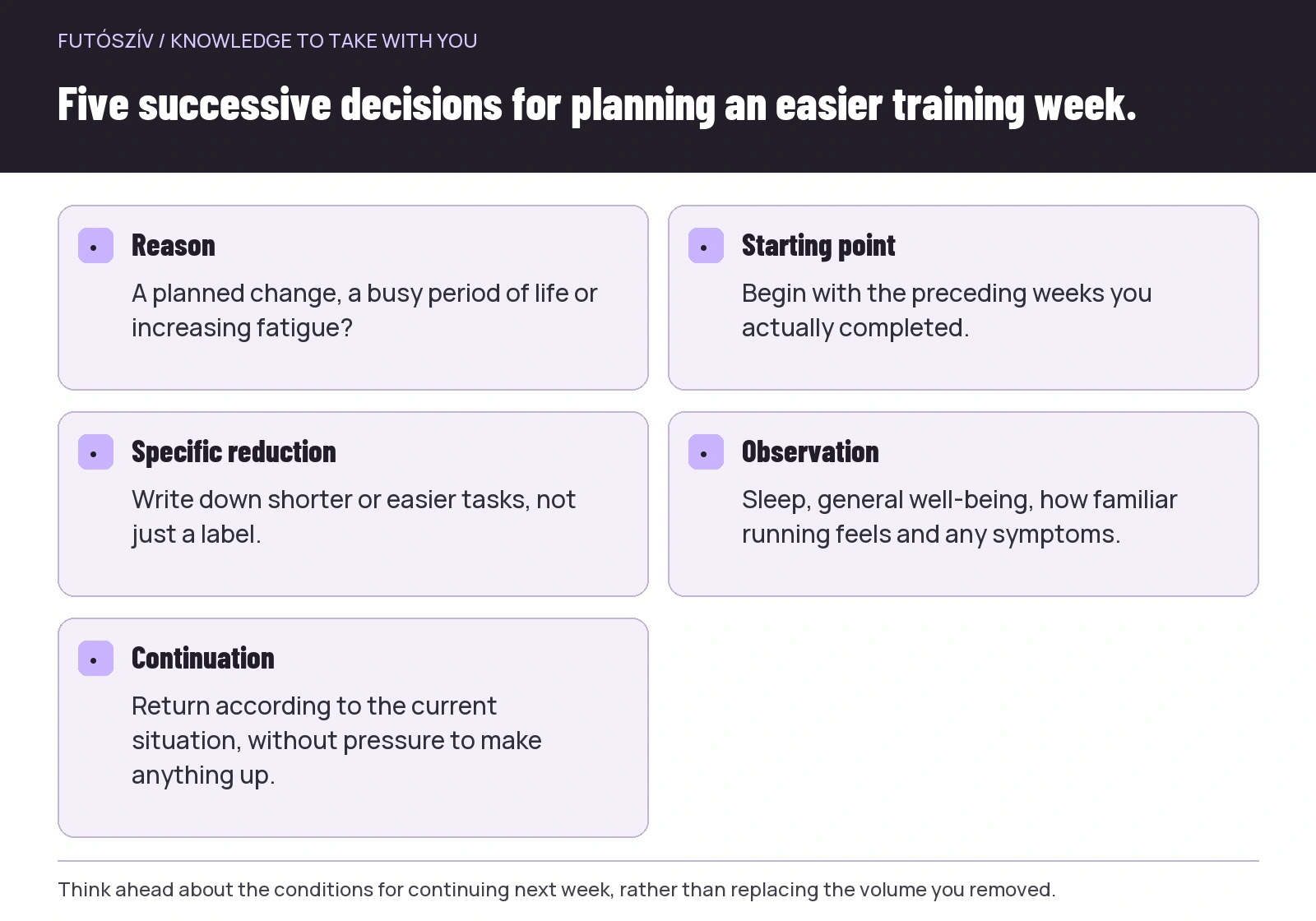
- Reason
- A planned change, a busy period of life or increasing fatigue?
- Starting point
- Begin with the preceding weeks you actually completed.
- Specific reduction
- Write down shorter or easier tasks, not just a label.
- Observation
- Sleep, general well-being, how familiar running feels and any symptoms.
- Continuation
- Return according to the current situation, without pressure to make anything up.
What should you observe, and what should you avoid diagnosing at home?
How you feel, sleep, unusual fatigue and the feel of familiar easy runs are useful observations. Heart rate or other device data may complement them, but a single value cannot tell you for certain what is happening. The direction of change and its circumstances are informative together.
In an experiment examining overload and recovery in triathletes, the physiological and biochemical variables measured did not prove reliable tools for early identification. The study’s findings do not mean that nothing is worth observing; rather, there is no simple home sign that removes every uncertainty.
If symptoms persist or cause concern, do not diagnose yourself with overtraining. Many causes may underlie reduced exercise tolerance. Alongside changing the programme, appropriate healthcare help may be needed.
Two different scenarios
Feeling well, with a planned easier week: the runner has completed the preceding period consistently and wants less load before the next block. They may retain part of their usual weekly rhythm with shorter, manageable tasks. The aim is continuity and less total work, rather than inventing a different workout every day.
Feeling worse, requiring an unplanned change: the runner has felt unusually tired for several days, and even easy tasks feel difficult. Here, the starting point is not an easier programme that must be completed. Further rest, a review of demands and professional help if needed may be appropriate; the severity of symptoms guides the decision.
Do not treat these situations with the same percentage. A change of plan must match its reason. Once this is clear, it is easier to let go of the idea that every easier week must look identical in numbers.
Returning is not paying a debt
At the beginning of the next week, review what has changed. You need not immediately prove that easing back worked through a performance test. A familiar, manageable run and how you feel during the day may provide more useful information than an all-costs record attempt.
Do not automatically redistribute the kilometres you left out across the following days. Reducing the load loses its purpose precisely when you immediately turn it into a burden of making up missed work. Continue from your current condition and the next goal.
If you do not feel better, or feel worse, the scheduled end of the week does not oblige you to return. Reassessing the situation matters more than the originally planned length of the reduction. A plan is useful when it can change in response to reality.
A brief check at the end of planning
Read through the week and look for hidden demands: a long weekend programme, an intense group workout, unfamiliar strength work or lots of travel. If several remain, perhaps only your running diary has become lighter. Return to your stated aim and decide accordingly.
A good easier week need not be empty or special. It is enough for it to present a clearly smaller, more manageable task and help you start the next period in an organised way. Do not judge its outcome by a single Sunday pace.
The most important lesson is your own response: which reduction produced a calmer week, where did unnoticed load remain, and what would be worth adjusting earlier next time? This turns easing back into experience rather than a calendar habit repeated mechanically.
Primary sources
- Deloading Practices in Strength and Physique Sports: A Cross-sectional Survey – self-reported practices in other sports, not a schedule validated for runners.
- Functional overreaching: the key to peak performance during the taper? – different responses to an overload and pre-race tapering programme.
- Monitoring changes in performance, physiology, biochemistry, and psychology during overreaching and recovery in triathletes – measurement limitations in early identification.
How Futószív articles are prepared: our editorial guidelines.