In an unfamiliar city, the hotel door looks like a good starting point: step outside, run a loop and return. In practice, the first few streets, getting back inside and the local schedule add many new details. For a calm outing, you do not need to copy the prettiest community route immediately. Build your own version with a clear approach and ending.
A hotel run may be short morning activity during a business trip or a separate holiday programme. Time available and arrangements with companions can differ. First say what you want from it: familiar easy movement, cautiously exploring the area or visiting a specific location. Your first outing in an unfamiliar city does not need to include everything at once.
Clarify returning before you leave
Check the accommodation’s exact name and address and which entrance you may use. There may be night access, a door code, a card or a particular reception procedure. A main entrance open during the day does not prove it works the same way at dawn. Check access with staff or official accommodation information.
Know what you need to get back to the room. Some places require a card for the lift; elsewhere a separate gate leads into the building. If sharing a room, coordinate the key. Taking every means of entry with you may affect your companion’s later departure too.
Include time after returning. Washing, changing, breakfast, packing and possibly checking out may await you. Reaching the accommodation door is not the same as being ready for the next activity. Work backwards from the whole morning to establish running time.
Five questions worth asking on site
| Question | Why does it matter? |
|---|---|
| Which exit can I use when leaving? | The nearest gate on the map may be locked |
| Where is the nearest suitable pedestrian connection? | Driving and walking access to the accommodation may differ |
| Are there current closures nearby? | Fresh local conditions may change the route |
| Where can wet or muddy kit be dealt with? | Room and shared-space use must be respected |
| When are related services available? | Breakfast, luggage storage or checkout may affect the time window |
A receptionist’s route suggestion can be useful local information, but use clarifying questions. A “good running place” may mean a long, distant loop or a route the person only knows in daylight. Explain that you want something short, easy to turn back from and achievable in your time window.
Start with the approach on the map
The journey to a popular park sometimes requires more attention than the loop itself. It may involve busy junctions, subways, level crossings or unclear pedestrian links. If the hotel’s immediate surroundings are unsuitable, you do not need to run from the door at all costs. Walking or a checked transport option may be part of the outing.
The NHS guide for beginner runners also recommends advance route planning. In an unfamiliar city, a short walk-through is a useful practical form of this. On arrival day, you can inspect the first few decision points and the intended entrance. The next morning, you can rely on some real on-site memories.
If a walk-through is not possible, choose an even simpler route. Few junctions, a clear turning point and an easily identifiable return may help. A route linking many attractions can be exciting but requires more navigation. A first outing is valuable even as a short familiarisation.
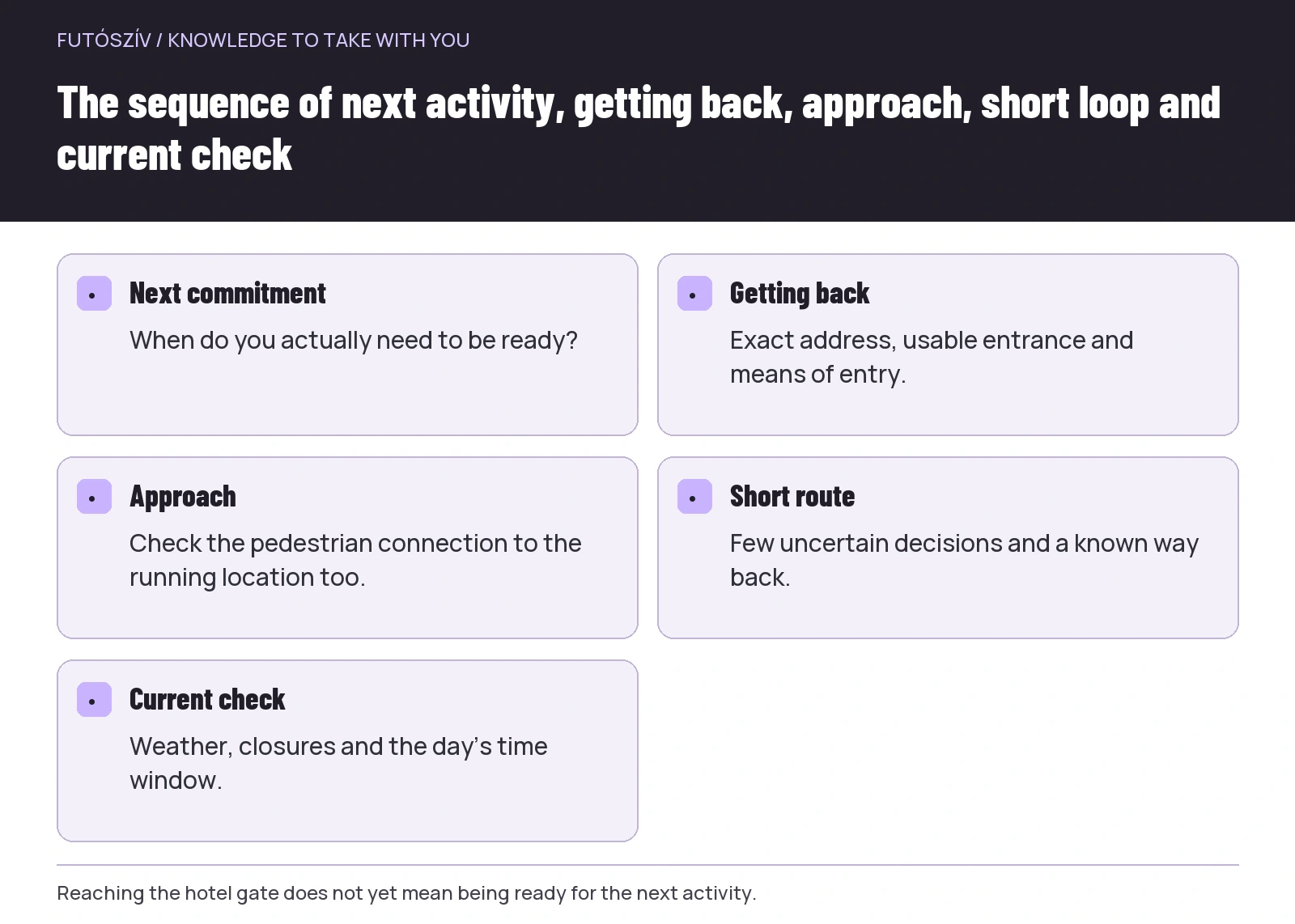 Enlarge diagram
Text version of the diagram
- Next commitment
- When do you actually need to be ready?
- Getting back
- Exact address, usable entrance and means of entry.
- Approach
- Check the pedestrian connection to the running location too.
- Short route
- Few uncertain decisions and a known way back.
- Current check
- Weather, closures and the day’s time window.
Three sources answer different questions
An official tourism site can show well-known running locations and attractions. The operator or land manager may provide more precise information on access and current rules. An on-site walk-through shows how all this connects to your own accommodation and time. Use the three types of information together.
The Budapest Info article presenting running routes , for example, provides urban starting points for active sightseeing. It does not imply the same route is easiest from every hotel. Your own approach, daily traffic situation and available time need separate checks.
The official Visit Debrecen city guide also describes running near the Nagyerdei Stadium. This is a location idea too, rather than live confirmation of opening hours or an event-free venue. If planning to go there, check current usability and access for the actual day. Distinguishing the source’s role helps avoid excessive conclusions.
Make the first route easy to turn back on
An out-and-back section you have familiarised yourself with simplifies many decisions. The turning point can be a recognisable square or park entrance where you can stop calmly and change direction. Do not put it in the middle of a busy junction. If the route turns out shorter than expected, the first outing can still have value.
A small loop at the location may suit too if the approach is simple. You then know the journey back to the accommodation separately and exercise in an easy-to-understand area. Every outing does not need to explore another neighbourhood. For short stays, predictability can be particularly practical.
Do not decide to extend the route solely from the first pleasant section. The return journey, breakfast and the next shared activity remain valid commitments. If you want to explore another part, plan a separate walk-through or outing next time. Keeping the first plan manageable may be more useful than immediately collecting every attraction.
Sightseeing and running can be combined by choice
If visiting attractions, allow for stops, photographs and cautious movement among people. These are chosen parts of the programme. Match the full time window to them, and do not regard it as a fault if many other activities accompany the recorded running time. A sightseeing outing has a different purpose from uninterrupted practice.
For photographs or checking a map, stop somewhere appropriate and leave passage clear. There are more than runners in front of an impressive building; tourists, local people and commuters use the area too. Arrange your programme to account for those everyday situations.
If today’s task is simple, familiar movement instead, you can reserve sightseeing for another time. Combining them is an option, not an expectation. On a business trip, choosing a nearby, straightforward location and returning in time for the agreed morning programme can be a good solution too.
Check the weather for the location
Look at the destination city’s current forecast rather than conditions at home. Planned time of day and route matter too. An urban park, riverside and higher ground can provide different environments. Clothing selected while packing does not oblige you to keep the original plan if different conditions await on arrival.
For travel in Hungary, the explanation of the HungaroMet warning system helps clarify the role of warnings. Check the current alert for the relevant area and period. Regional information is not a detailed condition report for every street; observe the situation on site too.
If the intended surroundings are unsuitable, have another option. It may be a shorter route already inspected, a genuinely available and suitable exercise facility at the accommodation, or another time. Indoor services and their usage rules need checking too. Postponing the outing can also be a clear decision.
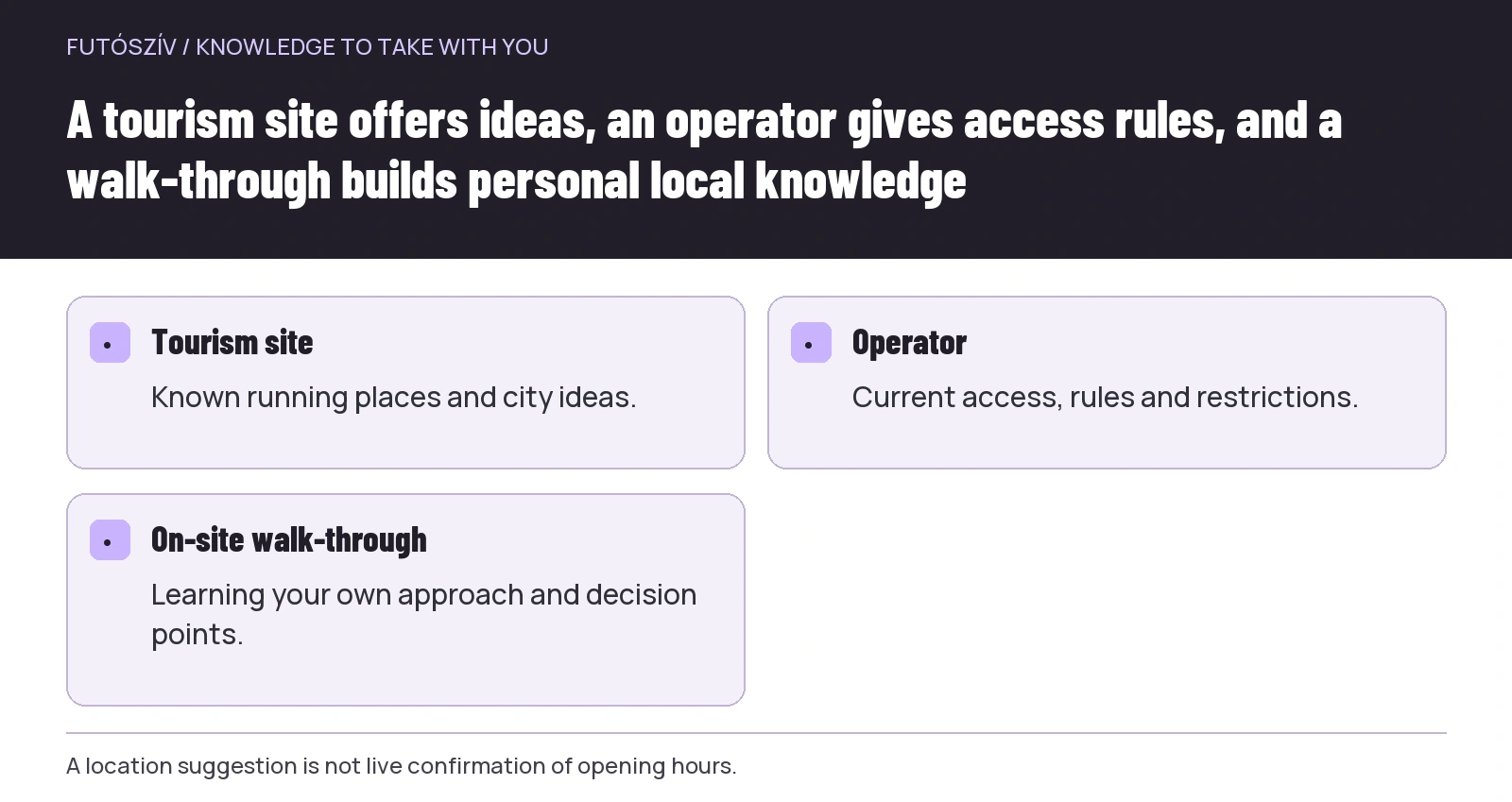 Enlarge diagram
Text version of the diagram
- Tourism site
- Known running places and city ideas.
- Operator
- Current access, rules and restrictions.
- On-site walk-through
- Learning your own approach and decision points.
Check key, address and contact separately
Before departure, carry the means of entry needed on return. Be able to show or say the accommodation’s address rather than relying solely on one map marker. Several hotels or apartments with similar names may exist in the same city. The exact address simplifies everyday navigation too.
If travelling together, explain your expected return and which programme you will be ready for. “I will be back by eight” may mean reaching the gate or being ready for breakfast at eight. Clarify the difference beforehand to reduce waiting and misunderstanding. Your run may connect to other people’s day too.
Carry your phone and key in a way already tested with your own equipment. In an unfamiliar place, you do not also need to experiment with a new storage system. If using transport back, the ticket or pass and a functioning device are separate parts of the plan. Arrange the option for getting back before running.
Hotel equipment care according to local arrangements
Consider how you enter the building with wet or muddy shoes. Ask whether there is a designated place to deal with them. Shared spaces and room furnishings are not automatically equipment-drying facilities. Follow both accommodation rules and item care instructions.
If you want washing or drying facilities, clarify access and conditions beforehand. A “laundry” sign may mean a service with a turnaround time, rather than an immediately available machine for your own use. Base tomorrow’s clothing plan on the actual option. A suitably prepared pack may be simpler than improvising in the room.
At the end of travel, also plan separate transport for used items and their next care step at home. Clothing’s condition does not change when put in a suitcase simply because running has ended. Closing the outing includes an organised way of dealing with equipment.
An illustrative business-morning example
A runner arrives at the accommodation the previous afternoon. They ask about the dawn exit, walk to inspect the nearby park entrance and the main return points. They allow enough time before the next morning’s meeting to get ready after returning. They choose a short, straightforward loop at the location without passing through a new neighbourhood.
In the morning, they check weather and the entry card, then set off according to the agreed plan. If part of the park were closed, they would not look for a large unfamiliar detour, but choose the shorter version clarified earlier or return. Success means calmly managing both movement and the next commitment.
The example does not recommend a particular hotel or guarantee a venue. It shows the decision sequence: returning, approach, short route, current check and closure. You can use this order in different cities while checking every on-site detail for the particular day.
Carry one observation into the next outing
After returning, note which part worked and where navigation took more effort. Perhaps another exit is simpler, the route’s approach is longer, or more time is needed in the room before the next activity. The second outing can then be more precise. Even in an unfamiliar city, you can develop your own default route suited to a short stay.
How Futószív articles are prepared: our editorial guidelines.