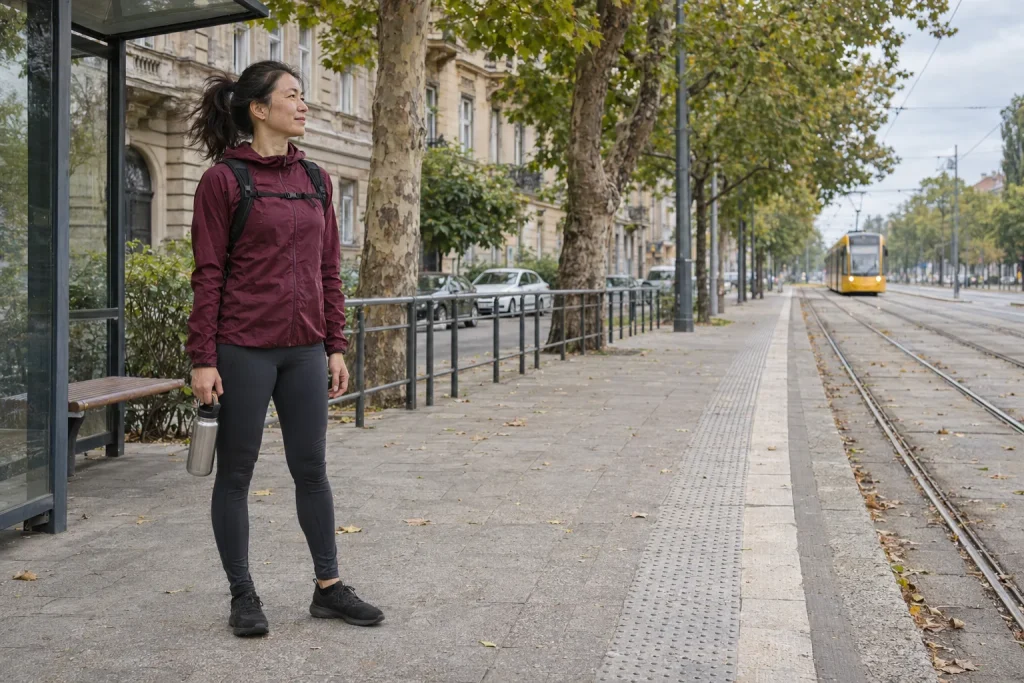
Fitting a run around a bus, tram or train is comfortable when you understand the limits of the connection and do not have to chase every minute while moving. A timetable can provide a useful structure for the day, but it is unwise to stake the end of the run on one service you can only just reach. The aim is an outing in which travel and running together remain clear.
The starting situation can vary. After work, you get off earlier and run part of the way home. At the weekend, you take a train near a park or forest path. In the morning, you continue by tram after running. Each has a different important connection, so first name the direction of the outing and the point that is genuinely fixed.
Which time is the real boundary?
If you must appear at work at a specified time, that sets the programme’s end. If you merely prefer a particular service home and others follow frequently, you have more flexibility. If relying on an infrequent regional bus, missing the connection can have different consequences. Timetable times do not all carry the same weight.
Write down one genuinely fixed point in the day. Then list what happens before it: walking to the stop, ticket handling, travel, interchange, approach, running, return and possibly changing clothes. The order depends on your route. Seeing the entire chain makes it easier to recognise where time is tight.
Catching the selected service should not become a hidden pace workout. If the programme only works when you hurry on the final section, planning may be too tight. Treat the form of movement and transport time window as separate decisions. Turning earlier or taking another service is often calmer.
Set the correct day first
When looking up timetables, check the travel date and direction. Weekdays, Saturdays, Sundays and public holidays can offer different services. Departure and arrival searches in a planner also answer different questions. If you need to be somewhere by a fixed time, enter the arrival condition correctly.
The MÁV Group journey-planning information also draws attention to checking timetables and current service changes. Do not rely solely on an old screenshot for your run. During planning, check information for the selected day, then check changes announced since then before departure.
For travel in Budapest, the BKK timetable page provides separate access to journey planning and service changes. In another town, find the appropriate operator’s official channels. This article does not specify route numbers or departure times because those belong to the particular day and location.
 Enlarge diagram
Text version of the diagram
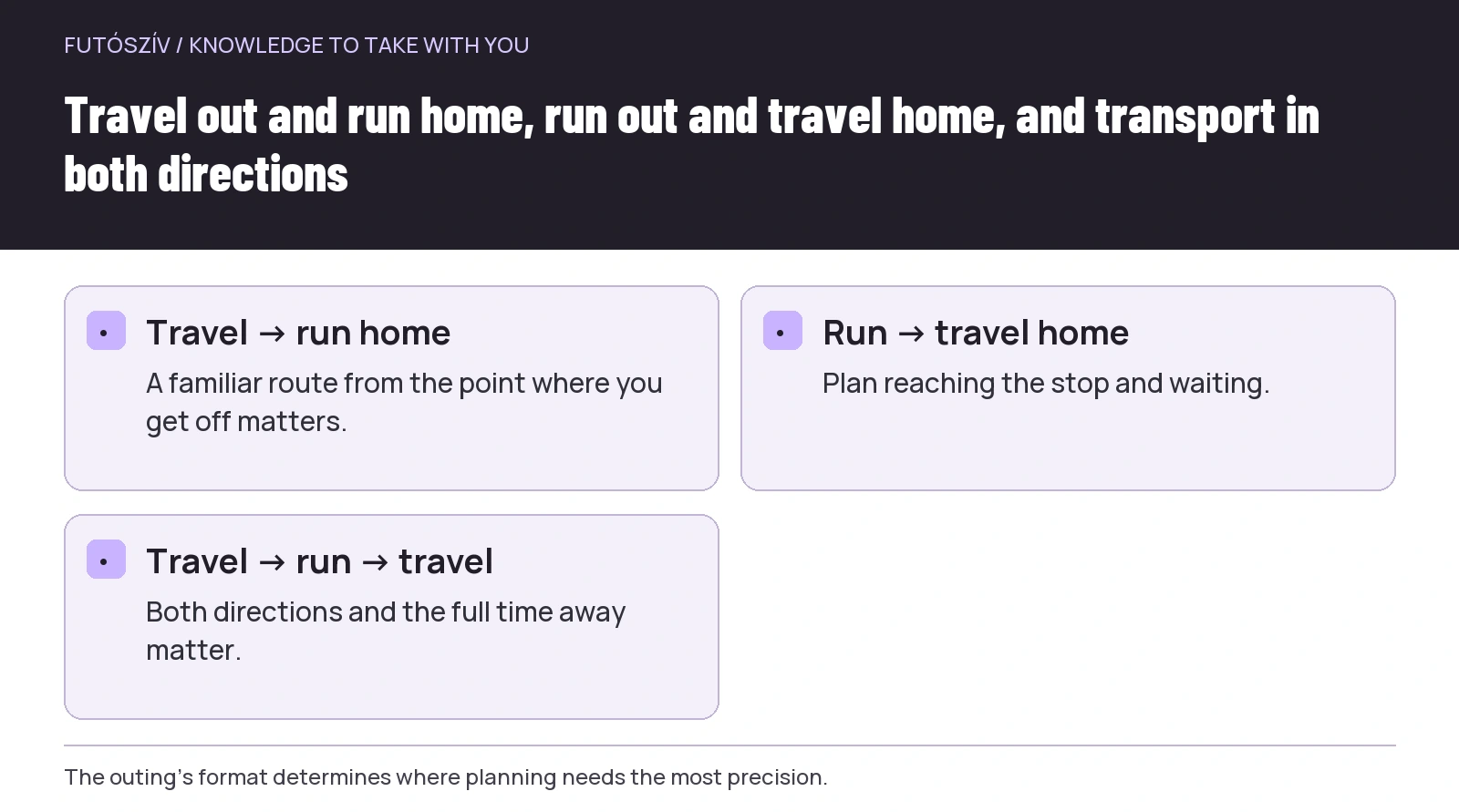
- Travel → run home
- A familiar route from the point where you get off matters.
- Run → travel home
- Plan reaching the stop and waiting.
- Travel → run → travel
- Both directions and the full time away matter.
Three distinct outing formats
Travel out, run home. Transport comes at the start of the outing and home is the destination. This can simplify getting back, but you need to genuinely know the route from where you get off. A stop that looks convenient in the timetable may not have a good pedestrian connection.
Run out, travel home. Here, you need to find and reach the appropriate stop at the end of the run. The turning decision, service frequency and waiting conditions matter. Leave time between the planned end of running and the vehicle’s departure to approach the stop and prepare to board.
Travel both ways, run at the location. This can suit getting to know a selected park or area. The whole outing may take longer than the time spent there. Check return details before setting off, rather than discovering at the end of the run that the next suitable service leaves much later.
| Format | What may become simpler? | What requires separate attention? |
|---|---|---|
| Travel out, run home | The destination and finishing at home | Pedestrian access from where you get off |
| Run out, travel home | You can choose a new endpoint | Stop, waiting and options for getting home |
| Travel there and back | More freedom to choose the location | Full time away and both transport directions |
A station is not a single point
On a map, a station name can easily look like one marker. In reality, it may have several exits, platforms, subways and bus stops farther away. There may be a separate approach between where you alight and the start of your planned running route. Inspect that section, particularly on a first visit.
For the return journey, the stop for the correct direction matters. A sign across the road may serve the opposite direction, and crossing between them is not necessarily direct. At a larger station, selecting the appropriate entrance can take time too. Do not leave these details to the last minutes.
If a journey planner shows a pedestrian link, also observe on-site signs and access. Temporary works or closures can change the approach. A short-looking route on the display does not justify ignoring the designated traffic arrangements. If the connection is unsuitable, you can choose another stop or outing format.
Be clear about the purpose of your time margin
No fixed number of spare minutes can be prescribed for every route. A frequent tram and an infrequent rural bus are different situations. Choose a margin based on the approach, possible interchange, local knowledge and next available option. The question is whether the programme remains manageable after a small deviation.
Make two scenarios. Plan A is the chosen service. Plan B explains what happens if you miss it. When is the next one, where will you wait, and must you update anyone about your expected return? Plan B is useful when it is an actually checked option, not just a hope that something will surely turn up.
Take particular care with the last or a very infrequent service. If there is no suitable alternative, adapt the running programme or choose another location. Completing a distance does not oblige you to accept uncertain travel home. The value of the whole outing includes a thought-through ending.
Work out the turning point from the return journey
On an out-and-back run, do not think about turning only at half your allotted moving time. Getting back to the stop, handling a ticket and boarding all need separate time. Hills, traffic or the approach can also make outward and return sections take different lengths of time. Do not let a rigid halving formula guide the plan.
You can choose an earlier, recognisable decision point. There, check the time window and how the return fits. If things have become tighter, a shortcut you have already walked may help. Do not improvise an unfamiliar detour for the timetable. A shorter known loop is often better than an uncertain cut-through.
On a shared run, state the turning rule beforehand. If one person has a connection, the others need to know when and where they leave. “Let us do one more little loop” carries different weight if it leads to waiting for an infrequent service. Precise arrangements protect a social outing from a rushed ending.
 Enlarge diagram
Text version of the diagram
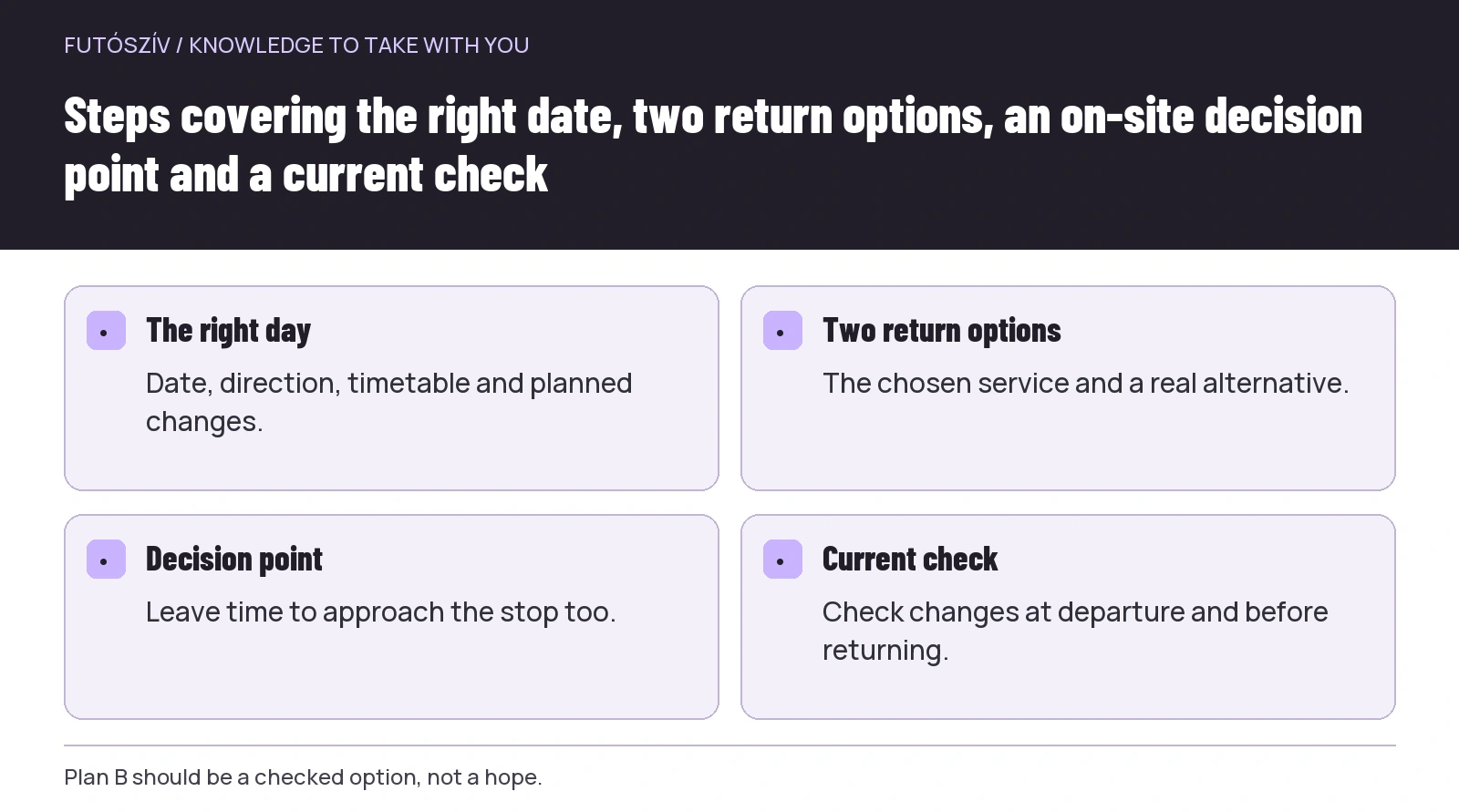
- The right day
- Date, direction, timetable and planned changes.
- Two return options
- The chosen service and a real alternative.
- Decision point
- Leave time to approach the stop too.
- Current check
- Check changes at departure and before returning.
Tickets and passes: buying and using are separate
Check which fare product you need for the route and how to use it. A ticket appearing in an app does not by itself explain validation or every condition. Prepare using the operator’s current instructions. Discounts or named entitlements may require further proof.
With mobile tickets, a functioning device is part of the travel plan. The BKK mobile-ticket information also explains validation and presentation steps. Check current requirements for your own product before departure rather than trying the system for the first time at the vehicle door.
If audio guidance, maps, payment and tickets all work on the same phone, pay particular attention to battery charge. Any backup should be in a form the operator accepts. A screenshot does not replace a ticket or live presentation in every situation. The particular fare product’s instructions determine this.
Dress for waiting too
Standing or walking slowly after a run is different from moving continuously. Consider where and how long you may wait, and what is available near the stop. Clothing and any layer you carry should suit the whole outing. Every situation does not call for a large load, but waiting should not be omitted from planning.
If the necessary change of clothes or layer cannot be carried comfortably, another format may suit better. For example, travel out and run home, where you finish movement directly at home. Simplifying logistics can sometimes help more than continually increasing the load.
Decide about food and fluids according to total time away and individual needs too. A short run at the destination may follow a long journey. Naming the two parts separately clarifies what needs arranging. A general travel example does not replace a personal healthcare or nutrition plan.
Illustrative example: a park run between two services
A runner wants to exercise in a familiar park on Saturday, reached by bus. In the planner, they first check the correct date, then choose the outward journey. Next, they find two usable departures back. They treat the later service as a real alternative and check where they could wait until then.
In the park, they choose a short, familiar loop with clear access to the stop. Well before the primary return departure, they have a decision point: continue the programme at the location and allow for the later service, or finish and head to the stop. The decision is not made at the last corner upon seeing the bus.
If the outward journey changes, they recalculate the time available at the location. They do not automatically try to squeeze the same programme into less time. Movement and travel together make up the day’s plan. Without specific route or timetable data, the example demonstrates the decision order; fill in current information for your own location.
Make three separate checks before and during the outing
The day before, check the basic timetable and planned changes. Before departure, check current service information, the necessary ticket or pass and your device. Towards the end of the run, stop somewhere suitable and check the return situation if the system provides it. Do not use your phone while moving in competition with attention to traffic.
If someone is waiting at home or travelling with you, communicate significant changes. Choosing a later service can be a good decision, but may affect others’ schedules too. Social coordination is as much part of the outing as the exact stop location. It makes the whole day easier to follow.
After the outing, note which part was tight or uncertain. Perhaps the walk to the stop took longer than expected, or another exit would have been simpler. You can improve this next time. A connection ultimately works well not because you catch it at the last moment, but because it fits calmly and clearly into your run.
How Futószív articles are prepared: our editorial guidelines.