Clock time and how long a run feels
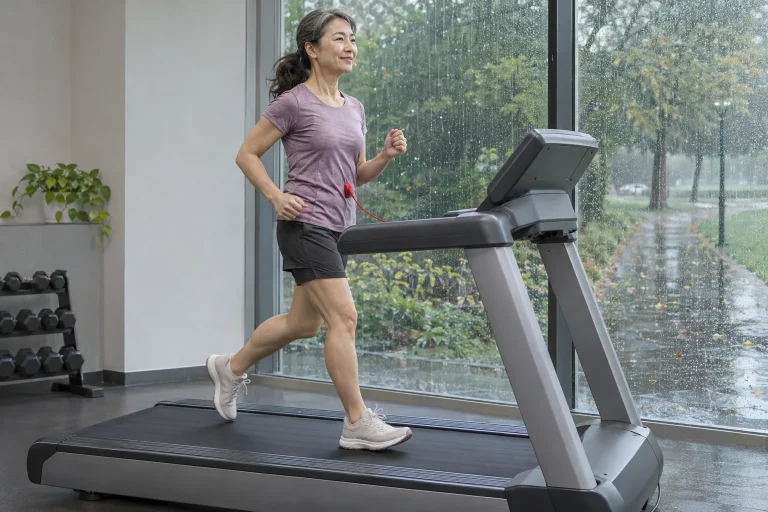
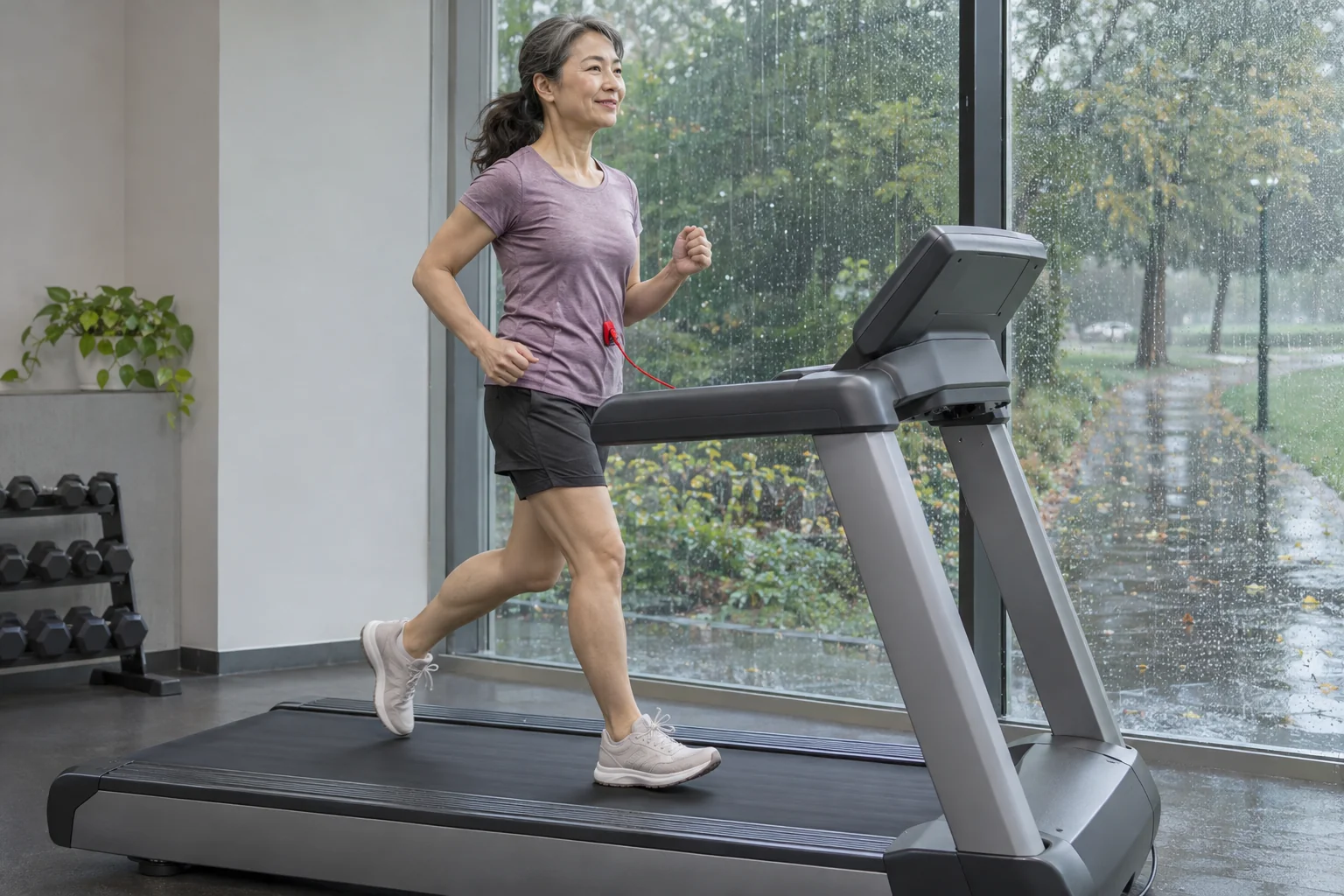
On a treadmill, it is easy to notice time. The display counts the same seconds, yet you may feel that it barely moves, or that the task ended sooner than expected. A sense of time dragging during a run, an estimate of its duration afterwards and the minutes that actually passed are three different questions. If research provides data on only one, it should not automatically be treated as an explanation of the other two.
Scenery sweeping past in a virtual environment is particularly interesting because it links visible travel to movement performed in place. It is tempting to suggest that a faster-moving image changes time perception and makes running easier. That is actually a chain of several assumptions. First, check which aspect of time perception was measured, then whether fatigue or performance changed. One finding does not establish the whole explanatory chain.
This article examines a 2025 experiment in a virtual running environment from that perspective, alongside an earlier study of perceived distance. The aim is to understand the distinctions, not to propose a home exhaustion test or a screen-speed recipe. Questions useful for your own running are identified separately from research findings.
What did the 2025 virtual-running study measure?
In Weippert and colleagues’ 2025 study, ten male endurance athletes completed two treadmill tasks to exhaustion: the virtual scenery showed optic flow matched to the machine or accelerated optic flow. After both conditions, they estimated the duration as shorter than it actually was. The ratio of estimated to actual time was higher with the accelerated scenery, while no corresponding condition effect was found for time to exhaustion or perceived fatigue.
Here, a higher ratio means the estimate was closer to the actual elapsed time. It does not mean that everyone felt the run lasted longer than it really did with the accelerated image. The average ratios reported in the study were 0.68 and 0.75. Both are below one. The result therefore cannot be summed up simply by saying that faster scenery made time fly more.
The task was a short, strenuous research situation involving a defined sample of athletes. It did not examine an ordinary easy treadmill session or a training programme lasting several months. The participation conditions and task boundaries belong in the interpretation. This article does not recommend seeking exhaustion or present the research display ratio as a personal setting.
Reading the ratio: what does a number below one mean?
When an estimated duration is compared with the actual time, the ratio is straightforward to illustrate. Below one, the estimate is shorter; above one, it is longer; at one, it matches the reference duration. This is a mathematical explanation, not a new research finding. It helps avoid confusing a difference between conditions with whether people judged elapsed time accurately.
Take an original example used only for illustration: if someone thinks ten actual minutes lasted seven, they have underestimated the duration. If they estimate eight in another situation, they still judge it shorter than reality, but by less. This does not establish that the second task was more unpleasant or harder to complete. An estimate of time is not, by itself, a measure of mood or physical workload.
Nor should the study data be turned into one person’s expected result. A group average does not mean every participant estimated with the same error, and it cannot say how you would judge a different workout. Accurate reporting remains useful when the numbers retain the description of the sample and task alongside them.
 Enlarge image
Estimating afterwards differs from watching the clock during the task
When you say afterwards how long something lasted, you are looking back on the whole experience. Regularly looking at the display during it gives you different information. In everyday conversation, it is easy to call both the same sense of time, although they may answer different questions. Understanding the research task precisely is therefore more useful than deciding from the headline whether time generally passes more slowly on a treadmill.
In your own experience, every second of a difficult interval might have felt long, yet you may recall the full session as shorter afterwards. Those statements do not necessarily contradict one another because they describe different judgements. This distinction is not a diagnosis and does not explain every experience of time. It helps you describe what you experienced more precisely.
In a personal log, choose a specific question. Were you bothered by checking the time frequently during the run? Or were you surprised afterwards by the session’s duration? Different changes may help in the two situations, and the same video need not solve both. Continue to respect the exercise task and your own safe limits.
Fatigue and performance are not other names for time estimation
An important finding was that the difference in time perception was not accompanied by a demonstrated change in every other area studied. If we highlighted only the sentence about time, we could easily imply that a visual trick substantially extended the run participants could complete. This study is a useful reminder that a change in a subjective measure and the actual outcome of movement need separate examination.
In everyday training, you may think less about time while watching certain content but feel the same exertion. On another occasion, a new video may be interesting without making you want to extend the task. A more pleasant attentional experience can have value in its own right; it need not become a performance promise. The purpose of training does not have to change to suit the screen’s effect.
Feeling that time was shorter does not override bodily signals either. Running remains real movement even when a story or landscape holds your attention. If an unusual symptom or illness occurs, changing the screen does not replace an appropriate response. Research on time experience examines one part of perception; it does not give permission to ignore the consequences of exertion.
Perceived distance offers a different comparison
In Parry and Micklewright’s 2014 study, visual travel was modified during five-kilometre tasks completed by twelve male runners. With slower optic flow, perceived kilometre points and perceived exertion differed, while actual pace did not differ significantly. This provided data about distance judgements and self-paced running; it was not the same as the 2025 retrospective time-estimation task.
We often track time and distance together while running, yet they can be asked about separately. Someone may feel the route is longer but estimate the total time as shorter afterwards, or may not change pace at all. A single everyday phrase, such as ‘the loop felt fast’, can therefore conceal several experiences. The exact research tasks help identify which strand has supporting data.
Even together, the two studies do not provide a general rule for how quickly scenery should sweep past on a treadmill. Their samples, tasks and outcomes differ. Their shared lesson is that several relationships between visual environments and the experience of movement can be studied, and the findings should not be compressed into one motivational trick.
When might an attentional focus other than time be useful?
For an easy indoor session, you can choose something comfortable to follow: changes in a route’s scenery, a simple audio signal or the rhythm of movement. This is a personal organisational option, not a treatment instruction derived from the experiment. You do not have to forget elapsed time at every moment. The question is how well your chosen focus suits that workout’s purpose.
If you are following predetermined intervals, paying attention to time signals may be part of the task. There is no reason to suppress the display at all costs in that situation. At other times, constant clock-watching may unnecessarily dominate the experience, and suitable content may add variety. The two situations call for different decisions. Choosing deliberately helps you avoid applying general advice to every session.
Prepare content while the machine is stationary and follow the particular device’s rules. Altered optic flow in research is not a call to try extreme visual speeds at home. A display is a reasonable option when it is comfortable, easy to follow and remains usable alongside managing the real environment.
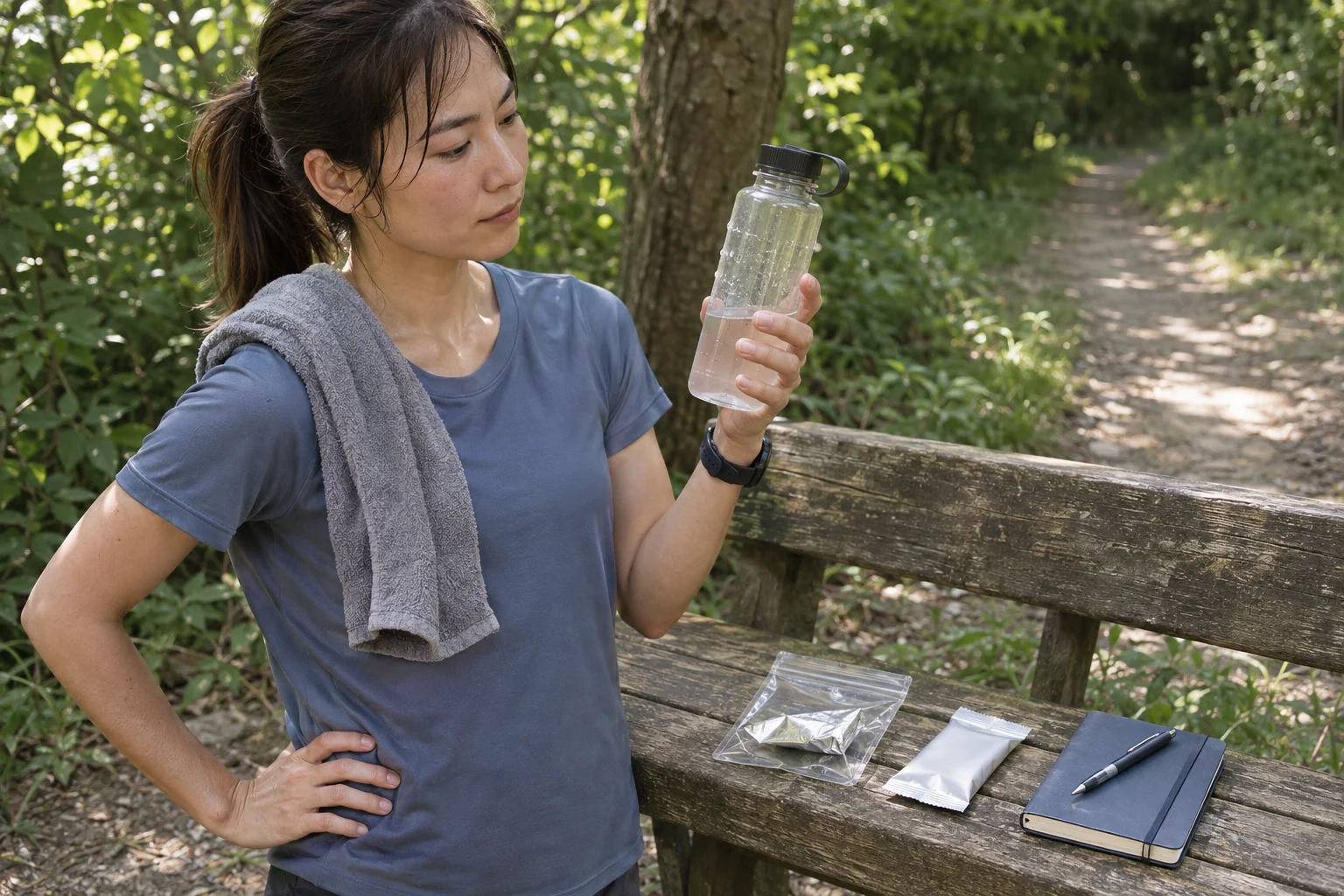 Enlarge image
A few clear notes are enough for a personal comparison
If you want to record the experience of several indoor sessions, identify the planned task, content and experience of time separately. Perhaps you checked the clock often, rarely thought about it or were surprised by the actual duration at the end. These are personal observations. You do not need to create your own laboratory time-estimation test, and the results cannot establish cause and effect.
Keep the circumstances in mind too. The screen’s content is not the only difference between the time experience of a short, easy run when fresh and a harder task after a tiring day. Your log can include sleep, time of day and workload if they seem important. The aim is to describe your situation better, not assign every difference to one factor.
If you find an option that suits you, you can simply use it. There is no need to check repeatedly exactly how much it changes your time estimate. The exercise environment is not another performance leaderboard. A workout that is comfortable to follow still has value if time does not feel shorter at all, but it fits your day better.
What claim is worth passing on?
A precise description is that, in a small, defined sample of athletes, changing virtual visual travel affected one measure of retrospective time estimation without producing corresponding changes in the other running outcomes studied. This is an interesting finding that leaves further questions open about longer or different types of exercise. It does not say everyone feels time pass more slowly on a treadmill or promise that a video will solve difficult workouts.
You can discuss your own experience just as precisely. Name when the task felt long, what you attended to and how you recalled it afterwards. Research can offer concepts to help. Your next-session decision can keep the time available, the workload you accept, a pleasant environment and the freedom to choose different content on another day together.
Sources and interpreting the experience of time
The publications were checked on 21 November 2026. The 2025 retrospective time estimate and exhaustion research task are distinguished from the perceived kilometre points studied in 2014. This article does not recommend a home exhaustion test or a virtual-speed setting. The examples are original explanations, and the images are illustrations created with AI tools.
- Weippert and colleagues: Optic Flow Speed During Running in a Virtual Reality Affects Perceived Time but Not Perceived Fatigue in Male Endurance Athletes, 2025
- Parry and Micklewright: Optic flow influences perceived exertion and distance estimation but not running pace, 2014
How Futószív articles are prepared: our editorial guidelines.