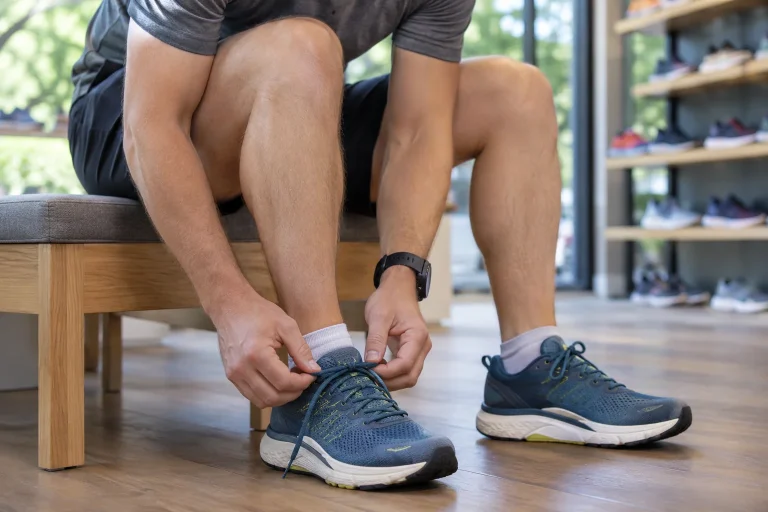
Loosening the laces can seem an obvious response to pain on top of the foot. Sometimes shoe pressure really is troublesome, and a more comfortable fit can matter. But pain along the line of the laces, or relief when they are loosened, does not reliably establish that the shoe is the sole cause. Onset, swelling, changes in sensation and normal walking matter separately too.
Seek urgent medical help for severe pain, inability to walk, a change in shape, a snap heard during an injury, a hot and swollen foot, or symptoms accompanied by fever or chills. The NHS lists these as specific warning signs. Finding a new lacing pattern is not the next task in these circumstances. Do not try to “test” a painful foot with another run for reassurance.
The top of the foot is not the name of a single tissue
Beneath the shoe upper lies more than skin in contact with laces. Bones, joints and soft tissues work together to produce foot movement. The Bexley NHS musculoskeletal information, for example, describes the extensor tendons on top of the foot: they transmit muscle force and help lift the foot and toes. A location marked on the surface can therefore involve several different questions.
A tendon’s role differs from a shoe’s. The shoe surrounds and holds the foot externally, whereas the tendon belongs to the system producing movement. They can interact without being the same thing. If shoe pressure bothers an already sensitive area, loosening may improve how it feels without fully clarifying the background. More comfortable pressure does not answer every musculoskeletal question.
You do not need an anatomical name to describe the exact location. Show where symptoms occurred during ordinary use: in the middle, at the side, towards the toes or closer to the ankle? There is no need to press hard over the whole top of the foot. If the location is hard to define, say so. An uncertain personal observation is more valuable than an online label chosen with confidence.
What changed first: the shoe or the pain?
Recall the beginning in chronological order. Did you wear new shoes, tie them differently or add an insole, or was the pain already present? A simple sequence helps distinguish actual events beforehand from an explanation chosen afterwards. You do not need a definite cause; keeping the timing of changes and your experience is enough.
You might, for example, have tried a new model while also walking more and changing your running in the same week. The shoe is then one circumstance, rather than necessarily the only factor. A sudden, severe new symptom in a long-used pair is a different history. These need not be treated identically simply because the laces pass over the same area.
A previous injury or foot problem already assessed can also form part of the background. Mention it and what is different now. An old report does not settle how a new change should be interpreted. Leave room for the current history: new swelling, different pain or changed walking is not simply another copy of the previous label.
 Enlarge image
When shoe pressure really may be relevant
The Bexley NHS discusses irritation from tight footwear as one possible circumstance in extensor tendon symptoms. The national NHS information also mentions shoes that are too tight among possible causes of pain on top of the foot. Pressure and fit are therefore legitimate questions, rather than exclusive explanations.
Several elements together determine the available space inside a shoe: your foot, sock, tongue, lacing and any aid used. Adding a layer can create a different situation within the same shoe. This is not personal advice to remove an insole. It shows why the whole arrangement is worth discussing rather than just the size on the label.
The aim of loosening may be more comfortable support, rather than letting the shoe move completely uncontrolled on the foot. A general article cannot choose lacing tension or a pattern for you. If a shoe seems secure only when very tight, but slips uncomfortably when looser, review the overall fit. Every discomfort need not be solved with an increasingly complicated knot.
Why is loosening not a diagnostic test?
Several circumstances change when you undo laces. You stop, external pressure decreases, the foot changes position and the previous activity is interrupted. If the sensation eases then, you cannot reliably determine each change’s contribution. The experience matters, but it is not an examination excluding involvement of bone, tendon or another structure.
For the same reason, do not tighten the laces again and run another loop to see whether pain returns. Reproducing symptoms is not necessary to make the history credible. If you have noticed a connection, describe it. It will be one piece of information in an individual assessment; identifying the exact mechanism is not your job.
Keep any remaining symptoms after loosening separate too. Pressure may have eased while walking still hurts, or swelling may remain after the shoe is removed. These are not minor exceptions to a story already decided. They show why one change in comfort cannot provide a complete explanation. New or persistent symptoms need not be hidden behind the laces.
| Situation | What can you describe? | What does it not establish? |
|---|---|---|
| Better after loosening | It eased after stopping and changing pressure. | It does not establish a diagnosis caused solely by footwear. |
| Still painful without shoes | The symptom remains after removing the footwear. | You do not need another shoe test to prove it. |
| A pinpoint symptom | Show the area where you already felt it. | Pressing cannot confirm or rule out bone injury. |
| New swelling | Describe when you noticed it and what accompanied it. | It is not necessarily just a mark from the laces. |
Symptoms associated with repeated loading can raise another question
The AAOS also describes foot and ankle stress fractures as bone injuries associated with repetitive loading. Symptoms can develop gradually without one major accident. This does not mean pain under the laces is usually a fracture. It means the absence of a specific injury event does not exclude every bone-related concern.
It matters if symptoms begin occurring with increasingly small everyday tasks. A sensation at the end of a run and pain making the walk to work difficult describe different functional situations. You do not need to deliberately take a longer route to see how far you can manage. A change that has already happened is enough reason to reassess the current condition.
According to the AAOS, an early stress fracture is not always visible on the first X-ray. A previous negative image therefore does not reassure about every later symptom. Interpret the result alongside the history and examination; persistent or changing symptoms can raise the question of follow-up. A report does not replace individual guidance about activity.
Naming a tendon does not automatically prescribe exercises
The possibility of extensor tendon symptoms needs evaluating through the history and examination. The Bexley NHS bases diagnosis and possible further investigations on individual clinical assessment. Not every pain on top of the foot is the same tendinopathy, and matching a location on an anatomical diagram is insufficient to choose treatment.
A toe raise or stretch from a general video is therefore not a compulsory next step for symptoms that remain unexplained. The movement’s purpose and suitability for the current condition matter more than how simple it looks. You do not need to follow lace-loosening immediately with a strong stretch or resistance exercise to test whether a tendon really was involved.
If you have already received individual rehabilitation exercises and develop a different pain or new swelling alongside them, report it. A plan previously considered appropriate does not require ignoring every new symptom. Follow-up can consider the exercise’s purpose, your experience performing it and changes in everyday function together. Independently increasing repetitions does not replace that feedback.
 Enlarge image
A shop and a clinic answer different questions
A shoe fitting can meaningfully address fit, how the foot is held and comfort in use. A healthcare assessment also clarifies the symptom’s origin and what you individually need to do. These forms of help can complement each other, but are not identical. Shop advice remains medically limited even if the adviser knows many running shoes and listens helpfully.
The NHS recommends healthcare advice for worsening or recurring pain, pain interfering with normal activities and changes in sensation. Foot symptoms require particular attention with diabetes. You do not need to try every size or lacing solution first in such a situation. Your symptom and its effect are already important information for seeking help.
You can bring details of your usual shoe, or the footwear itself if requested and easy to arrange. But do not delay care in order to show the shoe. The symptom’s urgency determines the action, rather than whether all your kit is at hand. Previous aids and advice can be added to the history later too.
A good next step is not another painful test loop
By the end of an individual assessment, the proposed explanation and purpose of the plan should be clear. If changing fit forms part of the approach, understand which experiences you should report back on. You do not need to bring the symptom back at any cost to test the effect. Changes observed during normal use and agreed follow-up can provide meaningful feedback.
Put everyday mobility alongside your running goal. How have walking, standing work or necessary tasks changed? These changes matter independently. Previous pace or distance does not establish what your foot can tolerate today, and a more wearable shoe is not automatically the same as fitness to run. An individual plan can connect those questions.
Loosening laces can be a simple comfort adjustment, but is not a diagnostic endpoint. Pain on top of the foot receives appropriate attention when onset, changes and whole-day function remain visible alongside its relationship with footwear. This preserves a genuine fit problem while preventing a persistent or potentially injury-related symptom from being covered by the reassuring phrase “I must just have tied it too tightly”.
Sources
- NHS: pain on top of the foot, possible causes and seeking help, 2025
- AAOS: stress fractures of the foot and ankle
- Bexley NHS: function and symptoms of the foot’s extensor tendons
How Futószív articles are prepared: our editorial guidelines.