Pain behind your toes, in the padded front part of the sole, can quickly lead you to a technical term: metatarsalgia. The name can help identify the location, but it does not mean the cause has been established. The NHS also lists several possible explanations and specifically warns against self-diagnosis. The next step is not necessarily a ready-made insole or a different running movement.
Seek urgent medical help for severe pain, inability to walk, a change in the shape of your foot, a snapping sound during an injury, a hot and swollen foot, or symptoms accompanied by fever or chills. The NHS treats these as particular concerns too. In these circumstances, do not look for the answer by trying on shoes, pressing the area at home or going for another run. The explanations below do not remove the need to assess an acute problem.
Naming the location and understanding the cause are separate steps
The forefoot includes the toes and the metatarsal bones behind them. The AAOS anatomical description distinguishes five metatarsals and the toe bones; these work together during walking. Pain felt “under the ball of the foot” therefore points to an area where several structures and functions meet. It does not identify a fault in one isolated component.
In the AOFAS information too, metatarsalgia means pain on the sole between the arch and the toes. Establishing the precise location is therefore a useful start. “Sole pain” may be too broad, but a technical term alone can create unwarranted certainty. The location and the history of the symptoms together are more useful than simply learning the name.
A simple comparison may help: naming shoulder pain does not immediately explain why the shoulder hurts. Similarly, naming the front part of the sole does not prescribe one treatment. There is no need to feel embarrassed if you can only describe the location in everyday language. “Underneath, behind my second and third toes” may be more precise than an uncertain use of a Latin term.
How can you show the location without a painful search?
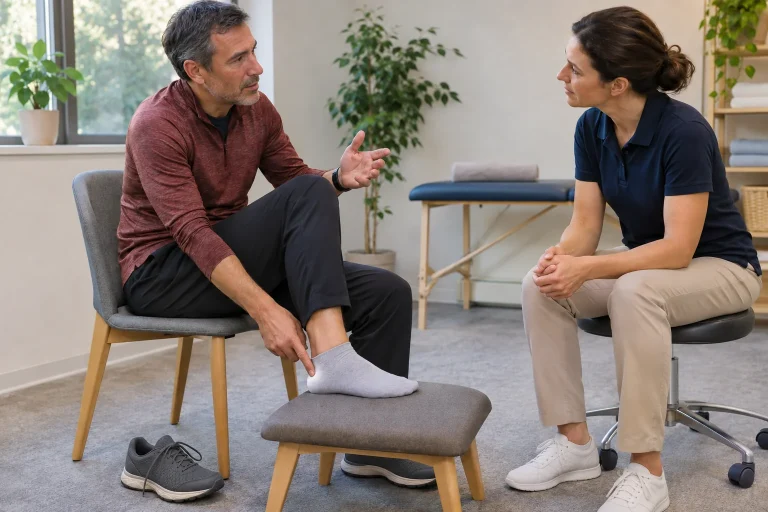
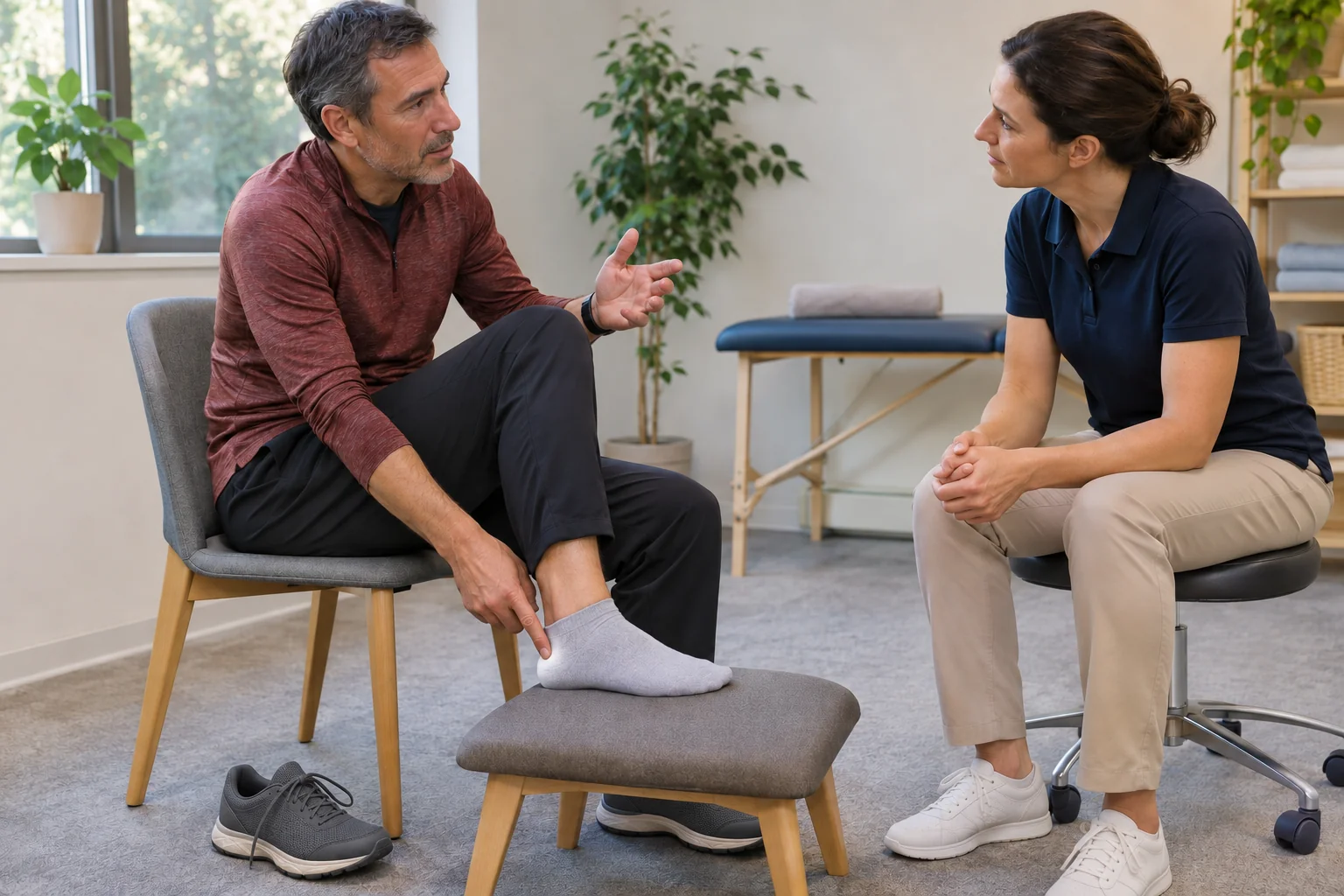
At an appointment, it may be enough to show the area where you felt the symptoms during your normal day. You do not need to press hard on every spot beforehand. Pain produced by pressure does not by itself provide a reliable diagnosis, and a circle drawn on a photograph cannot replace an in-person assessment. If you can only roughly recall the location, say so.
It is useful to know whether the sensation centres on a small point, occurs behind several toes, or has changed location over time. It is also worth distinguishing between the sole, the top of the foot and the spaces between the toes. These are not keys to diagnosing yourself at home. The aim is for the clinician to hear the history you actually experienced, rather than a version adjusted to fit an online diagram.
If you have noticed a callus, rubbing or another visible change, you can report that too. According to AOFAS, a callus can accompany symptoms in some circumstances, but pain does not require one to be present. The absence of a visible sign therefore does not prove that there is no problem to assess. Equally, a callus does not automatically explain every symptom felt beneath it.
 Enlarge image
A sudden injury and a gradual onset are different stories
If the symptoms were linked to a specific event, keep that detail. Did you step on something, trip, knock your foot or drop an object on it? The history is different if the pain became noticeable over days or weeks without a particular event. Having the same body part involved does not make the two situations identical.
The AAOS discusses forefoot fractures associated with both direct impacts and repeated loading. Pain and swelling can occur in these conditions too. This does not mean every painful forefoot is fractured, but neither does the absence of a major accident rule out every possible bone-related concern. Do not judge the validity of your symptoms by how dramatic the accident was.
Changes after the onset matter too. Did it first occur only at the end of a longer run, then later while walking to work? Or did it start easing after a single impact before worsening again? Explain the actual sequence. You do not need to add another long walk to prove a connection. The changes that have already happened provide enough of a starting point for an assessment.
Footwear can be relevant without being a complete explanation
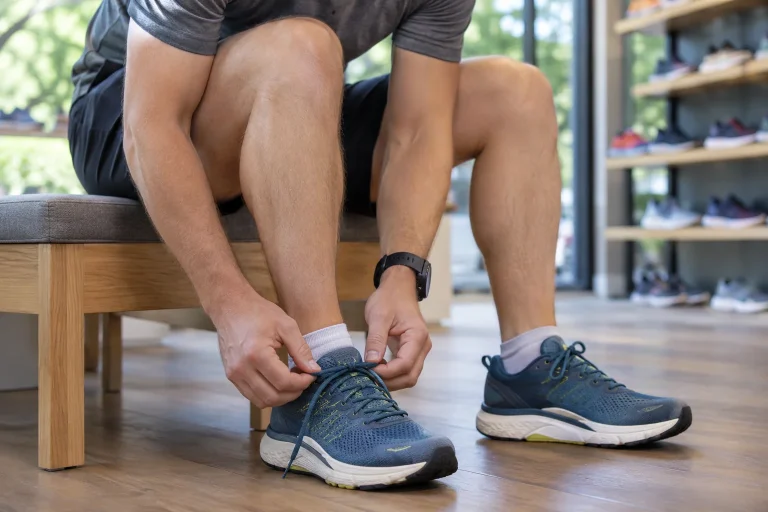
According to AOFAS, poorly fitting shoes can contribute to forefoot symptoms: tight shoes may squeeze the foot, while loose ones can allow slipping and rubbing. Comfort therefore cannot be reduced to a single size number. The shoe’s shape, the circumstances in which you wear it and what you experience in it are all details you can describe.
If the symptoms began in new shoes, that is an important timing connection, but not yet a proven cause. Your work, walking or running load may have changed at the same time. You do not need to choose one of these factors as the definitive culprit. The more precise question is which changes happened when, and what effects you noticed in everyday use.
Fitting advice in a shop and a medical assessment serve different purposes. A well-chosen shoe may be more comfortable, but a trial jog does not clarify every recurring or severe symptom. Do not treat the price of a more expensive model as a diagnostic guarantee. If normal walking has become difficult, you do not need to buy several new products before seeking help.
| Circumstance | Useful question | Premature conclusion |
|---|---|---|
| New running shoes | When did you start using them, and where do symptoms occur while wearing them? | Every symptom must be the shoe’s fault. |
| Work footwear | How much standing and walking do you do in it? | Only sports shoes matter. |
| Insole or pad | Who recommended it, for what purpose, and what do you experience with it? | Every painful forefoot needs the same product. |
| Good momentary comfort | What happens during your usual day? | Comfort in the shop rules out every injury. |
Why is an insole not an automatic next step?
The AOFAS mentions footwear modifications and individually recommended insoles or padding among possible management options. This does not mean that every painful forefoot calls for the same product, shape or placement. An aid should serve a specific purpose in the condition that has been assessed. Its product name cannot replace an explanation of what it is intended to achieve.
If you already use an insole, explain when it went into your shoe and on whose advice. Do not hide your previous experience, even if it made no difference or caused a new feeling of pressure. That is not your fault, and it does not prove that all similar aids are pointless. In an individual assessment, both the proposed solution and its actual use matter.
It is unhelpful to build an increasingly complicated layer of homemade pads, tape and insoles while the cause of the symptoms remains unknown. This can change the space inside the shoe and its comfort, while making the original situation harder to follow. If a professional recommends something, make sure you understand its purpose, how its effects will be reviewed and how to report back; the process should involve more than buying an item.
A forefoot strike is not a universal remedy
Runners often suggest immediately changing foot strike in response to pain in a body part. Yet naming the location does not establish which movement change would be appropriate. An online video cannot examine your foot, assess your current walking pattern or interpret the background to your symptoms. The feeling of moving differently does not by itself prove that the problem has been resolved.
The same applies to a barefoot trial run, an abrupt switch in shoe type and toe exercises that seek out pain. You do not need to experiment with these before a consultation. The value of your observations does not rise with the number of methods you have tried. If several changes happen at once, it is also harder to say which accompanied a change in symptoms and which had no noticeable effect.
If you are given exercises after an individual movement assessment, their purpose and execution should be clear. You can ask which everyday function they are intended to improve and how that relates to the question of running later on. Not every exercise aims to create a “beautiful” foot strike or imitate a form seen in a video. Your current condition and the problem as understood should justify the actions, rather than a general aesthetic expectation.
 Enlarge image
Everyday walking is an important outcome too
An athlete may focus on whether they can still train while shopping, standing at work or using the stairs has already become difficult. Do not leave these consequences out. The NHS lists pain that interferes with normal activities, worsens or keeps returning, and changes in sensation among reasons to seek medical advice. Foot symptoms also need particular attention if you have diabetes.
When reviewing your load, you can discuss essential and optional activities separately. You may not be able to stop standing at work with a single decision, and travel cannot always be avoided either. You can still ask for help with a workable plan. Useful care needs to relate to your actual day, rather than an imaginary week without work, family responsibilities or transport.
When monitoring the situation, compare more than running distance. Changes in walking, wearing shoes or doing a previously difficult task matter too. A change does not need to be a spectacular sporting achievement to be important. A precise account of improvements or difficulties in normal life helps ensure that the next step addresses your own problem.
A good explanation offers more than a new word
After the assessment, it is worth understanding whether metatarsalgia is simply being used to name the location of the symptoms, or whether a more specific condition has also been established. What is thought to be the most likely explanation, what remains uncertain, and how will changes be reviewed? Acknowledging uncertainty is not necessarily a shortcoming. It may be a precise part of the assessment that determines follow-up and further questions.
The need for imaging relates to this question too. According to the AAOS, for example, an early stress fracture does not always appear on the first X-ray, and further investigations may be considered if clinical suspicion remains. Not every painful forefoot needs the same imaging, and no single result is an independent clearance to run. The current history and individual assessment determine the purpose of an investigation.
Naming the location is most useful when it opens a more precise conversation. You can explain where it hurts, how it began, the circumstances in which it changed and what has become harder because of it. This can provide more usable information than immediately attaching the first insole or running movement to a technical term. Addressing a painful forefoot begins with understanding your situation rather than choosing a product.
Sources
- NHS: pain in the ball of the foot, 2025
- AOFAS FootCareMD: metatarsalgia, anatomy and possible causes
- AAOS OrthoInfo: toe and forefoot fractures
How Futószív articles are prepared: our editorial guidelines.