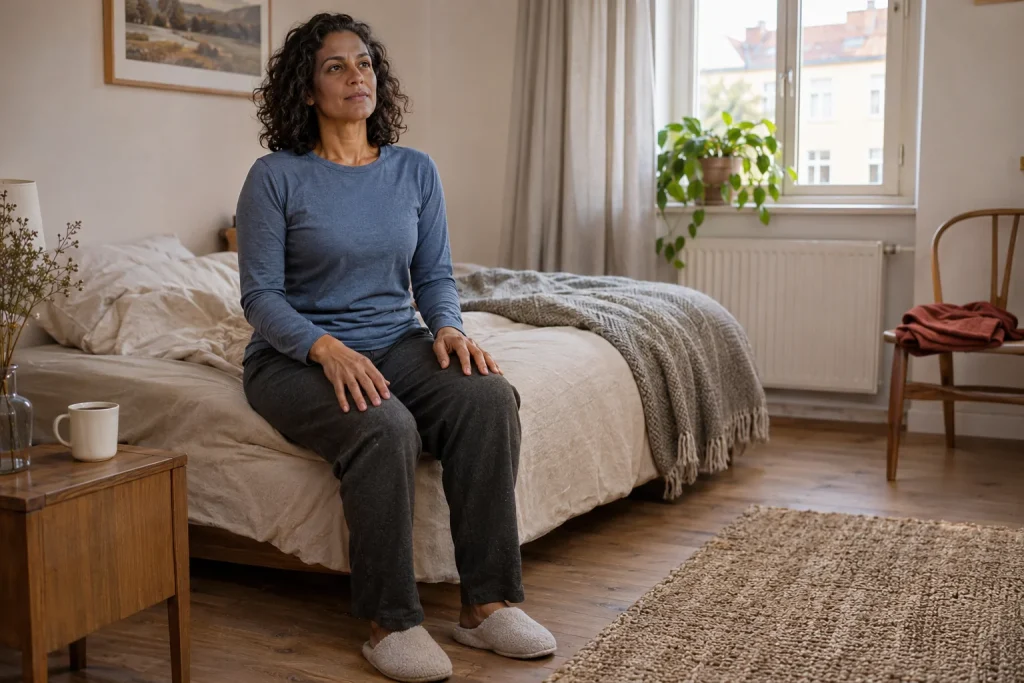
You feel awake, yet cannot move or speak. Sleep paralysis occurs when falling asleep or around waking. The NHS says sleep paralysis itself can be harmless although it feels very frightening; recurring events that burden sleep or emotional wellbeing warrant talking to a doctor. NHS: sleep paralysis.
This explanation does not apply to every inability to move or speech problem. Sudden one-sided weakness, facial asymmetry, speech or vision problems, new loss of balance or an unusually severe headache may indicate stroke: call 112 immediately. Do not wait to see if it passes or test it with a morning run. Even short-lived neurological symptoms may require urgent assessment. CDC: stroke warning signs.
Why does occurrence at the boundary of sleep matter?
Sleep is not one uniform state. NHLBI describes alternating REM and non-REM stages; REM features characteristic brain activity and rapid eye movements, with skeletal muscles generally relaxed in a state inhibiting movement. Different parts of the transition into wakefulness do not always resume usual waking operation simultaneously. Paralysis in this setting is not a diagnosis of a neurological injury arising during the day. NHLBI: REM and non-REM sleep.
The NHS explains sleep paralysis as temporarily being unable to move muscles while waking or falling asleep, although the brain is active. Timing is therefore essential: did it really happen around falling asleep or waking? The timing of sleep paralysis.
For a runner, the specific story might be experiencing it around a dawn alarm, rather than the distance planned that day. Sport may form the morning’s context but does not establish cause. When telling a doctor, retain the relationship to getting up, falling asleep and actual wakefulness.
Describe an intensely real experience without judgement
The NHS says a person may feel awake but unable to move or speak, or sense someone in the room or something pressing down. The phenomenon can last several minutes. There is no need for shame if fear remains after movement returns. Experienced intensity matters even when the explanation relates to sleep. NHS: experiences accompanying sleep paralysis.
In discussion, you need not choose a supernatural or single psychological explanation. Separately describe what you could and could not do, accompanying feelings and when usual function returned. The story may be personal; you need not present it in detail before a running group to obtain help.
Names for sleep-related experiences can easily become mixed. The NHS treats nightmares, night terrors and sleep paralysis as separate phenomena. With a nightmare, you may wake remembering the bad dream; sleep paralysis features temporarily obstructed movement or speech at the boundary of sleep. This distinction helps orientation rather than providing a certain home diagnostic test. NHS: distinctions between night-time phenomena.
 Enlarge image
What does recurring and distressing mean?
Episode count is not the only consideration. If fear makes you avoid falling asleep, shorten rest or struggle with constant next-day sleepiness, mention that separately. The NHS highlights considerable anxiety with recurring episodes and constant fatigue from insufficient sleep among reasons to seek medical help. NHS: when to seek help.
Our example: episodes are rare, but afterwards you postpone bedtime for days for fear of recurrence. In another situation, episodes happen more often with less fear, but you unintentionally fall asleep during the day. These histories can matter for different reasons. Frequency, distress and daytime consequences should not be squeezed into one score.
Mark uncertainty in short notes too. You do not need to know duration to the minute or decide with certainty whether you had fully woken. Label an estimate as an estimate. A professional’s clarifying questions can help interpret the experience; seeking help does not require a finished explanation.
Daytime falling asleep and muscle weakness are separate questions
Sleep paralysis alone does not mean narcolepsy. NHS information lists pronounced daytime sleepiness, unexpected sleep, concentration difficulties and, in some people, sudden emotion-related muscle weakness called cataplexy among possible narcolepsy symptoms. Sleep paralysis may occur within that broader history, but one sign cannot establish the whole condition. NHS: narcolepsy and symptoms.
Do not automatically rename unusual weakness during running or another awake activity sleep paralysis. Describe the situation, any fall or altered awareness and accompanying symptoms. New sudden neurological signs may require urgent care. An explanation of immobility around falling asleep does not exempt daytime events from assessment.
AASM’s professional narcolepsy information says assessment generally uses overnight polysomnography and a daytime multiple sleep latency test after detailed history and examination. These are targeted supervised investigations; a sports-watch estimate or personal home sleep-onset trial cannot replace them. Decide investigation needs from the whole difficulty, rather than applying the same process after every isolated frightening awakening. AASM: foundations of narcolepsy assessment.
An observation about sleeping position is not a personal guarantee
Cheyne’s original 2002 paper examined position and timing in two studies based on reports from 6,730 people in total, of whom 4,699 had experienced sleep paralysis. Lying on the back was reported more frequently during episodes. This is a self-reported association, rather than a randomised treatment trial, and does not prove a position change prevents sleep paralysis for everyone. Cheyne: position and circumstances of sleep paralysis.
Use such a finding as an observation question: do you remember the position, and is that known or assumed afterwards? Do not conduct a night-time provocation experiment to discover what happens for you. If another condition already has individual sleep or positioning guidance, do not rewrite it from a general association in an article.
The same applies to running time. Dawn training, travel or rotating shifts may appear in your history, but that does not mean exact exercise timing resolves the phenomenon. Observation is valuable as description. One episode or one quiet night cannot justify a certain prevention promise.
Bring three separate strands to the appointment
| Strand | A useful short account | Important distinction |
|---|---|---|
| The boundary of sleep | It occurred while falling asleep or waking; what could I perceive? | It differs from new weakness during an awake daytime activity. |
| The event’s experience | Movement, speech, accompanying sensations, recovery and uncertain estimates. | An intensely real feeling is not a standalone diagnosis. |
| The rest of the day | Sleepiness, unintentional sleep and fear of the next evening. | Daytime functioning is an assessment consideration of its own. |
NHLBI reviews sleep timing, awakenings, daytime consequences, health history and medicines when assessing sleep difficulties. Diaries or other investigations may supplement discussion as needed. The table is only an original discussion aid, not a clinical questionnaire or prerequisite for consulting a doctor. NHLBI: assessing the sleep history.
If a partner observed something, separately identify their account. Decide together about accompaniment, without sharing every personal detail with the running community. The healthcare conversation can include how frightened you were, rather than only duration. Describing fear does not weaken accuracy.
 Enlarge image
You need not prove the experience before the next running morning
Morning arrangements can be simple and flexible. After a distressing night, tell a friend you will decide about departure later or will not drive. This practical information may suffice for group planning. You need neither a successful run to prove you were unaffected nor interpret a missed run as evidence about personal strength.
If normal movement and speech have returned immediately afterwards but you remain unsure what happened, request individual advice. If new weakness, speech or vision changes persist, arise during the day or suggest stroke, follow the urgent route described earlier. Do not use sleep paralysis to justify waiting with a different symptom.
Do not drive when sleepy even if movement has fully returned. NHS daytime-safety advice concerns actual alertness rather than an app rating. Preserving rest and assessment opportunities matters more than an unbroken running streak. This is an organisational and safety decision, rather than home treatment. NHS: sleepiness and driving.
Understanding may reassure; persistent difficulties deserve care
Knowing sleep paralysis may name a previously incomprehensible frightening experience. That name helps only when circumstances and accompanying symptoms are clarified too. Individual questions may concern an isolated event, causes of daytime difficulty and whether further sleep-medicine assessment is needed.
A useful next step may be a short summary and appointment request rather than forced exercise or a personal medication trial. Individual movement and sleep advice should relate to your actual condition. Fear can then be taken seriously while preserving the distinction between a sleep-transition experience and urgent awake symptoms.
Sources
- NHS: sleep paralysis
- NHLBI: sleep stages
- NHS: narcolepsy
- AASM: professional narcolepsy information
- CDC: stroke signs
- Cheyne: position and timing in sleep-paralysis observations, 2002
- NHLBI: assessing sleep difficulties
- NHS: insomnia
- NHS: nightmares and night terrors
How Futószív articles are prepared: our editorial guidelines.