A small handheld device that makes breathing in harder and a calm breathing exercise may appear in the same list of “breathing improvement” recommendations. Yet they involve different tasks. One loads the muscles used for inhalation with a specified resistance; the other may target attention, rhythm or relaxation. Sharing a word does not make the methods or their evidence interchangeable.
As a runner, first ask what your goal would be: a change in a measured respiratory muscle variable, less discomfort during exercise, longer exercise tolerance in a laboratory or a better race time? These are separate outcomes. The overview below starts with original studies in runners and professional measurement guidance. It does not provide a ready-made load, repetition count or self-directed treatment programme.
Name the intervention according to the actual task
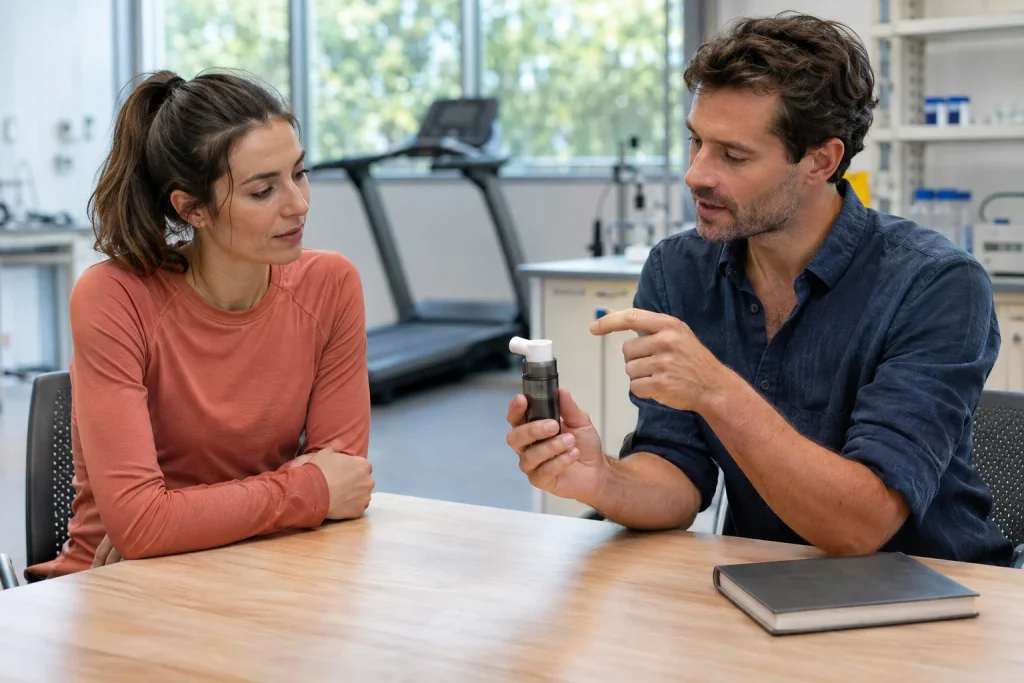
In inspiratory muscle training, or IMT, inhalation is loaded with some form of resistance. In research, its type and magnitude are specified, execution is checked and programme duration is documented. The appearance of a small plastic device does not describe that task by itself. Two similar-looking devices can provide different loading systems, while the way they are used can alter the task further.
A relaxation breathing exercise, in contrast, may aim to help someone settle or organise their attention. A rhythm linked to steps changes breathing timing. Exclusive nasal breathing restricts the airway used. These should not automatically be placed in the same intervention category as resistance-based muscle training. A scientific result must be linked to the particular task that was actually studied.
Consider an original everyday analogy: a weighted shoulder exercise, stretching and relaxation all involve the shoulder area, yet they are not the same programme. For the same reason, an IMT trial’s result cannot be attached to every breathing video. Naming a device or exercise is meaningful when the task and the change you intend to measure are also clear.
What did the newer study of thirty amateur male runners show?
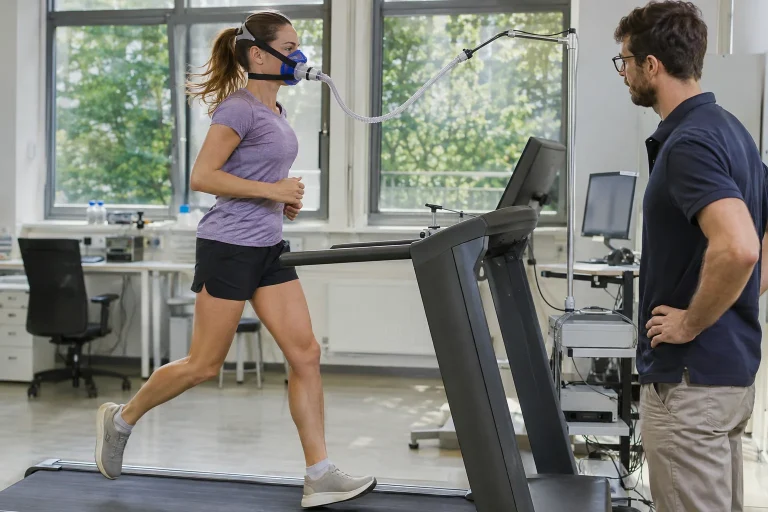
In Ren and colleagues’ 2025 randomised trial, thirty amateur male runners were allocated to two IMT groups with different loads and a control group. The eight-week supervised supplement took place alongside regular running training. The study analysed respiratory muscle pressure values, time to exhaustion, lactate and perceptual outcomes. Its sample and programme were specific, rather than a comparison covering every runner and device.
The authors reported improvements in several respiratory muscle pressure and exercise-tolerance measures in the trained groups, while finding no significant change in maximal oxygen uptake. This illustrates the distinction between endpoints: a positive result does not mean every physiological variable improves. The paper did not establish that any use of any commercial device produces a faster marathon for every runner.
The conclusion for you as a reader therefore has two parts. Under specified conditions, IMT can be a testable supplement that produces results. To assess transferability, however, you would need to know how closely the participants, programme and goal resemble your own situation. Alongside the research group’s name, read the participants’ characteristics and the endpoint actually reported.
The strengths and limits of the older controlled trial
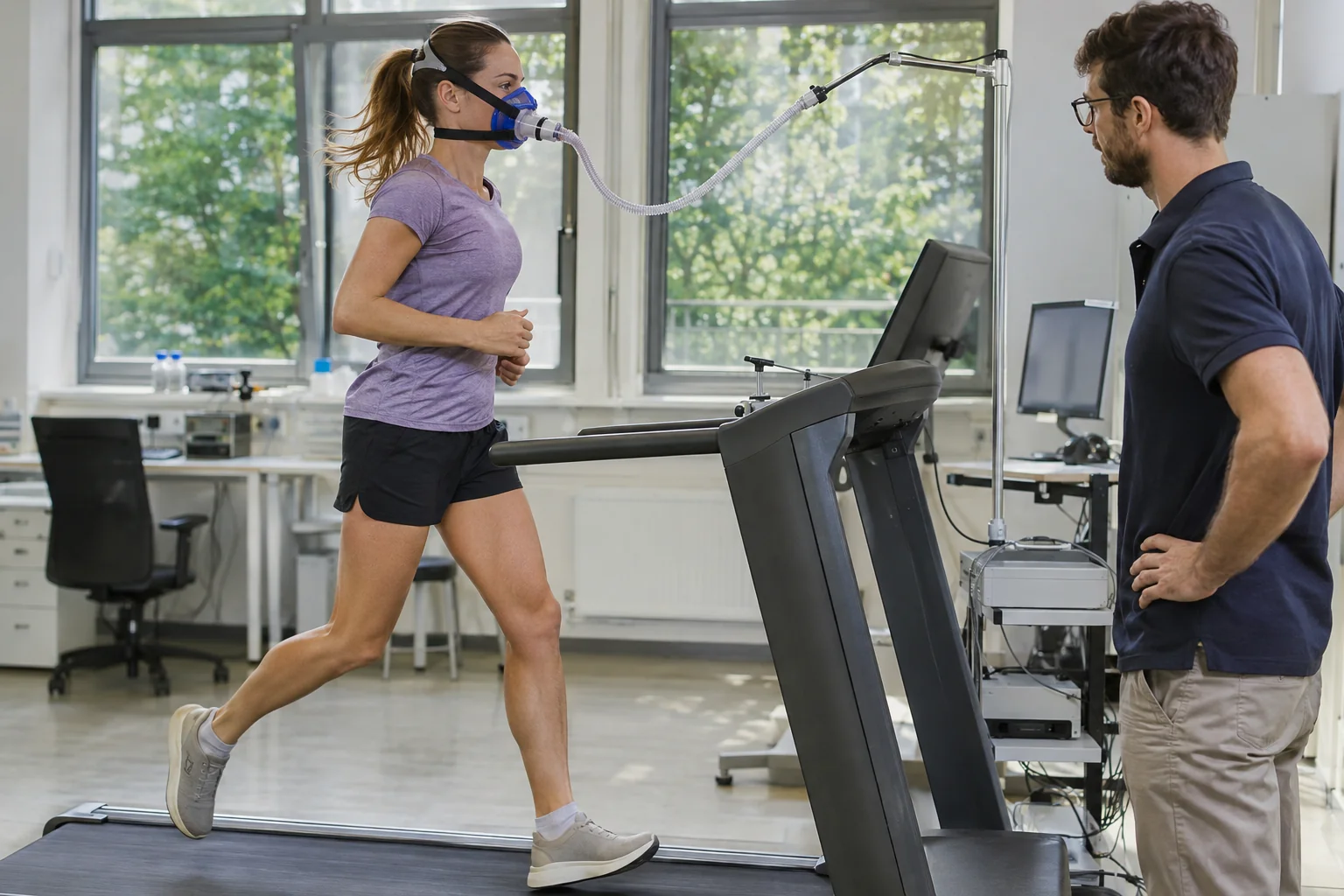
In Mickleborough and colleagues’ study published in 2010, twenty-four recreational road runners were assigned to inspiratory flow-resistive training, a sham intervention or a control group. The six-week comparison examined respiratory muscle function and exercise tolerance during constant-load treadmill running. The sham intervention is particularly important: it can help distinguish the targeted training effect from what using a device and participating may mean in themselves.
The reported outcomes included improved respiratory muscle function and longer performance of the particular constant-load treadmill task in the targeted group. That is not the same endpoint as running a specified distance in the shortest possible time. A percentage for exercise tolerance in the study therefore cannot be passed on unchanged as a percentage improvement in race time.
Naming the control and task precisely also helps with everyday product claims. If an advertisement says only that “performance improved”, ask which performance and compared with what. Inspiratory pressure, treadmill endurance time and race pace are three different outcomes. A good summary does not replace one with another that sounds more impressive.
 Enlarge image
Mouth pressure indicates respiratory muscle function, not an overall running score
The European Respiratory Society statement on respiratory muscle testing describes maximal inspiratory and expiratory mouth pressure as one way of assessing global respiratory muscle strength. This kind of voluntary test requires cooperation and appropriate execution; starting lung volume and the measurement procedure matter too. The value therefore needs to be interpreted under standardised conditions and in the appropriate context.
MIP refers to maximal inspiratory pressure. It is not the amount of oxygen taken up while running, the force used to run against the air or directly a kilometre pace. A change in this value first needs interpreting within the same measurement task. Training or clinical conclusions derived from it are a further step requiring knowledge of the full situation.
In an original imaginary dataset, one measured variable improves by twenty per cent while the result of the particular running test stays unchanged. There is no logical contradiction: two different properties were measured. An imagined analysis could also show the reverse, with an improved running test but no change in the chosen muscle variable. The relationship between measures must be established, not assumed merely because both share the word “performance”.
A longer time to exhaustion is not an equal reduction in race time
In a constant-load test continued to exhaustion, the question is how long a predefined task can be maintained. In a time trial, it is how long a fixed distance takes. The fixed and variable elements differ between the two tests. The same percentage therefore refers to completely different quantities. “Twenty per cent better” is meaningful only when the task is defined alongside it.
In an original teaching example, a runner completes an imaginary fixed-speed test for twenty-four minutes instead of twenty. Endurance time has increased by twenty per cent. That does not mean their previous fifty-minute 10K becomes forty minutes. The test measured sustainability at the same load; interpreting race time would require a different relationship between speed and duration.
If the imaginary test speed is twelve kilometres per hour, twenty minutes covers four kilometres and twenty-four minutes covers 4.8 kilometres. The extra 0.8 kilometres results from the longer time at the same speed. It does not tell us which speed could be maintained over five or ten kilometres. Doing the calculation yourself is useful because the data can easily sound like a racing advantage while describing a different task.
Why is a combined breathing programme’s result different?
In Wolff and colleagues’ 2025 experiment, a four-week breathing programme with several components supplemented endurance training in sixteen recreational runners. The programme included exercises at rest and nasal breathing during low-intensity running. It did not test the same targeted resistance-device task as the earlier IMT studies.
The supplemented group improved its breath-hold time at rest, but the reported maximal oxygen uptake and nasal-breathing performance endpoints did not show an additional group advantage. This proves neither that every breathing exercise is worthless nor that the IMT results are refuted. A different intervention and question were studied. Moreover, the programme’s components were used together, so the individual effects of each cannot simply be read from the results.
In an original experimental-design example, group A runs and trains with a device, group B runs and performs an attention exercise, and group C only runs. If there is no difference between A and B, we have answered a different question from one comparing A only with C. The choice of control shapes the conclusion. The label “breathing programme” does not tell us this, so look for the actual comparison.
Five specific questions about a device’s promise
First: which exact device and resistance method were studied? Second: who participated, and how similar was their fitness to that of the intended users? Third: was there a comparable control or sham intervention? Fourth: what was measured directly? Fifth: is the final promise in the advertisement the same as the study’s actual result? Following this sequence often makes an overly broad conclusion visible.
The manufacturer’s stated adjustability and proven effect are separate pieces of information. A wide loading range may tell you what task the device can create. It does not, on its own, tell you which setting suits you or whether it will improve your race. Copying a study’s dosage without personal history and appropriate measurement does not automatically make a programme individualised.
Hygiene, cleaning and replacement of components belong to the specific instructions for use. They cannot be borrowed from another model or a study’s general description. In a group, a device with a mouth-contact component is not simply a demonstration object. Documented usability is part of evaluating a product too, alongside the promised physiological percentage.
 Enlarge image
Give the supplement a distinct goal alongside running training
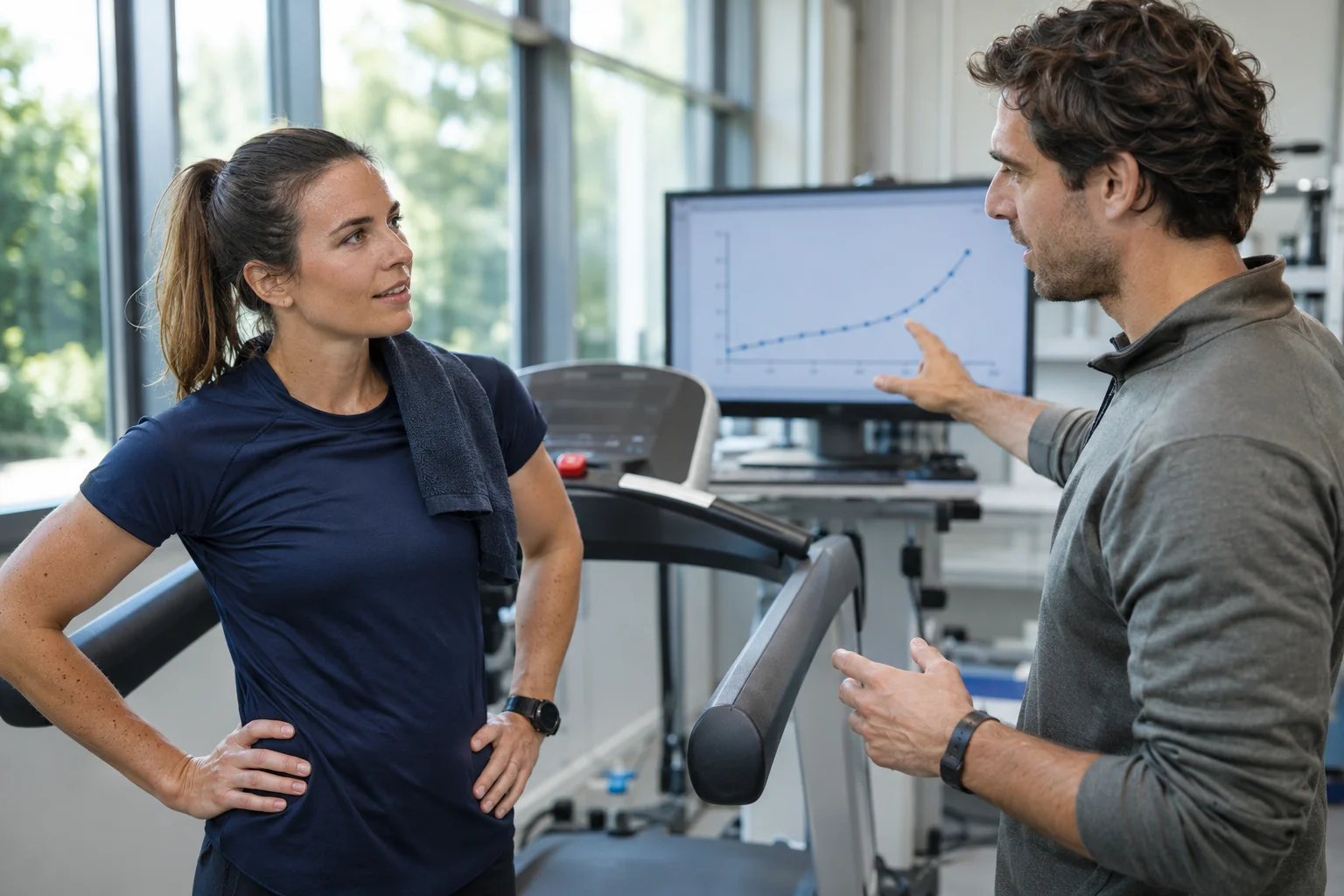
A useful discussion does not start from the assumption that every runner needs a new device. It starts with the task you want to address and how you would recognise a useful change. If the goal is a particular respiratory muscle variable, it needs appropriate measurement. If the goal is running performance, consider a suitable test and the entire training environment too.
In an original decision-making example, a runner wants only general relaxation at rest at the end of the day. It would not automatically be justified to use an IMT trial about treadmill exercise tolerance as evidence for that goal. Another runner is considering a targeted performance assessment agreed with a professional; resistance and outcome measurement are central questions there. The difference in goals determines which information is needed.
Keep other training changes in your log as well. If a new running programme, a different weekly load and more rest are introduced at the same time, improvement cannot be attributed to a single supplement. That does not make the experience worthless. It helps you state precisely what you noticed during a complex period and what did not yet allow a definite cause to be identified.
Respiratory symptoms are a separate task, not a device-selection question
Recurrent breathlessness while running or a new, unusual symptom cannot be attributed to weak inspiratory muscles without appropriate assessment. A commercial device and a self-measured score are not a diagnosis. If you are seeking a solution because of symptoms, clarifying them comes before experimenting with loads independently. A targeted training supplement and identifying a condition are different tasks.
Severe difficulty breathing or chest tightness requires stopping the run and seeking appropriate urgent help; the NHS official symptom guidance also makes this distinction. Feeling unwell while using the device must not be interpreted as proof of training effectiveness either. A description of a research method does not authorise working through symptoms.
In the world of respiratory muscle training and breathing exercises, precise tasks and endpoints therefore provide useful orientation. Some defined IMT programmes have produced favourable running-related data, but these are not guarantees covering every device, person and race. Keeping the goal, method, control and measured outcome together lets you proceed from real information rather than a breathing promise that merges everything together.
Sources
- Ren and colleagues, 2025: supervised IMT in thirty amateur male runners.
- Mickleborough and colleagues, 2010: a running study with resistance, sham and control groups.
- Wolff and colleagues, 2025: a multicomponent supplementary breathing programme.
- ERS, 2019: a professional statement on respiratory muscle testing.
- NHS: shortness of breath and urgent symptoms.
How Futószív articles are prepared: our editorial guidelines.