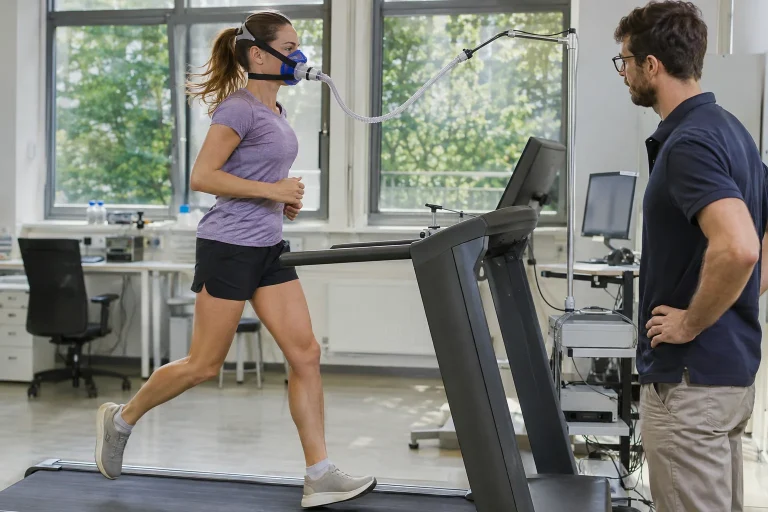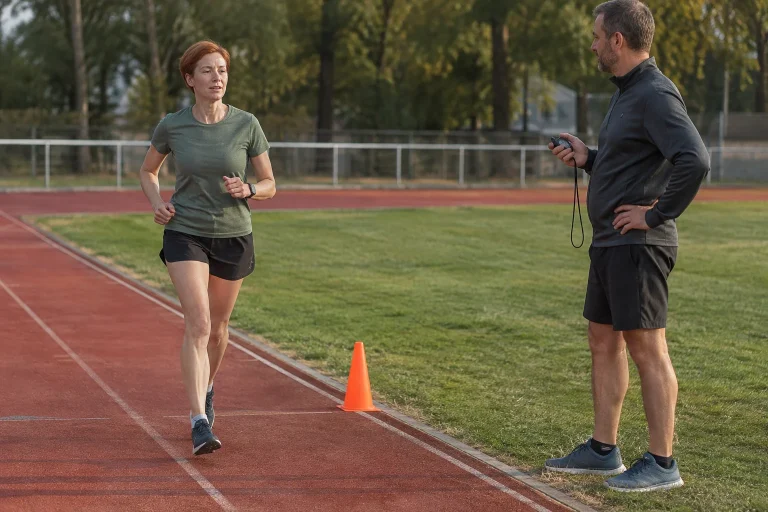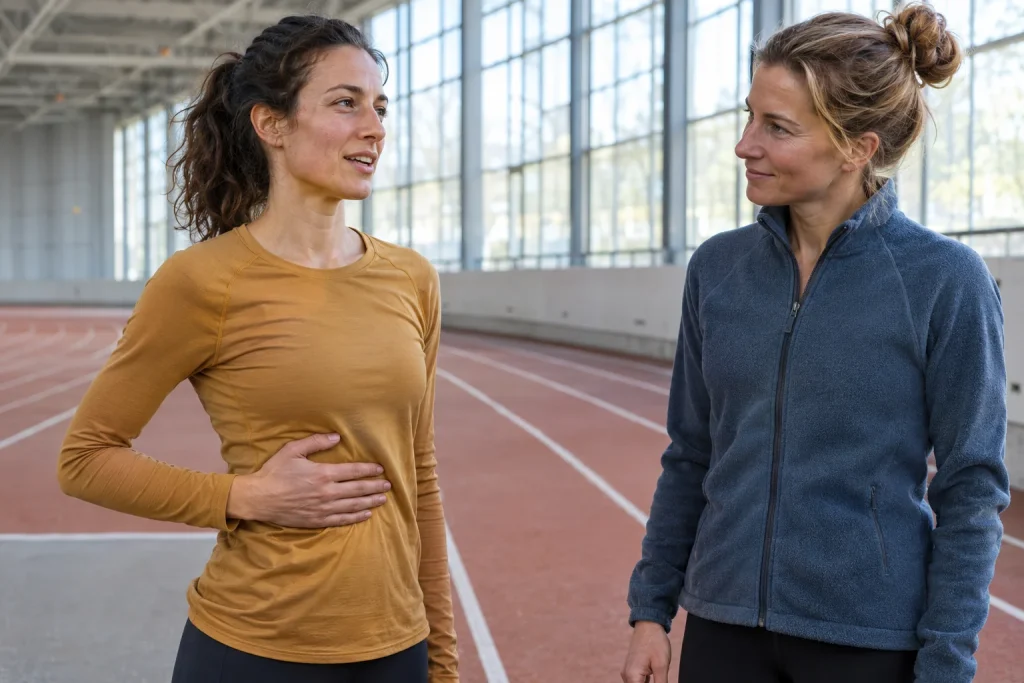
Inhale for two steps, exhale for two: the 2:2 rhythm is memorable, so it often appears as a ready-made running technique. The pair of numbers can indeed describe a useful pattern. But easy counting does not mean every runner at every pace must shape breathing around it.
Running and breathing are rhythmic activities that can become coordinated. The ratio, timing and persistence of that coordination are separate observations. We explore them through original step examples and human research. The aim is understanding your movement rather than complying with another compulsory pair of numbers while running.
First clarify the counting unit behind 2:2
In this article, everyday 2:2 means inhalation lasts for two consecutive foot contacts and exhalation for the next two. One complete breath therefore spans four steps. A step relates to the next contact of either foot; a complete stride cycle runs between successive contacts of the same foot and usually contains two steps.
Research ratios may instead express strides per complete breath or steps per respiratory cycle. Our 2:2 therefore means four steps, or two complete strides, per breath. A study’s 2:1 notation may sometimes describe that broader ratio, while everyday 2:1 would mean two steps inhaling and one exhaling. Notation alone can mislead.
When speaking with a coach, say the complete sentence: ‘inhale across two foot contacts, exhale across two’. In scientific writing, find definitions of stride, step and breath. Checking definitions is not a linguistic detail. Without it, the same numbers may be assigned double the frequency or an entirely different inhalation-to-exhalation ratio.
The same ratio at a different cadence means a different breathing rate
In our example, a runner takes 170 steps per minute. Our definition of 2:2 gives one complete breath per four steps, theoretically 42.5 breaths per minute. At 150 steps per minute, the same pattern gives 37.5. The name is identical, but breathing frequency differs. Neither value is a personal target zone or recommended rate.
At the same imaginary 170 steps, 3:3 covers six steps and would give approximately 28.3 breaths per minute. The three-step cycle of 2:1 would give approximately 56.7. This assumes steps and breaths follow the selected ratio exactly throughout. Real running includes transitions, speech, sighs and natural changes.
The arithmetic shows that ‘keep the same pattern’ depends on both leg rhythm and breathing rate. If cadence changes, the instruction would change breathing rate even if another rhythm felt more comfortable. Coordination cannot be understood from one ratio’s supposed merits alone. The actual task and individual response matter too.
 Enlarge image
Natural coupling is not one compulsory pattern
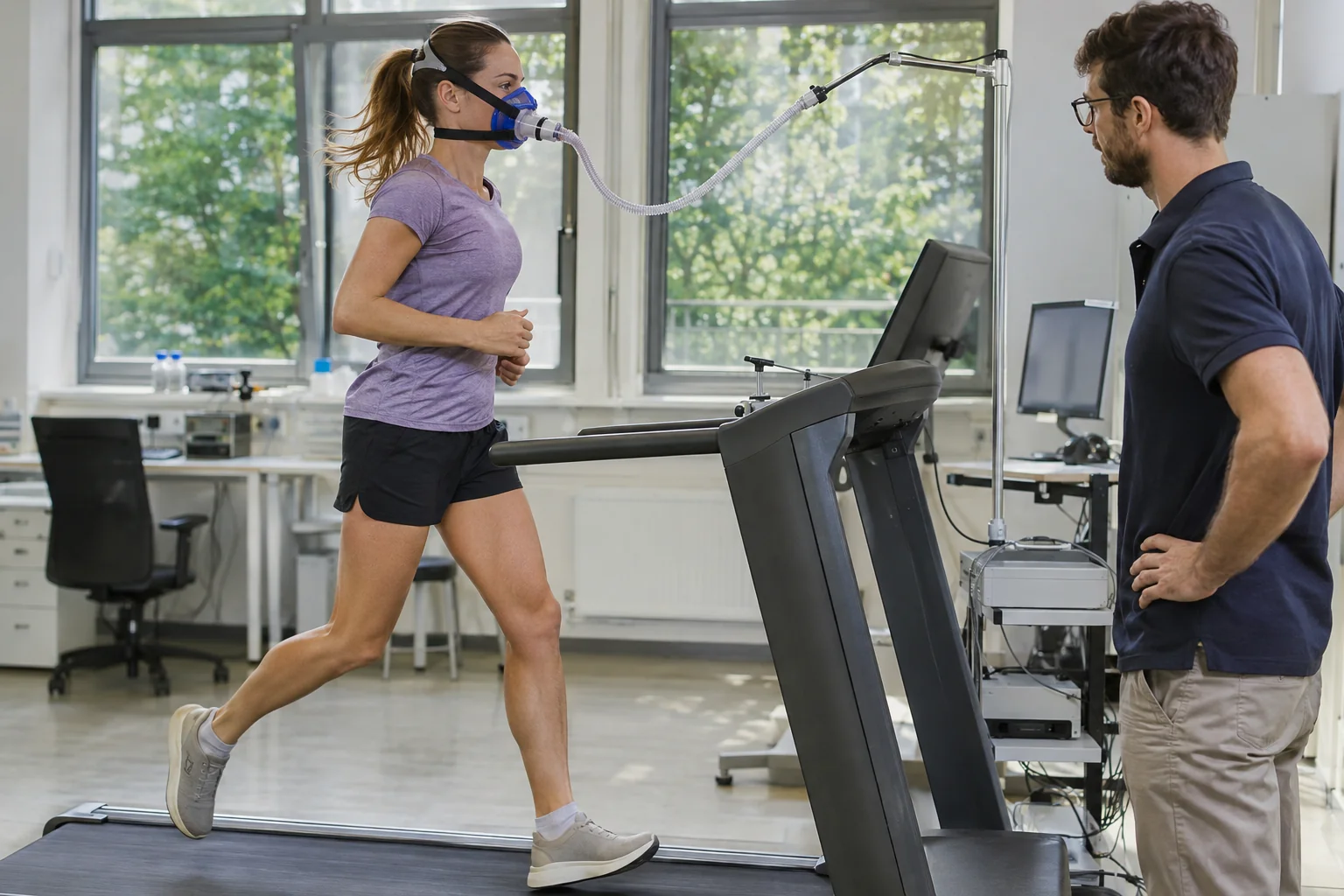
Daley, Bramble and Carrier’s original 2013 study followed fourteen people running at self-selected speeds. Airflow and step timing were analysed together, with differences in respiratory transitions between naturally preferred and less-frequently selected timings. The work supports a mechanical relationship between movement and breathing; it did not test a 2:2 prescription for every runner.
The study discusses multiple coupling ratios and an absence of coupling during human running. Brief movement-induced airflow effects also depended on the respiratory state in which they occurred. The authors proposed a possible mechanism concerning breathing-muscle work and fatigue for further study. Observing more favourable timing is not direct evidence of lower total running energy or improved race times for everyone.
The reader’s lesson is that rhythm can arise spontaneously rather than solely through conscious counting. Not visibly maintaining one ratio does not itself mean someone runs badly. A pattern is a describable feature, not a grade. Breathing observation remains useful when it does not become an examination to pass.
Ratio and phase are different questions
Ratio describes how many movement cycles correspond to one breath. Phase describes the movement point at which inhalation begins, for example. In our example, two people each breathe every four steps. One begins inhaling immediately after a left contact, the other later around the next contact. Total step counts may match, but timing differs.
Within an imagined one-second complete stride, an inhalation starting 0.10 seconds after contact begins at ten per cent of the cycle. Starting at 0.40 seconds places it at forty per cent. These are original illustrative time points, not preferred breathing positions. Percentage notation separates timing from simply counting cycles.
Takano’s 1995 research in nine experienced runners examined this phase relationship on uphill and downhill gradients. The position of inhalation onset relative to the stride differed between conditions. This shows why ratio alone is insufficient; the small study does not prescribe one inhalation foot for every hill.
A long average cannot reveal whether rhythms stayed coupled
Imagine our own ten-minute data series. During the first half, a runner consistently breathes every four steps; during the second, the relationship continually drifts. Average step and breathing counts across the whole period may still give a ratio near four. This does not prove stable coupling throughout. Average ratio and temporal locking are different properties.
McDermott, Van Emmerik and Hamill’s 2003 study analysed several treadmill speeds in five male runners and five male non-runners. Group averages did not show a simple difference in coupling strength, while individual adaptation patterns differed. This small cross-sectional comparison shows how group averages may hide individual timing strategies; it was not a long-term breathing-training experiment.
You therefore need not describe an entire workout with one ratio. ‘On the flat, calm section I briefly noticed a four-step cycle, which broke up while talking’ may be more precise. Such observations preserve setting and transition without claiming what averages cannot establish.
Breathing rate alone does not determine total air volume
The volume moved in a minute depends on breath count and volume per breath. In our arithmetic example, forty breaths of one and a half litres total sixty litres per minute. The same count at one litre gives forty litres. These are not running prescriptions or a complete description of effective gas exchange; they illustrate two data points’ roles.
Slowing or regularising rhythm therefore does not automatically improve oxygen supply. A visible or countable pattern omits volume, actual gas exchange and the whole task. A calm-looking face likewise does not replace measuring bodily response. Keep technical observation alongside perceived effort and running conditions.
In Rappelt and colleagues’ 2023 experiment on exclusively nasal breathing, changes in respiratory measures did not clearly change intensity distribution. This was cycling in nineteen participants, not a step-rhythm running programme. It illustrates that changing one breathing feature does not automatically establish every other physiological or training outcome.
 Enlarge image
How can you observe without controlling through force?
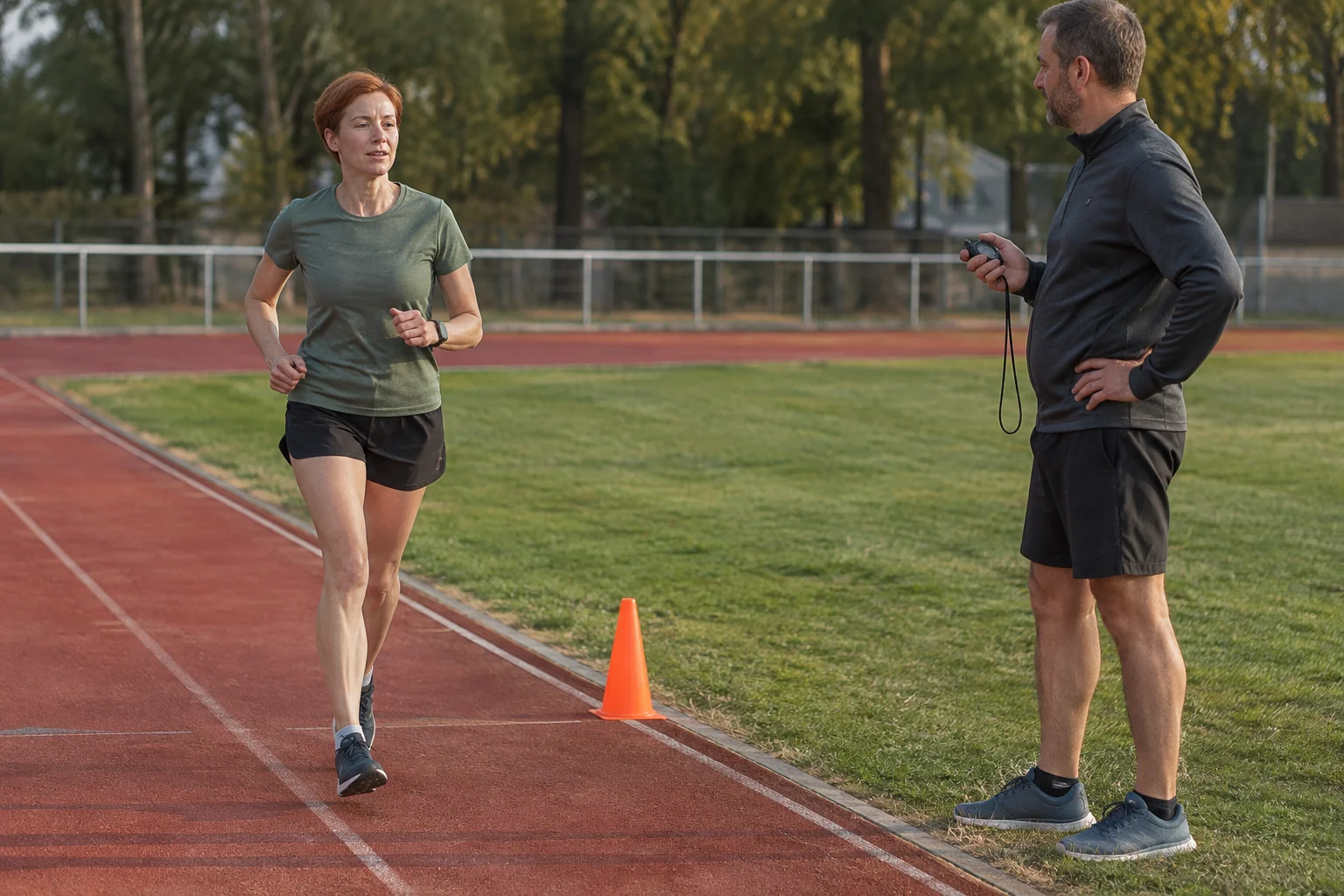
Notice rhythm in a familiar, calm running situation where counting does not distract from ground and traffic. Do not simultaneously change pace, cadence and breathing. Simply observe whether several consecutive complete breaths involve a similar step count. If observation itself is distracting, let it go. This is self-observation, not a compulsory drill or exercise test.
Discuss three things separately with a coach: the ratio noticed, its stability and how running felt. ‘I counted four’ differs from ‘it felt easier’, and both differ from laboratory-measured energy expenditure. Personal experience need not be dismissed, but do not call an unmeasured mechanism or performance advantage certain.
When comparing days, note terrain, pace, conversation and whether the pattern was spontaneous or deliberately counted. A run with hills and stops is not a clean breathing-rhythm trial. A few precise circumstances can help more than elaborate numbers. The aim is not to monitor every breath.
When does rhythm counting lose its purpose?
If maintaining the pattern requires breath-holding, forced restriction of airflow or uncomfortable movement changes, continuing merely to retain the ratio is unjustified. This article does not recommend mouth taping, breath-hold running or testing until dizzy. Observing naturally occurring coordination differs from suppressing air needs for a prescribed rhythm.
New or unusual breathlessness must not simply be classified as a rhythm error. The NHS symptom information distinguishes severe difficulty breathing and chest-tightness-associated symptoms, which may need urgent help. Stop running and seek appropriate care; recurrent symptoms also cannot be investigated by replacing one counting pattern with another. UK service telephone numbers are not transferred into the Hungarian setting.
2:2 can therefore be an understandable description and a natural pattern in some situations, but is not compulsory technique for everyone. Separately observing units, frequency, phase and persistence says more about real coordination. If breathing comfortably adapts to the task, you need not rewrite it for a number pair. Rhythm remains a useful question, not a universal answer.
Sources
- Daley and colleagues: coupling steps and airflow, 2013.
- Takano: breathing phase uphill and downhill, 1995.
- McDermott and colleagues: individual coordination patterns at several speeds, 2003.
- Rappelt and colleagues: breathing restriction and cycling intensity distribution, 2023.
- NHS: breathlessness and urgent symptoms.
How Futószív articles are prepared: our editorial guidelines.