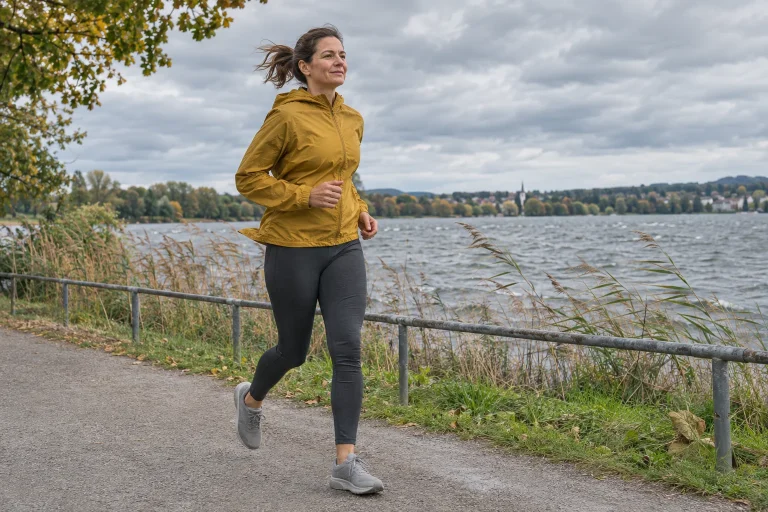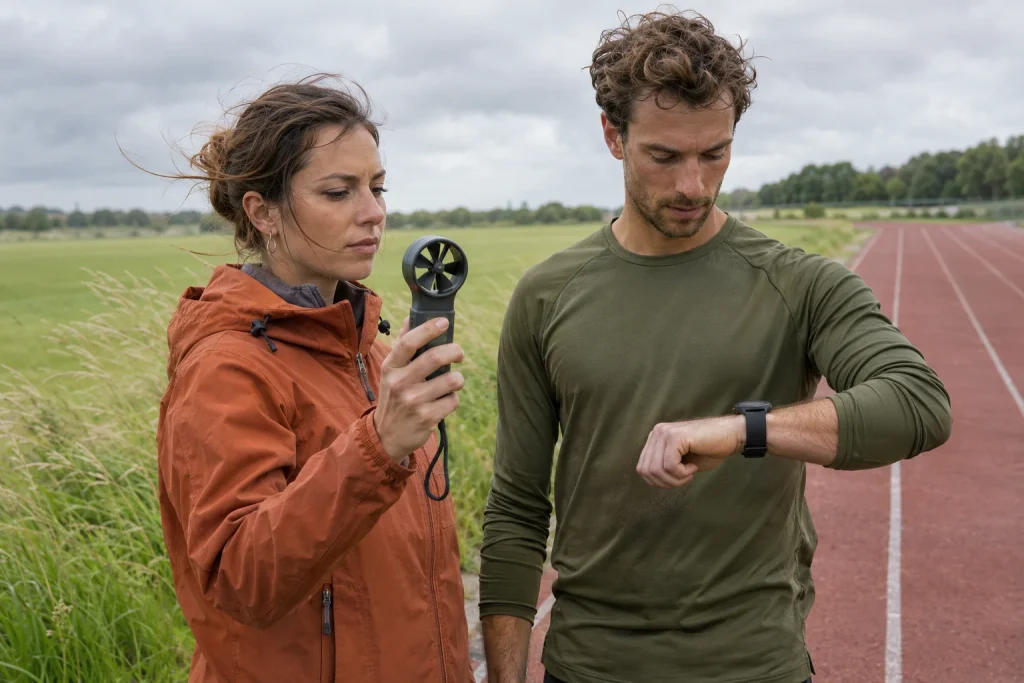
At the same pace, your watch shows more watts on the headwind lap and fewer on the return. It is tempting to calculate your own drag from the difference or decide how much better a second top was. But the display shows a complex, often modelled quantity. Of the experiment’s several unknowns, the watch does not necessarily measure everything directly.
The central question is identifiability: can several causes produce the same observed result? If so, displayed numbers alone cannot reliably isolate drag. Original simple calculations show where gradient, acceleration, wind and algorithms can enter. We also distinguish what a consistently used running watch can still help with.
Watch watts are not automatically direct drag measurements
The watt is a power unit, not a measurement method. A system may derive its display from directly measured force and speed, or from several sensor inputs and assumed relationships. In running, wrist or accessory movement, body mass and environmental data may all enter the calculation. Numerical detail does not reveal each component’s origin.
The official Garmin fēnix 8 description describes running power as an estimate calculated using running-dynamics information, user mass, environment and other sensor data. This is specific manufacturer documentation, not a universal definition for all running devices. It shows why the method description belongs beside the watts.
Aggregated data do not automatically allocate cost to one cause. In our fictional example, two models both produce 210 watts: one assigns 190 to other tasks and twenty to air, the other 180 and thirty. The total cannot tell us which split is correct. Identifying a component requires further independent information or a reference.
Where wind data comes from matters as much as its magnitude
According to the fēnix 8 running-dynamics settings description, accounting for wind combines watch speed, heading and barometer data with wind data available from the phone. That is not the wrist independently measuring the local flow field around the whole body at every instant. Setting and source are therefore part of the investigation.
Weather observation has its own standard. According to the Met Office explanation, wind is measured with appropriately placed instruments, typically ten metres high, and direction names where it comes from. A runner on a bridge, beside a wall or in a line of trees may experience different local conditions. Nearby weather data are not necessarily instantaneous airspeed in front of the T-shirt.
A handheld wind meter does not solve everything either. It informs local flow where and when it is held, according to its measurement method. It does not automatically describe the whole body’s front and rear pressure distribution or airflow around moving legs. It can be useful additional data without becoming a whole-body drag instrument.
 Enlarge image
A small airspeed error can suggest a large area difference
In the drag equation, force depends on relative airspeed squared when other factors are fixed. In our sensitivity example, suppose an independent reference measured exactly four newtons and air density is 1.2 kilograms per cubic metre. This is deliberately favourable: direct force is precisely what a wristwatch commonly lacks.
If relative airspeed is taken as four metres per second, the equation gives area multiplied by drag coefficient of approximately 0.417 square metres. Interpreting the same force at five metres per second gives approximately 0.267. The difference is about thirty-six per cent relative to the first estimate. The body has not changed; only assumed airspeed has.
This is not a numerical error test of a particular watch, but sensitivity of the relationship. Even with known force, accurate airspeed would be needed to calculate a personal aerodynamic factor. If force also comes from a model, two uncertain stages connect. Rounding the result to more decimal places does not make it an independent measurement.
Hills and acceleration can enter the same observation
In our approximate mechanical example, a seventy-kilogram runner moves at four metres per second up a one per cent gradient. For a small slope, vertical speed is approximately 0.04 metres per second. Multiplying mass, gravitational acceleration and vertical speed gives about 27.5 watts associated with potential energy. This is the specified mechanical component, not the full metabolic addition.
In another instantaneous example, the same mass moving at four metres per second accelerates by 0.1 metres per second each second. Mass × speed × acceleration gives twenty-eight watts of kinetic-energy change. Two full laps can have similar average speed while one contains more accelerations and decelerations. Lap distance and average pace therefore do not fix the complete mechanical history.
Jenny and Jenny’s analytical model of level running connects several movement parameters with required mechanical power. Cadence, contact time and body movement remind us that air is not the only variable. A repetition on another surface with different accelerations cannot simply reveal a garment’s drag difference.
A separate wind sensor can also combine measurement and modelling
The official Stryd metric description describes an Air Power component on wind-sensing versions, incorporating the estimated cost of moving against air into the total. The manufacturer lists several environmental and bodily factors. Documented local sensing may therefore provide a different source from remote weather, but the displayed component remains an interpreted, calculated quantity.
This does not mean every foot-mounted sensor senses wind or every identically named metric uses the same algorithm. Generation, features and settings matter. Our question is narrower than a whole-product assessment: does the system independently demonstrate a change in personal drag? That requires checking the specific method against an appropriate reference, not merely adding a data field.
Separate useful feedback from a measurement claim. A metric can consistently help document training without identifying a laboratory-accurate aerodynamic factor. Knowing consistent-use conditions helps interpret your own time series. Do not overestimate capabilities or reject an entire product because it cannot perform one narrow task.
Why do many repetitions not remove a wrong assumption?
Repetition may reduce random fluctuations when conditions and data collection allow it. Systematic differences are different. In our example, a scale always reads half a kilogram high: twenty measurements’ average is still offset by that amount. Precisely repeatable data are not necessarily a correct reference. The same can apply to a constant but wrong running-model assumption.
In another example, the true difference between two tops is zero, but the first is always tried in calmer weather and the second in stronger wind. More laps can reproduce the confounding ever more consistently. More data do not then separate garment and weather effects. Order, comparisons close in time and independent environmental measurements matter more than count alone.
Two fields on your own watch are not necessarily independent evidence either. If the power calculation uses the same pace and wind estimate later used to check it, the reasoning becomes circular. Agreement is partly a consequence of shared inputs. A strong check supplies information that does not merely repeat the same algorithm under another name.
 Enlarge image
What reference could strengthen the claim?
A suitable reference fits the question. Controlled wind-tunnel force measurement may suit drag on a fixed body or mannequin. Recording body movement and flow around a moving person can resolve further questions. Shared conditions remain essential: another posture and wind direction are not a clean clothing swap.
The 2026 field study of running aerodynamics, for example, tracked time-varying flow around six athletes using specialised particle tracking. Appropriate physical procedures can infer drag from such data. It collected substantially more information than a wristwatch’s ordinary time series; even there, a derived drafting estimate remained a separate step.
Reference uncertainty matters too. If the expected difference is smaller than the change the entire procedure can reliably distinguish, one favourable figure is insufficient. Scientific value includes methods, raw comparisons and error sources. An instrument’s professional appearance does not establish the accuracy of the whole procedure.
What should you record if you do a comparative run?
Record route, travel direction, lap times, stops and the device providing power. Note whether wind accounting was enabled and whether the paired sensor changed. Keep local wind observations separate: open riverbank, trees, bridge or buildings. This helps identify afterwards which data should not be interpreted simply as a clothing effect.
Keep conclusions appropriate to your trial. You can say, ‘On this lap, the watch showed higher estimated power at a similar average pace.’ That is more precise than ‘I measured the T-shirt’s drag’. The former states data and circumstances; the latter is a physical claim requiring independent knowledge of more variables. A diary’s usefulness does not depend on calling it a laboratory.
Personal drag therefore cannot be reliably read from one difference in watch watts. Local flow, other movement tasks and algorithm assumptions connect. The watch can remain a valuable recorder if you know its data’s origin and use it consistently. Call an aerodynamic claim strong when an appropriate independent reference supports the full estimation chain.
Sources
- Jenny and Jenny: multivariable mechanical running model.
- D’Angelo and colleagues: field airflow measurements around moving runners.
- Garmin fēnix 8: calculated estimate of running power.
- Garmin fēnix 8: wind-data sources and settings.
- Stryd: calculated metrics and Air Power.
- Met Office: meteorological wind measurement.
- NASA: the drag relationship.
How Futószív articles are prepared: our editorial guidelines.