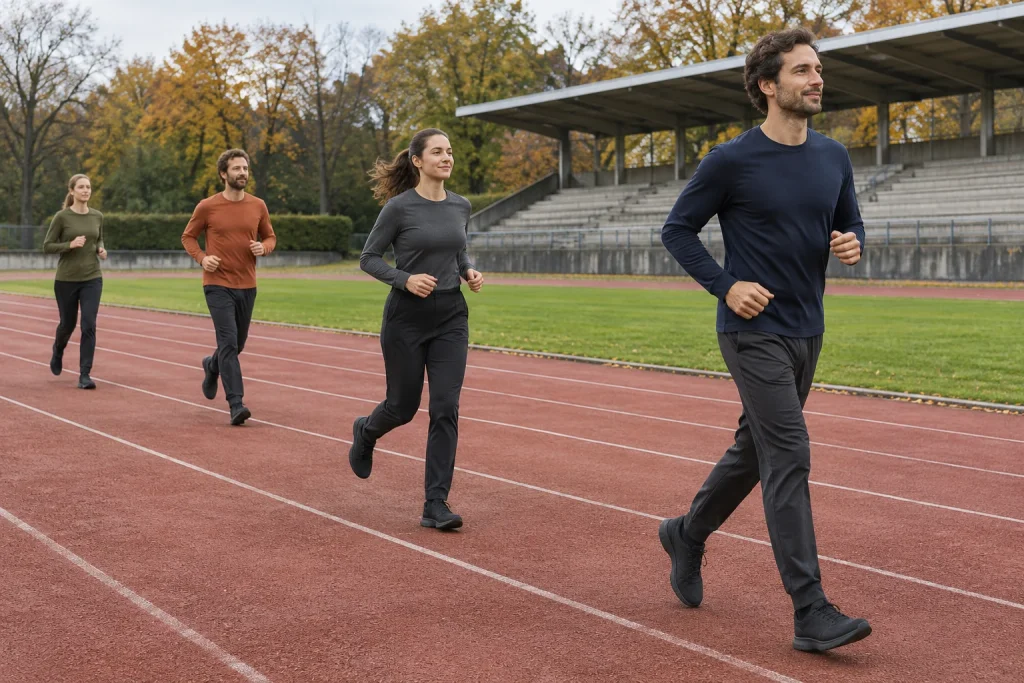
Drafting diagrams often show precise distances. A runner’s question is understandable: how close do you need to be for it to help in practice? But the scientific result first establishes the geometry used to calculate or measure airflow. It does not automatically establish a following distance recommended for everyone in a moving field.
Distance is not a single self-evident measurement either. Separation between body centres, the gap between torsos and clearance for a swinging shoe are different concepts. We start with these distinctions, then separate calculated drag savings, measurements behind a moving runner and the usable space of real group running. The aim is to turn a seemingly centimetre-precise research diagram into a precise question, rather than a risky instruction.
What does the diagram call distance?
In a model seen from above, each person’s position may be marked with a reference point. If the distance between points is given, body dimensions still need to be accounted for before discussing the actual clear gap. Another study may report the smallest gap between bodies. Those figures can differ even if the drawing initially appears to show the same single-file running.
In an original, purely geometric example, the centres of two imaginary rigid rectangles, each thirty centimetres long, are 1.2 metres apart along the direction of travel. The gap is 0.9 metres, because we subtract the two half-lengths. These are not fixed human body dimensions or recommended running distances; they simply illustrate the difference between a reference point and an actual gap. A number’s meaning on a diagram matters at least as much as its size.
A runner’s body is not a rigid rectangle. A leg can swing backwards, arms move and the follower’s shoe may enter the space at another phase. Empty space between torsos is therefore not the same as free movement space for every body part. A static model may show a selected pose whose closest points differ on the next stride. You cannot simply copy a laboratory diagram’s distance between runners’ chests.
Drafting is not a corridor of constant benefit
The flow behind a body contains regions with different speeds, pressures and vortices. What a follower experiences also depends on the size and shape of the body entering that space. The second person is not a passive measurement point: their presence modifies surrounding flow. Lower airspeed measured at one point is therefore not the same as total drag integrated across the whole follower.
The 2026 field research by D’Angelo and colleagues mapped airflow behind moving athletes. Six participants ran at approximately eight metres per second, and pressure and velocity fields were analysed to estimate distance-dependent drafting benefits. The near wake differed more strongly from undisturbed flow, with a smaller effect farther away. The follower’s benefit was not measured by recording a second runner’s complete oxygen requirement at every distance.
This is an important step towards understanding airflow during real movement. It also reveals the evidence pathway: first measure a flow field, then interpret aerodynamic potential from it; the follower’s complete energetic response would be a further step. Differences between near and far do not mean that all benefit suddenly disappears at one boundary. The space is generally not a simple on-off switch.
 Enlarge image
What do formation calculations tell us about position?
The single-file model by Beaumont and colleagues examined how a runner’s calculated drag changed at different positions in a line. It used specified body geometry and arrangements, then further relationships to estimate metabolic and time benefits from force. The favourable position is a result of that particular model. It is not a universal safe place for all running groups or a following distance to adopt automatically.
The research by Schickhofer and Hanson analysing several formations likewise found different forces for different geometries. ‘One behind another’ is therefore not enough detail to transfer the figures. Distance, lateral offset, body size, pose and airflow direction together describe the conditions. Changing any of them can make the magnitude of benefit and most favourable position a new question.
Models are powerful because many arrangements can be compared under controlled conditions. Their limitation is that chosen simplifications come with them. A calculation using static bodies must not be read as though it examined the full arm and leg cycle, every crosswind and every unexpected movement in a race field. Without a precise model description, a figure such as ‘sixty per cent savings’ is particularly easy to misunderstand.
Lower aerodynamic drag is not the same percentage saving in total energy
Drafting research can contain several kinds of percentage. One is a reduction in aerodynamic force on the whole body, another an estimated or measured change in total metabolic cost, and a third a hypothetical race-time benefit. They have different denominators. Many other tasks of running remain even with a large percentage reduction in drag, so total oxygen demand cannot simply be reduced by the same figure.
In an original conceptual example, an imaginary total cost is one hundred units, of which a chosen model assigns five to aerodynamic drag. Halving the latter makes the new total 97.5, not fifty. These numbers are not real physiological proportions or a fixed breakdown of running cost. They show that a component’s percentage and the percentage of the total are different quantities. A large relative change in a smaller component may produce a smaller change in the sum.
In a 2025 wind-tunnel experiment involving thirty-three trained runners, participants ran behind a mannequin under specified conditions. In a headwind, drafting reduced oxygen uptake compared with the headwind condition without drafting, but did not fully restore the fan-off condition. This is a direct physiological result in a selected laboratory task, not a general curve measured at every following distance.
Movement space can change quickly
Between two people running at identical speed, the gap is ideally constant. In a real group, the leader may avoid a puddle, slow briefly or signal to someone. The follower must perceive the changing situation as well as manage their own pace. Clear space therefore also means time available to react, not merely a distance visible in a still photograph.
In our very simple example, the leader slows to three metres per second while the follower briefly continues at four. The closing speed is one metre per second. In four-tenths of a second, the gap would shrink by forty centimetres if those values stayed constant for that long. We chose four-tenths for the calculation; it is not stated as a human reaction time or a basis for a safe distance.
The example concerns relative motion: the gap’s reduction is calculated from the runners’ speed difference, not from the forward speed of four alone. Real slowing and reaction are of course not so abrupt. Even so, space that looks comfortable in a picture can change within fractions of a second. The most favourable drafting point in a model does not describe this entire movement situation.
Visibility is also part of useful following
A follower needs to see the next section of the route and have the opportunity to choose their own foot placement. A tight group can hide a small obstacle or a stopping runner. Its importance varies with surface and pace. A research aerodynamic optimum does not automatically include full assessment of visibility, freedom of movement and unexpected situations.
A wide, closed training straight and a busy urban promenade are different environments. One allows an agreed group task; the other may include pedestrians, cyclists and people approaching from the side. The same distance figure therefore does not have the same usability. Available space and predictable movement by others need clarification before seeking any aerodynamic gain.
We do not derive a general centimetre-specific recommendation from the research. That does not mean all group running is complicated or dangerous. In practice, generous, comfortable space with a clear view and agreement on the shared task help considerably. Understanding airflow benefits does not remove the need to watch others and your own stride. Technical knowledge supports situational judgement.
 Enlarge image
How can you question a specific distance claim?
If a video or article says you must run at an exact distance, first ask where that distance was measured: between torso reference points, body surfaces or marked ground points? Second, ask whether moving people, a mannequin or computed bodies were studied. Third, ask which airflow direction and speed were used. Without those three details, the number is not a well-defined positioning measurement.
Then identify the outcome: airflow speed, pressure, drag force, oxygen uptake or estimated time? Evidence can build in stages, but the stages do not show the same thing. If a measurement was used only to estimate a follower’s benefit, say so. If physiology was measured directly, preserve that study’s own conditions. Precise wording is much more informative than extending ‘proven’ to everything.
Finally, clarify whether other real-world requirements were investigated. An aerodynamic study cannot be expected to determine the safety of every running group too. The problem begins when someone nevertheless derives that automatically from the technical result. A model can help explain why following may be beneficial, while choosing a practical situation remains a separate task.
A good following arrangement is more than the lowest force
A shared session may aim for steady rhythm, social enjoyment or completing a particular paced section. A well-functioning group uses space in which everyone can react, see ahead and signal if needed. Aerodynamic potential is only one part. If you feel uncomfortably close to others, you do not have to stay there for a supposed laboratory benefit.
The most important knowledge about distance is therefore the precise question. What was measured, how was the gap defined and which outcome resulted? The next step is assessing the real environment. This prevents the most favourable point of a flow model becoming an automatic race rule. Drafting physics remains interesting and useful, while runners retain safe, predictable movement space.
Sources
- Beaumont and colleagues: interactions between positions in single-file running.
- Schickhofer and Hanson: drag and energetic models of running formations.
- D’Angelo and colleagues: airflow behind a moving runner and drafting estimates.
- Steele and colleagues: direct treadmill investigation of drafting behind a mannequin.
How Futószív articles are prepared: our editorial guidelines.