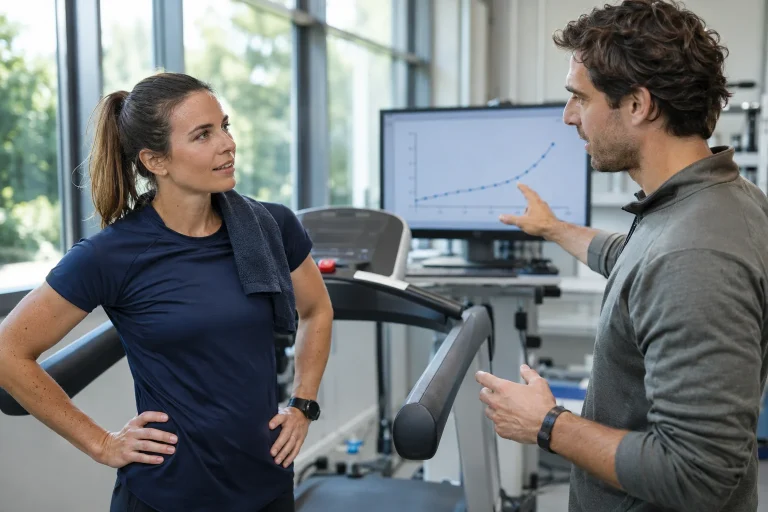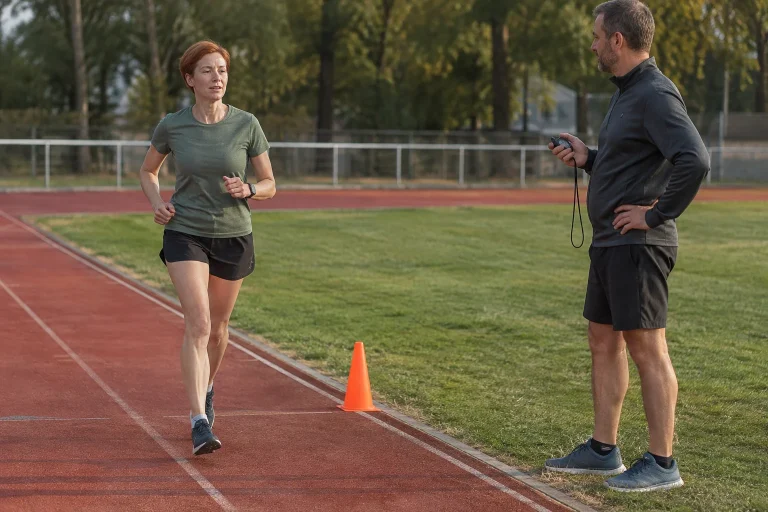
Two runners set their treadmills to the same speed. From outside, the task looks identical; internally, one may experience an easy run and the other much greater effort. In another experiment, everyone runs at a pace proportional to their own threshold: the physiological situation may become more similar, while actual speeds differ. The two studies therefore answer different questions.
This is one of the most important checks when reading research on running technique and shoes. What was held constant: pace, speed relative to threshold, heart rate or subjective effort? The choice is more than a methodological detail. It determines whether we compare a different movement pattern, lower energy demand or a faster task at a similar relative level. Using examples of our own, we show how the story changes with the axis fixed.
The external task and internal response are separate perspectives
The external task may include speed, treadmill incline, time spent running and surface. Researchers can set these directly or describe them precisely. Internal responses may include oxygen uptake, heart rate, blood lactate or perceived effort. These indicators may relate to one another, but do not measure the same thing or necessarily change in identical proportions in every situation.
The everyday expression ‘same effort’ is therefore insufficient alone. Participants may have chosen the same perceived category, run at ninety per cent of their own threshold speed or targeted a prescribed heart-rate range. These are separate rules. Speed proportional to threshold is one way to define relative workload, but does not establish that every internal indicator matches exactly in every participant.
When a headline leads you to think one kind of running is more economical, first find the actual task. Was oxygen demand lower at the same speed? Or did participants run faster under a similar relative condition? The first shows a cost difference for a given external performance; the second shows the speed associated with a particular rule. The results may relate, but one is not a synonym for the other.
The same twelve means different proportions for two runners
In an illustrative example of our own, one runner’s specified threshold corresponds to twelve kilometres per hour and another’s to sixteen. Prescribing twelve for both places the first at one hundred per cent of the reference and the second at seventy-five. These figures are not general zone boundaries; they portray invented people with different references. At the same speed, relative situations differ, potentially making some movement or physiological differences harder to interpret.
If instead we prescribe ninety per cent of each runner’s own reference, the resulting speeds are 10.8 and 14.4 kilometres per hour. The relative proportion matches, but actual speed differs by 3.6 kilometres per hour. The task between the runner’s foot and the ground has not thereby become identical. Speed also forms part of movement’s spatial and temporal organisation, so a biomechanical comparison must retain this difference too.
The research decision depends on the question. If we want to know how different people run along the same route at the same speed, fixing absolute pace is logical. If we want to examine them in similar relative tasks according to individual references, proportional prescription may be useful. No setting simultaneously removes every physiological and mechanical difference. The choice’s advantage and cost must be considered together.
 Enlarge image
Changing shoes can also change the reference speed
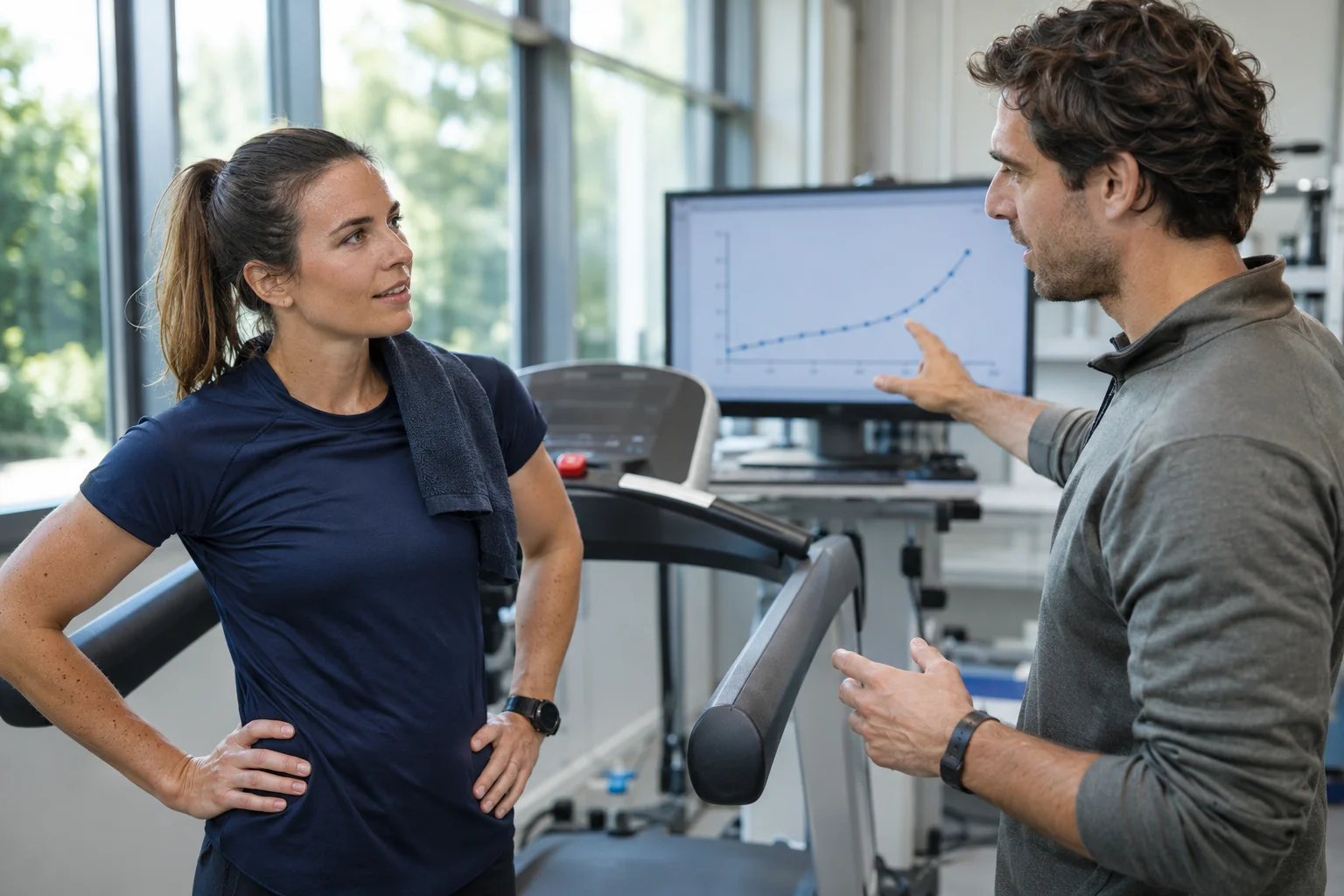
In Madsen and colleagues’ study involving ten trained male runners, threshold speed was determined separately in carbon-plated and control shoes. Of the eighty-minute runs, two used the same external speed and the third the relative speed associated with the carbon-plated shoe. Researchers could therefore examine shoe differences separately at the same pace and at a shoe-specific threshold proportion. The study was not a full marathon race.
In a simplified numerical example of our own, reference speed is fifteen kilometres per hour in one shoe and sixteen in the other. Running at fourteen in both gives relative proportions of 93.3 and 87.5 per cent. Choosing ninety per cent for each shoe produces speeds of 13.5 and 14.4. This is not the study’s exact dataset, but the consequence of the two decision rules. A new shoe can therefore yield different answers depending on the task requested.
The first comparison asks what internal response accompanies the same speed. The second asks what running looks like at the same fraction of the reference associated with the shoe. If contact time or stride length changes in the second comparison, speed change may also figure in interpreting the difference. It is incorrect to call everything the direct effect of a single component while the whole external task has changed too.
| Rule in our example | Reference A is 15 km/h | Reference B is 16 km/h |
|---|---|---|
| Same external speed | 14 km/h, 93.3% of the reference | 14 km/h, 87.5% of the reference |
| Same reference proportion | 90% → 13.5 km/h | 90% → 14.4 km/h |
Changing speed can also connect step variables differently
Running speed can simply be written as step frequency multiplied by forward distance per step, provided we consistently mean the same thing by a step. In our own example, 2.8 steps per second and a step length of 1.25 metres give 3.5 metres per second. If speed increases to 3.75 at the same frequency, mean step length changes to approximately 1.34 metres. Not every variable can remain unchanged simultaneously.
In the example, we held frequency constant; a real runner may change rhythm and length in different proportions. The calculation shows why speed matters in describing movement. If two study conditions permit different paces, differences in step parameters must also be connected with that task. Simply saying ‘steps became longer in new shoes’ omits an essential part without the pace.
In Mesquita and colleagues’ experiment with eight recreationally active men, several speeds and prescribed frequencies were combined. Movement and mechanical variables changed with the controlled conditions. This did not define a rhythm recommended for everyone; it examined how runners reorganise their steps within chosen constraints. Pace and frequency are therefore not negligible background data alongside a technique finding.
A homogeneous sample has advantages, but covers a different question
When participants have similar fitness, a common speed may also place them at more similar relative levels. This may help examine a targeted question, but narrows the people to whom the result can readily apply. Movement in a fast, uniform group is not automatically the average response of the entire recreational running community. Differences in age, body size, training history and individual reference remain part of interpretation.
In Tartaruga and colleagues’ study, the relationship between economy and biomechanical characteristics was examined in sixteen homogeneous male distance runners at a common speed below the ventilatory reference. The authors found associations with several variables. This means an observed relationship in a narrow, similar group, rather than proof that any runner would gain the same improvement by adopting the same movement.
This is particularly important when two studies appear contradictory. One may involve a sample with greater fitness differences at a common absolute speed, and another a homogeneous group in a similar relative task. The associations found can differ without either study being meaningless. Compare the sample and definition of workload first, before seeking the single ‘true’ movement parameter.
The same relative percentage does not describe everything either
A reference fraction always has a denominator. A percentage of maximal oxygen uptake, a percentage of maximal heart rate and a percentage of threshold speed are not the same formula. One scales an oxygen rate, another heart rate and the third running speed. A percentage sign alone does not put them on a common scale. Two articles’ ‘ninety per cent intensity’ may therefore involve a substantial difference in definition.
How and when the reference was established also matters. Was it measured in the same shoe as the long run? In a fresh state, with the same protocol? Did every condition have its own reference, or were calculations based on a common baseline? These answers help identify what changed in the comparison. If the denominator differs, the same percentage does not mean the same external speed.
A relative prescription is therefore a rule, rather than proof that the entire internal state matches. Researchers may still measure heart rate, oxygen, lactate and perception, whose results can refine the picture. As a reader, look for whether the study presents its prescribed target and actual responses separately. The label ‘matched to internal load’ is useful when the method behind it is also visible.
 Enlarge image
Three valid but different observations of your own
In the first situation, you run the same safe, smooth route at the same pace on two similar occasions and record perceived effort. This compares the experience of that external task. In the second, you choose a similar easy feeling and observe the resulting pace. This describes progress associated with the experience. In the third, you simply go out to move for the same duration and examine distance: speed and internal response may then vary more freely.
None is a laboratory measurement of running economy. Each can provide personal experience if we ask no more of it than what was recorded. Temperature, wind, route and the preceding days’ activity remain possible explanations. Consistency suited to the aim matters more than making all three observations identical at any cost. A running log is useful when you can later understand the task that produced a number.
If you try to compare shoes or technique, write down your chosen rule beforehand. ‘I was faster today, so energy demand fell’ does not follow from pace alone. ‘It felt easier at the same pace’, however, accurately describes the observed experience. Subjective experience gains value from clear, honest recording, rather than renaming it an instrument-based claim.
Reading order: task, reference, speed, result
Ask four questions before reading a research table. What was fixed? Based on which reference? What actual speeds resulted? What was measured as the outcome? This simple sequence reveals whether one condition compares cost at the same pace while another examines movement at differing speeds. The article’s main conclusion can only be interpreted with these details.
In the language of numbers, attend to both means and individual values. A group’s shared mean speed does not prove everyone ran at the same speed; prescriptions derived from individual references may differ. A study showing data for each participant reveals more about the actual task. A mean is a useful summary, but does not replace the protocol’s description.
The same pace and the same relative prescription are therefore two useful research tools. Neither can make running identical in every respect. A rule chosen for a clear question makes a result meaningful: are we examining cost, progress or movement adaptation? Retaining this in reading and your own log replaces many apparently contradictory technical tips with specific, understandable conditions.
Sources
- Tartaruga and colleagues: biomechanics and economy in a homogeneous group of runners.
- Madsen and colleagues: matched external and shoe-specific relative workloads during long runs.
- Mesquita and colleagues: a combined mechanical study of several speeds and step frequencies.
How Futószív articles are prepared: our editorial guidelines.