
One running report uses millilitres per kilogram per minute, another millilitres per kilogram per kilometre, while a shoe test reports watts per kilogram. All three may relate to running’s energy demand, yet describe different quantities. Read the unit before the number: otherwise a faster run’s greater oxygen uptake per minute can easily look like worsening economy.
Understanding running economy needs a few transparent conversions, rather than another ranking. Our own examples work through litres to millilitres, minutes to kilometres and oxygen to energy. The aim is connecting a report or research-table number with the actual question: how much was used in a given time, how much corresponded to one kilometre and under which conditions can two runs be compared?
A per-minute rate refers to a unit of time
Oxygen-uptake rate expresses how much oxygen the body takes up in a given time. The absolute value often appears in litres per minute. Dividing by body mass and converting to millilitres gives millilitres per kilogram per minute. This may suit certain comparisons between different body sizes better, but remains a time-based rate, rather than one referring to distance travelled.
In an illustration of our own, a sixty-kilogram runner takes up three litres of oxygen per minute. This is three thousand millilitres per minute, or fifty millilitres per kilogram per minute after dividing by mass. Both numbers express the same invented measurement differently. Actual oxygen uptake did not shrink because the number became fifty, nor did the result worsen because another table shows three thousand. First bring units into a common form.
Fifty millilitres per kilogram per minute alone is not a running-economy ranking. We would need speed, circumstances and the measurement section. The same value means something different in comfortable submaximal running and near maximal exercise. Maximal oxygen uptake and a particular task’s oxygen demand are separate questions; identical units do not make them interchangeable.
Per-kilometre cost also requires dividing by speed
If rate is in millilitres per kilogram per minute and speed in kilometres per minute, their quotient gives millilitres per kilogram per kilometre. Minutes cancel. Twelve kilometres per hour is two-tenths of a kilometre per minute because the hourly value is divided by sixty. This correctly converts time-based oxygen uptake into distance-based cost.
In the preceding example, fifty divided by 0.20 gives 250 millilitres per kilogram per kilometre. Check using time for one kilometre: at twelve kilometres per hour, this is five minutes. Five minutes at fifty millilitres per kilogram per minute also totals 250. Both routes perform the same dimensionally consistent conversion. The double check helps identify omission of the factor of sixty.
A common mistake is dividing fifty directly by twelve and calling the result per-kilometre cost. Minutes and hours then mix. The resulting 4.17 is not the correct 250 because time units were not aligned. Write the full units at least once during conversion. This is simpler and more reliable than judging correctness from whether the final number ‘looks usual’.
| Step in our example | Operation | Result |
|---|---|---|
| Absolute rate | 3 litres/min × 1000 | 3000 ml/min |
| Divide by mass | 3000 / 60 kg | 50 ml/kg/min |
| Convert speed | 12 km/h / 60 | 0.20 km/min |
| Distance cost | 50 / 0.20 | 250 ml/kg/km |
 Enlarge image
A higher per-minute value need not mean a higher per-kilometre cost
In a new example of our own, the same runner takes up thirty millilitres per kilogram per minute at ten kilometres per hour and thirty-six at twelve. The per-minute rate rose twenty per cent. The first speed is one-sixth kilometre per minute and the second two-tenths. Division gives 180 millilitres per kilogram per kilometre in both cases. More oxygen was used per minute, but the same amount corresponded to a kilometre.
This is possible because the faster runner covers more ground each minute. Rate and distance cost therefore offer different comparisons. The former relates to intensity of current functioning; the latter describes the amount per unit of route. Equal kilometre cost nevertheless does not mean the two paces feel equally difficult or can be maintained equally long. The runner’s capacity and exercise range also matter.
In reality, kilometre cost need not stay constant across all speeds. The example only shows relationships between units. Different measured results at two speeds need interpretation alongside protocol and energy conversion. Do not force your measurement into the example’s chosen direct proportionality. Conversion is a certain mathematical step; the resulting relationship is a measurement finding.
Why is counting oxygen alone not always enough?
Energy derived from oxygen is more than relabelling the same number. Different fuels have different oxygen–energy relationships, so indirect calorimetry may account for carbon-dioxide production alongside oxygen. The ratio of expired carbon-dioxide rate to oxygen-uptake rate is the respiratory exchange ratio, RER; this also requires appropriate interpretation of measurement setting and intensity.
In Shaw and colleagues’ study involving 172 trained endurance runners, oxygen cost did not change in the same way as energy cost across below-threshold speeds. RER and energy cost rose with speed, while per-kilometre oxygen cost did not differ significantly. This directly illustrates that the two economy indicators are not necessarily sensitive to the same changes.
In a conceptual illustration of our own, suppose oxygen cost per kilometre is 0.20 litres per kilogram. An energy equivalent of twenty kilojoules per litre gives four kilojoules per kilogram per kilometre. With twenty-one, it would be 4.2. The oxygen figure is identical while energy differs by five per cent. These are rounded example numbers, rather than actual substrate measurements for a particular runner or a recommended constant multiplier.
Watts, joules and kilocalories: time appears again
A watt expresses energy use per unit time: one watt is one joule per second. A report giving metabolic rate in watts per kilogram does not describe mechanical running power or directly give cost per kilometre. First know which power is meant. A watch’s watt estimate and a respiratory-gas-derived metabolic rate may share a word while covering entirely different measurements.
In our example, mass-normalised metabolic rate is 15 watts per kilogram and speed three metres per second. The quotient is five joules per kilogram per metre, or five thousand joules per kilogram per kilometre: five kilojoules per kilogram per kilometre. A kilometre here takes approximately 333 seconds; multiplying by 15 gives the same five thousand joules. Correct handling of seconds and metres again matters more than number size alone.
To express that cost in kilocalories, convert energy: one kilocalorie is 4.184 kilojoules. Five kilojoules is therefore approximately 1.20 kilocalories per kilogram per kilometre. This remains our invented example. It is not a nutrition calculator for every person, terrain and pace. Further questions separate mechanical work, total metabolism and daily food requirements.
Absolute or mass-normalised value: which are you asking about?
Total oxygen uptake can differ between runners of different masses even when per-kilogram values are similar. In our example, a fifty-kilogram runner takes up 2.5 litres per minute and a seventy-kilogram runner 3.5: both give fifty millilitres per kilogram per minute. Absolute quantity concerns the whole person, while normalised value refers to a unit of body mass. Neither is the other’s ‘incorrect’ version.
Researchers choose scaling for the question. Dividing by mass has different significance when comparing one person’s two shoes than when ranking people of very different body sizes. Simple division by body mass does not perfectly remove every physiological relationship either. Readers should above all compare like forms of data, rather than merge absolute and normalised values in one column.
If two reports for the same person record different body masses, the divisor also influences changes in the normalised value. This does not create a weight-change goal: the point concerns mathematical interpretation of measurement. Body size is not a simple performance-improvement switch. Preserve which value was used on test day and which quantity actually changed.
 Enlarge image
Gross or net, short section or whole workout?
A gross indicator includes the whole measured energy or oxygen rate during the task. A net version subtracts a defined baseline. Depending on method, this may be separately measured rest or standing. If one study reports gross cost and another net cost, part of the difference may come from definition. Look for the subtraction method in the methods section.
In our example, gross rate is three litres per minute and the chosen baseline 0.25, giving a net 2.75. At twelve kilometres per hour, absolute gross kilometre cost is fifteen litres and net cost 13.75. The calculation is clear, but selecting the baseline is a methodological decision. Arbitrarily subtracting a general resting number found online from one report, then comparing it with another study’s official net figure, is not sound.
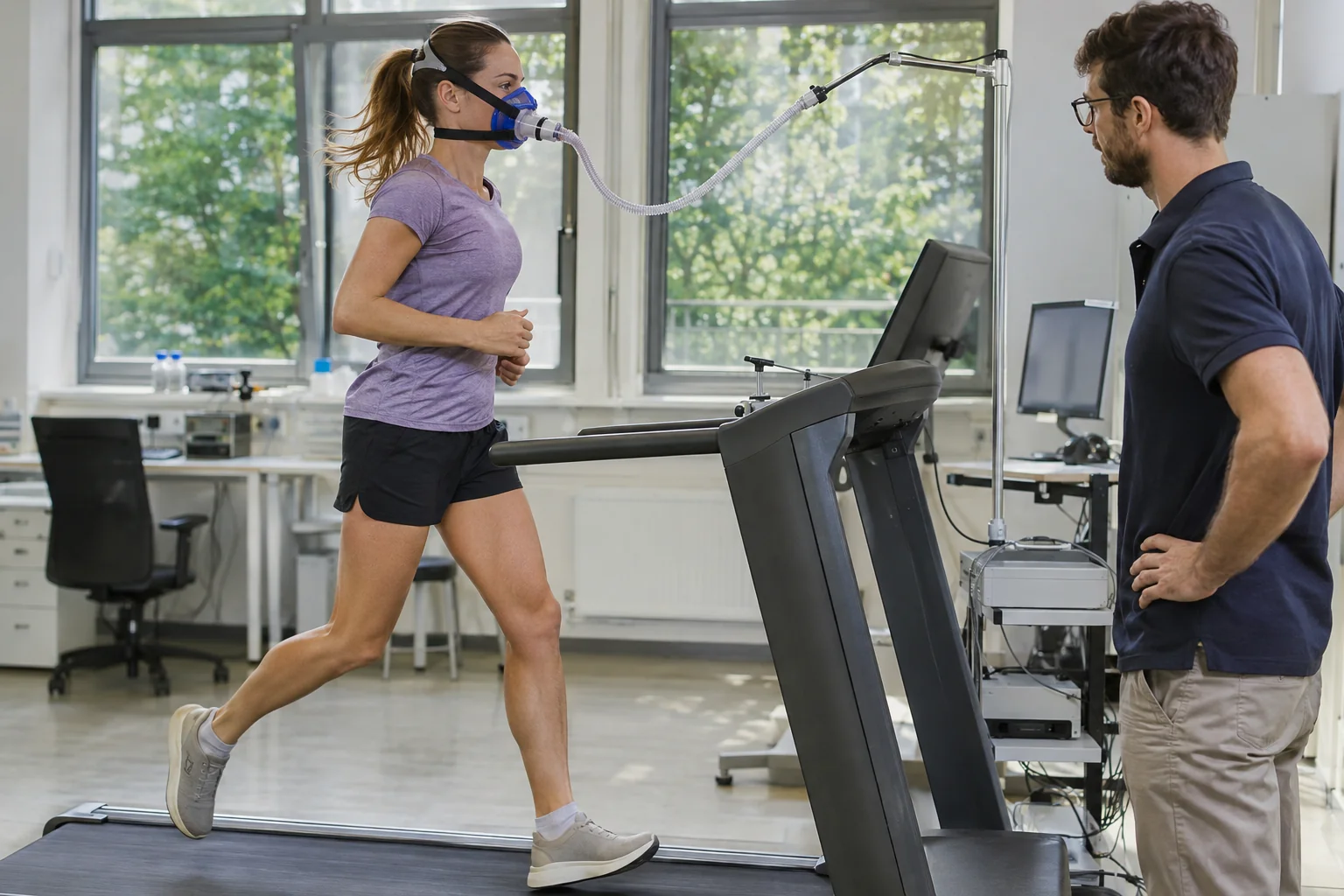
The time window also forms part of the definition. In Hoogkamer and colleagues’ shoe comparison, mass-normalised energy cost was calculated from oxygen and carbon-dioxide data collected during selected minutes of specified submaximal running sections. The mean of such a stable section differs from energy expenditure for an entire workout including warm-up, accelerations and rest. A section’s economy and the whole occasion’s total cost are different questions.
Five checks before a research table
First name the quantity: oxygen or energy? Second, the time or distance basis: per-minute rate or kilometre cost? Third, body-size treatment: absolute or mass-normalised? Fourth, gross–net definition and averaging window. Fifth, speed and running environment. This sequence reveals many apparently conflicting results as different definitions instead.
For example, Bolliger and colleagues’ 2026 shoe study also reported oxygen cost normalised to distance and body mass at several speeds. Other research chooses energy cost in watts per kilogram. The two articles’ numbers cannot be directly subtracted, even if both discuss running economy. Conversion to a common form is possible only when necessary speed, gas-exchange and definition data actually exist.
A properly understood unit is therefore more than a small-print technical detail. It determines which question a number answers. Knowing this prevents greater per-minute oxygen uptake automatically becoming worse running, or lower kilometre cost immediately becoming a guaranteed race time. Economy remains a useful, specific measurement perspective alongside performance’s other components.
Sources
- Shaw and colleagues: valid interpretation of oxygen cost and energy cost.
- Hoogkamer and colleagues: energetic comparison of marathon racing shoes.
- Bolliger and colleagues: multiple speeds and oxygen cost normalised per kilometre.
How Futószív articles are prepared: our editorial guidelines.