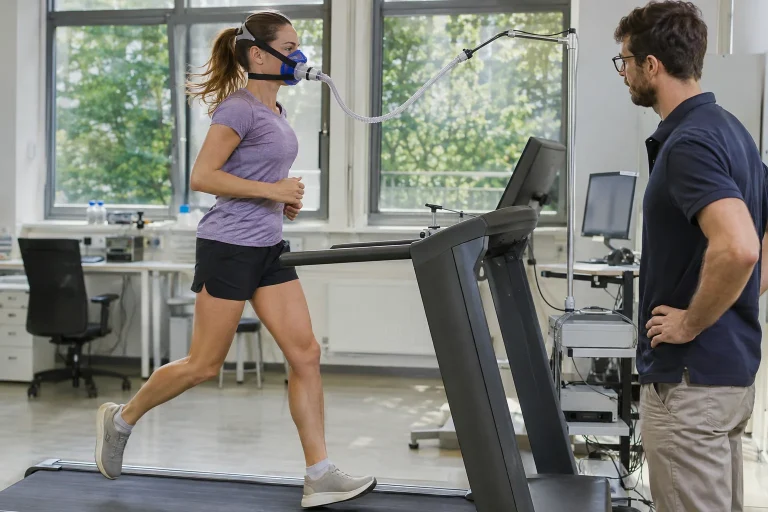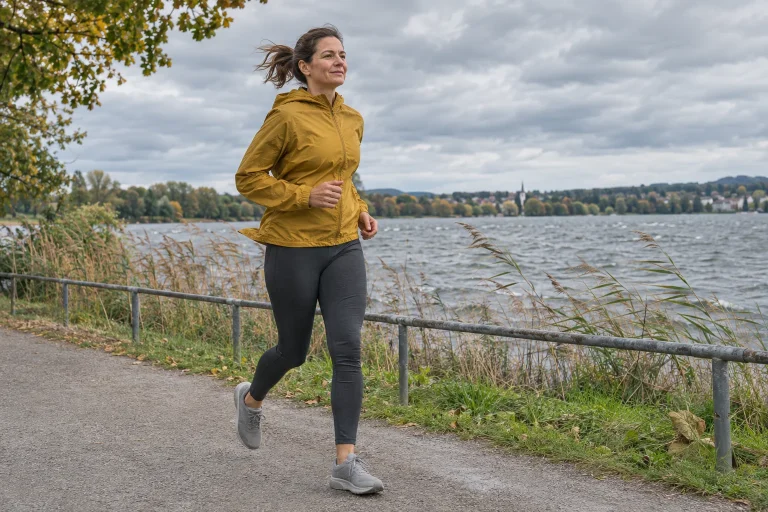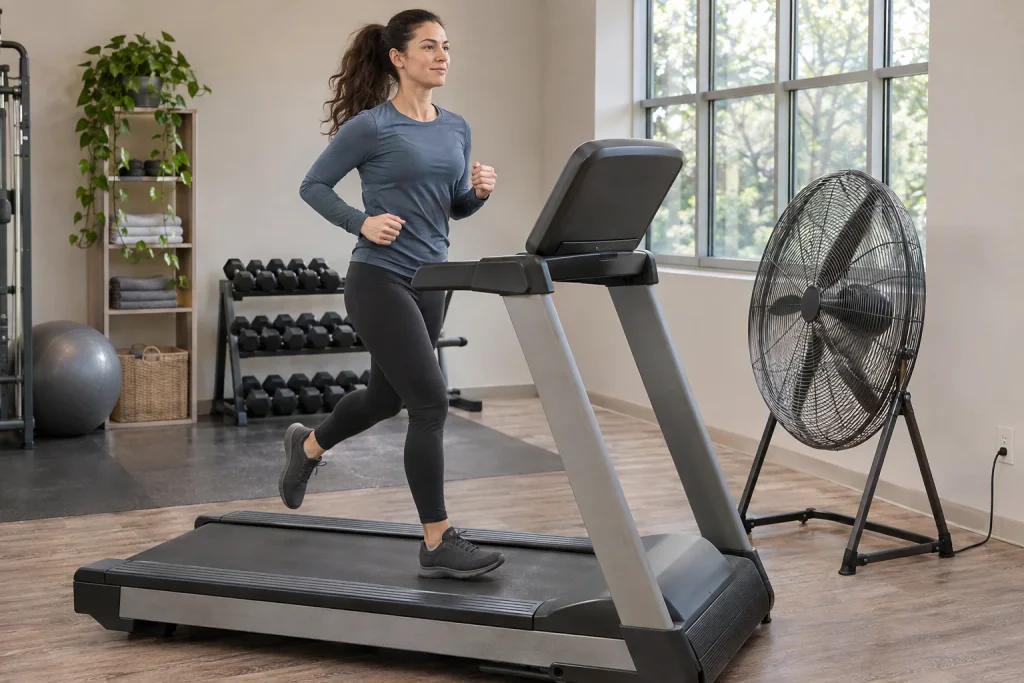
Outside, even in still weather, you feel air on your face while running. At the same displayed treadmill speed, this movement-generated airflow may be absent because your body mostly stays in one place relative to the room. Placing a fan ahead certainly changes something, but two separate things deserve attention: the force exerted by moving air and the environment for heat loss.
A more pleasant feeling does not automatically allow calculation of lower or higher running energy demand. Air can simultaneously provide mechanical resistance and participate in heat exchange. A narrow jet striking your face also differs from similarly fast airflow across the whole front of your body. Treadmill, room and fan form a shared environment; a single ‘one per cent incline’ setting does not describe it.
Relative to what does the air move?
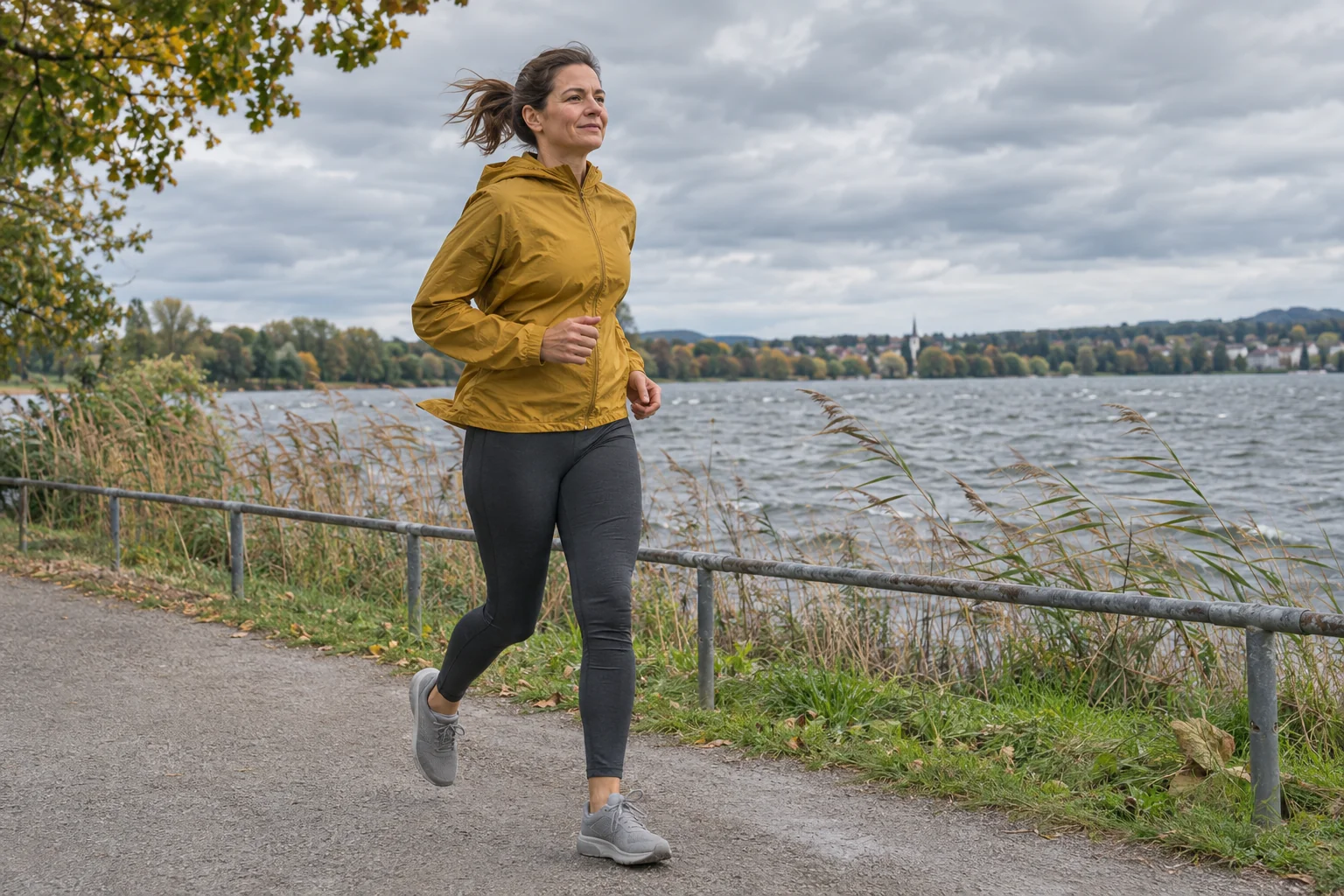
In still weather, an outdoor runner moves forwards relative to both ground and surrounding air. Setting complex local flows aside, relative air speed is then approximately the runner’s travel speed. On a treadmill, the belt moves backwards while mean trunk position remains almost constant in the room. A belt speed of twelve kilometres per hour therefore does not automatically mean equally fast head-on airflow relative to the whole body.
Arms and legs still move, and room air is not perfectly still, so not every aerodynamic effect disappears indoors. The point is the difference in whole-body airflow created by forward travel. Windows, room ventilation and fan position also shape flow felt relative to your body. Two treadmills set to the same speed can therefore provide different air environments.
In a simple outdoor example of our own, you run forwards at three metres per second. In still weather, the relative headwind is approximately three metres per second. If a two-metres-per-second wind comes directly towards you, the relative value becomes five; with the same wind from behind, the relative value along the line falls to one. This example excludes crosswinds and gusts. Those require accounting for directions, rather than simply adding two numbers.
Force and total energy demand are not the same
According to NASA’s basic relationship, a simple drag-force model is proportional to air density, drag coefficient, reference area and relative speed squared multiplied together. Body shape and position relative to airflow matter too. This models force, rather than the runner’s total metabolic cost. Lower flow under one condition does not remove running’s other tasks.
With the relative speed above changing from three to five metres per second and all other factors unchanged, the model’s drag-force ratio would be 25/9, approximately 2.78. This is our own ratio calculation. It does not mean running is almost three times harder or uses three times the calories. The multiplier concerns only one force component in the model. Interpreting total energy demand requires further relationships and measurement.
The interpretation framework is especially important on a treadmill. The trunk does not travel a kilometre through the room, yet running relative to the moving belt remains a real mechanical and physiological task. Ground-reaction forces may also adapt to counteract the fan’s force. Inserting zero mean speed relative to the room into one equation and declaring zero running energy demand or mechanical effect is not a sound approach.
 Enlarge image
Real airflow can modify horizontal forces too
In Steele and colleagues’ 2025 research, twenty-four trained men ran at two speeds under several airflow conditions. Headwind mainly accompanied changes in forward–backward ground-reaction forces, more strongly in the faster condition; vertical and temporal indicators did not change in the same way. This directly measured example shows that air is a mechanical circumstance, rather than merely a comfort accessory.
The result does not prescribe air speed for home training. Research airflow and a simple floor fan may differ in uniformity, direction and body coverage. The study nevertheless supports treating a fan as a meaningful detail in subtle biomechanical comparisons. If strong airflow reaches you on only one of two occasions, another variable has appeared alongside shoes, pace or technique.
In a test plan of your own, therefore first ask the goal. Runner comfort? Approximating an outdoor mechanical environment? Comparing two shoes’ energy demands under constant conditions? These are different tasks. A household fan may help the first without providing an accurate wind tunnel for the second. For the third, fixed position and setting may matter more than ‘imitating’ any outdoor speed.
Cooling sensation and measured metabolism can diverge
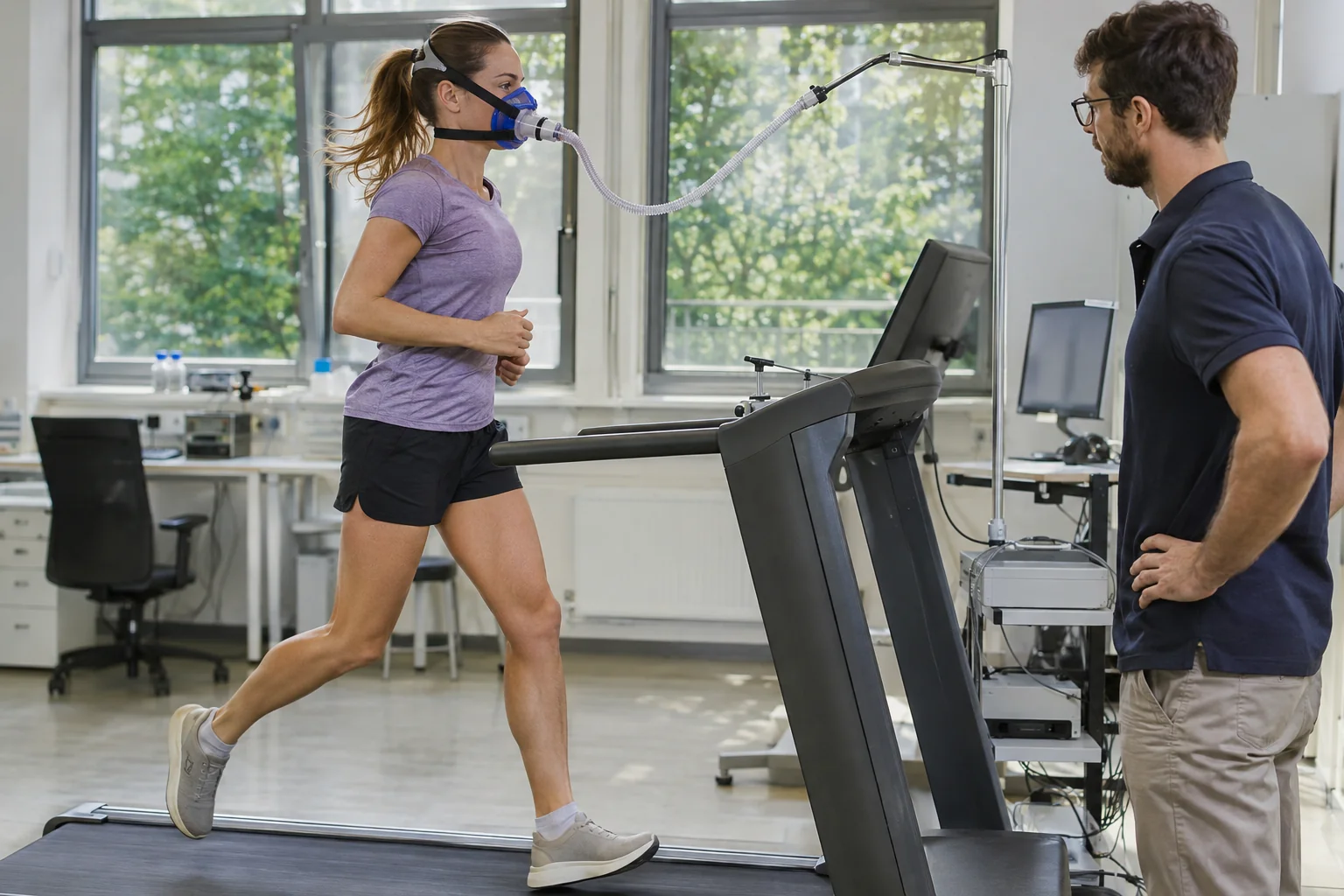
In Yamashita and colleagues’ 2024 wind-tunnel study, fourteen participants were examined under airflow of different directions and speeds in a temperate environment. The metabolic effect of lower air speeds remained within participant and measurement variability in the study, while the authors emphasised movement-generated airflow’s thermoregulatory importance. Comparing mechanical energy demand and comparing heat loss therefore need not lead to the same result.
A more pleasant run with a fan is therefore not itself evidence that airflow ‘helps you forwards’. Unpleasant heat sensation may fall while head-on air provides mechanical resistance. The two effects act at different levels, and personal experience summarises the whole situation. It helps to name general perceived effort separately from how hot the environment feels.
The study’s temperate setting should not be transferred to every hot, humid room. Air temperature, humidity and clothing also alter heat-exchange conditions. A fan does not automatically make any training room suitable, and pleasant air movement does not replace usable room conditions. As a practical decision, first choose an environment suitable for training, then adjust comfort settings within it.
Why are incline and headwind not the same?
Uphill running creates a different directional mechanical task from air resistance over level ground. Treadmill incline changes support geometry; a fan changes the environment relative to air. Similar oxygen consumption under two settings does not make both movements identical in every respect. The same overall energy demand can arise with different force and movement patterns.
The frequently cited Jones–Doust experiment examined several speeds and inclines alongside outdoor running in nine trained men accustomed to treadmill use. One per cent incline approximated outdoor energetic cost well in the short sections studied. The paper did not claim that airflow, cooling and every biomechanical characteristic could also be replaced this way. The energetic correspondence in its title is not complete environmental equivalence.
In practice, do not automatically add several ‘outdoor corrections’. Setting an incline, switching on a strong fan and then increasing speed on an app’s advice changes several separate variables. The resulting run may be a meaningful workout in its own right, but is hard to call the same outdoor pace. The best setting depends on the training goal you want to achieve, rather than how many retrospective corrections you collect.
A jet on the face is not uniform wind across the whole body
With a small desk fan, airflow speed and direction may vary through space. Your head may enter a jet while trunk or legs receive much less movement of air. An oscillating fan also changes the situation over time. The displayed level usually indicates the device’s setting, rather than a calibrated metres-per-second value maintained uniformly across your whole front.
In a room-layout example of our own, the fan stands close in front of your face on day one, and farther away beside the treadmill on day two. Both use the same setting, yet the environment differs. The first may concentrate air on the face, while the second reaches the trunk more broadly; side-on direction may also mean a different force effect. A matching setting number therefore does not adequately document a strict comparison.
A simple, repeatable home task does not need a precise airflow map. Consistently placing the fan in the same location, selecting the same direction and setting, and noting deviations may suffice. The goal is consistency, rather than an invented wind speed. A task requiring research-grade airflow needs suitable measuring equipment and an appropriately designed laboratory environment.
 Enlarge image
Five elements of a clearer indoor training note
Alongside treadmill identification, include set speed and incline, time spent running, fan position and setting, and basic room conditions. You need not invent decimal figures for everything. ‘Window open, large fan ahead, steady setting’ is a better note than an unverified ’12 km/h airflow’. Describe circumstances actually known.
| Observation | Useful note | Separate interpretation |
|---|---|---|
| Machine | The same treadmill and incline. | Actual belt speed has still not been measured. |
| Air | Fan ahead, in a constant direction. | The setting is not an air speed applying to the whole body. |
| Perception | More comfortable thermal sensation, similar overall effort. | Perception is not instrument-based metabolic measurement. |
| Deviation | The fan was not running on the second occasion. | A heart-rate difference may have a new environmental explanation. |
Simple safe-placement details also matter: position the fan stably, keep its cable out of the route onto and off the belt, and leave machine controls accessible. Do not drag it around on the floor while running. Set the comfort environment before training, or stop the machine appropriately before changing it.
Make the fan’s purpose clear
If you simply want more pleasant indoor running, usable thermal comfort and a repeatable room layout are worthwhile goals themselves. You need not claim a perfect recreation of outdoor wind. If comparing two small technique changes, however, keep the air environment similar too so differences remain more interpretable. Neither goal is more valuable; they require different evidence and precision.
Missing movement-generated airflow on a treadmill may therefore involve both mechanical and heat-exchange differences. A fan may affect both, but its effect depends on direction, air distribution and environment. Incline is another tool with another task. Understanding these differences makes well-arranged indoor training easier and converting every run into a single outdoor pace less tempting.
Sources
- Yamashita and colleagues: air speed, metabolism and thermoregulatory responses.
- Steele and colleagues: air resistance and horizontal ground-reaction forces.
- Jones and Doust: treadmill incline and approximating outdoor running’s energetic cost.
- NASA Glenn Research Center: the basic drag equation.
How Futószív articles are prepared: our editorial guidelines.