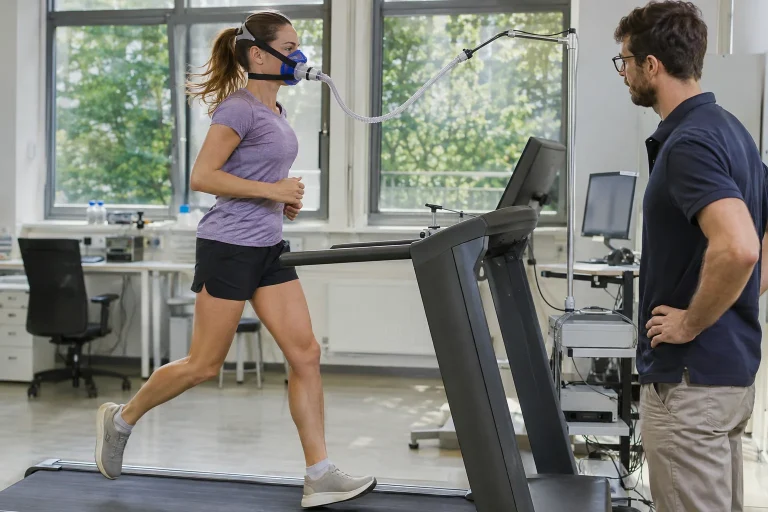
The display reads twelve kilometres per hour, corresponding to five minutes per kilometre. This setting looks like a precisely defined target, but the treadmill’s mechanics and regulation control an actual moving belt. Ask separately how closely average speed follows the display and how much speed changes within a single step.
The two discrepancies have different meanings. The average can be good while the belt briefly slows and accelerates; movement can also be relatively steady with a constant average offset. Comparing time and distance over a section may inform the first question, while within-step behaviour requires much more detailed measurement. Our examples below show the difference, followed by how to request a meaningful check without dangerous homemade belt markings.
Setting, average and instantaneous speed are different data
The speed setting is what you request from the machine. Actual instantaneous belt speed describes how fast the belt moves around a particular brief moment. Average speed is belt distance travelled over the period examined divided by time. When speeds alternate, the time average can match the target even if no instant of movement shows exactly that value.
In our idealised example, the belt moves at 11.4 kilometres per hour for half the time and 12.6 for the other half. The average is twelve, with fluctuation of plus or minus five per cent around the target. This is not a measured trace from a real treadmill; the abrupt square-wave change is imagined solely to simplify calculation. It shows why a good whole-minute average does not establish completely uniform operation.
Another imaginary machine moves at 11.8 throughout while displaying twelve. Its deviation from the setting is minus 1.67 per cent, but this thought experiment contains no fluctuation. The same machine therefore does not perform best on both average accuracy and consistency over time. A service report should specify which property was checked.
What did the four-treadmill study find?
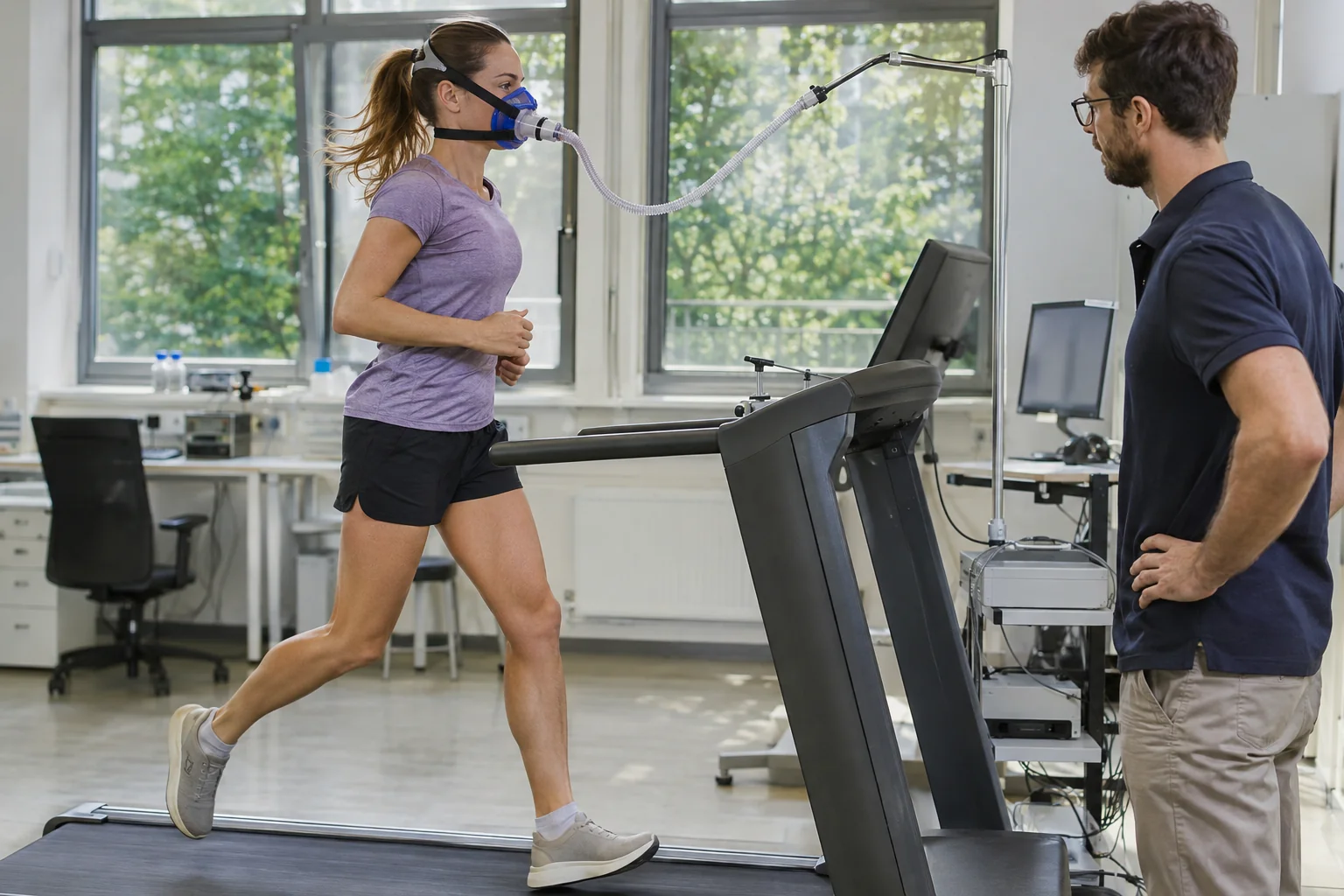
In the study reported by Willwacher and colleagues, seven participants walked and ran on four different treadmills. A three-dimensional camera system tracked belt movement. Mean speeds ranged from approximately 98 to 103 per cent of the setting; within-step deceleration and its timing differed by machine type. Effects of body mass and movement speed also depended on the machine. This small-sample study analysed specified equipment; it is not an accuracy certificate for every current treadmill.
An earlier experiment by Savelberg and colleagues compared overground movement with two treadmill conditions in nine participants. Within-step belt-speed changes were also associated with movement characteristics; the study highlighted the combined equipment–user system. Reading the display cannot therefore replace checking the moving belt, especially in measurements seeking small biomechanical differences.
These studies do not establish that an expensive machine is more accurate in every situation or that a cheaper one is unusable. Actual condition, construction and regulation matter too. Nor is it fair to transfer findings from a model once examined automatically to a newer product with a similar name. When buying or comparing, ask about verifiable specifications, maintenance requirements and actual service support instead.
 Enlarge image
The same running time can still mean different actual belt distances
Twelve kilometres per hour is exactly two hundred metres per minute, giving two kilometres of belt travel in ten minutes. In our example, let the actual average be only 11.76: two per cent below the setting. Belt travel in ten minutes is 1.96 kilometres, a difference of forty metres. Pace corresponding to the actual average is approximately 5 minutes 6 seconds per kilometre, rather than five minutes.
Running for thirty minutes on this invented machine would give six kilometres from the displayed target, but 5.88 from the actual average. This does not mean every treadmill is two per cent wrong: we chose that ratio for illustration. It shows how a small constant average offset appears proportionally in total belt travel. Comparing short and long sessions, the same percentage means fewer or more metres.
In another example, the belt moves at 12.24. This is plus two per cent, corresponding to approximately 4 minutes 54 seconds per kilometre. Pace and speed are reciprocals, so the change in seconds is not exactly symmetrical on the positive and negative sides. Rounding the displayed decimal and pace seconds can introduce another small difference; do not confuse that with actual belt-measurement inaccuracy.
| Our illustrative average | Belt travel in 10 minutes | Calculated kilometre pace |
|---|---|---|
| 11.76 km/h | 1.96 km | Approximately 5:06 |
| 12.00 km/h | 2.00 km | 5:00 |
| 12.24 km/h | 2.04 km | Approximately 4:54 |
Why do brief fluctuations matter when the average is good?
Force between runner and belt is not constant throughout a step. While the shoe is in support, the system’s instantaneous situation differs from when the foot is airborne. A speed trace can therefore reveal more about the mechanical environment than a whole-minute average. Two treadmills with identical mean speeds may behave differently over short periods, which can matter when interpreting detailed movement analysis.
The averaging window is fundamental here. If the belt travels thirty-three and one-third metres in ten seconds, its average is twelve kilometres per hour. That does not reveal its speed in each hundredth of a second. Many different time traces can produce the same total distance. Simple timing is not “bad measurement”; it answers a different question from high-time-resolution motion tracking.
Think of two car journeys with identical average speed: one steady, the other full of brief decelerations and accelerations. The analogy does not make car and treadmill mechanics identical, but helps separate an average from movement history. In a laboratory, choose the method according to whether the analysis concerns energy demand per total distance or mechanical processes during ground contact.
Three separate displays for the same workout
The treadmill, watch and phone app do not necessarily calculate from the same data. A treadmill may rely on information from its own speed or drive system. A watch’s indoor-distance estimate can come from other movement signals, while a connected sensor may add another data source. If final distances differ, first establish where each number came from before naming a faulty device.
In our case example, the treadmill shows 5.00 kilometres and the watch 4.75. Alone, this is only a discrepancy. It does not establish that the belt travelled exactly five kilometres or that the watch was definitely five per cent wrong relative to actual belt travel. Independent verification is missing. Adjusting the watch to the treadmill display can improve agreement between the two displays without automatically establishing correct physical speed.
A short source label is therefore particularly useful in the log: “based on machine display”, “watch indoor estimate” or “belt speed verified by service”. This does not needlessly complicate training; it may explain a sudden pace change later. Do not silently merge data from different sources into one record list as though they represented identical measurements.
Machine identity is also data in a comparison
During a multi-week training period, you may perform the same session in two gyms. Both times you set speed to twelve, but the machine, cooling, room temperature and underfoot feel differ. If the second run is harder, the difference cannot be attributed to a single cause. Recording the machine identifier and basic conditions helps create a genuinely comparable situation next time.
Choose a narrow comparison for a narrow research question. If you are interested in a small difference between two shoes, switching machines introduces another explanation. If you specifically examine the experience of using two treadmills, changing machines is part of the task. “Same machine” is therefore not a compulsory rule for every session, but a tool for clear comparison when you do not want machine effects as another variable.
In laboratory findings, how the applied speed was verified is especially valuable information. It matters whether the researcher only recorded the display, checked an unloaded average or tracked the belt during running too. Each provides something different depending on the measurement question. Look in the methods before treating one- or two-per-cent differences between studies as a direct competition.
 Enlarge image
What should you ask service, and what should you avoid improvising during a run?
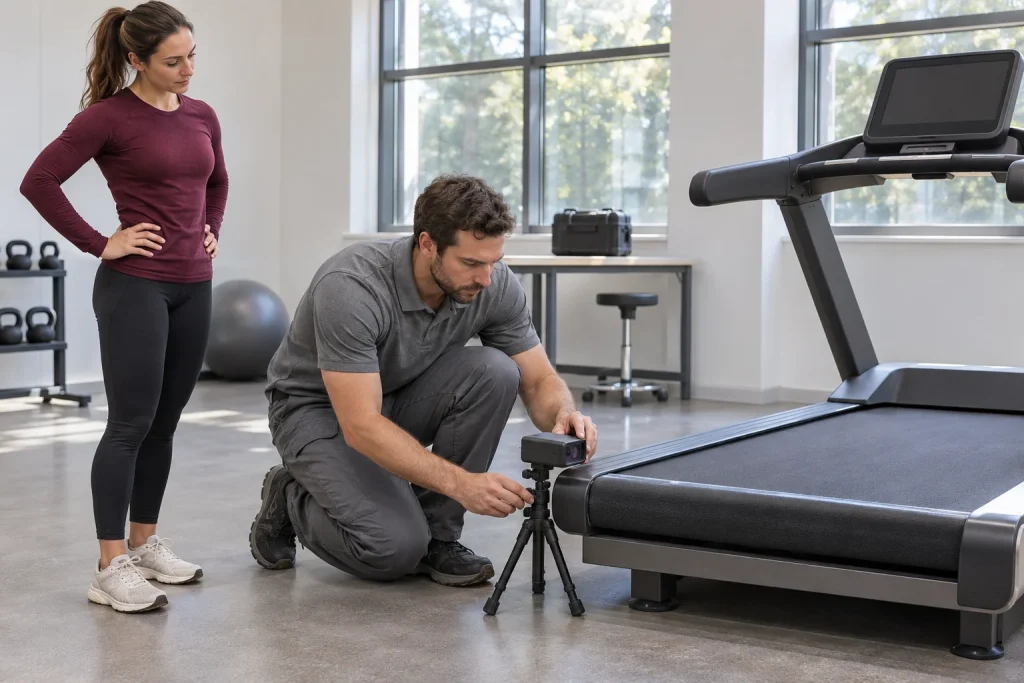
If the machine jerks unusually, slips or operates unpredictably, report the problem to the operator rather than continuing use. Do not try attaching tape to the belt, reaching beside a roller or opening a cover while moving. High-speed machinery and a moving runner together are unsuitable for manual measuring. Displayed versus actual speed can be checked with appropriate equipment following the manufacturer’s procedure.
Give service four specific details: which machine, what setting, under what circumstances the discrepancy appeared, and what you experienced. “Brief slowdowns felt at twelve after several minutes of continuous running” describes a fault more precisely than “the motor must be weak”. If sound or an error message accompanied it, record that from a safe, stationary position. Keep the presumed cause separate from the actual observation.
Ask what method, speed range and loading conditions were used for the check. “We calibrated it” alone gives little detail. Was average speed checked, or brief fluctuation too? Did they investigate the same fault you experienced? These questions do not require home diagnosis, but help ensure the response addresses the original problem.
How can training data stay useful?
Treadmill running can still be well planned and repeatable. Accurate interpretation requires knowing what you set and what you actually measured. Performing similar tasks over time on the same properly functioning machine builds your own comparison baseline. If you change machines, mark it in the log rather than immediately treating every sudden record or slowdown as a physiological change.
Discovering a small average offset later does not erase a session’s value. Twenty minutes spent running remains twenty minutes, and the completed task is your actual movement. Refine conclusions tied to route or race pace rather than invalidating the whole session. Mark uncertain data so it does not later become the mistaken basis for a rigid target pace.
A display showing twelve is therefore a useful setting, but not a complete speed trace. Average accuracy, within-step regulation and different devices’ distance estimates are distinct questions. Separating them gives you better service questions, a clearer training log and sounder comparisons. The aim is not to make every run an engineering examination, but to understand what each number can and cannot describe.
Sources
- Willwacher and colleagues: belt-speed fluctuations on four treadmills by body mass and speed.
- Savelberg and colleagues: within-step belt-speed changes and treadmill movement.
How Futószív articles are prepared: our editorial guidelines.