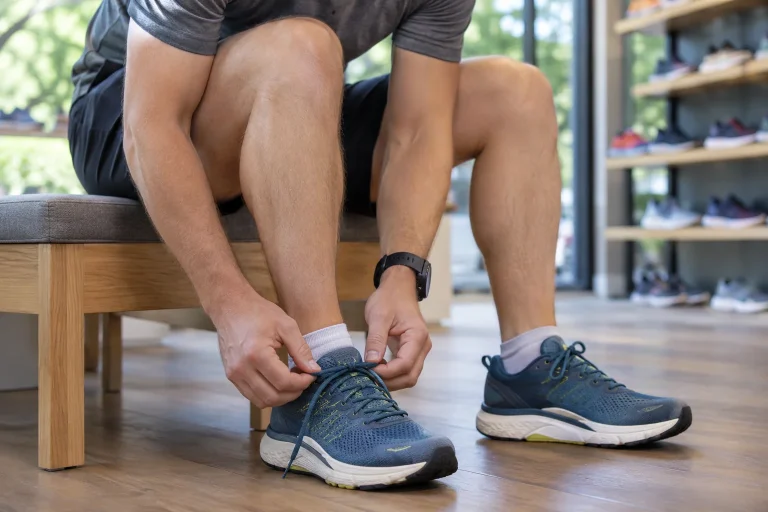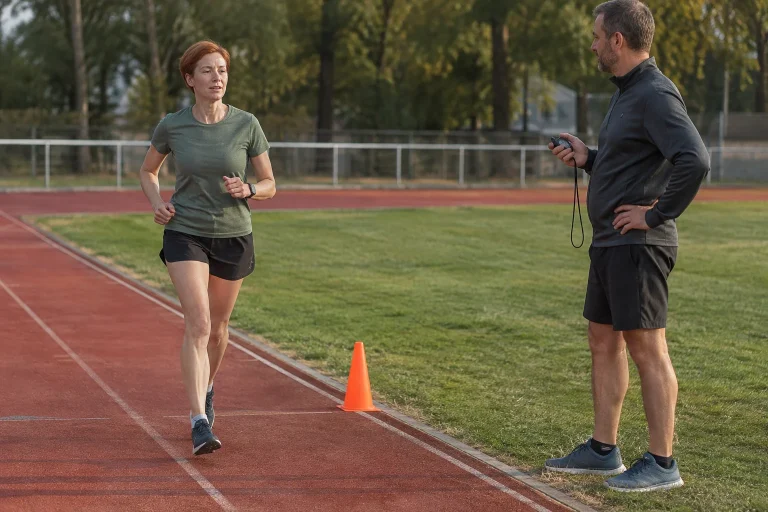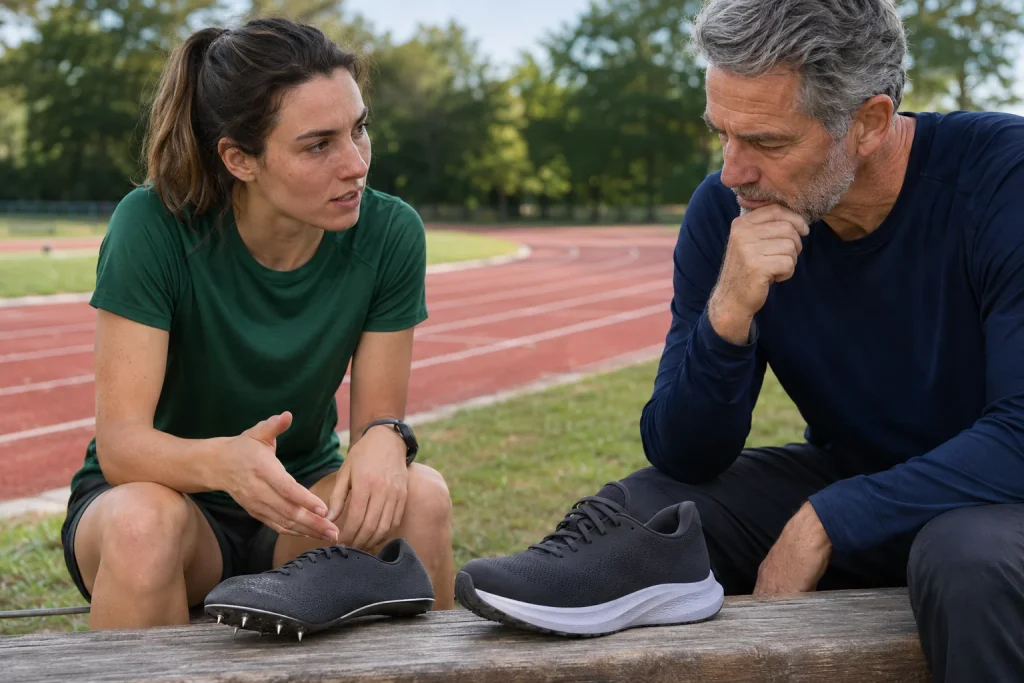
Beside the track, a low-profile spike sits next to a thicker road racing shoe. Both can use modern, light and resilient construction, yet serve different environments. A track runner’s few-minute section and a marathon’s hours-long task differ in more than duration. Surface, bends, pace, construction and competition rules all form part of comparison.
A good laboratory study can show how shoes worked for the runners examined. The next question is how closely our own task resembles it. This article starts with a 2026 spike–road comparison and examines practical conditions for transferring findings. It does not recommend spikes for roads; it shows how research across disciplines can be read precisely and usefully.
Spikes and road shoes encounter different tasks
Spikes concern contact with an appropriate athletics surface. A road shoe’s outsole works in another environment, and its entire sole construction can differ. This is more than screwing small metal pieces into the same shoe. Mass, geometry, upper and purpose together shape the task solved by the wearer.
A laboratory comparison on one treadmill makes external conditions more uniform. This assists study of differences without reproducing every competition environment. Outdoor-track bends, varied road surfaces and intended race duration add considerations. Describe measurement conditions and usage environment separately.
Our thought example: compare two devices on one smooth surface and find similar energy demand. We still do not know their behaviour on another surface or over longer periods. A uniform environment is both an experimental strength and a boundary on inference. Failing to examine every possible route is not a laboratory test’s defect.
What did the 2026 comparison measure?
In Needles, Kim and Grabowski’s research, seventeen competitive distance runners participated: seven women and ten men. Two advanced-technology spikes, an advanced road shoe and a conventional spike were compared. Women’s trials used 15 km/h and men’s 17 km/h. Repeated five-minute sections per shoe recorded metabolic and ground-reaction-force data.
Relative to the conventional spike, Nike Dragonfly and On Cloudspike conditions showed approximately 2.1 and 2.3 per cent favourable economy differences; the Vaporfly Next% 2 road shoe showed 1.9 per cent. These results share a common control. Alone, they do not establish a separate ranking of all three modern models in every pairwise comparison for every runner.
The data concerns a defined competitive sample, speeds and shoes. Its value lies precisely in that specificity. Technology was studied beyond road shoes, and modern spikes were compared through human physiological measurement too. The next step is reading task details rather than declaring a universal winner.
 Enlarge image
Naming test speed helps place the result
Our conversion gives 4:00 min/km for 15 km/h and approximately 3:32 min/km for 17 km/h. These are external test speeds, not recommended trial loads for everyone. Participants were competitive distance runners. If your easy pace differs substantially, that is an important question for applicability.
Repeating five-minute sections can supply more data on one condition without becoming a single long racing section. Four five-minute measurements total twenty recorded minutes, yet may remain separate trials. Breaks, shoe changes and protocol timing tell another story from twenty minutes of continuous racing. Simply adding total time can obscure this temporal distinction.
In other research involving trained and higher-level runners, stiffness effects on economy differed by group and speed, while time-trial results did not follow exactly the same pattern. This helps explain why shoe findings cannot all be summarised without speed and task. The same technological label can conceal separate protocols.
Contact time alone cannot tell you which shoe is faster
In the 2026 spike experiment, modern conditions combined favourable economy with longer contact time and greater estimated leg stiffness relative to control. This counters the simplistic “better shoes always shorten support” claim. Mechanical and physiological findings appeared in this particular combination in that study.
Contact time describes how long ground contact lasts under the chosen method. It is neither direct energy demand nor a complete performance test. Other movement variables may change as part of the shoe response. One duration increasing or decreasing cannot generally rate construction. Examine all measured outcomes.
Our example uses contacts of 220 and 230 milliseconds, a difference of 10 milliseconds. That does not reveal frequency, running speed, the force curve or bodily cost. Do not invent a complete biomechanical account from two times alone. The number is useful detail, but remains detail without additional data.
Track material and the leg shape support together
On laboratory surfaces with controlled stiffness, Kerdok and colleagues examined changes in runner mechanics and energy demand. Calculated leg stiffness and economy changed with the surface. This was not a spike-versus-road product test, but an example of human–surface interaction. Shoe results cannot be fully understood without their environment.
An energy-returning athletics surface, hard pavement and variable road surfacing are different mechanical situations. Slipping, unevenness and cornering can set different tasks too. A fixed smooth research setting can offer a good baseline, but needs information about your race surface alongside it. “Outdoors” alone is not a detailed surface description.
Assessing the spikes’ specific role would require examining the particular track–shoe relationship. Economy data cannot replace grip testing or establish usability on every surface. Interpret discipline-specific equipment in its intended environment rather than solely through its foam or plate.
The marathon brings another duration and usage questions
On a multi-hour road run, shoe and foot interact for a long time. Fit, upper, underfoot feel and experience during fatigue are separate questions. Favourable oxygen cost in a short laboratory trial is not a complete investigation of them. This does not make the short trial useless; it means longer tasks require further endpoints.
Use two columns in your comparison note: what did research measure, and what am I preparing for? The first might contain competitive runners, fixed fast speed, repeated five-minute sections and laboratory surface. The second contains your planned distance, expected pace, road surface, familiar fit and longer-use experience. Matches and differences become easier to evaluate.
| Question | Laboratory comparison | Your own long road task |
|---|---|---|
| Duration | Defined short sections. | The full intended run’s duration. |
| Environment | A fixed measurement surface. | A particular route and surface. |
| Outcome | Economy and selected mechanical data. | Comfort, fit and the complete usage task too. |
This table does not rank studies. A good laboratory can clearly answer its own question, while your trial can reveal usage details not measured there. Neither needs to perform the other’s role. Sources work together when you know the questions they arose from.
 Enlarge image
Permitted use and mechanical advantage need separate checks
A biomechanical finding is not competition permission. The World Athletics official rules collection publishes separate shoe regulations, while the official shoe-checking app helps find model approvals. Check the exact model and event-specific eligibility; a model’s approval does not automatically grant identical permission in every discipline.
Check this alongside the current event’s announcement and applicable rules. Marketing name, colour or approval of an earlier generation may not identify your exact model. Rules can change, so start from current official documents rather than an old social post. A study’s publication year alone does not describe today’s competition rules.
Retain three questions: is it permitted at this race, suitable for the usage environment, and what research result was measured? A shoe can perform favourably in one study while your event’s rules impose other conditions. Official approval does not establish personal comfort or identical economy benefits for every runner.
Match research to the task rather than ranking disciplines
The 2026 finding usefully described modern spikes and a road model in the competitors examined. Similar-magnitude gains against one common control do not justify a universal discipline ranking. Track and marathon equipment are not merely faster and slower versions on one scale.
Next time you read shoe research, first find runners, speed, surface and duration. Next identify the result’s unit and control. Finally, consider which parts resemble your use. This retains a track test’s lesson without automatically transferring it to an entirely different road task. Precisely named evidence helps more than a promise of a shoe winner across every discipline.
Sources
- Needles, Kim and Grabowski, 2026: economy comparison of modern spikes and road shoes.
- Rodrigo-Carranza and colleagues: speed, stiffness and running performance.
- Kerdok and colleagues: controlled surface stiffness and running mechanics.
- World Athletics: current official rules collection.
- World Athletics: introduction to the official Shoe Check app.
How Futószív articles are prepared: our editorial guidelines.