A new shoe changes how rolling feels, and the laboratory measures a lower energy demand. What caused it: thicker sole, softer foam, curved shape or stiff plate? If the entire construction changed at once, the component printed largest on the box cannot answer. Running-shoe properties work in relation to each other.
One important research task is to separate this complex package. This article explains the difference between comparing complete shoes, making targeted construction changes and varying several factors separately. Specific original studies and our own tables help identify when something can be said about one component and when we observe the whole system’s response.
Stack height, rolling shape and stiffening are separate variables
Stack height describes how much structure lies between foot and ground at a defined point. Rocker geometry concerns the sole’s longitudinal curvature and rolling shape. A stiffening element can also alter bending behaviour. The same stack height can accompany different curvature and plate placement. These three concepts are therefore not interchangeable.
The sole’s shape can also change under load. A side view on a table does not necessarily describe its running geometry completely. Foam compression, foot position and contact location together shape the path of forces. The relationship between a stiff element and curved sole can therefore be more than two independent catalogue figures.
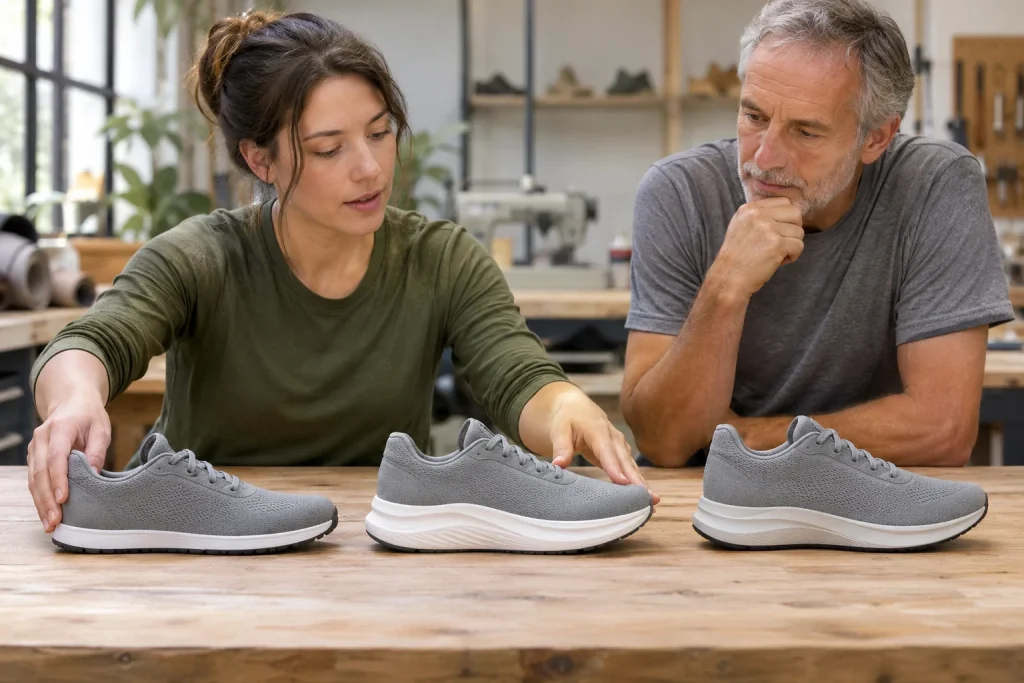
For our construction example, imagine two equally thick soles. One curves upward earlier at the front; the other remains flat longer. Even with identical foam and mass, thickness alone could not establish identical operation. Conversely, the same outer outline may hide different internal stiffening. An informative description names these separately.
Geometry can also shape forces’ rotational effects
Torque depends not only on force but on its line of action relative to the joint axis. Sole construction can change the ground-contact environment, affecting moment arms together with the runner’s posture. Greater stack height alone does not reveal the direction of every joint torque. Actual movement and force measurement show how the runner solved the task.
Flores and colleagues found differences in ground-reaction-force and limb alignment, joint movement and moments when examining a stiff element’s position within a shoe. This is a specific example of the geometric relationship. Plate location is not another name for material “strength”, but part of the whole system’s spatial organisation.
Our mechanics reminder: 800 newtons with a 0.025-metre perpendicular moment arm gives 20 newton-metres. A 0.030-metre arm gives 24 newton-metres for the same force. We do not calculate shoe effects from this, because the actual arm is not simply one sole-thickness figure. It shows why force and movement relationships need examination alongside construction labels.
 Enlarge image
Complete-shoe comparison answers a whole-package question
A new model with different foam, mass and sole shape gives its wearer a new system. This usefully shows which outcomes were measured in each complete shoe, but is less suited to assigning every difference to one component. The control model’s name belongs to the result just as much as the more favourable shoe’s.
In the 2026 experiment reported by Bolliger and colleagues, three specific shoe conditions were compared at slower running speeds. The advanced-technology model had a more favourable oxygen cost than the controls examined. Measurement described the human response to complete shoes, not a percentage breakdown of separate foam, plate and geometry contributions.
Write down two sentences from such a study. First, which products were compared in which task. Second, which outcome differed. Label a component explanation as a hypothesis if not experimentally isolated. A product advantage can be real while exact component contributions remain open.
A four-condition experiment helps separate foam and plate
In Perry and colleagues’ original research, four conditions combined EVA or PEBA foam with or without a stiff plate. Eight men and six women ran the protocol, with shoes examined in repeated mirrored order. The aim was not to rank four shop shoes differing in every respect, but deliberately to separate two factors. With identical geometry and mass, the researchers examined foam and plate relationships with economy.
Relative to the conventional-foam, no-plate baseline, changing foam or adding a plate separately gave approximately 1.3 per cent favourable differences, and together approximately 1.9 per cent. Importantly, the study found no significant foam–plate interaction. The difference between summed point estimates and the combined result therefore cannot simply be called a proven, universally applicable mutually weakening effect.
This illustrates why experimental tables and statistical questions need reading together. One part shows observed averages; the other shows how strongly data supports a particular difference or interaction. An interesting numerical detail does not require a stronger mechanistic conclusion than the full analysis supports.
Our example: addition and interaction are different ideas
The following table uses wholly invented cost indices. A conventional baseline is 100 units. We imagine 97 with foam changed alone, 98 with a plate alone and 94 with both. The changes separately reduce cost by 3 and 2 units. Simple addition predicts 95, whereas the chosen combined value is 94: one further unit of difference appears in combination.
| Our hypothetical condition | Without a plate | With a plate |
|---|---|---|
| First foam type | 100 units | 98 units |
| Second foam type | 97 units | 94 units |
Another invented system could have a combined value of 96, giving a smaller total effect than the simple sum of separate improvements. These examples illustrate interaction: is one factor’s effect the same in both states of the other? Real data also involves individual variation and measurement uncertainty, so four group averages alone cannot settle statistical certainty.
This matters in everyday shoe explanations because benefit percentages from separate studies cannot automatically be added. They may involve different people, baseline shoes, foams and tasks. Differences found for a plate and a foam need not sum in a third product. Examine the particular combination.
A shoe targeting one property does not hold the person unchanged
In Petrella and colleagues’ 2026 study, nineteen well-trained male runners used two shoe conditions differing in midsole compliance. Alongside a favourable economy result, several knee-motion and power characteristics changed. Even in this targeted construction comparison, the whole runner’s movement response appeared. The authors treated direct examination of muscle fibres as further work.
A controlled shoe variable therefore does not mean everything within the body stays unchanged. The question is precisely what response the modification produces. Changes in leg-model stiffness or knee position with a more compliant sole may contribute to understanding the mechanism. Shoe–human interaction cannot be reduced to passive materials alone.
Cigoja and colleagues’ related stiffness research also showed differing movement of the foot arch and estimated muscle–tendon units. This again illustrates how a local construction change can affect other parts. Examining a plate separately is useful for this reason too, while results need interpretation within the complete movement system.
 Enlarge image
Compare measurable properties rather than product names
A clear shoe-comparison note should contain more than brands. Include mass and the shoe size used for that measurement, characteristic stack height, known foam mechanics, geometry and stiff-element design. Not every property is available for every product. Mark missing information as missing rather than inferring it from a marketing name.
- Mass: which size, and one shoe or a pair?
- Compliance: how much does the structure deform under what load?
- Return: which material or complete-shoe test produced the ratio?
- Geometry: which external curvature and internal plate location are known?
- Human outcome: energy demand, comfort or movement data?
Retain the method alongside laboratory mechanical properties. Bending stiffness and compression stiffness differ. A foam sample and complete shoe are different measurement objects too. Results from different procedures may only be comparable within their own category. Shared units alone do not guarantee identical protocols.
Keep usage experience in a separate column. A well-fitting upper, pleasant underfoot feel on a familiar route and manageable pace all matter. They need not be artificially explained as one component’s effect. Runners wear complete shoes, so experience of the whole product has its own value even when an internal cause cannot be isolated at home.
The level of causal explanation should follow the experiment
If two complete shoes were compared, conclusions should first concern those complete conditions. A targeted plate-location change allows discussion of that specific arrangement. Four foam-and-plate combinations allow analysis of separate and combined roles. Research gains meaning when design and inference remain aligned.
The same applies to your everyday shoe change. “Rolling felt more pleasant in this new model on this run” is precise. “The plate definitely reduced my knee load” names a mechanical cause and outcome you did not measure. You need not justify experience through an overly detailed internal explanation. Observe what is actually accessible well.
Thick soles, foam, curvature and stiffening together form the construction interacting with a runner. Separating components matters scientifically, and human testing of the complete system matters equally. Connecting each to its proper question makes shoe technology clearer: fewer general labels, more specifically named properties and genuinely supported conclusions.
Sources
- Flores and colleagues: stiff-plate location and movement geometry.
- Perry and colleagues: four-condition, mass-matched comparison of foam and plate.
- Petrella and colleagues: targeted examination of midsole compliance.
- Cigoja and colleagues: shoe stiffness and estimated foot function.
- Bolliger and colleagues: human comparison of complete shoe conditions.
How Futószív articles are prepared: our editorial guidelines.