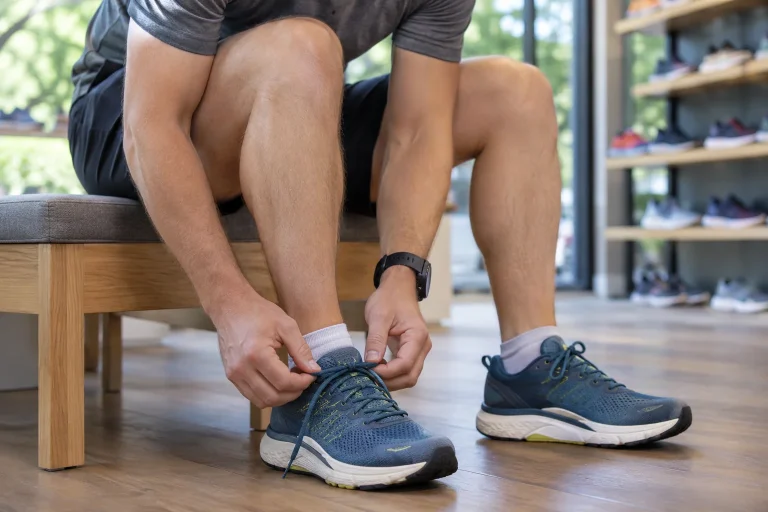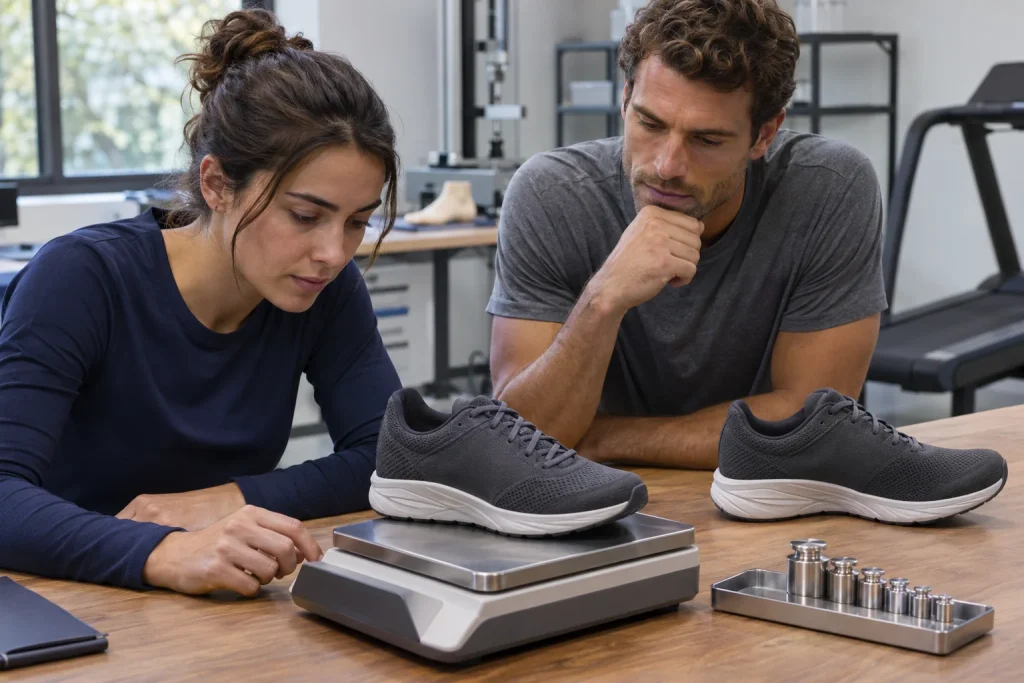
A hundred grams on a shoe seems small compared with a whole person’s mass. Running involves more than moving the whole body forwards, however: mass on the foot follows a different path with every step from an object carried at the waist. Shoe-mass research therefore requires a carefully designed comparison, rather than simply weighing things on kitchen scales. Added mass must be distinguished from changes caused by cushioning and construction.
A single shop specification in grams cannot settle whether lighter is always better. This article begins with a classic mass-controlled study, then uses our own mechanical and experimental-design examples to explain the comparison. It is neither weighted running training nor a barefoot-transition programme. The aim is to understand what researchers can isolate and what should remain separate when choosing your shoes.
First identify precisely what the gram figure means
Shoe mass is usually specified for one shoe in a particular size. If a model is 100 grams heavier per shoe, the pair differs by 200 grams. This basic unit question matters when reading research too. “100 g per shoe” and “100 grams in total” are different conditions. Always check whether a number refers to each foot or the whole pair.
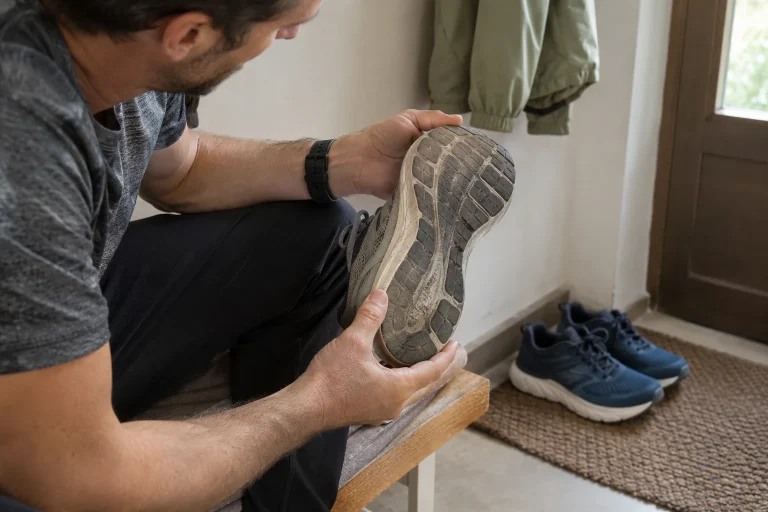
Size and measurement condition can matter too. The catalogue sample size’s mass is not necessarily the exact mass of your larger or smaller shoes. Moisture or dirt can contribute when weighing used shoes. A clear comparison therefore names size and condition, rather than placing grams copied from different sources beside two brand names.
Our example: one shoe of model A weighs 220 grams and one of model B weighs 270. The difference is 50 grams per foot and 100 grams per pair. Treating this as a 100-gram difference per shoe doubles the input in the reasoning. Any percentage calculated afterwards would rest on the wrong basis, even if the chosen formula were otherwise correct.
What did the classic mass-controlled study add?
In Franz, Wierzbinski and Kram’s original experiment, twelve men experienced in barefoot running ran at 3.35 m/s with a midfoot strike. They were studied barefoot and in lightweight cushioned shoes, with additional conditions adding mass to the feet or shoes. Respiratory-gas measurements compared energy requirements across conditions. The design aimed to separate the effects of mass and wearing shoes.
Within the range studied, adding 100 grams per foot increased oxygen uptake by approximately 1 per cent. Barefoot and shod running did not clearly differ by themselves, but at equal mass the lightweight cushioned shoe produced a more favourable energy requirement. The research therefore showed both the role of mass and how other shoe properties can offset a mass difference. This is a result from a specific sample and protocol, rather than every runner’s personal grams-to-seconds formula.
Retain the participants’ experience and movement pattern. The research did not study transition in beginners who had never run barefoot, and it was not an injury programme. A controlled measurement setting therefore does not recommend abruptly abandoning shoes or changing foot strike to save mass. The scientific question here is separating components of energy demand.
 Enlarge image
Why is mass on the foot different from mass at the waist?
An object’s path matters when changing its motion. In a simple model of a swinging limb rotating around an axis, mass farther away can create greater rotational inertia about that axis. The relationship I = m × r² illustrates this for a point mass. A real human leg is not a single rigid rod, so we use the formula only to illustrate the geometric difference.
In our example, 0.10 kilograms at a distance of 0.8 metres contributes 0.064 kg·m² of inertia. At 0.2 metres, the same mass contributes 0.004 kg·m². Their ratio is sixteen, although the added mass is identical. This does not mean the runner’s energy demand increases sixteen times as much. It simply shows why masses carried in different places cannot be treated as identical mechanical tasks solely on the basis of grams.
During running, the leg moves around several joints, its path changes and muscles act together to perform the task. Mass carried at the waist has effects too, but creates a different task. “It is nothing compared with body weight” therefore does not settle shoe-mass questions. Researchers must actually compare the particular placement of mass.
Mass manipulation in a laboratory is a measurement tool, rather than a home training idea. Attachment, distribution and test conditions belong to the protocol. Interpreting available research and observing normal use provide enough starting information for choosing shoes; you need not add homemade weights to your feet to demonstrate the classic experiment on yourself.
Cushioning and mass can act simultaneously
Comparing two complete shoes can mix at least two kinds of effect. The cost of carrying a heavier structure may differ, while foam and geometry may change how the body functions. A lighter shoe with a different design is more than a few grams removed from an older model. When several properties change at once, the net outcome does not identify every component’s contribution.
Using an invented cost index of our own, suppose condition A is 100 units. Another construction at equal mass would give 97, while for illustration we imagine extra mass adding +1 unit. Complete condition B could therefore be 98. This example assumes additive effects and is not an actual shoe model. It shows that a heavier shoe could produce a more favourable overall result if other changes offset the cost of mass.
In another case, the structural advantage might be smaller and mass could offset or reverse it. Real interactions are not necessarily simply additive, which is why an actual human comparison is needed. A “guaranteed advantage percentage” constructed from components alone can easily claim more than any measurement demonstrated.
The 2026 study at slower speeds also compared complete shoe conditions, including conventional, advanced-technology and hybrid prototype shoes. Group differences applied to those particular models. This is a different research task from progressively adding mass to one otherwise unchanged shoe. Both are valuable when used to answer their own question.
How is a comparison designed to isolate effects?
We can imagine four conditions: lighter and heavier versions of one construction, then lighter and heavier versions of another. Within the same construction, we can examine mass change; at equal mass, we can examine construction differences. This illustrates experimental design, rather than claiming any specific study used exactly these four conditions.
| Our hypothetical condition | Construction | Mass | What can it examine? |
|---|---|---|---|
| A | First construction | Lower | Starting reference. |
| B | First construction | Higher | Mass change within the same construction. |
| C | Second construction | Lower | Construction comparison at a shared mass level. |
| D | Second construction | Higher | Further checking of interactions. |
Managing order matters because a runner may warm up or become fatigued between trials. Familiarisation, rest, speed and measurement equipment matter too. A good protocol attempts to separate these factors from the variable being examined. Completely identical weather or daily condition is not always possible, but research should show how it reduced confounding effects.
Isolation can have a technical cost too. An added element is not only mass if it also changes shoe bending or fit. The methods description is therefore more than a formality: attachment and construction details reveal how cleanly “we changed only grams” applies. As a reader, consider control quality, rather than only the final percentage.
What do comparisons of modern complete shoes show?
In Kuzmeski and colleagues’ 2026 research, fifteen trained runners ran under four advanced-footwear conditions. A prototype produced through computer-based, data-driven design was compared with other modern models and showed more favourable average running economy. The study evaluated complete product constructions. It was not an isolated test establishing that shoe mass alone caused every difference.
For a new-generation shoe, grams are therefore just one column. Human testing reveals responses to different designs, and the control model matters too. An article reporting shoe mass alongside a physiological advantage does not establish the entire causal relationship by presenting them together. Lower mass may contribute, but other changes would need to be isolated separately.
Modern findings do not invalidate the classic mass study. They add that complete construction develops too. Accurate interpretation retains two statements: mass carried on the foot may impose a physiological cost, and other shoe properties can also influence running’s energy demand. Neither needs to disappear for the sake of the other.
 Enlarge image
Do not automatically convert the percentage into marathon seconds
Laboratory oxygen cost belongs to a given external speed. Total race time results from many factors. If a study associates added mass with an approximate cost change, you cannot directly subtract the same percentage from your target time. How cost changes at a fixed pace is a different question from which pace you can sustain over a whole race.
Our calculation warning: 1 per cent of a four-hour marathon is 2 minutes 24 seconds. This is mathematically correct, but not a personal time saving derived from shoe-mass research. Connecting the two quantities would require an additional performance model and appropriate evidence. Appealing second-by-second precision does not supply that connection.
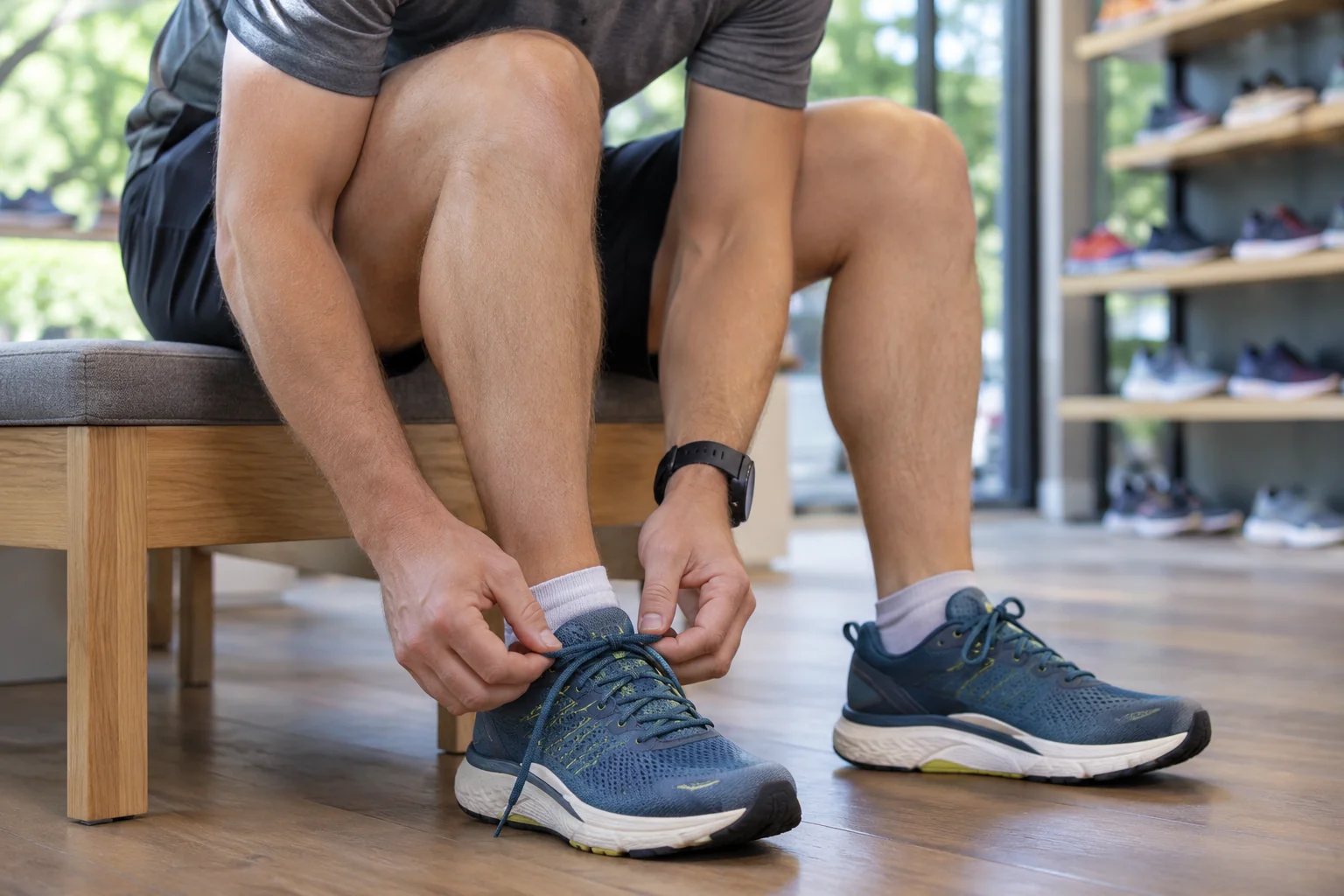
Lightweight construction may matter in your own choice, but fit and comfort also form part of usability. A shoe selected solely by grams may not serve the particular route or task well. It is more useful to compare mass clearly in the same size, then add construction and personal-use considerations.
What should you take from the scales to the running track?
Scales can provide accurate shoe-mass data, but not a complete ranking of running economy. Research can say more about mass when other factors are managed deliberately. The usability of the whole shoe requires separate evaluation for a given person, task, environment and comfort.
- First, the unit: one shoe or a pair, in which size and condition?
- Then the control: the same construction modified, or a completely different shoe?
- Next, measurement: which speed, participants and physiological outcome?
- Finally, the decision: what does the gram figure add to your own task?
The story of a hundred grams then becomes more interesting than a simple light-versus-heavy judgement. It shows how research can isolate a component and why a shoe should be understood as a structure working with the body. Grams matter, but a decision also requires knowing what those grams carry: which fit, geometry and use characteristics they bring into the next step.
Sources
- Franz, Wierzbinski and Kram: mass added to the feet and the metabolic cost of barefoot and shod running.
- Bolliger and colleagues: comparison of complete shoe conditions at slower speeds.
- Kuzmeski and colleagues: data-driven shoe design and human economy measurement.
How Futószív articles are prepared: our editorial guidelines.