A shoe foam is labelled as returning a large proportion of energy. Will the runner therefore use that same proportion less energy? No: mechanical testing of foam and human running economy ask different measurement questions. One loads a specified sample; the other measures the physiological cost of a living person running at a given speed. The two results can be connected, but cannot be substituted for one another.
Understanding the difference helps with more than interpreting advertising percentages. It also explains why the whole sole structure, the amount of energy and the timing of its return matter. This article uses our own calculations, original materials testing and human shoe experiments to explain the two levels. The aim is to name a genuine benefit correctly, rather than devalue the technology.
A machine loads a sample in a predefined way
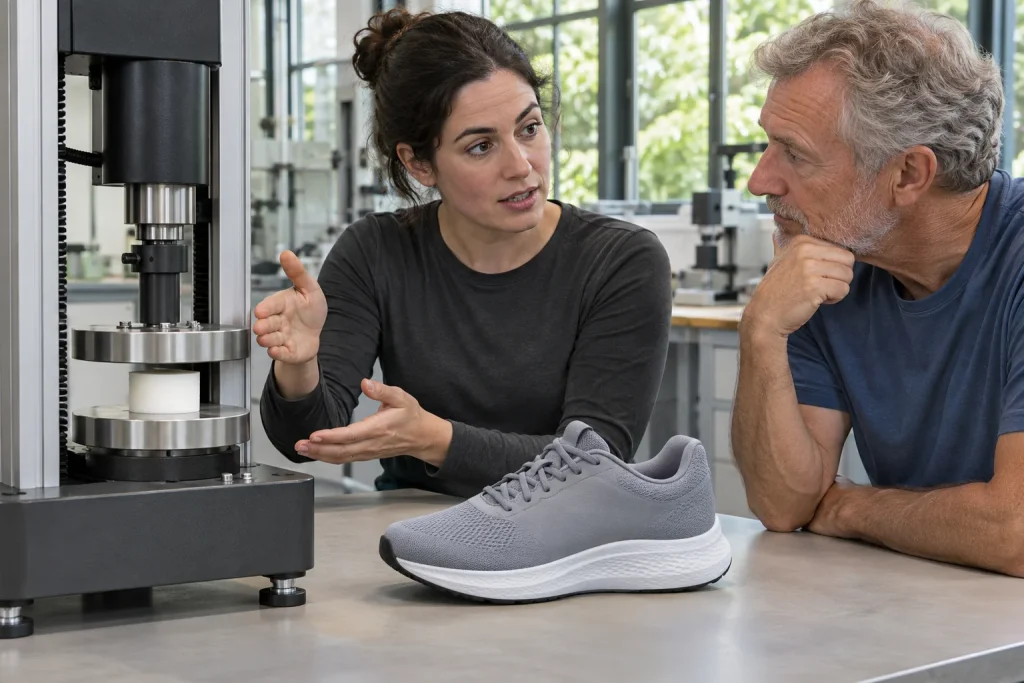
In foam testing, the specimen’s size, shape and loading method can be specified. A machine can track force and displacement during compression and unloading. Their relationship allows work, or energy, to be calculated. The ratio of energy recovered from the sample during unloading to energy put in can provide an energy-return percentage. The output is meaningful only alongside the defined procedure.
The original methodological and measurement study Energy return in footwear – revisited separately compares slow compression and impact testing. It includes input and recovered energy calculated from force–displacement curves, as well as the difference between them. Its central lesson is that the percentage depends on the test method; similarly named energy-return figures may come from different loading procedures.
A material name is therefore not a full measurement description. Alongside “foam return”, ask about specimen shape, load magnitude, loading speed and which cycle was tested. A cut-out specimen and a complete shoe sole present different tasks. The percentage alone does not identify which physical situation in which part of a running step the test attempted to represent.
The percentage’s denominator matters at least as much as its numerator
In our simple example, a machine does 5 joules of work on a sample, which returns 4 joules during unloading. The return ratio is 4/5 = 80 per cent, with a difference of 1 joule. This does not mean the system generated 80 per cent new energy. Some of the energy previously put in has returned. In this example, input and output belong to the same test cycle.
For another sample, suppose the input is 10 joules and the returned amount is 7 joules. The percentage is 70, lower than before, but the returned energy is 7 joules, which is greater. Looking only at percentages hides this difference. The sample’s load capacity, input energy and absolute recovered amount are separate measurements.
| Our illustrative sample | Input | Returned energy | Ratio |
|---|---|---|---|
| A | 5 J | 4 J | 80% |
| B | 10 J | 7 J | 70% |
We do not select running shoes from this table. It contains samples loaded with different inputs, so the examples do not represent identical use conditions. They serve to distinguish percentages from joules. A sound comparison first aligns method and loading; only then can differences between percentages be discussed.
 Enlarge image
Compression, return and timing are three separate properties
A softer element may deform more under a given force. This still does not establish what proportion of energy it returns or how quickly. Compliance, loss and the time course of recovery are separate concepts. The everyday word “springy” can confuse all three, although they play different roles in a running step.
In our timing example, two elements each return 4 joules. One does so in 0.10 seconds, the other in 0.04. Average power is 40 and 100 watts respectively. Energy is identical; its output over time differs. This simplified calculation does not estimate a runner’s power, but shows why a single return percentage is not a complete description of behaviour.
In relation to the runner’s movement, when and in which direction the returning mechanical effect appears also matters. A machine test can use a predefined cycle, but the person wearing the shoe continually changes body position and force pathways. A foam property is therefore one important input to the complete system. The human outcome must be observed separately.
Limits to the material’s deformation are also part of the question. If a specimen operates within a completely different force range in testing than in use, applicability of the percentage needs reassessment. Finding the same polymer name on two specifications is insufficient. Sample density, thickness and geometry are part of the mechanical system tested.
Why is the path from machine-measured joules to human energy demand not straightforward?
During running, people do more than compress shoe foam. Muscles generate force, limbs move, tendons may store and return energy, and the body’s centre of mass rises and falls. Changing a shoe can alter these subprocesses too. Foam output therefore cannot establish the whole body’s cost through a single direct multiplication.
In Cigoja and colleagues’ original study, modifying shoe bending stiffness was accompanied by changes in estimated motion of the arch and muscle–tendon units. Shoe–foot interaction was therefore more than adding a simple material property to an unchanged person. The quantities studied came from mechanical models, rather than metabolic values taken directly from a foam percentage.
In our own thought experiment, suppose an element returns 1 joule more energy per cycle. This does not necessarily reduce the runner’s whole-body physiological cost by exactly 1 joule. Different force production, timing and movement may occur, and the efficiency of active function is not a simple constant conversion for every subprocess. A human comparison must reveal the actual cost difference.
If an advertisement retells a foam percentage as a running-economy percentage, inspect the denominators. The first may involve mechanical energy put into a sample; the second, human metabolic cost measured at a given speed. They involve different systems and quantities. Sharing a percentage sign does not give the two results the same meaning.
What does a human crossover shoe study measure?
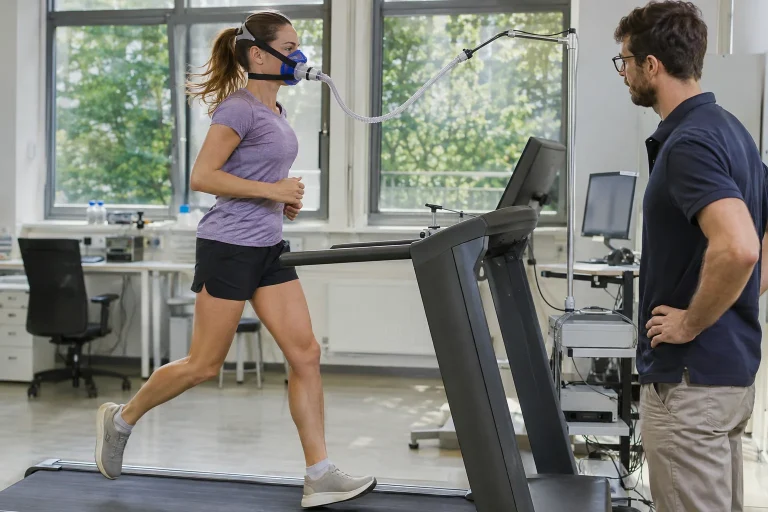
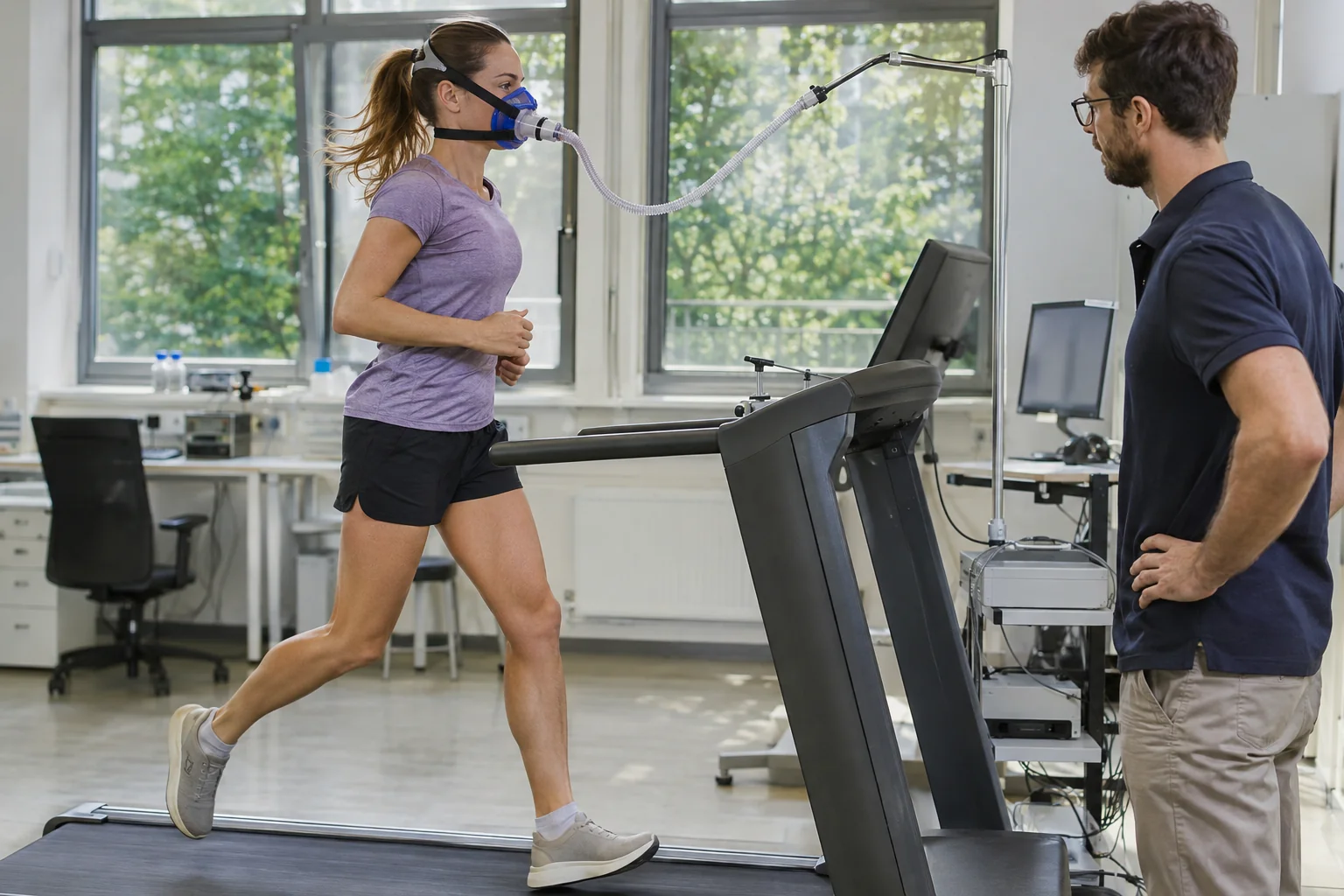
In a human comparison, the same runner can perform an identical external task under several shoe conditions. Respiratory-gas measurements can establish the task’s oxygen or energy cost. Managing order, speed and repetition helps separate shoe differences from fatigue or daily condition. The specific protocol determines how strong a comparison is obtained.
In Bolliger and colleagues’ 2026 study, fourteen runners completed the protocol under three shoe conditions, at four speeds and on three separate days. Measured oxygen cost, perceived effort and comfort were separate outcomes. One advanced shoe showed a more favourable cost than the controls, while no clear comfort difference was found. They measured the human response to the complete product, rather than directly converting a single foam sample’s value.
In the 2026 experiment reported by Kuzmeski and colleagues, fifteen trained runners took part in an economy comparison in four advanced shoes. A prototype developed through data-driven design produced a more favourable result than the models examined. Here too, the whole construction underwent the human test. Such a finding can support a physiological claim under the tested conditions, but the separate roles of individual components would need separate investigation.
Two levels of evidence are therefore useful to runners: a materials test describes the mechanical property examined; a human experiment shows the physiological response to that particular shoe. Having both makes the explanation clearer. If only one is available, do not imagine the other’s result into existence.
The first cycle and a repeatedly loaded sample are different states too
Materials testing may also include repeated loading. The original fatigue study of elastomeric foams used in running-shoe midsoles examined several commercial foams through cyclic compression and microstructural methods. Cushioning and return properties changed across loading cycles. This provides examples of different material states and damage processes, rather than a universal shoe-replacement mileage.
A manufacturer figure based on an initial measurement of a new material sample does not necessarily describe its state after extended use. That requires knowing after which cycles, conditions and loads it was tested again. Linking laboratory cycles to actual running kilometres requires additional assumptions. Shoe uppers, outsoles and the runner’s use can introduce further differences.
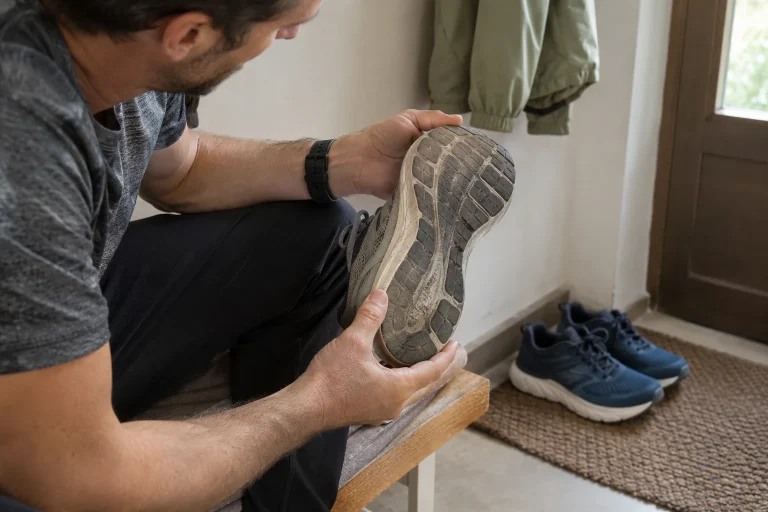
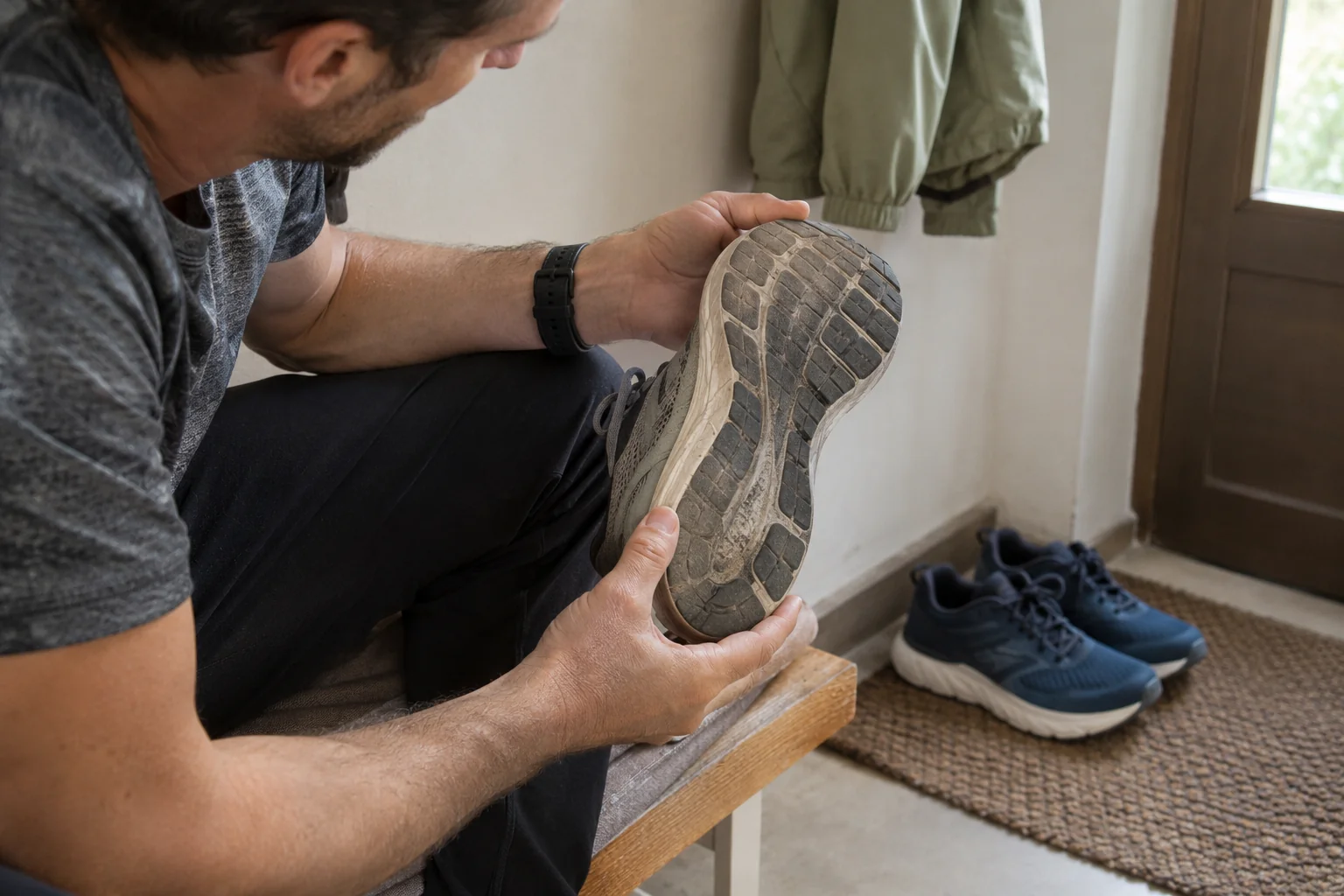
When observing your own shoes, you can track comfort, the sole’s visible condition and the familiar experience of use, but this does not yield an authoritative personal return percentage. Pressing a sole by hand is not the same load as an instrument’s specified cycle either. It can remain a useful everyday observation without being called a laboratory value.
 Enlarge image
How should you read a high energy-return percentage?
First identify whether it concerns a foam sample, midsole or complete shoe. Second, find the method: slow compression, cyclic loading or impact testing? Third, identify the reference: input energy, returned energy, loss or another similarly named measure? Once these are clear, the percentage becomes a specific measurement claim.
- Sample: a piece of material or a specified part of the complete product?
- Loading: are force, displacement, speed and number of cycles known?
- Ratio: exactly which output was divided by which input?
- Absolute value: are joules or other physical measurements given alongside the percentage?
- Human evidence: was the particular shoe’s running economy measured separately?
Distinguish percentage points from relative increases too. In our example, the return ratio rises from 70 to 80 per cent. This is 10 percentage points and a relative increase of approximately 14.3 per cent from the starting value of 70. Neither automatically means a 10 or 14.3 per cent reduction in the runner’s energy demand. The calculation describes change in the specified material property.
If the test description is missing, the best conclusion is that the method behind the figure is insufficiently transparent for comparison. You need not decide the whole shoe’s quality from this. Comfort, fit and human studies may still provide information; it is simply not possible to place that particular materials percentage precisely in context.
A material advantage is useful when it works within the human system too
Good energy return can be a real and important material property. Runners must nevertheless move with the complete shoe. Foam, mass, plate and geometry interact, while the body actively solves the task of running. The physiological benefit therefore becomes assessable within the whole system through appropriate human measurement.
Next time you see a large percentage, ask whose or what energy it concerns. If it belongs to foam loaded in a machine, read it as a materials test. If it belongs to a runner, look for speed, the control shoe and protocol. The two levels can then remain connected without either promising something on the other’s behalf that was never actually measured.
Sources
- Energy return in footwear – revisited: original materials-testing and methodological analysis.
- Compression fatigue of elastomeric foams used in midsoles of running shoes: repeated material-loading study.
- Cigoja and colleagues: shoe modification and estimates of the foot’s muscle–tendon function.
- Bolliger and colleagues: human shoe comparison at slower speeds.
- Kuzmeski and colleagues: economy testing of complete shoes.
How Futószív articles are prepared: our editorial guidelines.