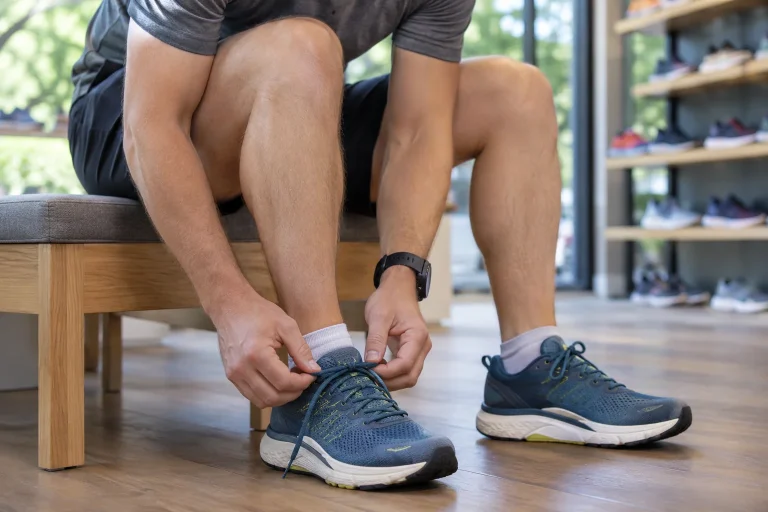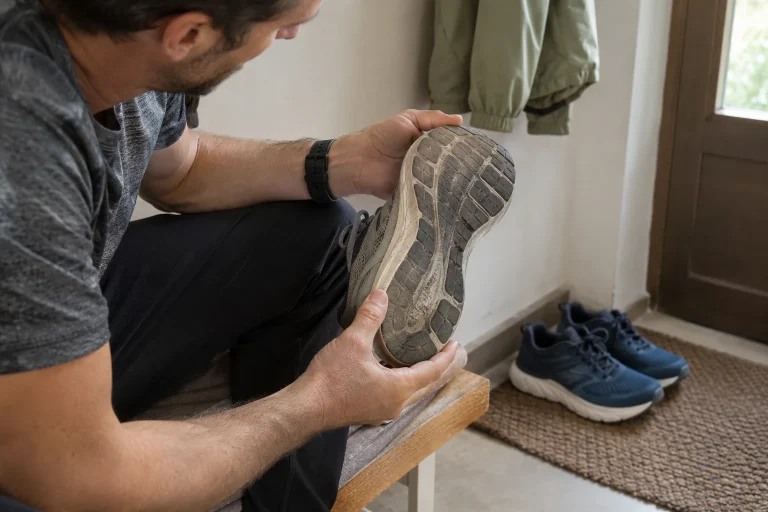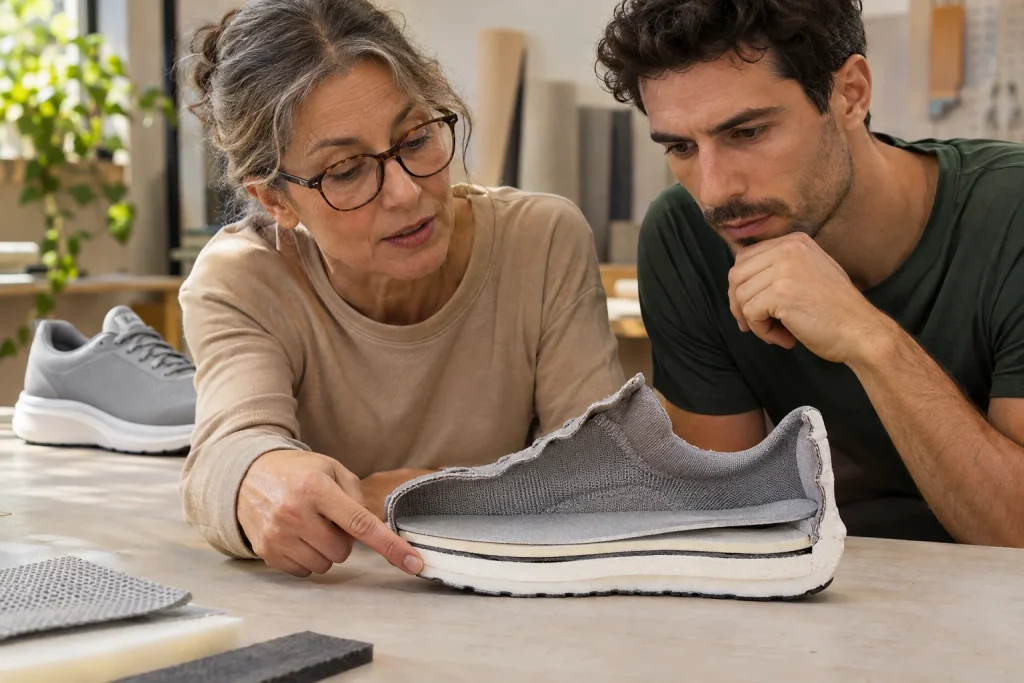
Two running shoes can both contain a stiff plate without producing identical movement sensations or foot function. Alongside material and bending resistance, its position between sole layers matters. Is it closer to the foot or deeper towards the outsole? Which foam, geometry and ground contact surround it? The label “carbon-plated” does not answer these questions.
Position within a shoe is a mechanical question. Foot bending, ground-reaction-force direction and its moment arm relative to the movement system can change. This article explores the relationship through a specific construction experiment, our own moment examples and practical questions for product descriptions. It does not seek one ideal layer arrangement for every runner, but explains why a shoe is more than a list of its materials.
High and low plate positions refer to the shoe’s layers
A sole can contain parts serving several functions: a removable insole under the foot, structural and cushioning layers beneath it and an outsole facing the ground. The stiff element is positioned relative to these. Here, high and low therefore refer to plate placement within the structure, rather than total stack height or heel-to-toe drop.
A cross-sectional drawing can help, but identify exactly what it represents. Manufacturer illustrations may be schematic, and the plate’s path may differ at the heel, midfoot and forefoot. A stripe visible from the side does not necessarily reveal the full layering. For a question about actual construction, a model-specific detailed description is worth more than one marketing caption highlighting a material name.
Our reading example: two specifications both list a 40-millimetre heel height and a stiff insert. This still does not establish the plate’s distance from the foot, its curve or where it loads the foam. Those two shared figures allow several constructions. Total stack height and an internal component’s position are separate, complementary information.
What did the plate-position experiment compare?
In Flores and colleagues’ original study, fourteen male recreational runners ran at two individually determined speeds. In one condition, the stiff element lay beneath the insole; in the other, between midsole and outsole. Researchers analysed ground-reaction force, joint movement, net moments and work. This was a specific placement comparison, rather than an evaluation of all plated shoes in general.
At the speeds studied, the higher placement showed lower propulsive ground-reaction force, different MTP and ankle movement, and better alignment between the ground-reaction force and the leg. Lower lower-limb moments and less positive knee work also appeared compared with the lower placement. The study demonstrated the biomechanical response to a particular structural change. It does not automatically establish identical comfort or racing advantages for every runner.
For readers, the key insight is that this relationship exists. A plate is more than present or absent: its position belongs to geometry working with the runner. Ask questions the comparison genuinely opens: what changed in force direction, where did joint movement change and which work curve followed? These are more specific than the general question “which carbon is better?”
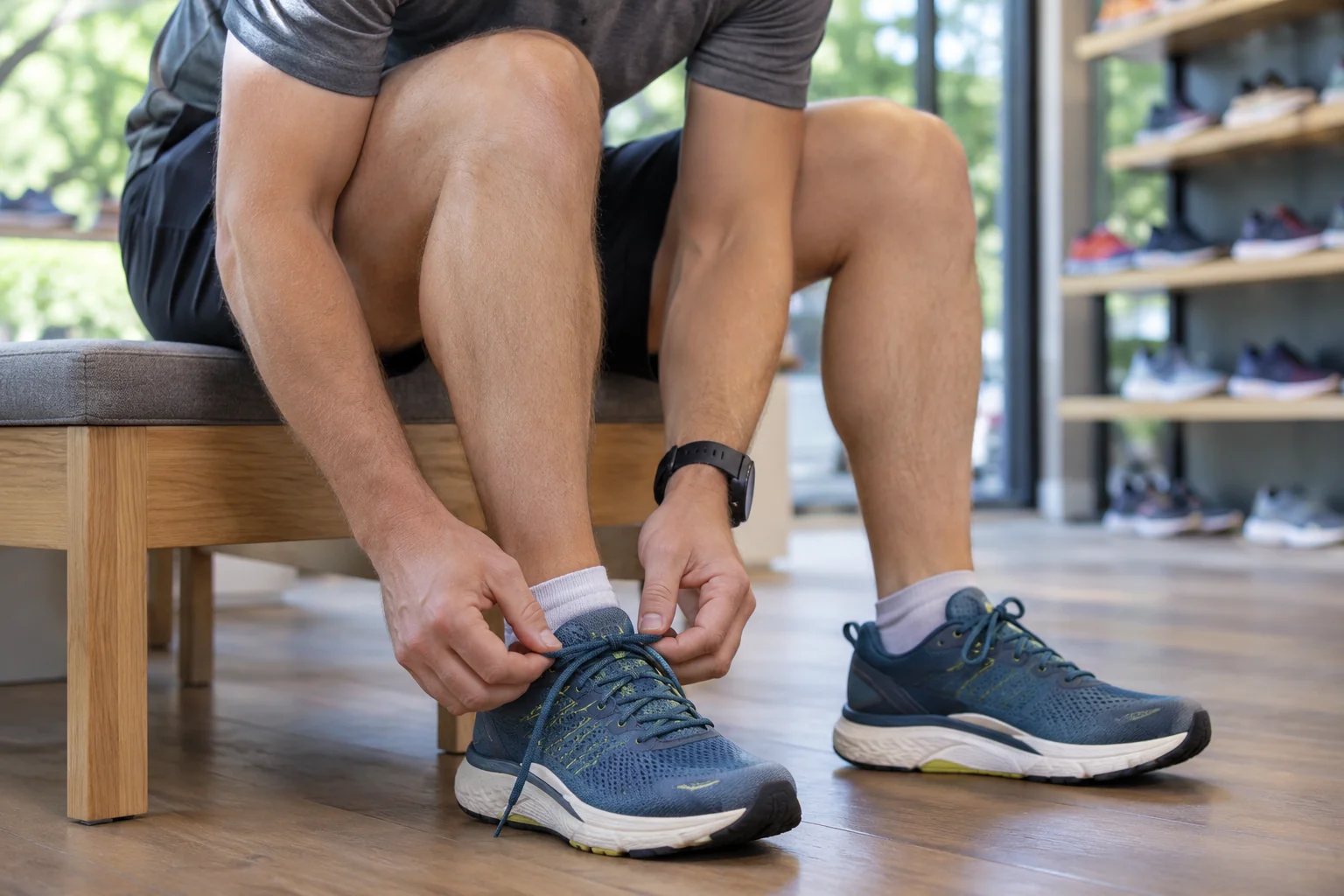 Enlarge image
A moment depends on both force direction and its moment arm
The turning effect around a joint depends on more than force magnitude. The perpendicular distance between the force’s line of action and joint axis, or moment arm, matters too. A force line can move closer to an axis without the total force decreasing. The moment can then fall. This is a basic mechanical relationship, rather than something unique to shoes.
In our simple example, 1000 newtons acting with a perpendicular moment arm of 0.03 metres produces 30 newton-metres. Keeping force the same but reducing the arm to 0.02 metres gives 20 newton-metres. Force did not decrease, yet the turning effect fell by one third. The numbers illustrate the relationship, rather than report measurements from a particular ankle or knee.
The reverse example is especially instructive. Force falls from 1000 to 900 newtons, but the moment arm increases from 0.02 to 0.03 metres. The moment rises from 20 to 27 newton-metres. A smaller force produced a larger turning effect. One force column therefore cannot establish the direction of change in every joint moment: geometry must be considered too.
The running leg is a more complex system moving in several planes, so we do not calculate actual tissue loading from this example. It helps make sense of the alignment measured in research. Changes in force line of action and limb position can alter the joints’ mechanical task. Local shoe construction can therefore connect with more distant movement variables.
The toe-base joints and ankle do not respond identically
The joints at the bases of the toes are often abbreviated MTP. Forefoot movement and ankle-angle change are different coordinates. A larger or smaller excursion in one does not automatically describe the other. Shoe studies therefore provide separate curves for the two areas, and their relationship over time is worth examining too.
Sole bending and anatomical joint angle are different things as well. External foam may deform while tracked points on the foot describe another motion. A video of a shoe bent by hand therefore cannot replace foot kinematics recorded during running. It involves different loading, geometry and objects of observation.
Another original stiffness experiment, comparing the same shoe with and without a carbon insert, found redistribution of positive work at the MTP joints and knee. This is a complementary mechanical example: a local shoe change can affect outcomes at several joints. Plate placement and increased stiffness are nevertheless different interventions. Their research questions should not be treated as identical.
A useful note-taking method is to write beside each figure which component, property and use situation changed. “Plate position” is a different entry from “whole-shoe bending stiffness”. This prevents two studies on similar topics from forming a seemingly uniform story broader than the actual investigations.
A shared laboratory trend does not define a universal runner type
A small-sample study at specified speeds provides data about its own participants and conditions. A group average may help explain construction, but is not a personal selection formula. Predictively classifying a runner requires other data and a decision rule checked in advance. A single knee angle or body mass does not automatically become that rule.
In 96 runners, Chollet and colleagues found different individual physiological responses to modifying the bending stiffness studied. There was no clear group-level improvement, while groups formed afterwards showed both more and less favourable changes. This studied responses to stiffness, rather than providing a personalised test of high versus low plate placement.
Together, these findings teach us what information remains missing for a particular purchase. Construction may be mechanically interesting; individual comfort and energy demand remain separate questions. A runner may feel more comfortable in a shoe without research allowing us to calculate their precise joint moments. Preserve that experience as personal information, rather than necessarily explaining it through an effect in a laboratory group.
Comfort, economy and joint work are separate endpoints
Comfort is subjective experience; running economy is physiological cost measured at a given speed; joint work comes from mechanical calculation. Change in one does not guarantee matching change in the others. Comparing shoes’ oxygen costs requires a human physiological comparison. Asking which is more comfortable over a longer run cannot be answered fully by a short mechanical trial.
Our fictional scenario: a runner tries two shoes. One feels smoother through the forefoot, while standing feels more stable in the other. This does not establish lower knee moments in the first or greater tendon energy return in the second. The observations are still useful: they identify perceived use characteristics. Precise wording preserves their value.
Mechanical data do not become less interesting because they fail to answer every question. A construction changing moment arms can help explain foot movement and generate new research tasks. Transparent product communication states what was actually tested. Naming the measured endpoint offers much more than summarising something as “more efficient in every way”.
 Enlarge image
What should you ask of a product description or research figure?
On a product drawing, first identify the foot and ground, then the plate and surrounding layers. Next, check whether it shows that model’s actual construction or a general technology schematic. A diagram reused for several models is not necessarily a precise cross-section. Model generation and version matter when interpreting construction too.
- Where is the stiff element relative to the insole and outsole?
- What are its shape and extent, and do we know this for the exact model?
- Which mechanical property was measured, under which loading conditions?
- At which speeds and in which participants was the running study conducted?
- Does the finding claim a moment, work, energy requirement or comfort outcome?
Write the study’s two conditions side by side, mentally distinguishing unchanged and changed parts. Changing only plate position permits a different interpretation from changing the whole sole structure too. If the description omits something, leave it as an open question. Do not invent missing construction details from a photograph of a neighbouring model.
During use, track what you can actually observe: fit, comfort, task, duration and how experience develops. Without your own laboratory, you need not manufacture personal moment-arm or joint-work results. Musculoskeletal questions can be interpreted alongside the complete running situation. A shoe’s internal drawing provides interesting background, rather than a personal diagnostic finding.
Plate position is an important relationship within the whole structure
The answer to the title’s question lies in the path of force and geometry of movement. In another position, a plate may relate differently to foot, foam and ground. Joint excursions, force line of action and net work curves may consequently change. Naming the plate material is therefore insufficient when describing shoe behaviour.
The best reader’s conclusion is specific: this experiment compared these two placements and found changes in these directions in these movement variables. This explains construction’s role while keeping personal comfort and purpose of use open. A technical detail then genuinely explains a running shoe, rather than becoming another label on its box.
Sources
- Flores and colleagues: stiff-plate position and running biomechanics.
- Cigoja and colleagues: bending stiffness and joint work.
- Chollet and colleagues: individual physiological responses to bending stiffness.
How Futószív articles are prepared: our editorial guidelines.