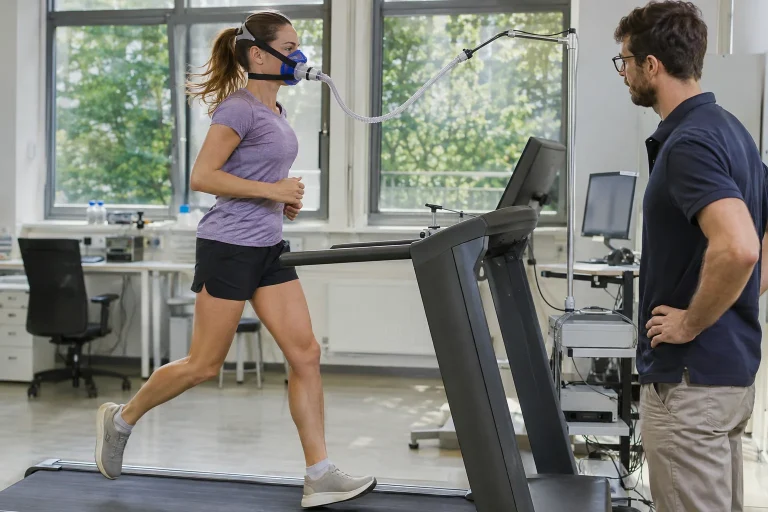
A spring returns stored energy, yet a runner cannot bounce indefinitely without exertion. How can both statements hold? Tendon elasticity and active muscle function are not alternatives. Components of a muscle–tendon unit can undergo different length changes while meeting the demands of the same step. An elastic element can assist movement but does not create free new energy.
‘Energy return’ becomes informative when we ask what lengthened, where stored energy came from and when it returned. This article unpacks those processes using actual ultrasound studies, computer simulations and original simple mechanical examples. It does not provide spring-training instructions; it makes the combined function of living muscle and tendon clearer.
Whole-unit length is not muscle-fibre length
When joint position changes, the associated muscle–tendon unit’s overall path can change too. Muscle fibres and tendon do not necessarily shorten or lengthen equally or simultaneously. Fibre orientation, anatomy and elastic-element behaviour also contribute. Visible ankle position therefore cannot directly reveal movement of every internal component.
An original series-element illustration: an active element shortens by 4 millimetres while its connected elastic element lengthens by 7 millimetres. The whole system in this simple linear arrangement becomes 3 millimetres longer. The active part shortened while the whole unit lengthened. Real muscle geometry is more complex, but the example clearly distinguishes whole length from component changes.
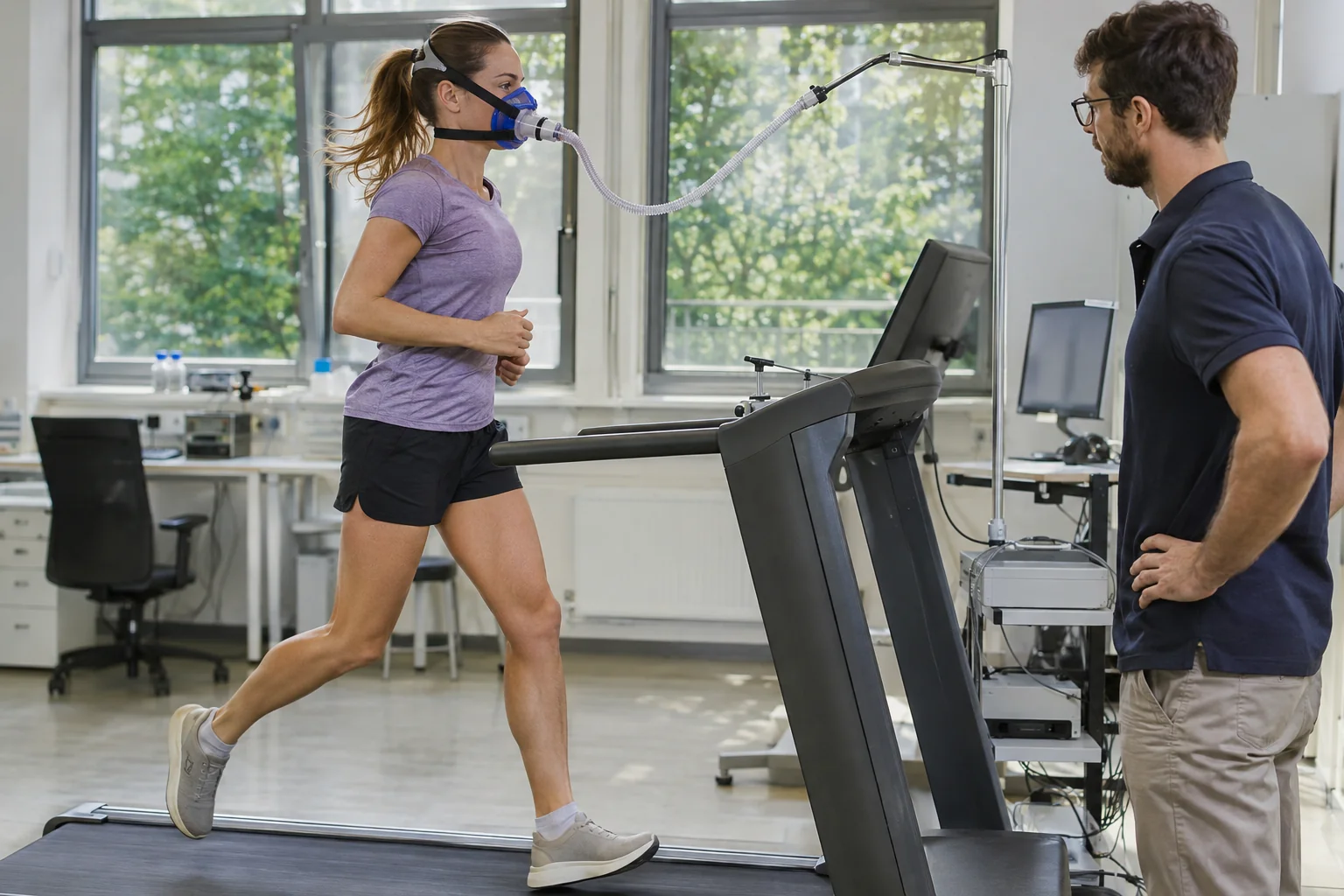
In Lai and colleagues’ in-vivo human study, ultrasound observations of muscle fibres were combined with inverse dynamics at different walking and running speeds. Soleus fibre-length changes were small compared with the complete muscle–tendon unit; the elastic portion contributed substantially to unit changes. The study illuminates precisely what an external running video cannot show separately: different movement of internal components.
Maintaining force remains active even with little length change
Mechanical work and active force production differ. A force-producing muscle may shorten, lengthen or operate at nearly constant length. If an idealised element’s ends do not move relative to one another, external mechanical work may be zero while force is maintained. This does not make the living muscle’s metabolic demand zero. Creating force is itself a physiological function.
Imagine holding an object still: it does not move upwards, yet you exert yourself to hold it. This is not a quantitative running-muscle model, but an illustration of work versus force production. Do not read ‘muscle shortening very little’ as ‘switched-off muscle’. Exact length and shortening velocity form part of operating conditions in running.
An original study examining two important running muscles showed different fibre behaviour in soleus and vastus lateralis. Soleus shortening and near-isometric vastus lateralis function supported different tasks, while elastic elements contributed to both systems. ‘Spring-like running’ therefore does not imply one muscle strategy. Several active behaviours can fit the whole movement.
 Enlarge image
Elastic energy must enter before it can return
An ideal spring stores energy from work performed while stretching it. The spring does not generate that energy. In running, changes in kinetic and potential energy, active muscle function and energy transfer between parts may jointly load the system. Recoil timing affects when stored energy becomes mechanically available again.
Our linear spring example uses stiffness of 100,000 N/m and elongation of 0.01 metres. The formula ½ × k × ΔL² gives 5 joules stored. In an ideal loss-free case, at most those 5 joules return during unloading. Assuming a ten per cent loss leaves 4.5 joules available. These are selected illustrative values, not measured loss ratios for a human tendon.
Energy and power remain distinct here too. Returning 5 joules over 0.10 seconds gives average power of 50 watts; over 0.05 seconds it gives 100 watts. The second creates no more energy: the same amount appears in less time. One stored-joule value cannot therefore explain running’s elasticity; suitable timing and integration with the rest of movement matter too.
Muscle-fibre operating conditions also affect energy demand
Fibre length and shortening velocity influence force production. An elastic element can connect the whole unit and its fibres in a way permitting different velocities. External movement may change faster while some fibres shorten more slowly. Running does not become passive, but active function may operate under more favourable conditions.
In Uchida and colleagues’ whole-body simulation, tendon compliance was varied across speeds of 2–5 m/s. Individual muscles’ estimated metabolic costs responded differently: fibre lengths and shortening behaviour mattered too. A favourable whole-system response in the model does not mean the stiffest or most compliant possible tendon would be optimal for every muscle.
Modelled percentage tendon elongation is particularly easy to misunderstand. It is a parameter set at a defined reference force and examined by the computer under several conditions. It is not an instruction to stretch the Achilles tendon to a particular percentage while running. People do not adjust their force–elongation curves separately while everything else stays fixed. Simulation explains the relationship.
Acceleration and steady running may involve different tasks
At steady speed, movement can return to similar states each cycle. During acceleration, the next step produces greater forward speed, changing the whole mechanical task. Alongside circulating energy, new kinetic energy appears. We cannot expect the same parts to contribute in exactly the same proportions in every running situation.
In Lai and colleagues’ original study of accelerating sprinting, experimental data were combined with computer modelling. Muscle-fibre work contributed more at the earliest ground contacts than in later steps and the steady running used for comparison; stored tendon energy remained important. The study illustrates active and elastic contributions coexisting, not either disappearing entirely.
A pattern observed in easy running should therefore not automatically be sought during a sprint start. Precise speed, acceleration and task descriptions belong in interpreting research. ‘The tendon works during running’ is too broad: which muscle–tendon unit, phase, speed and outcome? Meaningful detail lies in those questions.
Shoes can also change the context for foot and tendon function
In Cigoja and colleagues’ crossover experiment, thirteen recreational men ran in the same shoe with and without a stiffness-increasing insert. Movement data were used to estimate arch and muscle–tendon-unit behaviour. Arch deformation and several shortening quantities differed in the stiffer condition. This was a specific biomechanical model result, not direct measurement of every individual fibre.
Shoe and body are therefore not isolated springs whose catalogue values can simply be added. Foot position, arch movement, ground interaction and timing may change together. Commercial models may also differ in foam, plate, geometry and mass. A shoe’s stated energy-return property is not an assessment of the whole runner’s muscle energetics.
Your experience still matters: how does the shoe fit, how comfortable is it and which task do you use it for? Simply do not automatically rename easier-feeling running as a measured tendon-energy change. Subjective impression, race result and laboratory-estimated muscle–tendon data are separate information. They may complement, but do not identically replace one another.
 Enlarge image
What is visible on ultrasound, and what requires further calculation?
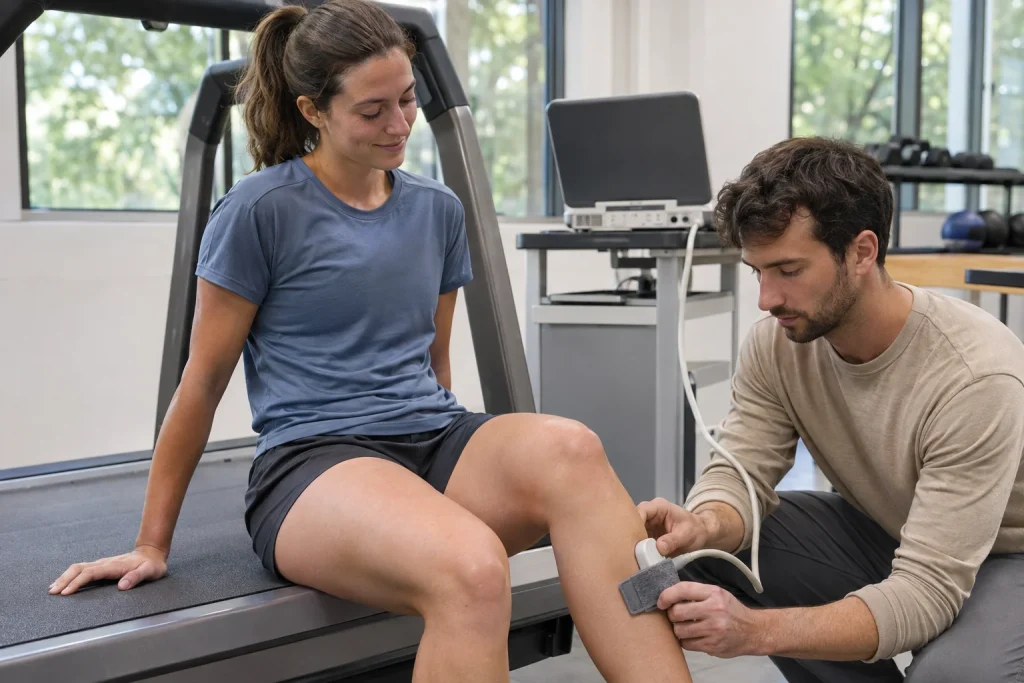
In running-muscle research, fibre segments tracked on ultrasound provide different data from camera-measured joint position. Determining force often requires another measurement or model. Linking datasets in time matters; otherwise a fibre position could be paired with force measured at another instant. Instrument synchronisation is therefore not a minor detail.
When reading such research, separate directly tracked image features from estimated quantities. Fibre length, tendon or unit length, force, power and metabolic cost are distinct outcomes. Ultrasound may support one, movement capture, force measurement or simulation another. An attractive animation is informative when its methods reveal their origins too.
This does not mean everyday running requires regular assessments like these. Scientific measurement helps understand function. Assessing symptoms and researching energetics in a healthy runner are different questions. An ultrasound probe alone promises neither diagnosis nor performance; the particular assessment’s aim and protocol determine what it can answer.
What should you take from the spring analogy?
First, internal body elements do not undergo the same length changes. Second, stored energy entered the system earlier and can be useful when returned at the right time. Third, active muscle force may remain necessary despite little shortening. These ideas already offer a more accurate picture than ‘the springier, the freer’.
- Whole unit and fibres: separate movement data, not synonyms.
- Energy and power: identical joules over different times mean different watts.
- Model and person: a simulation parameter is not a direct training instruction.
- External experience and internal process: feeling easier is not a direct tendon-energy measurement.
Deliberately reducing contact time is not a certain route to the same internal behaviour either. Moore and colleagues found an individual curved relationship between contact time and metabolic cost at fixed speed and frequency. Whole movement is not optimisation of one time value. An appropriate training question needs more information than a spring analogy or the smallest possible displayed number.
An elastic tendon does not run instead of the muscle. Together, they shape energy storage and return, fibre operating length and velocity, and fulfilment of the next step’s task. Retaining these distinctions helps evaluate energy-return claims more accurately, whether in research, shoes or a coach’s explanation.
Sources
- Lai and colleagues: in-vivo human soleus-fibre and muscle–tendon-unit function.
- Original study: muscle-specific force production and work during running.
- Uchida and colleagues: tendon compliance and muscle-energetics simulation.
- Lai and colleagues: muscle–tendon mechanics in accelerating sprinting.
- Cigoja and colleagues: shoe stiffness and estimated muscle–tendon function.
- Moore and colleagues: contact time and metabolic cost.
How Futószív articles are prepared: our editorial guidelines.