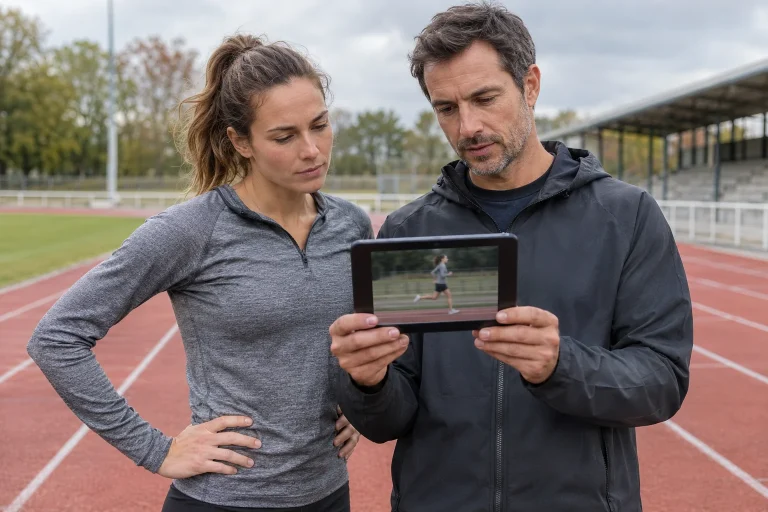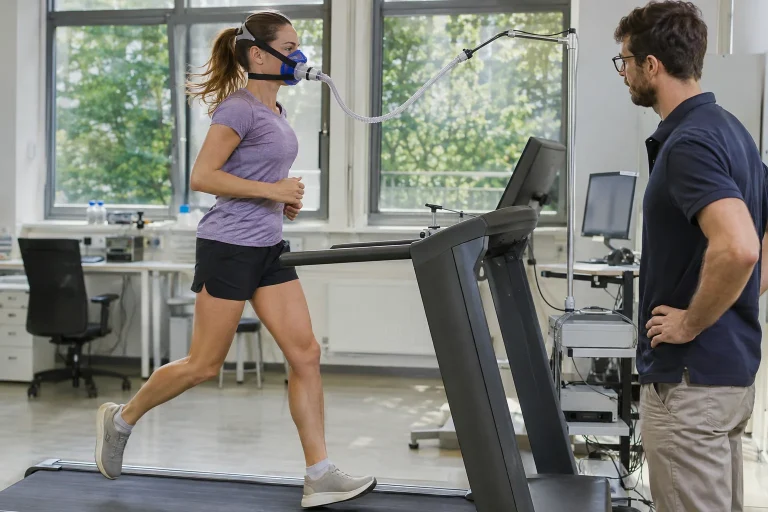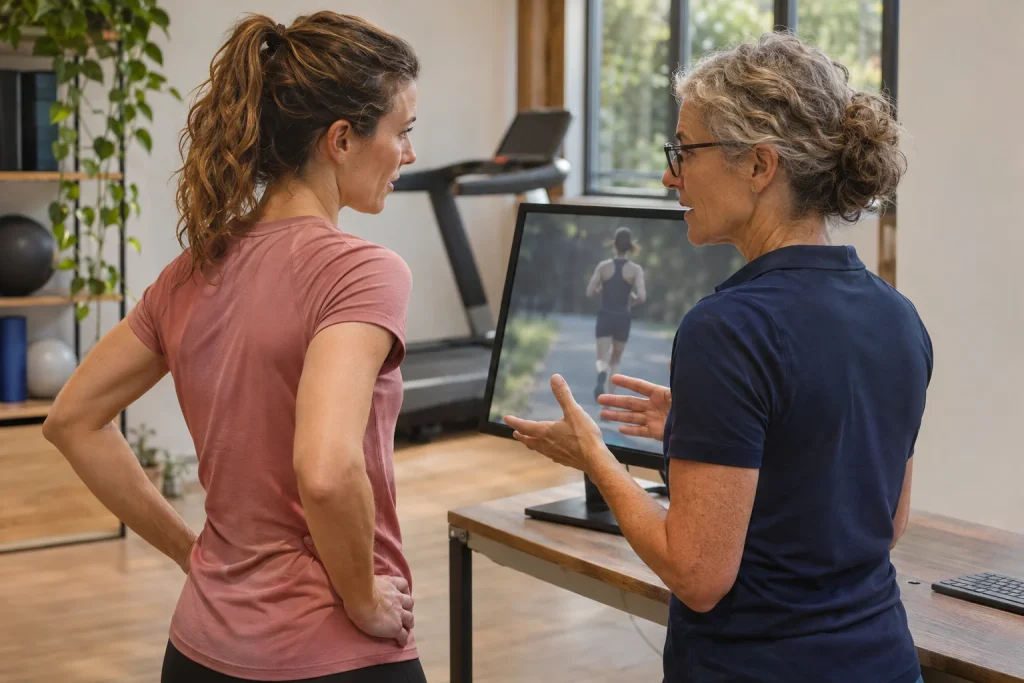
A runner’s trunk is not a rigid box travelling motionless above the legs. The shoulder girdle and pelvis can rotate during running, arm movement is visible too, and a camera records just one view of it all. If two analyses judge video accuracy differently, the first question is therefore not which study to believe. First check whether they measured the same movement using the same procedure.
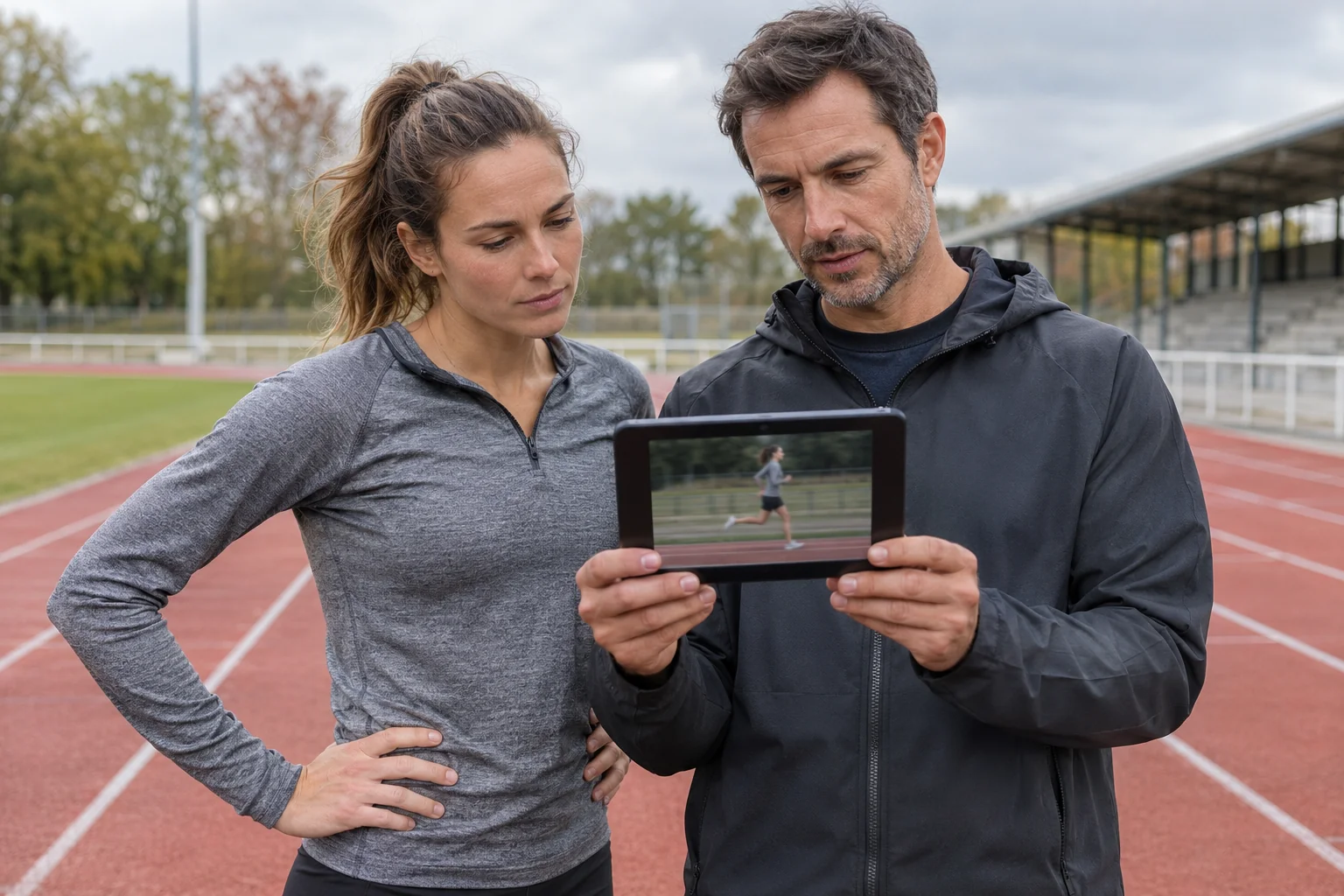
Trunk rotation is a particularly good example. A camera set overhead may reveal shoulder rotation, whereas a side-view phone image would require inferring the same rotation from different clues. Video usefulness is not a general yes-or-no question: variable, viewpoint, processing and intended use determine it together. We use upper-trunk rotation to learn how to separate these factors.
The shoulder line relative to running direction: name this first
The simplest way to imagine upper-trunk rotation in the horizontal plane is to view the line joining the shoulders from above. When one shoulder moves forwards, that line rotates relative to a transverse direction fixed to the running path. This does not yet describe the shoulders’ position relative to the pelvis. That would also require the pelvis’s direction.
There are therefore three separate questions: how far the shoulder line rotates relative to the track; how far the pelvis rotates; and the difference between them. A good measurement of the first does not itself establish accuracy for the third. Everyday wording such as ‘my trunk twists’ could mean any of these. Choose which you mean before precise analysis.
Leaning sideways, bending forwards and rotating horizontally are not the same movements either. In a side-view recording, one shoulder may partly obscure the other while forward upper-body lean is clearly visible. A visually striking backward arm swing is not directly the shoulder-line angle. Before choosing an app, state which geometric relationship the image will actually show.
In one specific study, an overhead view was key
In Weber and McClinton’s original study, upper-trunk rotation was measured in sixteen runners. Two-dimensional footage came from a tablet mounted above the treadmill, not an arbitrary side-view phone video. The method used markers on the shoulder region and a direction fixed to the treadmill. On 60-frame-per-second video, two raters analysed right and left peaks across five consecutive running cycles on two occasions.
The procedure showed excellent repeatability measures and good agreement with the three-dimensional reference. The full methods description also explains that finding the peak and measuring the angle were separate processing steps. The lesson concerns a planned, evaluated measurement working for its purpose; it does not mean a phone calculates every trunk movement accurately from any position.
For runners, this produces practical questions. Does your camera see the same direction? Are the same landmarks visible? Does the software seek the same peak? Is the reference running direction or pelvis? If any changes, the new procedure’s accuracy would need separate support. Similar variable names do not make two measurements identical.
 Enlarge image
Correlation tells you whether numbers vary together
Imagine four entirely fictional reference values: 5, 10, 15 and 20 degrees. A video procedure gives 10, 15, 20 and 25 degrees for the same situations. The order is flawless, increases identical and linear correlation between the series perfect. Yet every video result is 5 degrees higher than its reference. Correlation therefore does not answer whether the methods’ numbers are interchangeable.
Assessing agreement also examines differences between paired values. Is there a general offset? Are differences similar at smaller and larger angles? How widely do individual discrepancies scatter? A Bland–Altman plot is one way to display these: it plots the methods’ difference against the average of the two values. The question now concerns distance between numbers, not merely a shared ordering.
In our example, every difference would be +5 degrees. Real measurements usually give varying differences scattered around an offset. If a service displays only a large correlation coefficient, agreement remains an open question. This is especially important when drawing conclusions from a change of a few degrees: high correlation alone is not a personal error limit.
Peak values do not become a full movement curve
Maximum right and left rotation are two selected values. They show how far the observed shoulder line travelled in each direction. They reveal less about how quickly it rotated, which leg position accompanied the peak or how long it spent between extremes. Several time courses can connect the same two extremes.
For an original illustration, imagine the shoulder line ranging from −10 to +10 degrees in two running cycles. In one, rotation progresses evenly; in the other it stays near the middle longer, then changes faster. Peaks match but timing differs. Evaluation of peak-angle measurement does not automatically establish equal accuracy for the whole velocity curve or timing relative to the leg.
‘Continuous measurement’ requires further processing: points must be tracked in every usable frame, temporary occlusion handled and movement placed on an appropriate time base. A method working well at a peak can serve its own purpose without handling every subtask. Analysis is valuable when you receive the output actually evaluated.
Left and right: numbering can change more than movement
Angle signs depend on the chosen coordinate system. If rotation to the right is positive, left may be negative; another programme may report both peak magnitudes as positive numbers. Mirrored video may even swap directions. Before comparing displays, check how the software names sides and whether it shows signed values or absolute magnitudes.
An original example: from −8 to +12 degrees, total range is 20 degrees. The peak magnitudes differ by 4 degrees, while the midpoint of the extremes is +2 degrees. Those are three distinct numbers. Another run from −10 to +10 degrees also has a 20-degree range but a midpoint of zero. A single ‘rotation: 20°’ label hides this distinction. The example is not a normative target and makes no claim about which run is better.
The track’s reference direction can also shift results. If treadmill or running path is not fixed identically in analysis, the shoulder-line angle may have a different zero. A constant signed offset may therefore sometimes suggest reviewing the reference line. Interpret the individual’s movement only after numbering and camera direction are clear.
Why might hip or knee results differ?
In Neal and colleagues’ phone-based study, hip-adduction and knee-flexion variables were compared with three-dimensional data in runners with patellofemoral pain. Validity was poor for those outcomes. This does not contradict the favourable overhead trunk-rotation finding: the variables, recording and processing tasks differed.
The automated side-view method in Peebles and colleagues’ research likewise agreed with its reference differently across variables. A simple lesson is not to judge all video technology with one word. Seek evidence for the particular measurement. A favourable result for one view and body part does not authorise interpreting every other angle in the same way.
When selecting a practical service, request an example of the precise output. ‘Peak upper-trunk rotation relative to the treadmill’s transverse direction’ is interpretable. ‘Whole-body biomechanics score’ leaves many more questions open. How is it calculated? Why were those weights chosen? Which part is a measured position and which a software-generated summary? Detailed naming helps assess actual content.
 Enlarge image
How can footage become your own checkable measurement series?
Start by defining the task. If you and a professional follow trunk movement, record the reference direction, selected points and whether the aim is a peak or a time course. Resolve safe camera placement for the actual venue; a phone insecurely attached above the runner is unsuitable. Do not imitate laboratory supports through dangerous home improvisation.
Retain original footage and processed images. If clothing, hair or an arm hides a shoulder landmark, do not remove that from the account. Note why a step was omitted or considered uncertain. Such comments are part of measurement quality. A polished results image is harder to check if no one knows which cycle and selection produced it.
Compare the same running situation when following change. If one recording uses comfortable pace and the other the end of a fast interval, trunk movement relates to different tasks. Briefly note speed, shoes, treadmill and timing of the recording. Not every condition can be perfectly matched, but differences must at least be known before attributing every change to the camera.
Which decisions can this information support?
A good video report is primarily a precise description: at this speed, with this method, in these cycles, we observed these upper-trunk peaks. Repeated measurement can add which result changed and how consistently. This already provides useful common ground for a coaching discussion. ‘Rotate your shoulders exactly this many degrees less’ is another kind of statement: an intervention needing a separate purpose and rationale.
Trunk angle alone does not reveal oxygen demand, joint force or future injury. If recording concerned pain, the symptom history, relationship with loading and appropriate examination remain important. If performance motivated it, times, training and actual effort also belong in the picture. Measurement helps by answering a specific question rather than reducing the runner’s whole function to one angle.
Next time you encounter apparently opposing video findings, build a small comparison table: variable, view, reference, processing, runners studied and evaluated outcome. Often this already shows there is no real contradiction. A well-designed overhead trunk measurement and an uncertain measurement of another angle can both be true. Video becomes no less valuable; you know more precisely which part you can use for which purpose.
Sources
- Weber and McClinton: validity and reliability of video measurement of upper-trunk rotation.
- Full methods of the original trunk-rotation study.
- Neal and colleagues: phone-based assessment of hip and knee angles.
- Peebles and colleagues: automated side-view running measurement.
How Futószív articles are prepared: our editorial guidelines.