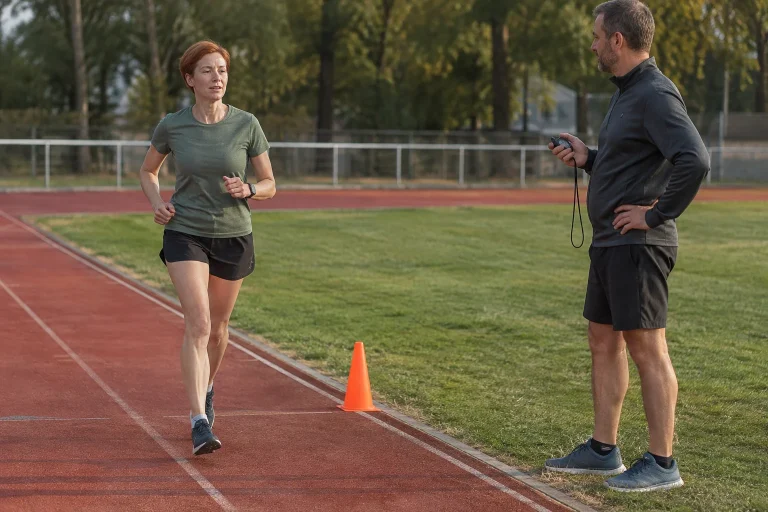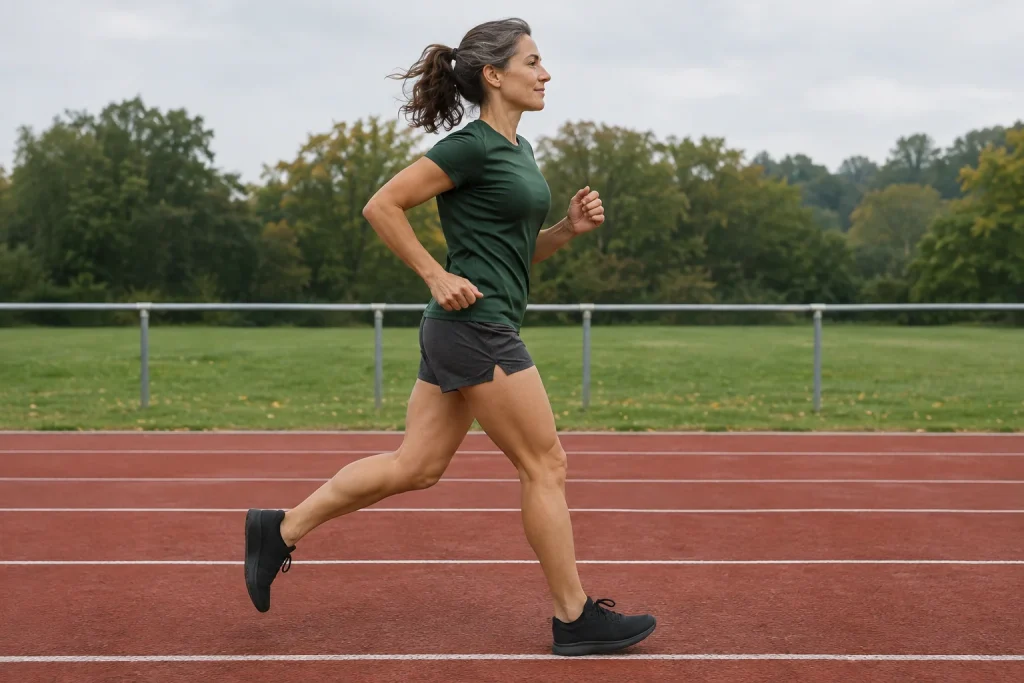
You run exactly one kilometre in five minutes, and the watch shows a steady pace curve. That does not necessarily mean your body travels at precisely constant speed throughout each step. Ground contact may begin with braking force and later produce propulsion; the two may balance over a complete step. Steady running therefore does not mean horizontal acceleration is zero at every instant.
This distinction helps explain force-plate curves, research tracking pelvic velocity and mechanical running models. The original examples below describe movement. They are not foot-placement prescriptions and do not ask you to consciously remove every sign of braking while running. The aim is to understand the relationship between variation within a step and the average of the whole run.
Kilometre pace averages many steps
Distance divided by time gives average speed. It does not show how speed was distributed within the period. Mild accelerations and decelerations may occur across a kilometre while the average remains exact. The same can occur on a shorter timescale within a step: the body’s centre of mass may slow briefly before accelerating again.
For an original illustration, imagine two half-periods. Speed is 2.9 metres per second in the first and 3.1 in the second, with equal durations. The time average is 3.0 metres per second. Sections slower and faster than 3.0 remain real parts of the movement. This is a simple two-stage example, not the shape of an actual running step; a real velocity curve may vary more continuously.
A wristwatch’s pace is not automatically the step-by-step speed of the whole body’s centre of mass either. A mounted sensor, external camera or whole-body movement model may track a different point at different temporal resolution. It is therefore unsurprising if enlarged laboratory data show fluctuations while a training app’s pace summarised over several seconds looks smooth. The two graphs do not necessarily show the same quantity.
Force and impulse: the sign matters too
Taking forward as positive, ground-reaction force slowing the runner backwards is negative and propulsive force is positive. Summing force over time gives impulse. The resultant horizontal impulse over a full observed period equals the change in horizontal momentum. When the relevant speed state is identical at the beginning and end, impulses from all external horizontal forces sum to zero.
In our simple model ignoring air resistance, braking ground impulse might be −8 N·s and propulsive impulse +8 N·s. They sum to zero. This does not mean the curve stayed on the zero line: it had negative and positive areas. For a body mass of 70 kilograms, a resultant impulse of −8 N·s alone would mean approximately −0.114 m/s of velocity change. The later positive impulse of equal magnitude would restore it.
‘Braking impulse’ often denotes the magnitude of the negative part and may therefore be reported as a positive number. Elsewhere it includes the sign. Check the definition when reading a report: 8 and −8 may be two ways of representing the same negative curve section. Graph direction, measurement coordinates and sign convention together make the data interpretable.
 Enlarge image
Instantaneous velocity and foot position are separate observations
The relative position of the grounded foot and body may relate to movement mechanics, but one photograph is not a complete force curve. The visible shoe-contact point alone cannot calculate the whole body’s instantaneous horizontal acceleration. The body has several segments, and muscle activity and ground interaction change continuously. Keep the descriptive observation precise: where was the foot, and at which moment?
Velocity of a tracked pelvic point is not identical to the whole body’s centre-of-mass velocity in every circumstance either. The pelvis may be a useful study reference, but arms, legs and trunk also move relative to it. Name a research proxy by its own name. ‘Minimum forward pelvic velocity’ and ‘all braking forces’ will then not silently become the same metric.
Folland and colleagues, in 97 runners, measured three-dimensional movement and respiratory gases. Minimum horizontal pelvic velocity was among variables associated with energy demand and performance. This was an observed relationship, not experimental proof that every runner should change speed fluctuations through the same technique instruction. The movement variable measured and a coaching intervention are separate steps.
Why is energy demand not zero when impulses balance?
Impulse and mechanical work are different. Impulse sums force over time; work sums its effect along displacement. After slowing and reaccelerating a body, final speed may return to the starting value while energy has meanwhile moved into another form and back into mechanical motion. Zero net velocity change does not mean every component process disappears.
In our point-mass example, a 70-kilogram body slows from 3.0 to 2.9 m/s. Kinetic energy, calculated as ½ × m × v², changes from 315 to 294.35 joules, a decrease of 20.65 joules. Returning to 3.0 m/s requires an equal increase. The difference between initial and final energy is zero, yet we described a 20.65-joule decrease and a 20.65-joule increase in between.
We have not claimed that every decrease during running becomes unrecoverable heat, or that only one muscle produces the increase. Elastic storage, energy transfer between segments and active function can all belong to the system. The example explains why zero net impulse or zero final energy difference cannot be equated with zero muscle work and zero metabolic cost.
Air resistance means ground impulses need not sum to zero either
Outdoors, relative airflow also exerts force on the runner. If it acts backwards on average, propulsive ground impulse must balance it too when starting and ending speeds match. Ground braking and propulsion considered separately are therefore not necessarily exactly equal. A zero resultant concerns all external forces included.
An original example simplified with constant force: let backward air resistance be 4 newtons and step time one third of a second. Air impulse is approximately −1.33 N·s. If ground braking impulse is −8 N·s, balance requires approximately +9.33 N·s of propulsive ground impulse. The two ground portions sum to +1.33 N·s, balanced by the air’s −1.33 N·s.
With the same fictional 4-newton resistance and a travel speed of 3 m/s, the associated mechanical power is 12 watts: force × velocity. This is only power overcoming that simple external resistance, not the runner’s total energy demand or the running-power value on a watch. Real drag also involves relative airspeed, posture and other factors. The constant 4 newtons is an illustrative input.
What does an analytical running model add?
Jenny and Jenny’s model connects mechanical power demand in level running with speed, body size, step frequency, contact time and wind. Vertical movement, braking early in stance and air resistance have separate roles. Such a model makes relationships between variables calculable. Its assumptions must nevertheless be read alongside its conclusions.
In a descriptive model, it is easy to change one variable while holding everything else fixed. Human running makes this harder: changing contact time may also alter frequency, range of movement or landing position. A model’s ‘what if’ question is not automatically a task a runner can adjust with a separate switch. The calculated mechanical relationship is valuable, but is not a personalised technique command.
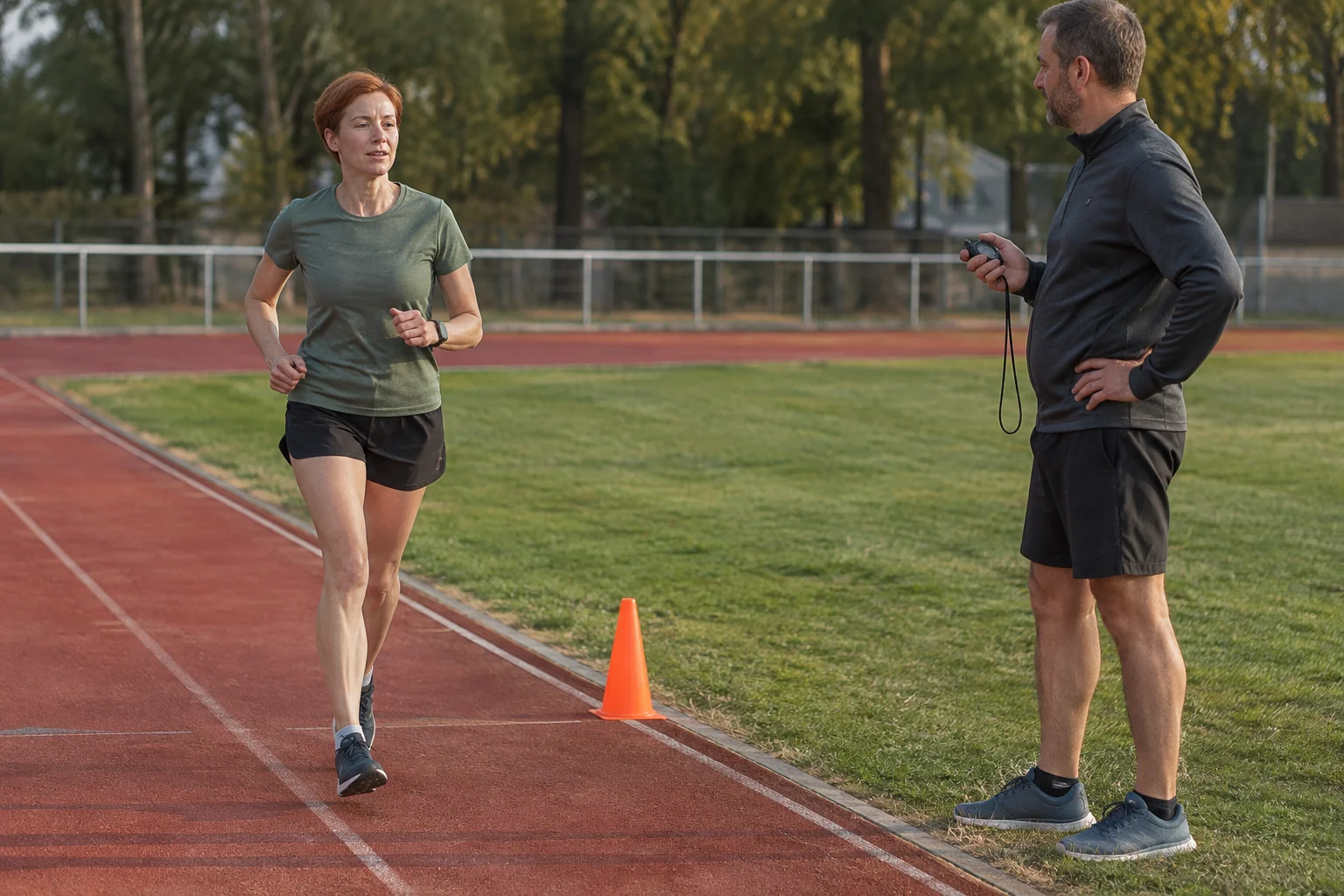
As an interpretation exercise, underline fixed and changed inputs in a model’s description. Constant speed, identical mass and a selected force profile? Or several measured situations from a real person? The answer determines which question the result addresses. A good reader does not regard every simplification as an error, but understands which relationship it reveals and which detail it leaves outside.
 Enlarge image
Shoes can also change how joint work is distributed
The mechanical work of a running step is not performed by one joint alone. Cigoja and colleagues, in thirteen male runners, modified the same shoe using an insert that increased bending stiffness. Measured joint work was redistributed between the knee and metatarsophalangeal joints. This was a specific controlled comparison; it does not imply the same response for every commercial shoe or runner.
Net joint work, work of the body’s centre of mass and individual muscle function are not one interchangeable curve. If one joint shows less positive work, first check what happened elsewhere, which interval was integrated and which kinematic data underpinned the calculation. One knee’s single peak does not represent the whole body’s mechanical task.
This also helps practical running conversations. A shoe may feel comfortable while laboratory data show a different distribution; these are different levels of experience. Your comfort, actual training and measured mechanical outcomes provide separate information. One report does not require consciously rewriting every part of a natural step. First be clear which question you are trying to solve.
How should you read braking and propulsive curves?
First check the axis and sign: which direction is positive, and does the graph show force on the runner or the opposing force the runner exerts on the ground? Newton’s third law makes their directions opposite. The same contact may therefore appear with the sign reversed depending on which body the graph concerns. The title and methods identify which you are viewing.
- Period: a full stance, one step or an average of several steps?
- Quantity: instantaneous force, peak force, impulse or mechanical work?
- Reference: movement relative to the ground, a treadmill or a tracked body point?
- External effects: does the model include air and the route’s gradient?
- Comparison: were speed, shoes and processing method identical?
Distinguish the environmental conditions of treadmill and outdoor measurement too. Air movement relative to the body may differ in stationary laboratory air compared with travelling along a road. The measurement method defines the relationship between the treadmill’s coordinates and the runner’s movement. ‘Constant pace’ alone is not a detailed description of the mechanical system.
Steady running is thus not motionless balance, but repeated movement in which slowing and accelerating parts together produce forward travel. Keeping force, impulse, work and average speed distinct turns the curve from a mysterious wavy line into something understandable. You can name what happens within part of a step and what remains across the whole run’s average. This understanding comes before a genuinely justified technique decision.
Sources
- Jenny and Jenny: an analytical model of mechanical power demand in running.
- Folland and colleagues: kinematics, running economy and performance.
- Cigoja and colleagues: shoe stiffness and joint work.
How Futószív articles are prepared: our editorial guidelines.