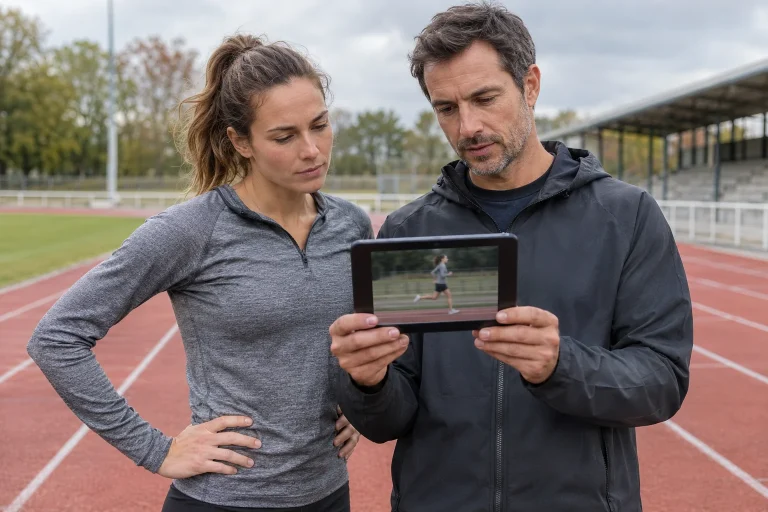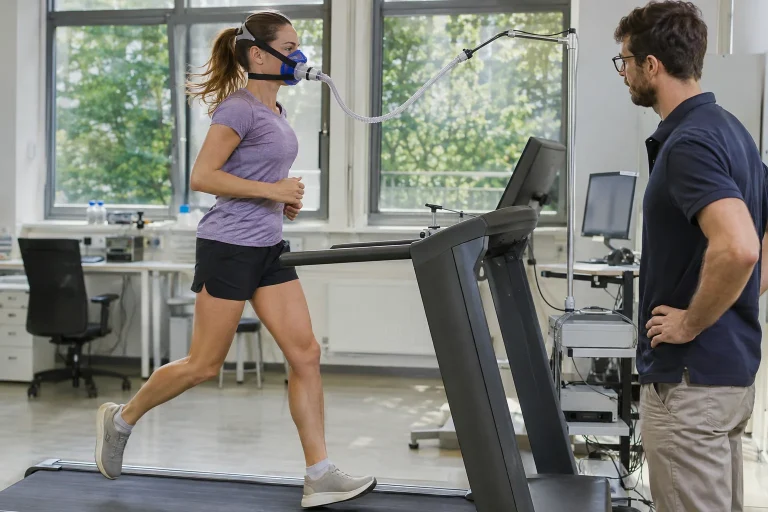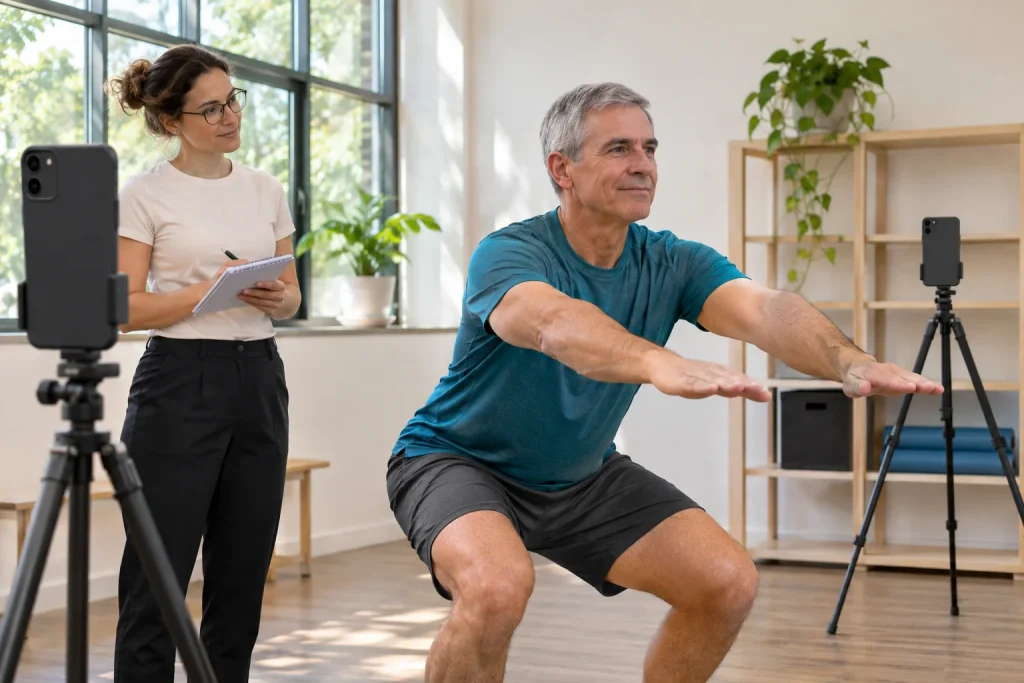
You upload two running videos, a moving skeleton appears on screen, followed by a coloured force curve around a knee. The display is convincing, as though the camera had looked inside the joint. In reality, several successive tasks have taken place. Recognising image points, estimating spatial position, fitting a human body model and making physical calculations may have produced the final result. None of these is a minor technical detail: together, they determine what the number means.
AI-based movement analysis can be valuable when the question and method fit. For runners, a good starting point is being able to trace the final result backwards: what produced this angle, this torque or this force estimate? The following guide breaks down the measurement chain. Specific research, official modelling documentation and original mechanical examples help distinguish visible movement from internal function calculated from it.
The video initially contains pixels, not joint forces
A camera records light. Identifying the position of the body visible in the image is already a processing task: where might the shoulder, hip, knee or ankle be? A displayed point is not necessarily a marker attached to the skin; it may be an image-recognition model’s estimate. If another leg or clothing obscures a body part, the software has less direct visual information available. View an apparently continuous point trajectory alongside the original recording.
The OpenCap system presented in 2023 used recordings from two or more smartphones. It combined points from image recognition, spatial reconstruction, learned anatomical-marker estimation and movement simulation. The system illustrates how consumer cameras can underpin complex biomechanical analysis. It does not mean the internal force in a knee becomes directly visible in any arbitrary phone image.
For an everyday comparison, think of a map: a photograph, location identification and a calculated route are separate things. Each is useful but makes a different claim. Likewise, video, the point trajectory identified on it and a calculated force curve are separate layers of results. A good service makes clear which you receive and how they connect.
Three-dimensional movement has geometric requirements
Depth does not appear in a flat image in the same way as horizontal position and height. Several cameras with known positions relative to one another provide information on the same movement from different directions. Combining views requires handling both the cameras’ spatial relationships and timing. If one camera shows an earlier instant, we would be trying to interpret two different positions of the same knee as one point.
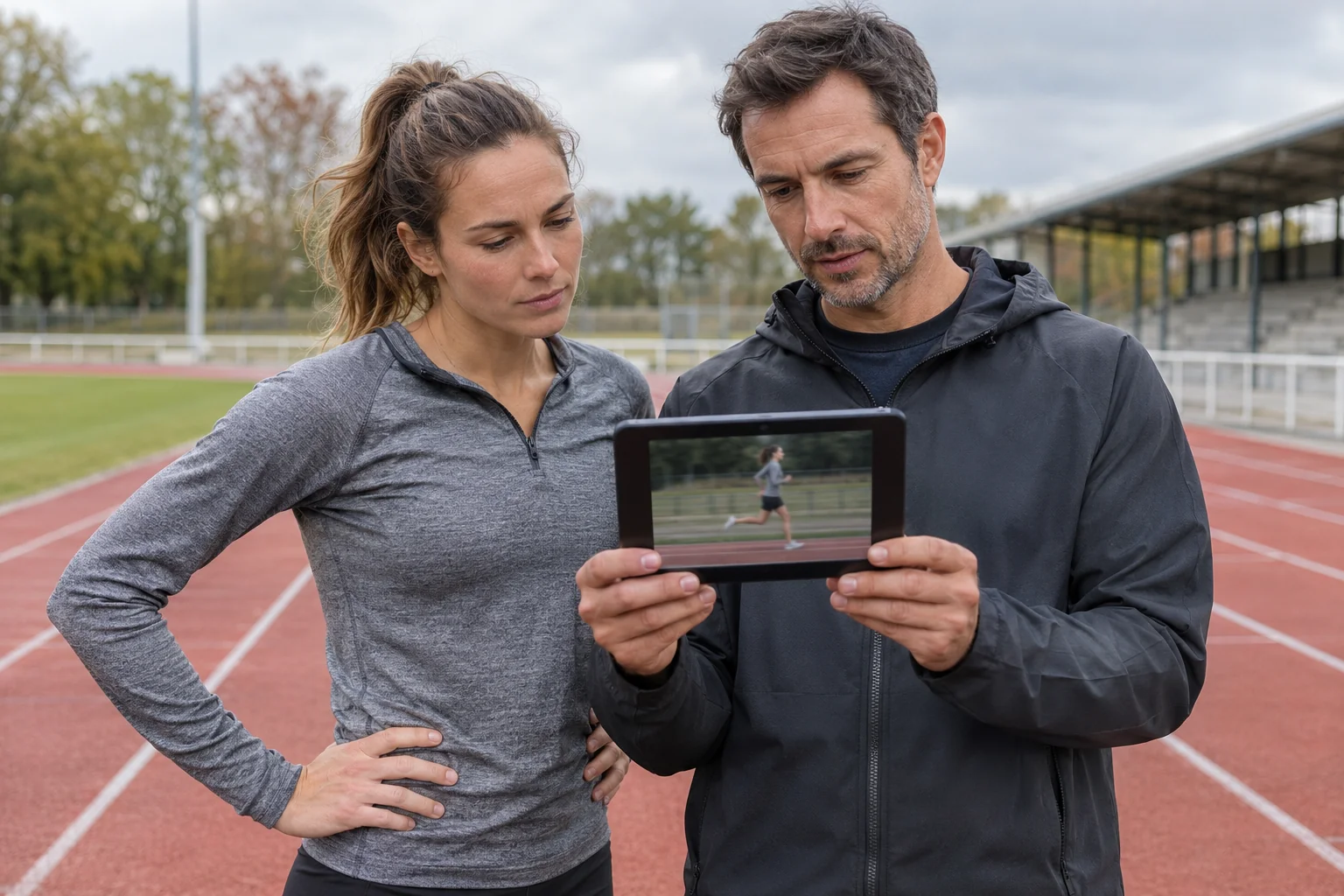
A good recording protocol therefore involves more than uploading a video. The observation area, camera fields of view and movement path must fit together. An obscured point, a foot leaving the frame or uncertain time alignment may continue to affect later results. Software may handle some gaps, but without retaining the input it is difficult to assess what was actually visible.
An original organisational example: a research facility first checks what both cameras see with the track empty, then makes a trial recording of the participant moving comfortably through the area. If a chair hides the ankle from one camera, it is moved before data collection. This is a simpler, more transparent correction than accepting an uncertain estimated ankle trajectory throughout the series afterwards.
 Enlarge image
Kinematics: where is the model, and how does it move?
Kinematics describes movement: position, angle, velocity and acceleration. When software fits a body model to tracked points, the model’s possible movements and geometric structure also play a role. The displayed knee angle may therefore be a coordinate of the selected model. It matters which movements that model allows, how it was scaled to the person’s dimensions and which image points it was fitted to.
The official OpenSim explanation describes model positions, velocities and accelerations as inputs to the dynamics calculation. Acceleration can be particularly sensitive to how movement data are handled. A sudden point change caused by an image-recognition jump is not necessarily real, abrupt acceleration of a body part. Beyond the moving skeleton, point tracking and data processing therefore also require checks.
An original simple example: an object’s three positions at equal time intervals are 0, 1 and 2 centimetres. This suggests steady forward movement. If the middle point is mistakenly placed at 1.5 centimetres, the first section appears faster and the second slower. The endpoint is unchanged, but the intervening velocity change is different. This shows why visually checking only the beginning and end of a video is insufficient.
Net joint moment is not the force of a single muscle
Mechanically, torque describes the turning effect a force produces about a given axis. The moment arm matters alongside force magnitude. In a simple example using a perpendicular moment arm, a force of 500 newtons acting through 0.04 metres produces 20 newton-metres of torque. A different moment arm requires a different force for the same torque. This is an original illustrative calculation, not a measured muscle force in a human knee.
Inverse dynamics can seek net forces and moments from movement and the model’s physical characteristics. The OpenSim documentation specifically warns that the net intersegmental force interpreted this way must not be equated with the force between joint surfaces; muscle effects also contribute to the latter. Confusing the two quantities in a report can lead to substantial misunderstanding.
For runners, the label ‘joint loading’ is therefore not enough. What lies behind it: net moment, a contact-force estimate, ground-reaction force or a proprietary score? Units help: newtons indicate force and newton-metres indicate torque. A coloured percentage without units needs a further definition. Clarify this when receiving the results sheet, before comparing curves of different colours.
Why do individual muscle forces require assumptions?
Different patterns of muscle activity can contribute to the same net turning effect. The OpenSim description of static optimisation explains one method that distributes the task among muscle forces at each instant under a specified optimisation criterion. External forces and body-model characteristics must be measured or modelled for this. This is one particular modelling option; its name does not denote the same procedure as OpenCap’s dynamics simulation.
In our two-element model, one pulling force with a 0.04-metre moment arm produces a positive moment, while another with a 0.03-metre arm produces one in the opposite direction. The net condition is 0.04 × F1 − 0.03 × F2 = 20 newton-metres. If F1 is 500 newtons and F2 is zero, the condition is met. If F1 is 800 newtons and F2 is 400 newtons, 32 − 12 also equals 20 newton-metres. Two different pairs of internal forces produce the same net result.
This deliberately simple model does not account for actual muscle geometry, force–length relationships or joint contact. It does show, however, that individual forces do not always follow uniquely from a net moment. A modelling rule helps select a solution. That does not make the estimate useless, but the selection conditions belong in interpreting the final result.
What was checked, and during which movement?
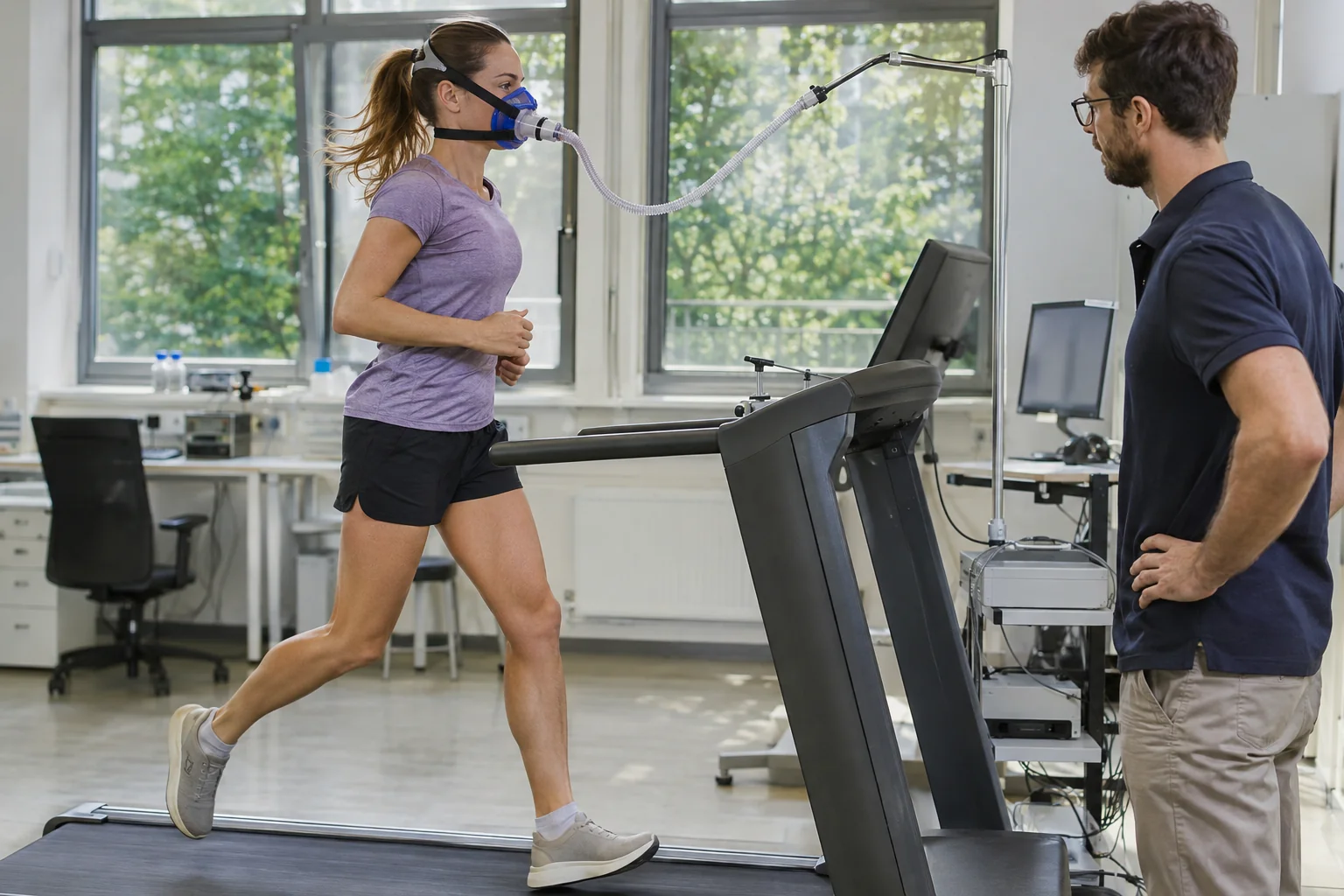
The original laboratory evaluation of OpenCap examined walking, squatting, rising from a chair and drop jumps in ten healthy participants, using camera and force-measurement references. These are specific tasks. The research cannot assign the same accuracy promise to every running pace, an arbitrary single phone video and every internal tissue force. An appropriate evaluation is decisive for a new use.
Another method was evaluated on side-view running kinematics, and agreement differed between angular variables. For phone-based hip- and knee-angle measurement, the procedure examined showed poor validity. These results help you ask about a service’s specific output rather than classify every AI movement-analysis method as either good or bad.
A useful checking question is whether the same task, similar participants and the same outcome were examined. A system identifying side-to-side differences in a squat well is not, by itself, an evaluation of Achilles-tendon force estimated at 4:30 min/km running pace. A similar screen and a shared AI label do not bridge the gap between those measurement tasks.
 Enlarge image
Handling video data is also part of the service
Running footage may show faces, bodies, clothing, locations and other people. A view rendered as points or a skeleton does not prove the original video has ceased to exist. Before uploading, check where processing happens, who can access the raw images, which sharing option you select and how deletion can be requested. These questions are easier to clarify calmly before recording.
The currently available OpenCap terms of service address developer access to videos and participant-selected public data sharing separately. This is a concrete example of why you need to read the particular service’s wording. Blurring faces, sharing processed data and handling raw video may involve separate decisions. With another service, different conditions need checking.
As a personal on-site checking habit, inspect the background too. Another runner waiting in a doorway, a nameplate or a document left on a table is unnecessary for movement analysis. Select an area and framing that show the participant’s movement clearly while limiting incidental unrelated information. This is a simple, practical part of preparing the recording.
What should accompany the results so they remain usable later?
An interpretable report includes the task, speed or movement situation, recording method, model used and output names. Numerical series need units and a time basis. If comparing left and right sides is the aim, side labels and selected repetitions matter too. These provide a reproducible starting point for the next measurement.
- Image result: which points did the system identify, and was anything obscured?
- Movement model: how was it fitted to the participant, and what does it call an angle?
- Dynamics result: which force or moment does it estimate, under which assumptions?
- Evaluation: against which reference and in which movement was it compared?
- Data handling: where do the raw video and processed results remain?
The best next step may be a clearly phrased question: does the observed pattern change when repeated in the same situation; can the section highlighted by the software also be recognised in the original image; which outcome does the professional consider genuinely relevant to the runner’s goal? Technology offers more than an impressive animation when the reasoning between a number and a decision is transparent too. This lets you use the model estimate in its proper place, from the recording’s history to the practical question.
Sources
- Uhlrich and colleagues: OpenCap, original research.
- Full methods and validation of the OpenCap research.
- OpenSim: how inverse dynamics works and distinctions between force concepts.
- OpenSim: static-optimisation inputs and muscle-force estimation.
- Peebles and colleagues: side-view running kinematics.
- Neal and colleagues: phone-based 2D running measurement.
- OpenCap: current terms of service and data-sharing conditions.
How Futószív articles are prepared: our editorial guidelines.