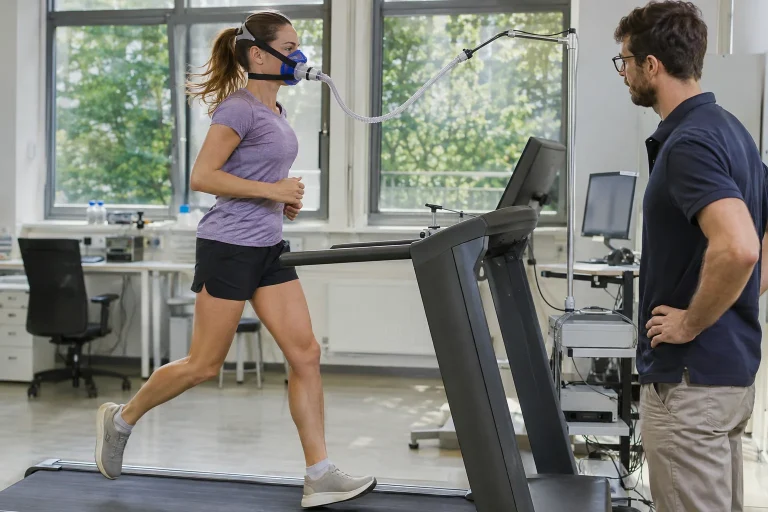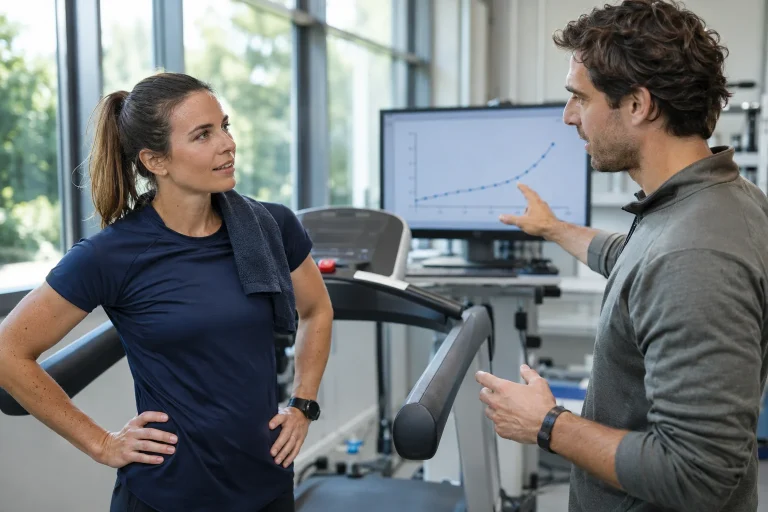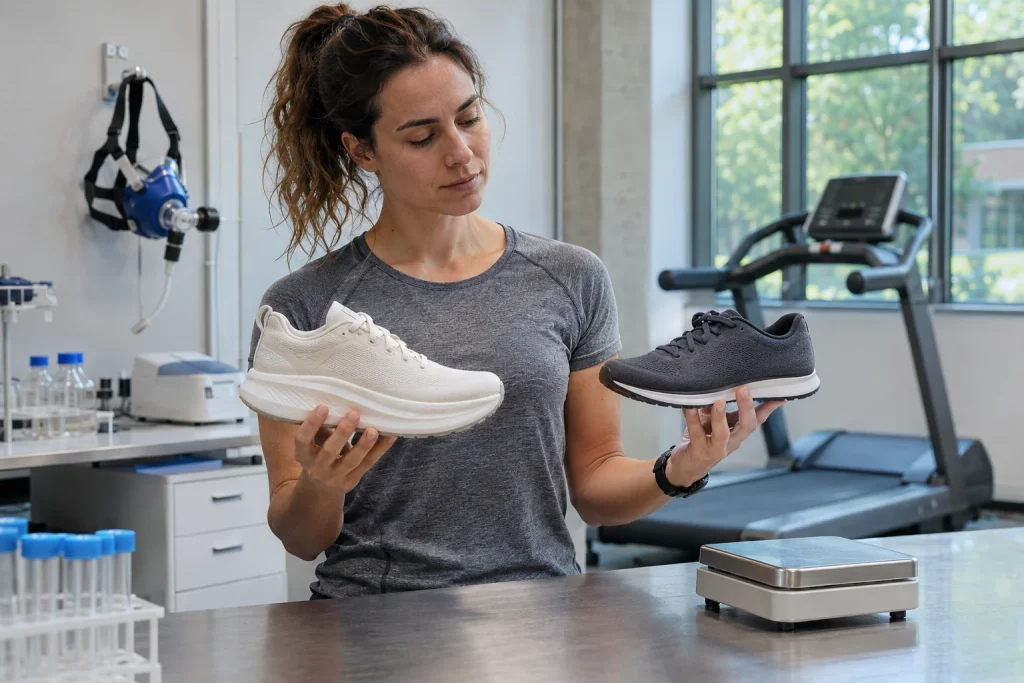
Four per cent lower oxygen demand sounds good, and the question immediately follows: will the marathon then take four per cent less time? Laboratory economy, sustainable speed and finishing time are three different quantities. Through our own numerical examples and original shoe studies, we follow the steps missing between a marketing percentage and your personal seconds.
What does four per cent mean in the measurement?
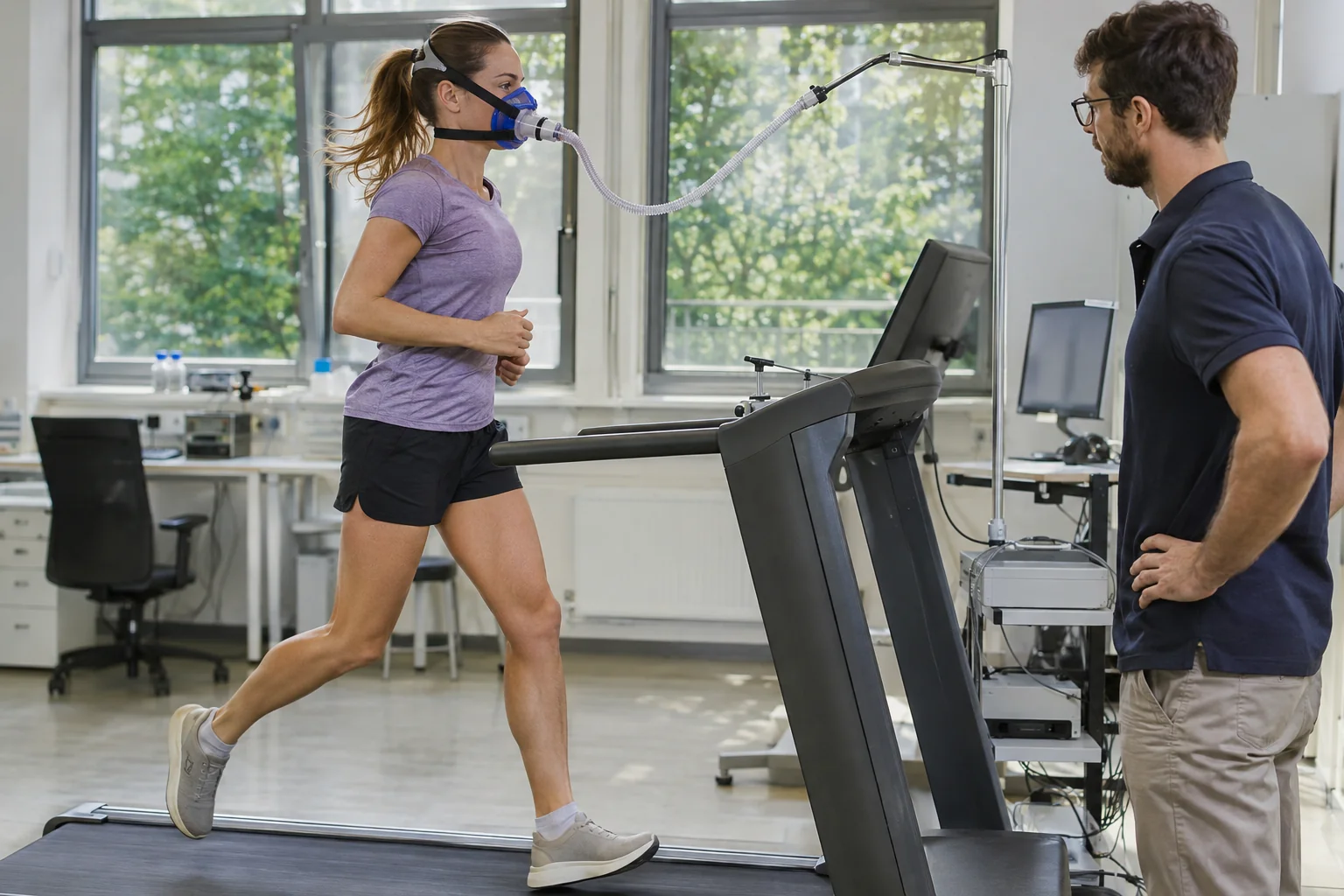
Running economy describes how much oxygen or energy is needed for a specified running task. In shoe comparisons, a common question is how this demand changes at the same speed. The runner is not completing their fastest marathon in the laboratory. The outcome is a cost difference associated with a particular speed and protocol; further separate steps would be needed to reach race time from it.
In our own numerical example, relative oxygen uptake measured at a given speed falls from forty to 38.4 millilitres per kilogram per minute. The difference is 1.6, which is four per cent of forty. This correctly describes the fictional measured difference. It does not tell us what speed the same person could sustain for the whole marathon. In the example, that second question has not yet been measured at all.
Pay attention to the unit too. Oxygen uptake per unit of time and oxygen cost per kilometre are different quantities, although convertible at the same speed. At different speeds, comparing the same column of numbers is no longer sufficient. An advantage described in text is understandable only when we know what was measured, at which speed and relative to which comparison shoe.
The percentage change in speed is not the percentage change in time either
Over a fixed distance, time is inversely proportional to speed. If speed increases by four per cent, the new time is the old time divided by 1.04. This is approximately a 3.85 per cent reduction in time, not exactly four. Conversely, if time falls by four per cent, speed becomes 1/0.96 times as great, an increase of approximately 4.17 per cent. This is pure mathematics, not an estimate of a shoe’s expected effect.
For a fictional time of four hours, or two hundred and forty minutes, reducing time by four per cent gives 230.4 minutes. A four per cent increase in speed instead gives approximately 230.77 minutes. The difference is not large, but clearly shows why the percentage needs a precise name. Even before introducing oxygen cost, we have already distinguished two different claims.
The four per cent in a marketing sentence may be a group-average oxygen advantage, a difference measured at a selected speed or another comparison. Subtracting the same amount directly from finishing time skips two conversions: from cost to sustainable speed, then from speed to time. More precise reading does not diminish technology’s possible value; it ties it to the right question.
 Enlarge image
An illustrative model reveals the missing assumption
Imagine a purely educational model in which energy demand rises with some power of speed. The shoe reduces this demand by four per cent at every speed, while the available sustainable power remains unchanged. These are already strong assumptions stated separately. The calculation is not a physiological description of a person or a personal prediction taken from the studies presented.
If demand is directly proportional to speed in this toy model, the new time becomes 0.96 times the original. If demand is proportional to speed squared, the new time becomes the square root of 0.96 times the original, approximately 0.9798 times it. The same four per cent cost difference produces a four per cent time difference in the first model and approximately two per cent in the second. The models’ assumptions changed, not the initial percentage.
Real running is not determined by the two simple formulae chosen here. We used them to show that no assumption-free path leads from a single laboratory percentage to marathon seconds. The relationship between speed and demand, and the assumption about sustainable power, would also need specifying. Neither a confident slogan nor an apparently precise calculator removes this missing step.
What did researchers find at slower speeds?
The 2026 crossover study focusing on slower running speeds compared three shoe conditions and several speeds in fourteen moderately trained participants over repeated test days. An advanced racing shoe showed lower oxygen cost than the conventional comparison shoe. No clear speed dependence of the difference was found within the range examined.
This is an important nuance compared with the oversimplified claim that the technology can matter only to very fast runners. However, the study did not measure improvement in every participant’s full marathon finishing time. Oxygen cost, perceived effort, comfort and shoe preference were separate outcomes. Even alongside favourable laboratory findings, their meanings do not automatically merge.
For your own question, therefore, examine test speed too. If the study used a speed far from your intended race, retain this distinction when considering transfer. A closer speed offers a more useful connection, but is still not identical to your whole race. A shoe’s laboratory advantage can be real without guaranteeing a personal time saving calculated to the second.
Energy demand and measured performance belong in separate columns
The 2023 research examining longitudinal shoe stiffness conducted a three-thousand-metre time trial alongside shorter economy measurements with trained and higher-performing male runners. The two groups’ economy responses differed depending on speed, while their time-trial improvements were similar. This already illustrates why two different outcomes are worth actually measuring separately.
The three-thousand-metre result is still not a marathon result, however. Duration, pacing and the study environment differ. Even if a paper had measured both, the comparison’s conditions would still need clarification. The correct conclusion is not that a shorter test is worthless, but that evidence must be interpreted at the distance and in the sample in which it was produced.
For everyday reading, make two separate lines: what was measured at the same speed, and what was measured in an actual performance test? If the second is empty, do not fill it with imagination. If data exists, examine distance, participants and uncertainty. This approach preserves both interest in technology and precise reading of sources, without exaggeration that decides a purchase.
A mechanical model is not another name for metabolic measurement
We discuss both mechanical and metabolic characteristics in running, but the terms are not interchangeable. The original modelling work analysing the mechanical power demands of running connected speed, air resistance, step characteristics and body movement, among other factors. The description uses assumptions; it is not identical to oxygen cost measured directly in a particular shoe.
A model can help explain why speed and environment matter, but every variable within it does not need to become an immediate technical instruction. Step frequency affecting a formula’s result does not imply a compulsory cadence for everyone. The same applies to shoe stiffness or another structural element. The combination of the whole shoe and the person involves more than a single altered parameter.
The best checking question for readers is simple: is this a direct measurement, an actual performance test or a conclusion calculated from a model? All three can be valuable, but support claims differently. If the answer is unclear, do not treat the percentage in the text as though it were a precisely known personal race-time difference. The type of evidence is part of interpretation.
 Enlarge image
A group average is not a number for your own feet
Different individual values lie behind a group average, and measurement has uncertainty too. Two people in the same shoe do not necessarily show the same difference. At the same time, personal experience should not be elevated into a definitive laboratory result from one good run alone. A more pleasant feeling matters, but is neither a direct oxygen measurement nor controlled evidence of a marathon time saving.
If requesting a real laboratory comparison, ask about the protocol: at which speed does it take place, are conditions repeated, how is shoe order arranged and what uncertainty accompanies the result? These are not pedantic details. They clarify exactly what the number means. Individual measurement becomes more useful when its limits remain present in interpretation too.
Your own practical observations involve other questions. Does the shoe fit well, is fastening manageable, does it work around turns on your route and how comfortable is it over a longer activity? Note these separately from performance estimates. You do not need to convert comfort into an oxygen percentage or a soft feeling into certain speed gains. Information kept separate can together give a much clearer picture.
What statement should you take away from a shoe test?
A precise summary names the participants, test speed, conditions compared and measured outcome. For example, in that sample at the same speed, a lower oxygen cost was measured in one shoe. This is a substantive claim and needs no invented finishing-time guarantee. If the study also conducted a performance test, its result can appear in a separate sentence with the particular distance.
In your own marathon plan, separate the equipment decision from changing starting pace. Favourable research on a new shoe does not automatically rewrite the performance picture from your preparation. Your previous race, experience of sustained runs and the particular course still matter for the starting plan. A possible equipment advantage does not remove the need for pacing, organisation and preparing nutrition and hydration.
A four per cent oxygen advantage can therefore be interesting and meaningful laboratory data, but is not directly a four per cent improvement in marathon speed. Models, assumptions and further observations stand between the two claims. Making them visible lets shoe research say more, not less: it becomes clearer which question it helps with and where your own race’s still-unmeasured story begins.
Sources
- Bolliger and colleagues: oxygen cost of advanced shoes at slower speeds, 2026.
- Rodrigo-Carranza and colleagues: stiffness, economy and three-thousand-metre performance.
- Jenny and Jenny: an analytical model of running’s mechanical power demands.
How Futószív articles are prepared: our editorial guidelines.