The strength routine supporting your running may contain many tasks you previously performed lying on your back without a second thought. During pregnancy, however, even a familiar position may need review. The useful question is not simply which exercise to cross off, but what the task was intended to achieve, which position suits you and who can teach you the modified version individually. A new plan does not have to replace every element of the old one like for like.
If you become dizzy, feel faint or unwell during an exercise, stop, ask for help and seek medical guidance about a new or unusual symptom. For severe illness, chest pain, serious difficulty breathing or fainting, call 112 in Hungary. You do not need to assume the same position again to find out whether the symptom recurs. Choosing the next strength exercise comes later.
Why do recommendations mention lying on your back separately?
The ACOG patient information on exercise during pregnancy explains that, when lying on your back, the uterus can press on the large vein returning blood to the heart and briefly reduce blood pressure. The position can therefore feel different for reasons beyond reduced comfort. The general advice relates to a physiological consideration, not an assessment of your previous strength training.
The current NHS exercise page describes avoiding activity lying flat on your back for more than a few minutes in later pregnancy. The CDC information mentions avoiding activities that require lying on your back after the first trimester. Do not turn these wordings into a personal safety limit monitored with a stopwatch.
Individual guidance needs to clarify how modifying position applies to you, taking pregnancy and your known condition into account. You need not wait for symptoms before asking about the routine. Having been able to perform an exercise comfortably for a long time in the past is not a reason to continue it unchanged now. Earlier performance and assessment of the present position are separate questions.
Explain the exercise’s purpose as well as its name
A name in a workout list does not always say exactly what you do. The same name can cover several versions, with different supports, ranges of movement, equipment and hold durations. It may help the professional if you explain what you learned previously, why it entered the routine and how you usually perform it. They can decide about a demonstration; you do not need to recreate a situation that made you unwell.
The task’s purpose helps make sense of a modification. It may have been general strengthening, part of previous rehabilitation or an addition to a sports training programme. These are different starting points. If it was originally given for a medical reason, say so specifically; a replacement exercise online may not answer the same question.
Not every old element needs a new counterpart. The professional may simplify the whole session, suggest a different emphasis or request further assessment first. The success of a modification is not shown by whether the new list is equally long. The aim is a routine that is clear and appropriate now, rather than preserving the quantity in the former sequence.
Five details to clarify for a replacement version too
Alongside position, support, movement, equipment and transitions are parts of the task. Replacing an exercise done on your back with a standing version is not simply turning the same movement upright. Balance demands and use of the environment may differ. This article assigns no generally suitable replacement position; it shows what is worth discussing during instruction.
| Detail | A useful question | Why should it not be omitted? |
|---|---|---|
| Starting position | How should I position myself for this particular task? | The exercise name does not describe the whole position. |
| Support and environment | What stable support or clear space is needed? | The situation shown in a clinic may differ at home. |
| Execution | What should I pay attention to during the movement, and what should I not force? | A short video may omit important details. |
| Dose | How much work and which breaks are in the individual plan? | The old number of sets cannot automatically be copied over. |
| Starting and finishing | How should I get into and leave the position? | The transition is part of the task actually performed too. |
If your equipment at home differs from that used during instruction, say so. Soft furniture, a wheeled chair or a cushion to hand does not become appropriate support merely because it has a similar shape to the equipment demonstrated. You do not need to improvise independently. Ask which conditions are necessary and what to do if they are unavailable at home.
 Enlarge image
Do not automatically attribute a symptom to the position
The circumstances in which a symptom occurs and its cause are separate things. Noticing dizziness while lying on your back is important information, but you do not need to close the medical question yourself on that basis. The CDC information on maternal warning signs discusses dizziness, fainting, difficulty breathing and chest symptoms separately. A new or unusual symptom needs reporting, rather than simply being recorded as an error in workout setup.
Explain when the feeling began, what you were doing, whether you stopped the activity and whether there were other new symptoms. If you cannot give an exact time, do not invent seconds. “I took up this position and then felt unwell” can be a clear account. You do not need to prove the event matters enough with your watch’s heart rate graph.
If the symptom resolved, that belongs in the account too, but is not a reason to try the same thing again without discussion. Clarify the conditions for continuing with your clinician. Reproducing a symptom is not a necessary home test, and a previously comfortable version does not become an automatic solution simply because another video showed it.
Let the instructor know about pregnancy and your individual boundaries
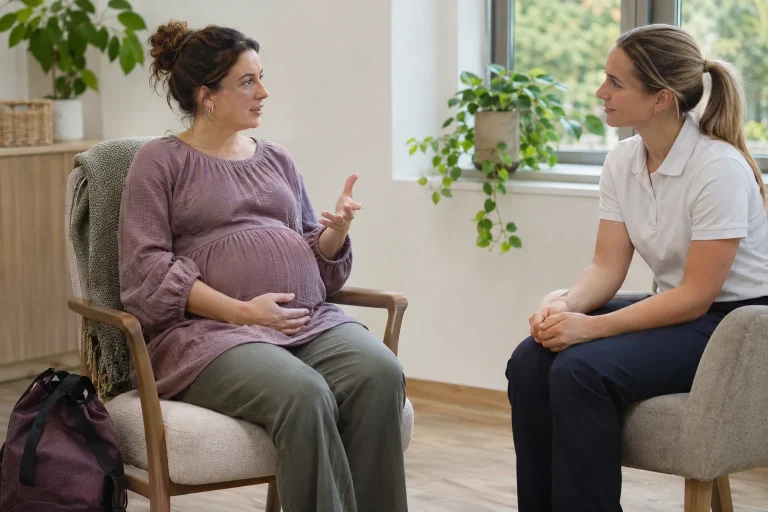
The NHS specifically recommends that your trainer or instructor know you are pregnant. A general easier option announced at the start of a class may not answer your question about the particular task. If you have received an individual modification from your care professional, discuss how it can be followed in class. The instructor organises the teaching situation; medical suitability cannot be inferred from the group’s rhythm.
Ask beforehand whether you can clarify the version before the exercise and whether a task can be omitted without immediately having to complete another instead. Rapid transitions in a group do not allow every individual question to be resolved. Prepared participation may include not performing that movement for now, until your individual guidance is clear.
You do not have to announce a full medical history publicly to the instructor. Necessary boundaries can be discussed discreetly, and an uncertain question taken back to your maternity care professional. A class name such as “for pregnancy” does not establish by itself that every exercise suits every participant. Individual symptoms, history and current advice still matter.
A video can be a useful reminder, but cannot see your whole situation
When practising at home, a movement on screen can easily look like a ready-made solution. It may not show how the participant positioned themselves, which support they use, what load they previously received or which individual modification was advised. The video does not assess your circumstances. A similar pregnancy week or outfit does not make the person’s plan your plan.
If you receive a reminder video after individual instruction, it can provide a useful reference. Know which part applies to you, which differences you should use and whom to ask if something is unclear. You do not need to assemble a task from ever more sources: separate details can easily produce a version nobody has actually taught you.
Positioning yourself around a screen is a separate organisational question. If understanding the explanation requires an uncomfortable turn or constant reaching for the phone, pause the video and clarify the task first. Keeping up with the demonstration’s pace is not necessary for valuable learning. A task understood and suited to you matters more than uninterrupted playback.
The whole session can be reorganised too
Removing the section lying on your back may change a session’s order and purpose. The time freed up does not have to be filled with other equally difficult tasks. Discuss with the professional what should remain, what is needed now and what belongs later. A shorter, clearer routine is not inherently less valuable.
With strength work supporting running, it is particularly easy to cling to an old programme because you called it “only prevention” or “just core work”. The name does not alter the fact that you are performing real physical activity. If the running plan has changed, the supporting tasks are worth adapting to the current situation too, rather than treating them as unchanged background work.
Rest and omission can be deliberate parts of an individual plan. You do not have to make up a missed exercise by doubling it the next day. If you fear losing previous strength because of a modification, tell the professional. It is easier to interpret that question together than to seek a harder alternative alone out of guilt.
 Enlarge image
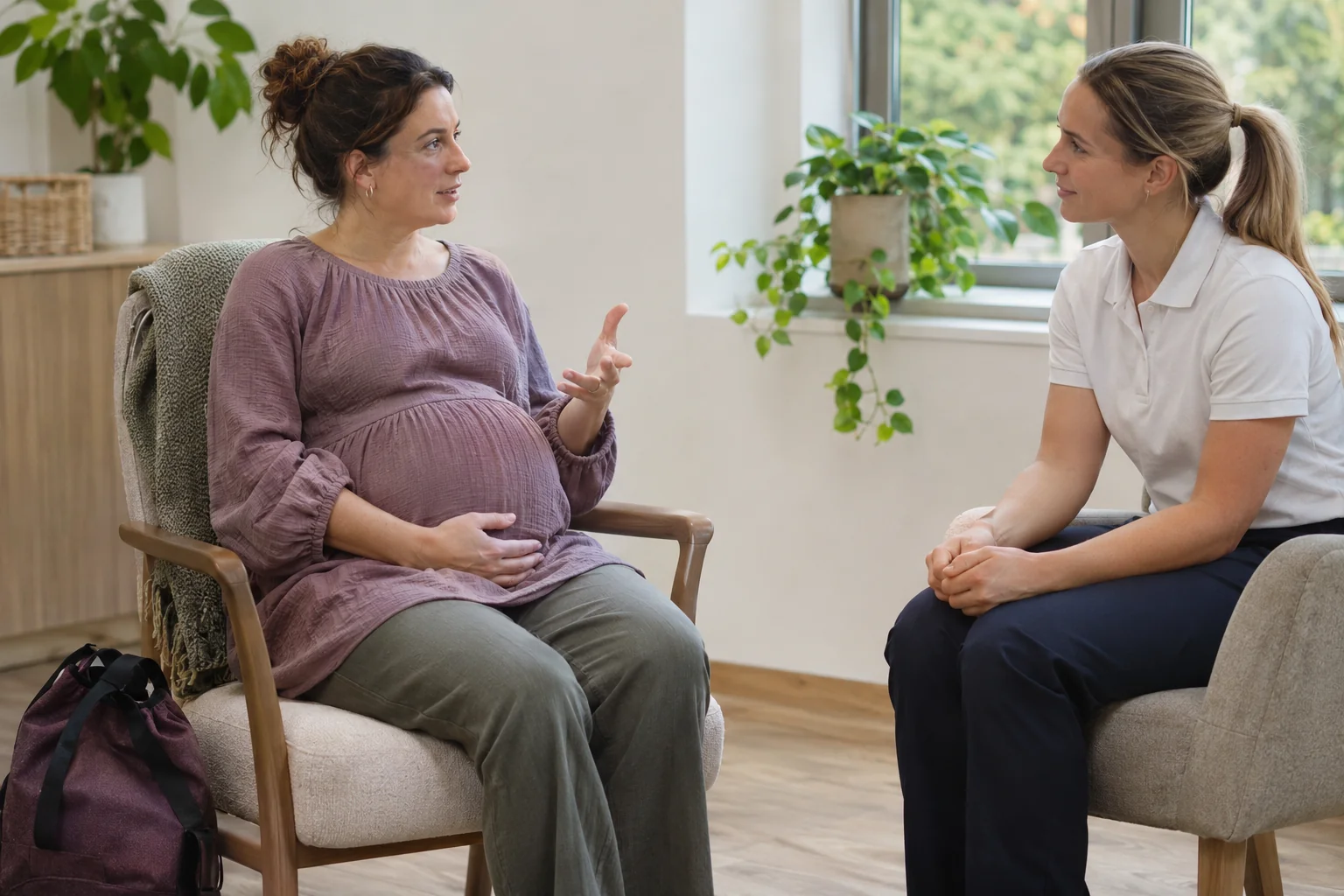
Ask for an explanation you can follow at home
A useful question is: “What is the purpose of this modified task, and what shows that I am doing it according to my individual plan?” You do not need to seek maximal range of motion or a strong muscle sensation as proof. Learn the specific points provided by the professional. If a term such as support or starting position is unclear, ask for different words.
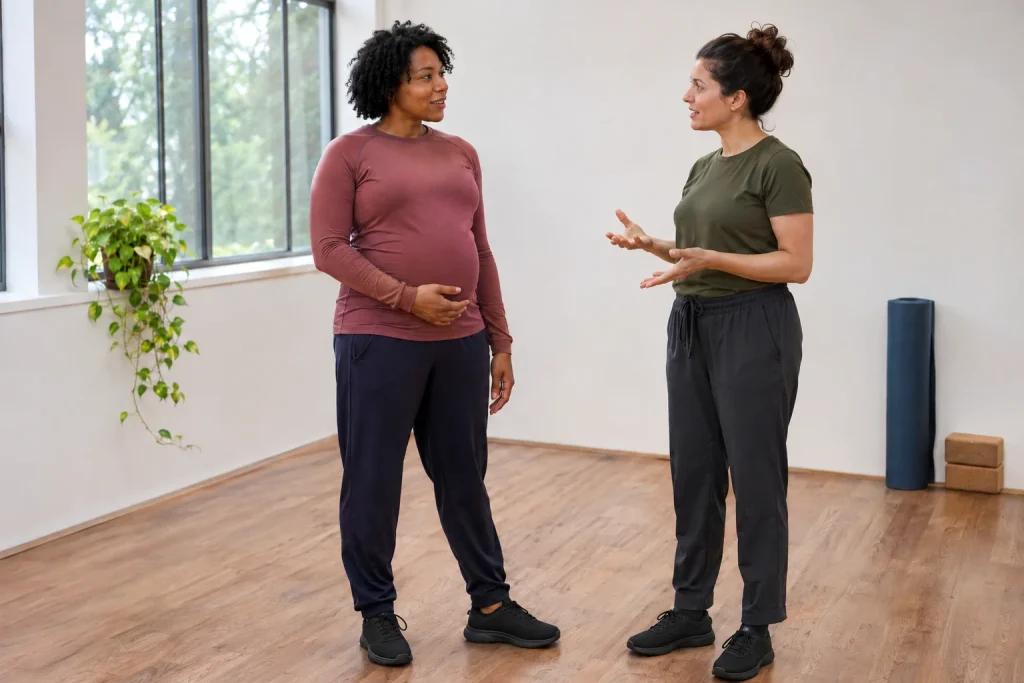
At the end of instruction, briefly explain back what you will do, within which boundaries and when you need to stop or ask. This can quickly reveal a different understanding of the advice. You can write a short reminder of your own version, but the note should be more than a general exercise name. The purpose is accurate recall, not another complicated training diary.
Discuss review too. What should happen if comfort changes over the coming weeks, a new symptom appears or the task proves impractical at home? A solution previously considered appropriate is not permanent permission. Discussing the plan again later is a natural part of adapting during pregnancy.
Modification is learning, not a test of skill
Even an experienced runner may find it unfamiliar to rethink an old strength exercise. This is not the loss of earlier technical knowledge. You are seeking an appropriate solution for a different condition and different requirements. Asking questions is as much a part of sporting independence as knowing your familiar routes.
If the rest of the group continues with the old version, you can still follow your own plan. Joining a shared session does not require identical set counts or positions. Individual guidance is a much more specific reference than whatever someone happens to be doing on the mat beside you.
A useful replacement is therefore not the name of one universal exercise. It is an understandable process: naming the purpose of the old task, discussing current condition and any symptoms, learning an appropriate version individually and reassessing it later. Strength work can then concern deliberate activity suited to the present situation, rather than preserving an old list at any cost.
Sources
- NHS: exercise and position during pregnancy
- CDC: pregnancy activity and position
- ACOG: exercise in pregnancy, physiological changes and precautions
- CDC: urgent maternal warning signs
How Futószív articles are prepared: our editorial guidelines.