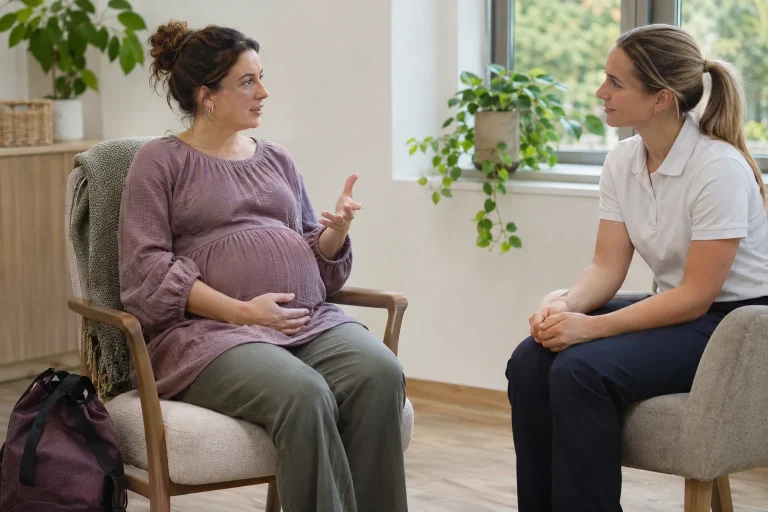
You have already stopped running, yet pain around the pelvis still appears by the end of the day. This is not necessarily a contradiction: commuting, stairs, prolonged sitting or standing and household tasks remain part of your day even when the training diary stays empty. With pregnancy-related pelvic girdle pain, it is therefore worth describing the whole everyday story to your maternity care professional or physiotherapist. Sport is one chapter, not the entire map of demands.
The aim is not to watch every movement as a source of danger or diagnose the cause of pain at home. It is to give the professional more than an answer to “How much do you run?” They also need to see when standing up is difficult, where you have many stairs to use and which task lacks help. This creates a basis for discussing genuinely practical changes suited to your individual assessment.
The symptom story does not end when training is cancelled
Pregnancy-related pelvic girdle pain can appear around the pelvis, lower back, hips or thighs. According to the Irish HSE health information, symptoms vary between individuals and can interfere with everyday movement for some people. Naming the precise location is not a diagnosis in itself; it matters because it helps you explain clearly what you experience during assessment.
After giving up running, you may expect the rest of the day to continue unchanged. Yet previously unnoticed tasks may now need particular attention. In an upstairs office, stairs are not a sports programme, but they involve movement; standing in a shop is not a workout, but you still spend time in the same position. These do not need to be converted into kilometres to enter the discussion as important circumstances.
Load here is not a score you can add up with a formula of your own. We are not claiming that a minute of standing equals a minute of running, nor creating a daily permission system based on pain. It is more useful to make recurring situations visible: which movement or position occurs often, where symptoms appear and what scope you have to change it.
Morning preparations can provide meaningful information too
The NHS page on pelvic pain lists using stairs, standing on one leg, turning in bed and getting out of a car among situations that may worsen pelvic girdle symptoms. It is worth reporting if dressing or setting off in the morning has become difficult, for example. These are not insignificant details compared with “real training”.
You do not have to reproduce the pain for the conversation. The situation already observed is enough: “I noticed it while putting on trousers in the morning”, or “It became uncomfortable when I reached the second floor.” A brief description should also include whether this is new and how it has changed compared with earlier days. If a detail is uncertain, you can simply say that you did not observe it precisely.
Describing the daily environment helps in finding individual solutions. Is there a seat for dressing, how far away is the exit, must you carry a heavy bag and which transport do you use? This article does not tell you how to perform each movement. These details instead help the professional understand which activity needs practical advice.
Make the journey from home to work clear
Travel can often be divided into sections: walking to the stop, waiting, sitting or standing on a vehicle, changing services and then walking again. “I get there in half an hour” does not reveal which part is difficult. Briefly recalling an ordinary route may add more to individual assessment than total journey time alone.
The availability of choice can make a difference. A route where you can stop whenever needed or find a seat differs from one involving transfers in a crowd with bags. This is not a medical ranking of transport modes, but a description of your own circumstances. If changing the journey requires discussion with family or work, recognising that early is useful too.
A simple sketch or list may be enough for the consultation. Do not create a performance map with a step count and a route run again. The questions are which section causes difficulty, what has changed and which realistic alternative you could discuss with the professional. Do not postpone assessment needed because of symptoms until a perfect route diary is finished.
 Enlarge image
Seated and standing work can restrict your options differently
The RCOG patient information discusses the role of prolonged sitting and standing, frequent stair use and lifting heavy objects, and recommends workplace discussion when symptoms make this necessary. The point is adaptation suited to your own situation, not an identical rigid posture or break rule for every pregnant person.
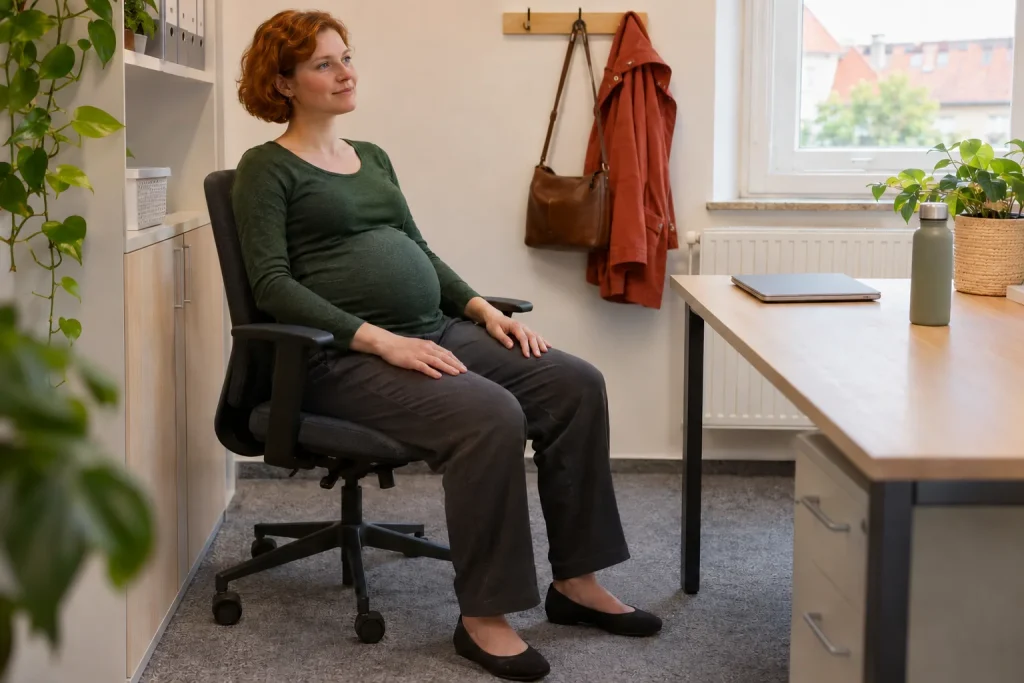
For office work, explain whether you can change position, how long uninterrupted meetings last and where a toilet or place to rest is available. In standing work, continuous customer service, stockroom tasks or lack of cover may be the real obstacle. “Try to rest more” becomes practical advice only when it is also clear how you can get the opportunity.
| Workday situation | What should you bring to the discussion? | What practical question might arise? |
|---|---|---|
| A long seated meeting | When do symptoms appear, and is it possible to change position? | How can the situation be interrupted in line with individual advice? |
| Standing customer service | How long does it last, and are a chair and cover available? | Who can help temporarily reorganise the workflow? |
| Many stairs | Which route makes them recur, and is there another way to get there? | Can unnecessary trips back and forth be reduced? |
| Moving objects | Which objects, how often and in what environment? | For which task should you request help or specific professional advice? |
In a workplace conversation, you can discuss the necessary change specifically without sharing every private detail. This article is not an employment-law guide and does not claim that the same reorganisation is immediately available in every workplace. If a solution is uncertain, seek help from your maternity care professional and the relevant workplace professional to clarify your individual next steps.
Include evening tasks in the daily picture too
The end of work is not necessarily the end of demanding situations. Shopping, cooking, washing, caring for another child or more stairs may follow. RCOG explicitly mentions considering help with household tasks and shopping. Asking for help here is not a special favour: it recognises that individual advice must be put into practice among real daily responsibilities.
Alongside saying “I have no time to rest”, describe one specific evening. For example, after work you shop, carry the bags home and then stand in the kitchen for a prolonged period. The professional is not scoring how your family works, but may be trying to understand where harder situations accumulate. A change might involve sharing a task, different timing or an adjustment tied to individual advice.
It is easier to hand a partner a specific task than to ask for help generally. “Be more considerate” is different from “I cannot manage bringing the shopping home well at the moment; could you take that on?” You do not have to give up every activity alone or push through it in pain. The solution often consists of organisational decisions by several people, rather than another list of exercises assigned to you.
Turn observations into a useful account of the day, not constant self-monitoring
A short note may help if recalling the day is difficult at the consultation. You can write three lines: the situation in which symptoms appeared, what they interfered with and what change you noticed later. There is no need to assign a pain number to every minute or a rating to every step. An excessively detailed system can easily become more work than the information it provides.
Try to separate observation from cause. “There were many stairs today and I had pain in the evening” connects two events; “The stairs damaged my pelvis” is already a claim your own diary cannot establish. Assessment may include considering other causes too. The HSE information also presents pelvic girdle pain as a complex condition that varies between individuals.
A good note makes seeking help easier; it is not a prerequisite for seeking help. If pain interferes with movement or everyday life, report it even without a finished diary. If a particular movement caused a symptom only once, you do not need to repeat it again and again as proof. A professional may request further observation, but can then do so purposefully and with knowledge of your individual situation.
What can you clarify with the physiotherapist and maternity care professional?
The NHS and RCOG emphasise reporting symptoms early and, when needed, assessment by a physiotherapist experienced in pregnancy-related pelvic problems. The aim is more than a name: it is to support everyday movement and understand your individual tasks. Choosing exercises online does not replace this; a solution suitable for someone else is not automatically your next step.
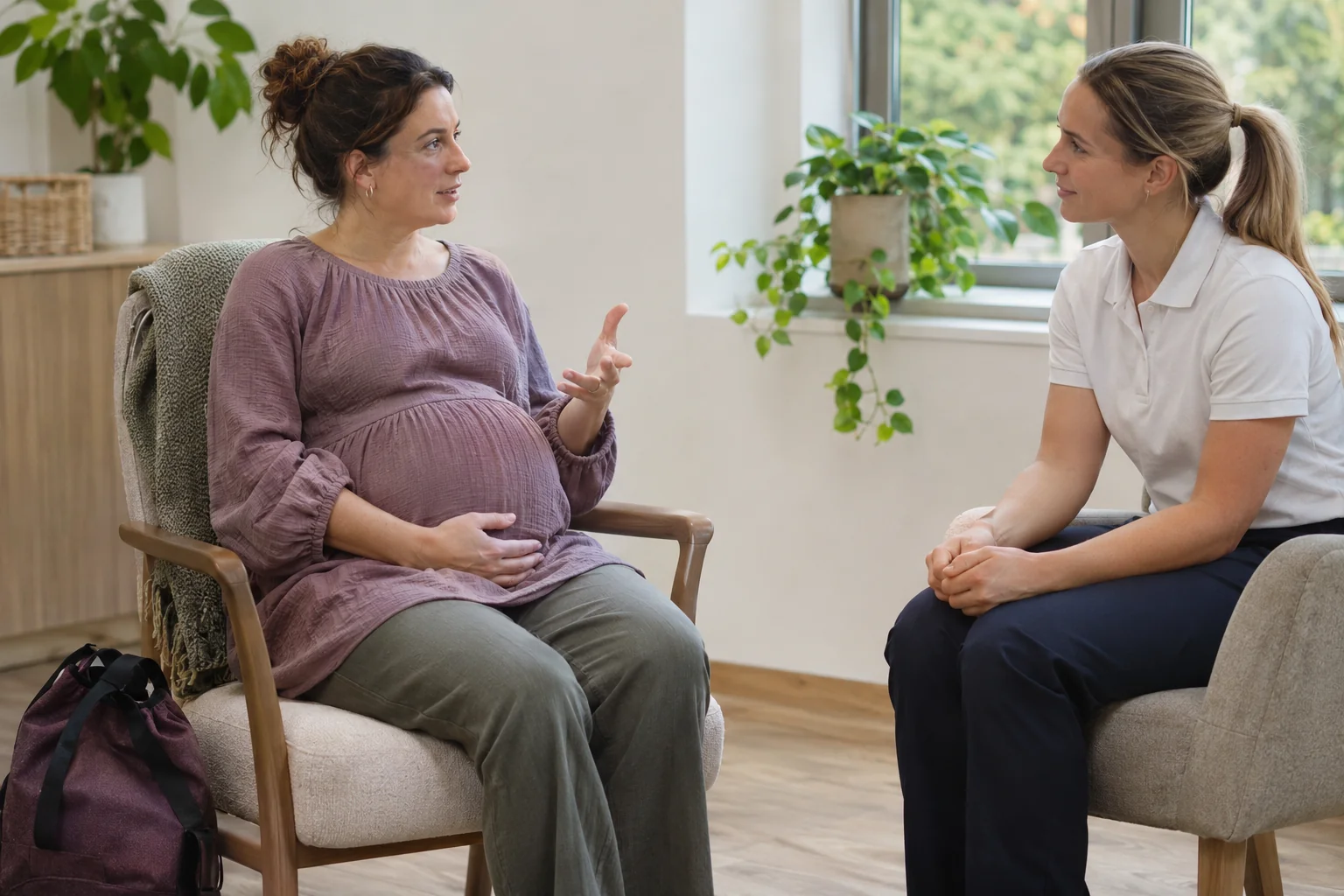
You can bring questions that arise in your actual day to the consultation. How should you arrange changes of position? Which tasks need help? Might equipment be needed, and if so, how should it be used? What should you do if reorganising the working day does not improve the situation? An answer is useful when it applies beyond an exercise in the clinic to the environment outside the door.
If you have been given a task or equipment, explain its use back and report problems that arise when putting it into practice. Do not independently alter the advice for the sake of a more intensive workout. Pressure to “do something, at least” can easily become another attempt that causes symptoms. Feedback about the individual plan provides more information than silently making more and more adjustments.
 Enlarge image
Put the running question alongside the whole working day
When you have symptoms, running is not the way to check whether the situation is “really serious”. The NHS discusses staying active alongside avoiding situations that make symptoms worse. Ask specifically about running and describe the other demands of your day too. Do not assume that because sport is your only enjoyable activity, it must certainly remain unchanged.
It may also be important for your coach to know that a working day is much harder than a day off. Whether a programme is practical depends on more than the length of a session. However, a coach does not decide in place of a physiotherapist or maternity clinician: they can help interpret agreed medical boundaries within a sporting calendar.
A temporary pause in running does not need to be filled with another equally demanding task to keep the training diary complete. Follow any individual recommendation you have about activity. If there is no clear answer, the next step is discussion, not trying an internet workout described as “pelvis-friendly”. Organising your day can itself be important work even when it does not appear as a sporting achievement.
When should you not wait for the next movement assessment?
Not every back or pelvic symptom in pregnancy should automatically be treated as part of already recognised pelvic girdle pain. The NHS information on back pain recommends urgent contact for back pain accompanied by fever, vaginal bleeding, painful urination or other new symptoms. Contact your maternity care professional with a new or changing symptom instead of waiting for the next summary of your workday diary.
According to the NHS, loss of sensation in the legs, perineal area or around the genitals is a sign requiring immediate emergency assessment. For severe acute illness in Hungary, call 112. The overall workday picture is useful, but does not reduce the importance of a new warning symptom. The next question to resolve then is not a more ergonomic chair or a shorter running loop.
Describing everyday demands is valuable because it brings the individual plan closer to your life. You do not have to treat the whole day as training or feel that every movement is a mistake. It is enough to make clear with the professional what is difficult, where change is possible and when help needs to be sought again. The decision about running can then be made with knowledge of your actual day, rather than an empty training diary.
Sources
- RCOG: pelvic girdle pain and pregnancy
- NHS: back pain in pregnancy and warning signs
- NHS: pelvic pain and individual support
- HSE: pelvic girdle symptoms and everyday situations
How Futószív articles are prepared: our editorial guidelines.