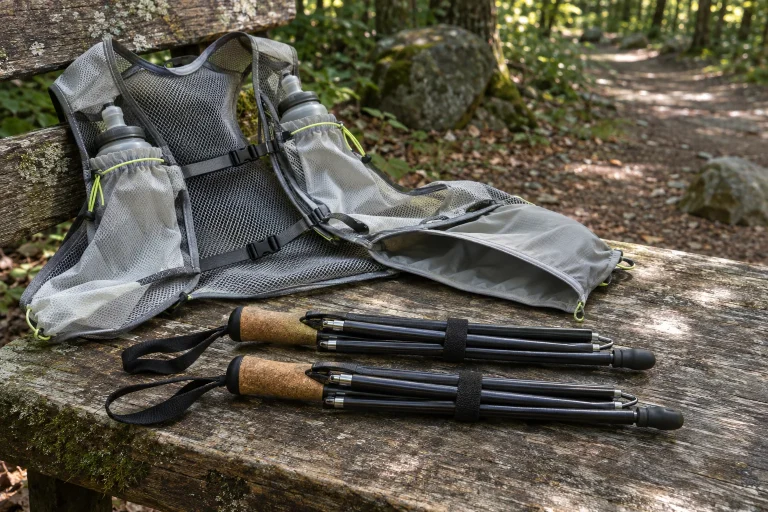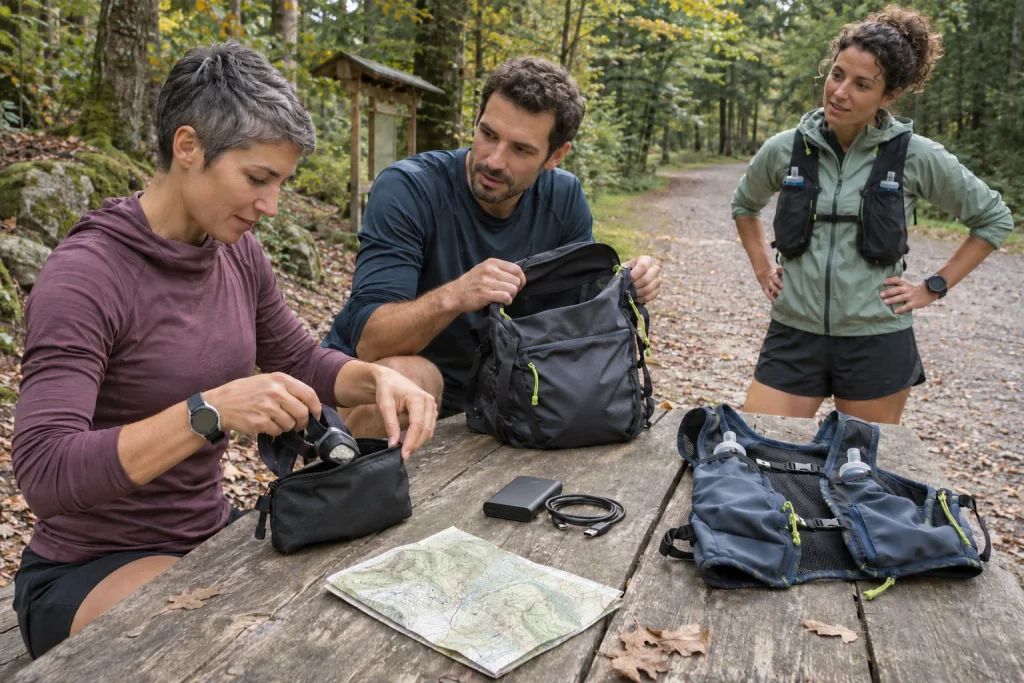
Before a group trail day, someone often suggests that everyone need not bring everything because equipment can be shared. That can be sensible organisation, but only if it is clear what is shared, what is personal, who has it and what happens when the group changes. A bag everyone assumes someone else will bring is no longer an administrative issue once you reach the venue. The shared list’s main job is therefore to remove assumptions.
This article explains the organisational logic of sharing equipment. It is not a complete mountain or medical kit list, first-aid guide or statement of what is compulsory for every Hungarian trail run. Necessary equipment depends on the chosen activity, conditions and group’s skills. Sharing helps only when actual access and usability are preserved too.
Clarify the activity before the objects
You cannot build a sensible shared pack merely from the fact that you are going into woodland. Which route, how much organisational time, which expected conditions and what group format? A short activity returning to a centre differs from a more distant point-to-point day. It also matters whether you stay together or have sections starting separately and leaving earlier.
Review equipment needed for the plan by function: navigation, communication, lighting, personal provision suited to the weather, necessary support and other tasks for that activity. Every category need not be duplicated identically in everyone’s bag, but neither can you declare beforehand that one device will cover every situation. Function and access matter together.
The Scottish Mountain Rescue equipment information also emphasises choosing items according to the activity and expected conditions, alongside necessary skills. You do not need to copy a list for the Scottish mountain environment unchanged into Hungarian trail running. The general lesson is that an object’s presence does not replace choosing appropriately for the situation and knowing how to use it.
Do not divide personal and shared equipment by weight
A personal need does not become communal because assigning it to someone else would be lighter. An item for personal use, individually sized clothing or a personal device needed by someone serves a different role from an accessory usable by several people. The person concerned should arrange personal medical needs under appropriate professional guidance; a group spreadsheet is not a place to collect detailed medical information.
The Mountaineering Scotland group-equipment guide updated in September 2025 separates individual and group-level items and notes that contents depend on activity and conditions. Take the principle of distinction from it rather than a general medication or treatment list. Select the pack needed for your own activity with appropriate knowledge.
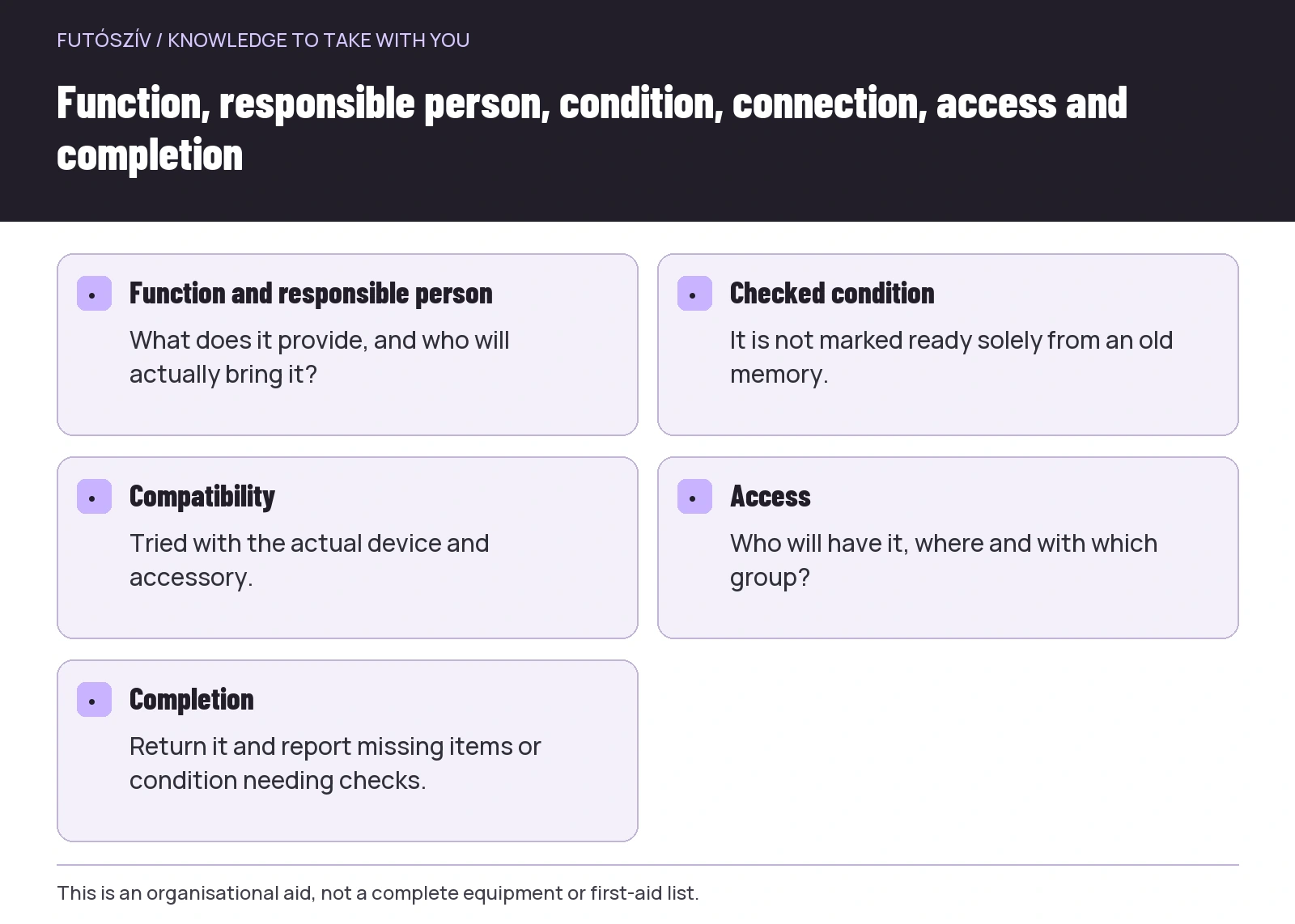
Four questions help assess whether something can be shared: who might need it, when, how many people can use it simultaneously and where its carrier will be then. If use is immediate or several people need it in parallel, one shared item may be inadequate. The count alone does not describe access.
 Enlarge diagram
Text version of the diagram
- Function and responsible person
- What does it provide, and who will actually bring it?
- Checked condition
- It is not marked ready solely from an old memory.
- Compatibility
- Tried with the actual device and accessory.
- Access
- Who will have it, where and with which group?
- Completion
- Return it and report missing items or condition needing checks.
Name someone who commits to each shared item
Replace ‘someone bring it’ with one person explicitly undertaking the item. The list should show its role, the carrier’s name and checking status. You do not need a complicated inventory system, but an item should not remain unassigned. A confirmed commitment and an open request are different statuses.
The person bringing it also needs to actually check it before leaving. Remembering that it worked months earlier is insufficient. Charge, suitable accessories and condition appropriate to the task can matter. Report uncertainty in time so the group does not discover on site that a shared requirement was never met.
Owner and carrier are not necessarily the same. For borrowed equipment, clarify who received it, who can use it and when it will be returned. Shared organisation should not make personal ownership invisible. Returning items and reporting anything missing are as much part of the day as the departure list.
Test usability before leaving
The compatibility of a charger, cable or map file is not established by a similarly shaped connector. Check the actual device pair and real operation. A downloaded map helps when it opens on the relevant device and its user understands it. Ticking the shared list provides real information only after that.
More than one person may need to know how to use equipment. If only one participant can operate it, access depends on their presence and situation. This is not equally important for every item, but clarify it for an essential function. Do not conceal limits in your own knowledge behind technical equipment. A different activity or appropriate instruction may be the next step if needed.
The check should not become an exhausting demonstration before every outing. Verifying critical, new or changed connections is enough. Do not improvise something requiring manufacturer instructions or training in a car park. A shared trail day does not automatically make anyone a competent operator of unfamiliar equipment.
Plan access alongside group movement
A shared item can be in the same place as the group yet hard to access. If everything is deep inside one bag, even a simple need may require stopping and rearranging the entire team. Give necessary equipment a known place without leaving the pack unnecessarily open to others. Sensitive or personal contents can be handled separately.
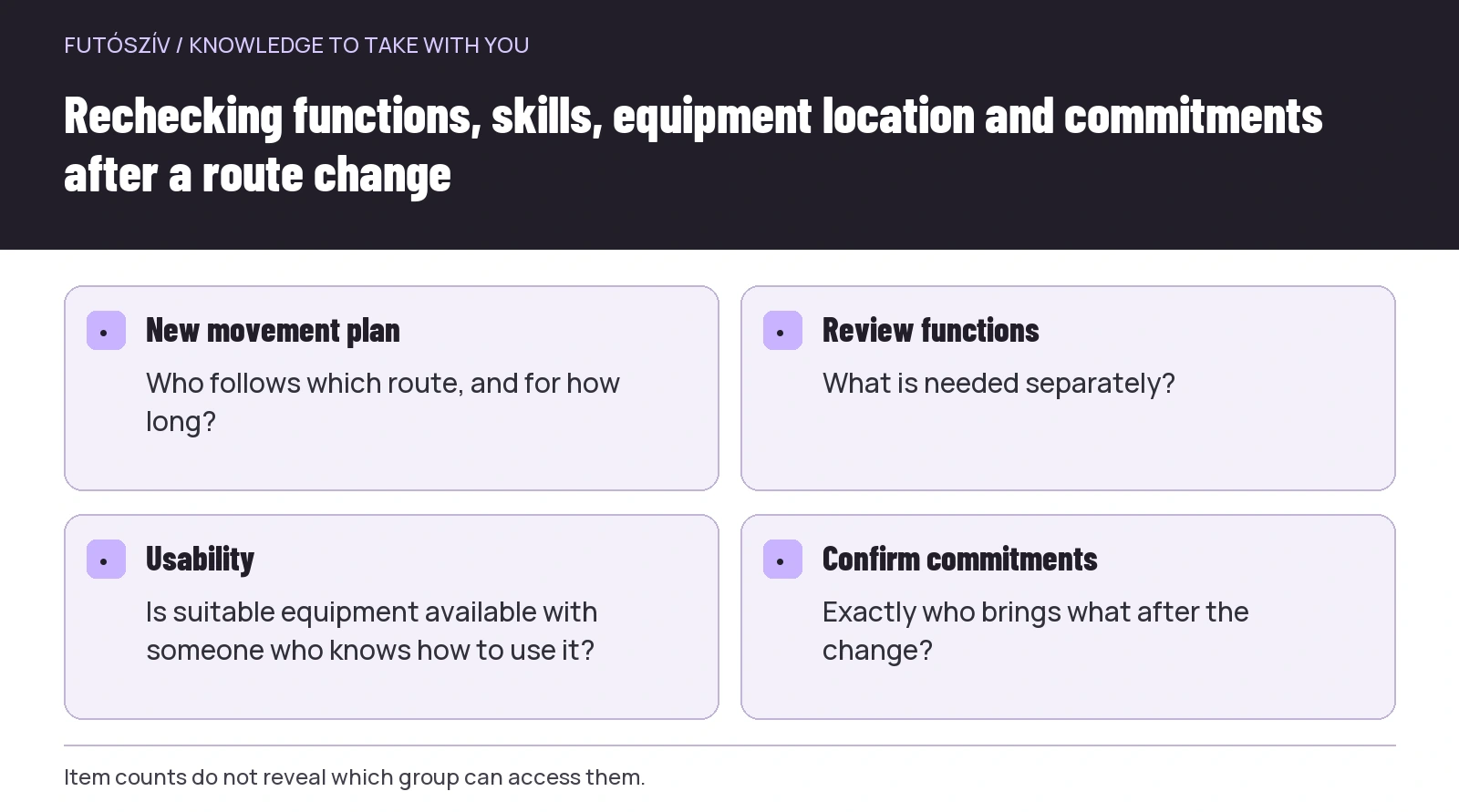
If the group splits, review functions again. Dividing headcount is insufficient if all navigation equipment remains with one subgroup. The same applies to someone leaving early or an unexpected route change. Shared-pack distribution can change with the movement plan.
Do not solve sharing by assigning most communal items to a less experienced participant because they are slower. Commitments should be proportionate and agreed, and equipment location should support required access too. The aim is understandable, workable group organisation rather than mechanically equal burdens.
 Enlarge diagram
Text version of the diagram
- New movement plan
- Who follows which route, and for how long?
- Review functions
- What is needed separately?
- Usability
- Is suitable equipment available with someone who knows how to use it?
- Confirm commitments
- Exactly who brings what after the change?
A useful shared list can have six columns
Alongside the item name, include function, carrier, checked condition, the connection required for use and return arrangements. Match detail to the activity. A simple borrowed accessory may need less information, while a solution connecting several devices also needs compatibility recorded.
| Field | Example question | What it prevents |
|---|---|---|
| Item and function | Which task does it solve? | Unnecessary duplication or an apparent solution |
| Responsible person | Who will actually bring it? | Everyone counting on someone else |
| Condition | Has it been checked before departure? | Treating an old memory as an established fact |
| Connection | Which device and accessory does it work with? | Compatibility surprises |
| Access | Who will have it, where and with which group? | A necessary item travelling another route |
| Completion | To whom and when will you return it? | Forgotten loans and missing accessories |
The list does not replace a brief confirmation before departure. If someone becomes ill, cancels or chooses another start, their shared item may become unavailable too. Review that specifically when something changes, rather than updating only the number of free car seats.
Make the backup’s role specific
A backup does not necessarily mean another identical copy of everything. Understand which failure you want to address and what solution is sufficiently independent of it. If two tools depend on the same phone losing charge or the same network connection, their number may exceed the genuinely separate options. Review dependencies between functions too.
Choose necessary backup with knowledge appropriate to the activity. This article does not give a universal technical or mountain-safety minimum. It helps record conditions of use alongside objects. If those conditions are not met, simplifying or changing the programme can also be a solution.
Improvised repairs to failed equipment should not become an automatic commitment. Appropriate use and manufacturer limits matter, especially for an essential function. Knowing when an item in uncertain condition cannot continue in use is part of shared-equipment competence too. Do not leave it marked checked on the list then.
A fictional example of a changing group pack
Five friends plan a trail day, but two choose a shorter loop. Under the original idea, one participant would carry the detailed map and most shared technical accessories. Discussing the two routes’ split reveals that every device also expected on the longer loop would leave with the shorter-route group.
They do not simply give someone else a heavier bag. They review which functions each subgroup needs, who can operate their own equipment and which accessories are compatible. Personal belongings do not automatically become part of the shared pack. They briefly confirm the new distribution and do not mark uncertain items ready.
At the end, they return borrowed equipment with its accessories and report anything needing checks. The previous carrier’s name does not automatically carry over to next time. They retain useful columns but agree commitments again for the particular activity. The system remembers the method without inventing ongoing obligations for participants.
Closing is a shared task too
After arriving, check that every borrowed item and necessary accessory is present. Arrange cleaning, drying and further checks under manufacturer guidance and agreements with the owner. Do not mention uncertainty arising from use only before the next departure. Reporting missing items or faults in time is part of shared use.
For the next day, record actual experience: which item was unavailable when needed, which connection should have been tested earlier or which task had nobody committed to it. ‘There was too much stuff’ alone is insufficient; functions reveal what was needed and what remained unnecessary.
The main achievement of well-shared equipment is not everyone’s bag weighing the same. What matters is that every necessary function has a real person responsible, suitable equipment and an accessible user. The group then heads onto the trail with commitments clarified beforehand rather than assumptions.
How Futószív articles are prepared: our editorial guidelines.