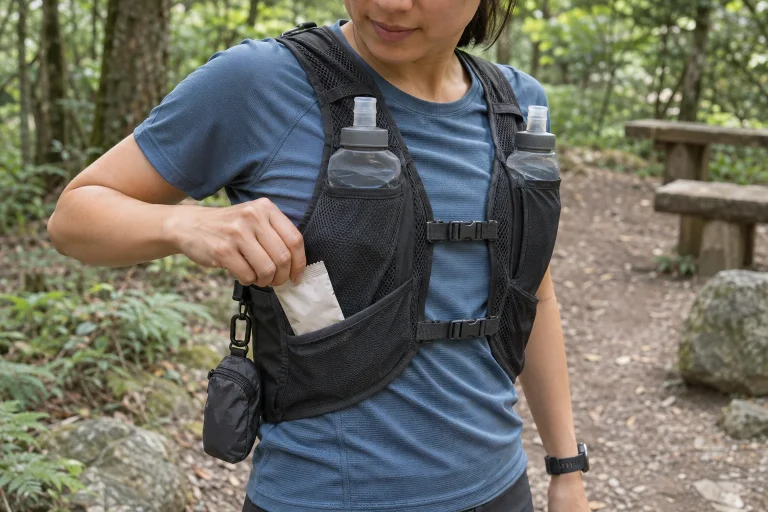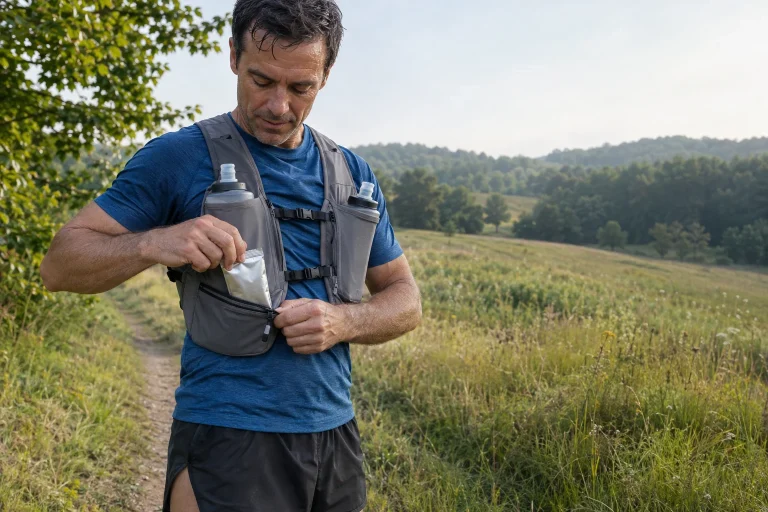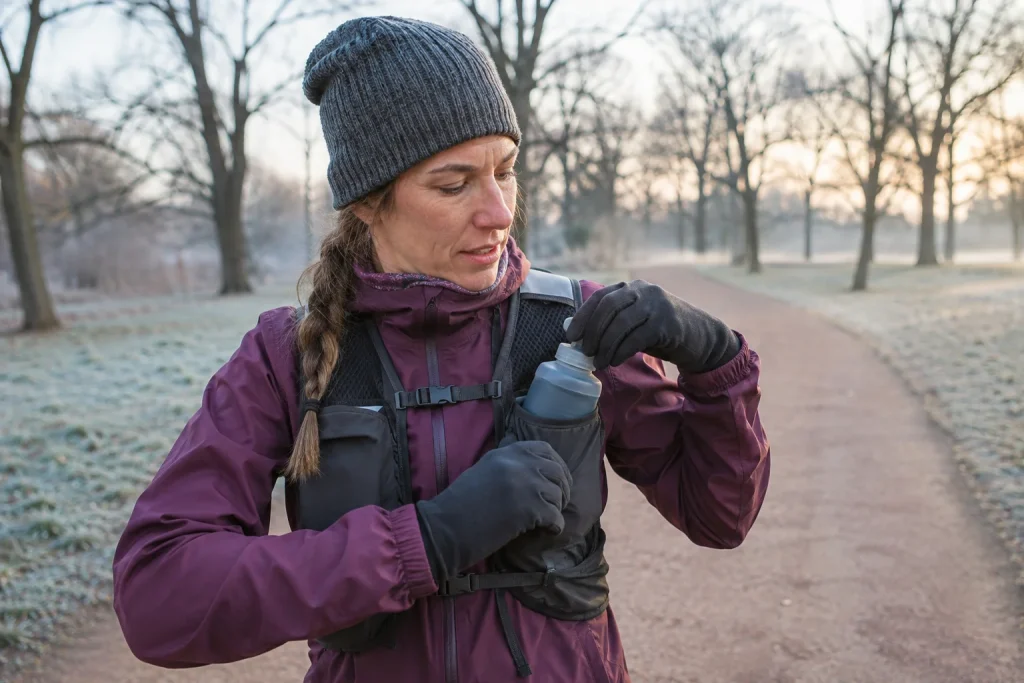
On a winter run, you may carry what you planned as enough drink yet struggle to access it. Thick gloves do not work with a small cap, a jacket covers the vest pocket or the drinking tube sits somewhere you repeatedly have to reach. Preparing for cold therefore includes using drinking equipment and clothing together. Carried supplies genuinely help only if you can use them appropriately in your own kit.
This article addresses access and equipment operations, not personal fluid needs or treatment of cold injuries. It gives no guaranteed anti-freezing solution for every temperature or shared sipping interval. Consider the drinking plan, training demands and health circumstances separately. Manufacturer examples always apply to the particular system; transfer them to another item only according to its own instructions.
A glove trial makes sense with your full outfit
Put on the jacket, vest, gloves and any additional hand-warming layer you would actually use. A cap easily opened barehanded in a warm room does not establish easy access with gloves. Try it in a calm, safe place: retrieve the equipment, use it as intended, close it and secure it again. The first aim is not a fast time, but being able to follow every step.
Notice which steps require removing gloves. If several do, the system may need reconsidering. A new bottle is not necessarily needed: another position, a more accessible pocket or an appropriate accessory made for the equipment may help. Modifying gloves or adding a homemade pull can create another fault, however. Choose only a change whose use and secure attachment you actually understand.
Look for three separate access barriers
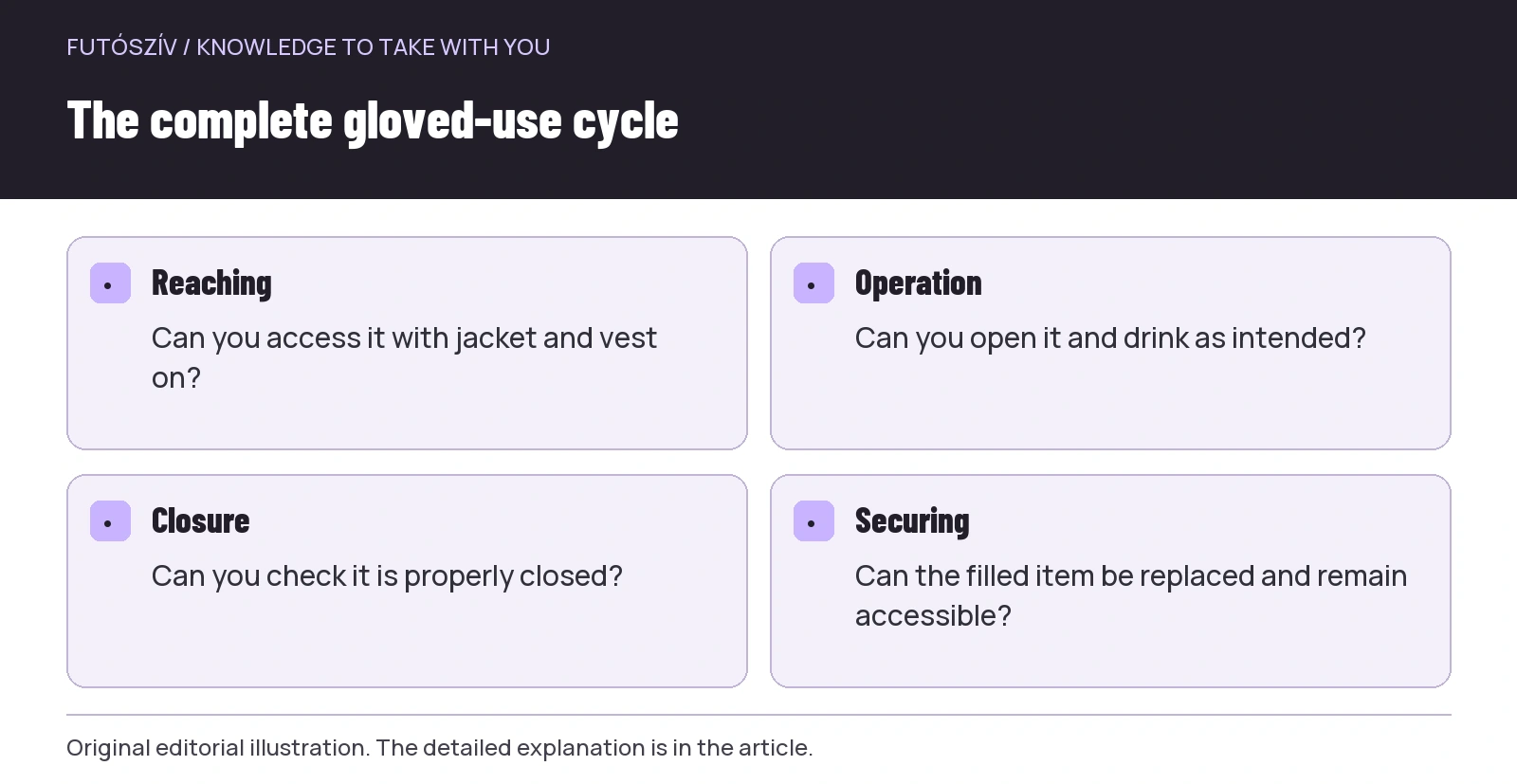
First is reaching: can your hand get to the pocket or valve? Second is operation: can you grip, open, use and close it? Third is replacing it: after drinking, can you put it away without falling out or leaking while keeping it accessible next time? These are different tasks. A bottle may come out easily while a full soft container is difficult to slide back into the same tight pocket.
Naming the obstacle precisely may allow a smaller, targeted change. A new cap does not necessarily solve a reaching problem. An awkward valve does not necessarily need a larger vest. Write a short sentence after trying: ‘the jacket edge covers the left pocket’ or ‘I cannot check the cap closure with gloves’. That gives a sensible next step.
Clothing layers change tube routing
The Cascade Designs manufacturer guidance for cold weather also mentions routing as much tubing as possible in protected positions, for example inside a pack, strap or jacket. This concerns its own systems, not a guarantee for every routing arrangement. With your own tube, also check for kinks, whether attachment allows necessary movement and appropriate access to the mouthpiece.
Putting on or removing a jacket may change this arrangement. Avoid loops that hinder dressing or catch on objects. Use zips and vest straps only as designed; do not trap equipment between them when unsuitable. After changing layers, briefly check the drinking point’s location, whether necessary valves are closed and whether the next movement will pull the tube.
 Enlarge diagram
Text version of the illustration
- Reaching
- Can you access it with jacket and vest on?
- Operation
- Can you open it and drink as intended?
- Closure
- Can you check it is properly closed?
- Securing
- Can the filled item be replaced and remain accessible?
Insulation is an option, not an unlimited guarantee
The CamelBak care and cold-weather information describes handling tubes and valves, positioning closer to the body and appropriate backup for its reservoirs. The manufacturer also warns that water can still freeze in extreme cold despite these measures. Calling a system insulated therefore does not establish operation in every weather and run. Actual conditions and your own use still matter.
If choosing an insulating sleeve or tube cover, check specific compatibility. Does the control remain accessible underneath or beside it? Does the mouthpiece still close properly? Does the sleeve interfere with attachment? Look at the whole sequence, not just an insulation label. An accessory that complicates necessary drinking or closure checks may introduce another problem. Assess usability in your own full equipment.
A manufacturer’s technical tip is not a personal drinking dose
Some manufacturer guides offer technical ideas for handling water remaining in tubes or regular use. Do not turn these into personal medical dosing rules. If the system’s instructions permit a particular operation, follow those instructions; another valve or filter may have different limits. Operating equipment and the amount to drink should remain separate questions.
The British Dietetic Association sports nutrition information emphasises appropriate fluid provision throughout the period around exercise. Cold surroundings are no reason to leave necessary access unresolved. Nor should protecting equipment require drinking an amount different from your own appropriate plan. If the technical system works only through that compromise, change the equipment, route or conditions of the run instead.
Two sets of instructions limit liquid temperature
Check both drink and container instructions. Different bottles, tubes and valves do not necessarily accept the same liquid temperature. Hotter water is not a universal solution for an awkward winter system. The manufacturer’s permitted range and safe consumption conditions matter together. An accessible mouthpiece does not help if its drink is at an unsuitable temperature for consumption.
Before running, do not force an iced component apart or clear it with a sharp object. If equipment cannot work as planned, handle it in a safe setting under its own instructions. Open flames, improvised heating and unknown additives are not justified quick fixes. Accessible backup or changing the run provides a sensible winter-plan response, rather than forcing equipment on site.
Give the cap a clean place where it can be retained
With a screw-top bottle and gloves, consider where the removed cap stays during filling or use. Do not put its inside on snow, the ground or a bench of uncertain cleanliness. An attached cap can help prevent loss if it does not disrupt filling and closing. An added cord raises separate attachment and snagging questions; do not assume every strap automatically improves the system.
Check closure while stationary if needed rather than struggling on the move. Inspect the cap’s required fit and the bottle’s attachment. A hurried, partially threaded closure may later leak and wet clothing too. A simple, reliable sequence may be worth more in your own use than a seeming advantage of a few seconds. A rest or refreshment stop can belong in a winter plan.
| Trial step | What you observe | A possible targeted change |
|---|---|---|
| Retrieving in full clothing | Does a jacket or strap cover access? | Positioning compatible with the manufacturer’s design |
| Opening with gloves | Can the control be gripped and operated? | Another item or position you can actually manage |
| Drinking and closing | Can you distinguish open and closed states? | A brief safe stop and separate closure check |
| Replacing when filled | Does the container fit the designated pocket? | Trying the full system again, not only the empty one |
 Enlarge diagram
Text version of the illustration
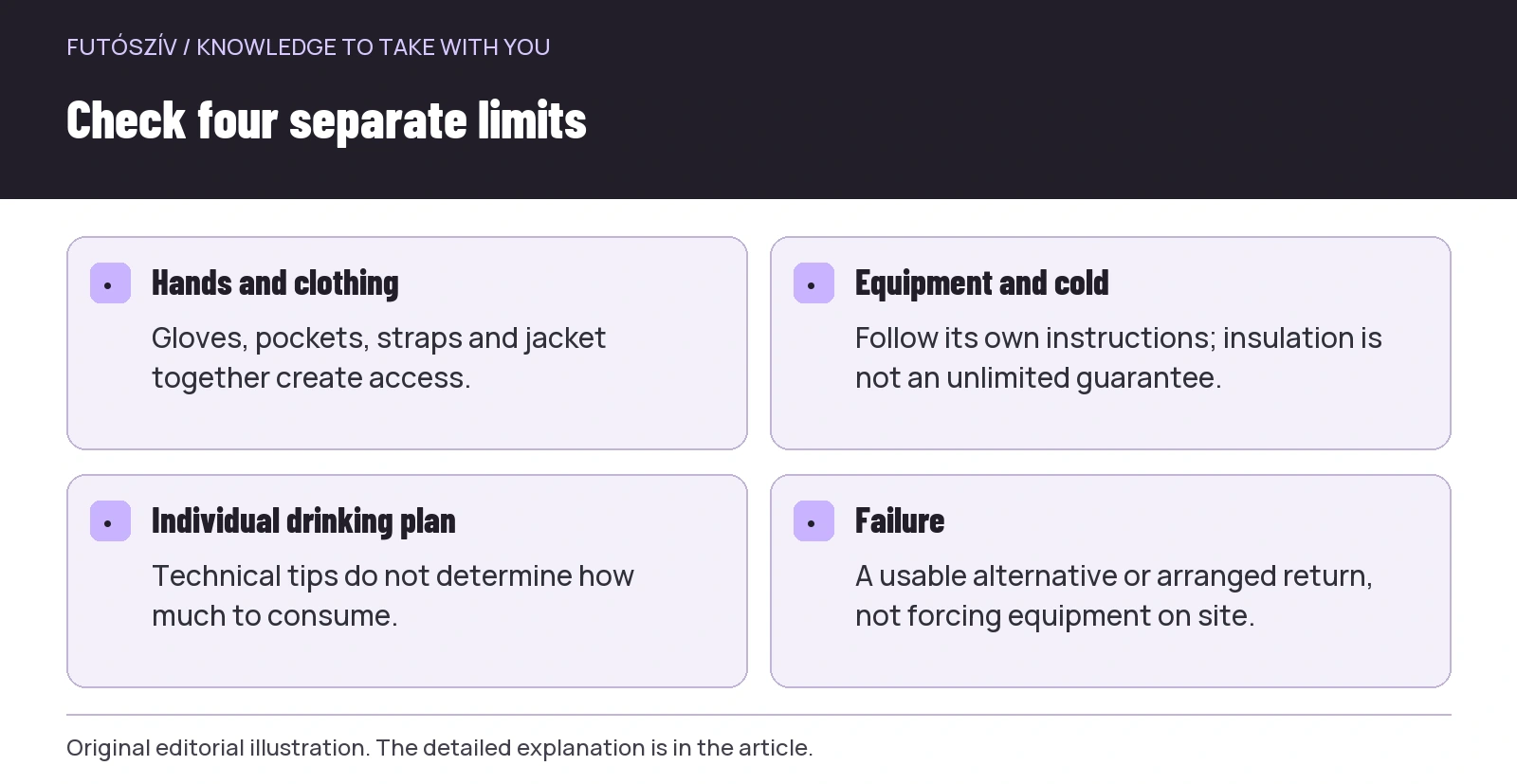
- Hands and clothing
- Gloves, pockets, straps and jacket together create access.
- Equipment and cold
- Follow its own instructions; insulation is not an unlimited guarantee.
- Individual drinking plan
- Technical tips do not determine how much to consume.
- Failure
- A usable alternative or arranged return, not forcing equipment on site.
Conditions before and after a stop may differ
Everything starts in its usual place, but after refilling the container’s shape, gloves’ condition and layers’ arrangement may differ. Do not end the trial at the first sip. Replace the item and check access again. If a bottle goes back into the pocket only when empty, a single dry check before leaving would miss that. The real task is repeating the whole cycle.
Give other equipment somewhere to go at a stop too. Do not try to hold gloves, cap, cup and packaging in one hand simultaneously. At a race, follow the station layout and instructions. Allow the task the time it needs. Do not skip necessary access to drink because it cannot be done as quickly as on a summer training run.
A backup must solve access too
A reserve in the same inaccessible pocket with an equally ungrippable cap does not solve the main problem. Your appropriate plan needs an alternative you can actually use in expected conditions. This might be another arrangement or a different access method checked properly beforehand. Alongside carrying it, try retrieving, closing and actually using the backup.
The ability to interrupt the run belongs here too. If the drinking system fails, know beforehand where and how you will return to appropriate conditions. Do not start searching for unfamiliar, seasonally closed fountains after failure. If the route lacks a workable alternative and suitable return, change it before leaving. A backup plan is more than another object: it is a clear decision for when the main system cannot do its job.
Agree with companions where to regroup
In a group, say when you need to stop to access equipment. Make clear where you will wait for each other, avoiding a split that leaves someone alone with awkward equipment. Help should be understandable beforehand: holding a strap or bottle differs from altering an unfamiliar drink. Do not swap personal mouthpieces or containers, and do not change an individual plan through well-meant guessing.
At home, handle cold-weather equipment according to its own cleaning and drying instructions too. Check closures and attachments for damage and note the actual access barrier. Use the next trial to improve that. A small, targeted position change may help more than several new accessories not yet tried together. The winter system needs to work in your own hands.
Have both supplies and usability
Before leaving, check reaching, opening, intended use, closing and securing again in full clothing. Interpret cold-weather manufacturer advice for the particular model, and do not rule out freezing merely because of an insulating cover. If the system cannot be used, keep a workable adjustment available. The technical side of drinking then becomes a clear preparation task rather than a discovery made in the cold.
Sources and further reading
- Cascade Designs: How do I prevent the water in my hydration system from freezing in cold weather?
- CamelBak: Care & Cleaning – cold-weather reservoir guidance
- British Dietetic Association: Sport and exercise
How Futószív articles are prepared: our editorial guidelines.