
In women’s masters running, someone who has trained for decades can stand at the same age-group start line as someone who has just discovered the sport. They share an age classification, but differ in sporting history, health, daily demands and what they want from running. A good goal starts with these circumstances, not what someone supposedly ought to achieve or abandon after a particular birthday.
A realistic goal is not necessarily modest. It can include improvement, racing and ambition while making room for sleep, strength training, work and caring responsibilities. The framework below helps distinguish race classification from individual preparation and choose a plan grounded in everyday life.
‘Masters’ is not a health category
According to World Masters Athletics information, masters competition operates with age groups beginning at 35. This is a sporting classification, not a statement that every runner within it shares the same physiology or life stage. The training needs of someone in their thirties and someone in their seventies cannot be described by the same age label either.
The particular event’s current rules determine the precise conditions for participation and classification. The 2026 WMA rules apply to an official competition system; age groups at a Hungarian recreational run need checking separately. Meeting an entry condition is not a medical assessment of fitness for sport.
Give age group, current sporting condition and goal separate lines in your own plan. The category can tell you who you are assessed alongside, but not how much you slept, which injury you are returning from or how much time you can regularly devote to training.
Sporting history matters at least as much as age
A long-term regular runner, someone returning after an extended break and someone starting again may need different starting plans. An old personal best is useful information about your history, but is not the same as current capacity. If much changed during the break, the next programme needs to account for that too.
List the activity you actually did in recent weeks. How often did you run, which sessions felt good and which did you recover from appropriately? A real record is a better foundation than an old training plan or one exceptionally accommodating week.
Being a beginner is not a disadvantage that must quickly be erased either. Learning a new movement skill, route and weekly rhythm is a task in its own right. Age-group competition may be a later goal, but preparation does not become serious by immediately following more experienced runners’ programmes.
Choose three types of goal instead of one result figure
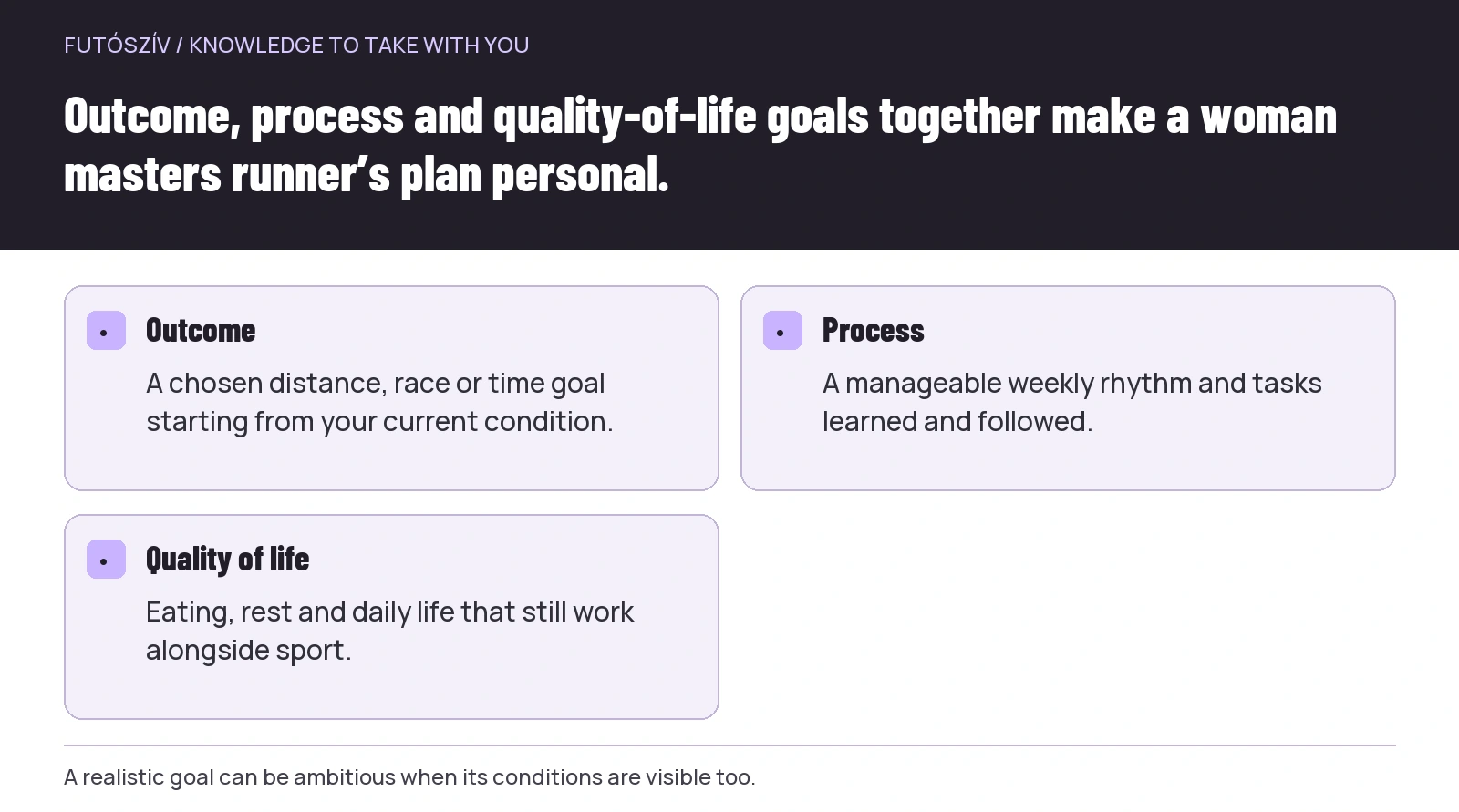
The first can be an outcome goal: a distance, race or finishing time. The second should be a process goal: the regular, manageable habit you will build towards it. The third should concern quality of life: what you want daily functioning to feel like alongside sport. Together, the three show when the plan genuinely works.
For example, preparation for a shorter race might include a weekly running rhythm you can follow and having energy left for the day after sessions. These are organisational examples, not training doses for everyone. The particular distance and amount should follow from your current starting point.
If pursuing the outcome repeatedly harms the process and daily functioning, review the plan. You do not need to wait until starting becomes completely impossible. Adjusting a goal is part of planning, not a judgement of an athlete’s character.
 Enlarge diagram
Text version of the illustration
- Outcome
- A chosen distance, race or time goal starting from your current condition.
- Process
- A manageable weekly rhythm and tasks learned and followed.
- Quality of life
- Eating, rest and daily life that still work alongside sport.
Use age-adjusted comparisons as a tool
The British Masters Athletic Federation presents age grading as a comparison considering both age and the particular event. This can offer an interesting perspective, but it is not a personal health score or a prediction of the result you should achieve.
A calculation rests on tables and a chosen system. Comparing results from different apps makes sense only if they use the same basis. A more favourable percentage does not mean your current training load is appropriate in every respect.
If the assessment motivates you, use it as part of the sporting experience. If it turns every outing into another test of your worth, reduce its role. Well-structured training, movement quality and wellbeing also provide information about your progress, beyond a placing obtained through adjustment.
Strength and balance may need their own calendar space
The WHO physical activity guideline recommends muscle-strengthening activity alongside aerobic activity for adults; for older adults, it also emphasises multicomponent activity targeting functional balance and strength. Different age-specific recommendations should not automatically be applied as one identical programme for every masters runner.
The practical question is which other movement tasks you do alongside running and how they fit your condition. Strength training should not appear only once a problem exists. Where necessary, learn technique, difficulty and progression with an appropriate professional.
A new task is a training demand too. When introducing it, do not automatically increase every part of your running volume during the same period as well. A simpler change gives feedback you can follow more clearly and makes it easier to understand what works.
Menopause is individual, not an explanation for everything
Masters age groups include runners before, around and after menopause, with different symptoms. The NICE guideline emphasises care shaped by individual symptoms, preferences and health circumstances. Hot flushes, sleep problems and other symptoms may matter, but every harder run need not automatically be attributed to the same cause.
If a new or persistent symptom changes sport and daily life, seek an appropriate healthcare discussion. Temporarily adjusting the running plan may help organisation, but does not replace assessment or necessary treatment. Tolerating difficulty as an athlete is not a requirement for receiving care.
Share as much practical information with a coach or running companion as you want. For example, you may currently need a more flexible morning time or an easier outing. You do not have to give every participant a detailed health history for your needs to be considered.
Do not fund recovery from whatever time is left
Alongside the run’s timing, preparation should include meals, opportunities to sleep and the day’s other demands. If every session means going to bed later, eating hurriedly and a tense day, the programme may be achievable on paper but too tight in real life.
Try planning from the time actually available. Fewer, better-organised sessions may fit than previously. Sharing family responsibilities may help make an important session possible. Recovery conditions partly depend on shared arrangements, not only personal attitude.
A harder week should not automatically trigger a chain of catch-up workouts. If a session is missed, look at what remains important over the coming days. A programme is not a debt list that must be paid off at any cost by the end of the week.
 Enlarge diagram
Text version of the illustration
- Competition framework
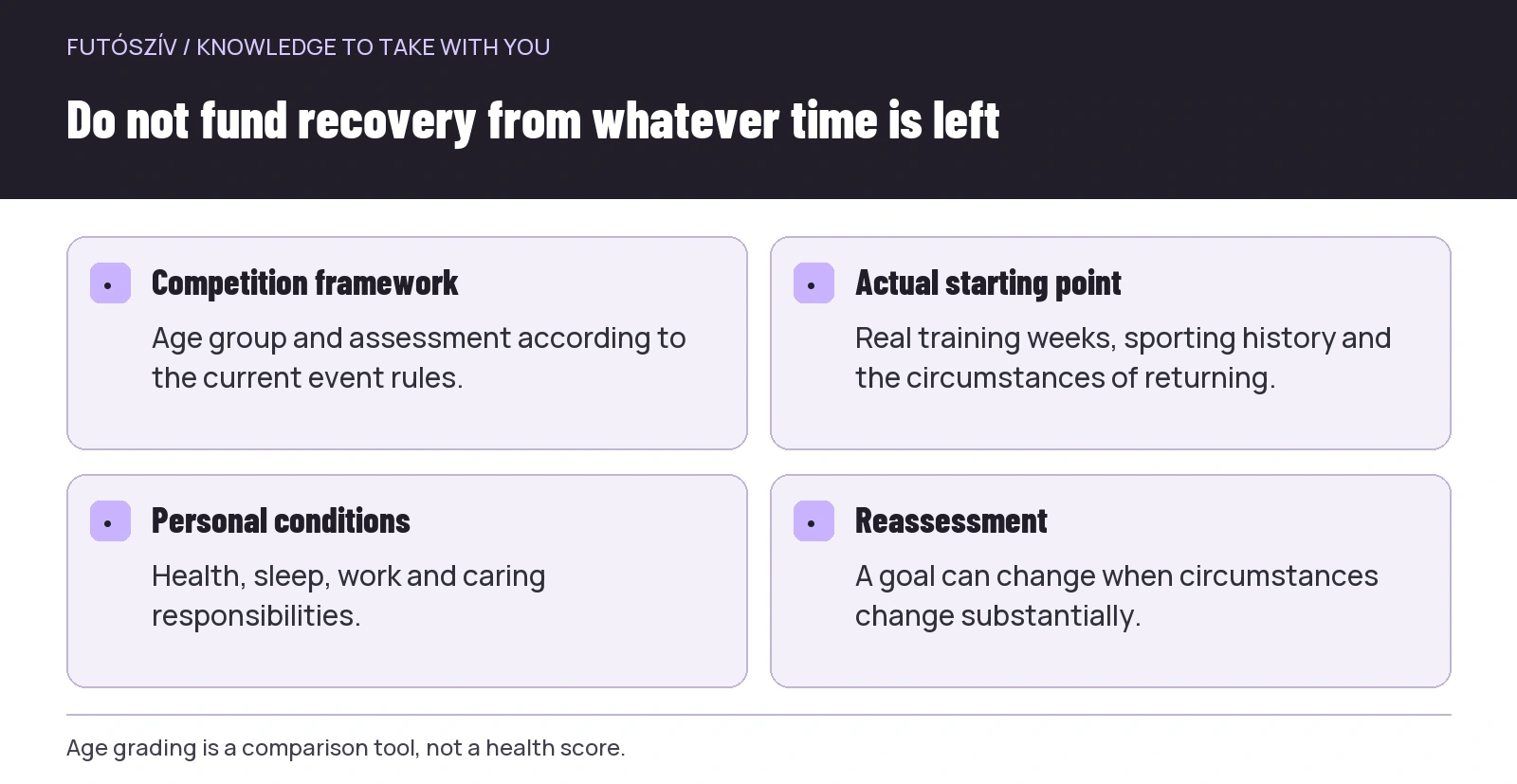
- Age group and assessment according to the current event rules.
- Actual starting point
- Real training weeks, sporting history and the circumstances of returning.
- Personal conditions
- Health, sleep, work and caring responsibilities.
- Reassessment
- A goal can change when circumstances change substantially.
Let the race calendar provide rhythm, not constant proof
In age-group racing, it is easy to add every attractive opportunity. Before entering, consider travel, weather, the course and the intervening weeks. Starting involves more than race time: preparation and getting home form part of the overall demands too.
You can choose a few more important goals, leaving other occasions as social or learning events where appropriate for your condition. State the different intentions beforehand. An event intended to be easy is then less likely to carry you automatically into chasing a result.
Always check current event information, especially age group, eligibility, entry deadline and distance. Knowing the competition system is a practical advantage, but does not replace considering individual preparation and health.
Make your whole life situation visible when working with a coach
A good conversation asks about more than weekly kilometres. Explain work schedules, caring responsibilities, sleep opportunities and previous injuries. These help explain why the same plan works one week and not another. Feedback is information the programme needs, not an excuse.
Ask the purpose of each session, what can be adjusted and which signs should prompt a discussion. An individual plan should have a simpler version too. If full completion is the only accepted answer, the system struggles to adapt to real days.
Clarify in advance how results will be evaluated too. Progress can mean pace, a better sense of endurance, training that is easier to follow or more confident participation. A measure suited to your own goal produces fewer meaningless comparisons.
The community should not expect one single women’s sporting story
Not every woman masters runner wants to move for the same reason. Racing matters to some; others value company, time to themselves or the enjoyment of movement. These can coexist and change over time. A group need not assign one motivation on everyone’s behalf.
An inclusive outing communicates a precise distance and pace, allows shortening and does not base every decision on the fastest runners. A newer or slower participant is equally a member of the community. Alongside celebrating age-group success, returning and learning can be made visible too.
Language matters as well. Instead of resigned or exaggeratedly heroic remarks about age, ask the runner’s own goal. You do not have to look younger or be extraordinary for sport to be a valuable part of life.
Four questions for reviewing a goal
- Does the plan start from my current sporting condition or expectations of my former self?
- Does the weekly rhythm leave room for meals, rest and daily functioning?
- Alongside a result figure, what process and quality of life do I want to build?
- Which circumstance has changed enough to make adjusting the goal worthwhile?
Revisit the answers every few weeks or after a significant life change. You do not need a new plan every day, but an earlier decision need not be treated as unchangeable either. Consistency and flexibility can coexist within a goal.
As a woman masters runner, an age group can provide an exciting competition framework, but your sporting life is broader. A real starting point, appropriate help and manageable goals can create a system in which ambition and life circumstances fit together.
Sources
- World Masters Athletics: FAQ
- World Masters Athletics: 2026 Competition and Technical Rules
- British Masters Athletic Federation: Age-Graded Standards
- WHO: Guidelines on physical activity and sedentary behaviour, 2020
- NICE NG23: Menopause – identification and management
How Futószív articles are prepared: our editorial guidelines.