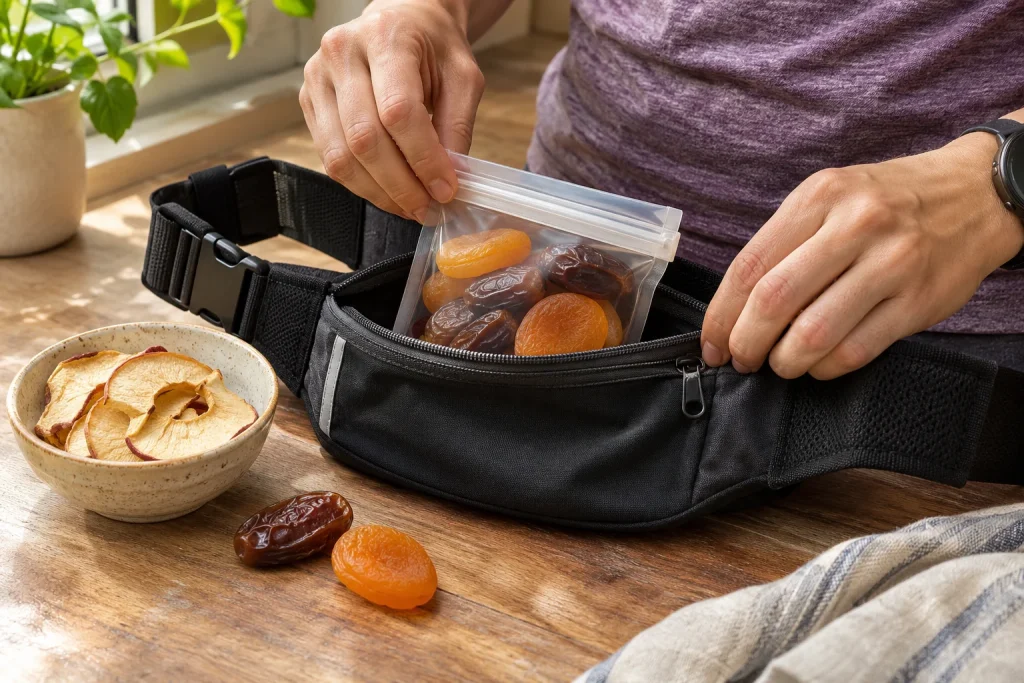
Dried fruit takes up little space and comes in many textures. That does not mean every pack works the same way in a running belt, or that every product has the same composition. Soft dates, drier apple slices and pieces that stick together may need different handling. Start with the actual label, intended use and packaging rather than a universal handful-sized portion.
This article helps you understand a product and organise packing portions at home. It is not a personal sports diet, does not claim everyone should eat dried fruit while running and does not prescribe grams per hour. Fuelling needs should reflect activity demands, individual circumstances and health requirements. If you need advice, work with a dietitian experienced in sport. With an allergy or known dietary restriction, your current personal plan takes priority.
First name the occasion you are packing it for
Fruit eaten as part of a meal while travelling serves a different purpose from fuelling during training. Food stored in a running bag may also be intended as an ingredient in a meal after finishing. Write down which applies. Without that clarity, you may choose a texture or pack size convenient for one occasion but awkward for another. A food’s name does not describe every possible use.
The British Dietetic Association sports nutrition overview connects dietary needs with activity demands and individual circumstances; it also lists dried apricots among examples of carbohydrate-containing foods. This does not make all dried fruit nutritionally identical or automatically appropriate running fuel. A product needs a place within the whole eating plan. Below, we examine packaging and label-reading decisions.
Start with the ingredients rather than the front of the pack
Read exactly which fruit and additional ingredients the pack contains. A mixture, a coated product and a version containing a single ingredient are not necessarily the same. An added ingredient may affect flavour, texture or storage life. A ‘fruity’ description alone cannot establish the complete recipe. When comparing two packs, read each one’s own information rather than assigning a general database average to them.
‘No added sugar’ does not mean the product contains no sugars. Interpret carbohydrate and the separate ‘of which sugars’ line according to the particular nutrition label. A fruit piece’s size is not a nutritional unit either. Two apparently similar pieces may have different weights, so you cannot reliably transfer one pack’s contents to another brand or fruit simply by counting pieces.
Keep allergen information with your own packed portions too
The European Commission allergen-labelling information explains highlighted allergens in ingredient lists and warnings about possible unintended presence. The list also includes sulphur dioxide and sulphites under the specified labelling condition. Read the particular dried-fruit label too; do not assume a fruit-based product automatically meets every dietary restriction.
If you divide food into your own small pouches, retain the original product’s identity and essential information. A photo of the entire legible label can help you find details later, but still know which pouch comes from which product when using it. Do not combine leftovers from several bags into an unnamed shared supply. If offering it to someone else, do not merely say ‘dried fruit’: composition and warnings referring to cross-contamination may matter to them too.
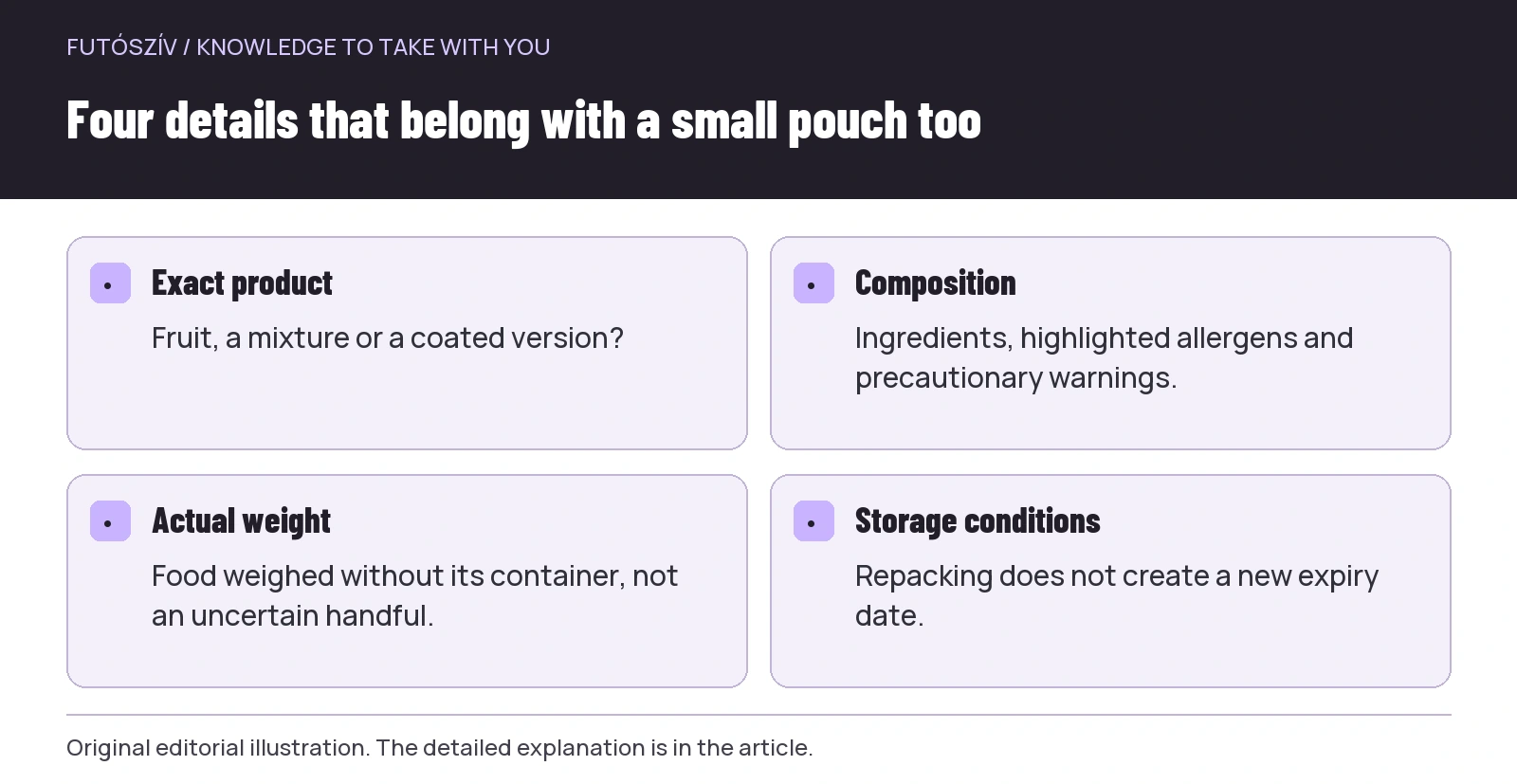 Enlarge diagram
Text version of the illustration
- Exact product
- Fruit, a mixture or a coated version?
- Composition
- Ingredients, highlighted allergens and precautionary warnings.
- Actual weight
- Food weighed without its container, not an uncertain handful.
- Storage conditions
- Repacking does not create a new expiry date.
Connect nutritional values to the amount actually weighed
The label’s information and the weight of your own portion are two separate inputs. A value per hundred grams gives the amount in your pouch only when you know the weighed quantity. This is simple proportional arithmetic, but its result is not automatically the intake appropriate for you. The calculation tells you what is in the pack. Needs should not be determined solely from a kitchen scale or an online table.
An entirely fictional educational label shows sixty grams of carbohydrate per hundred grams. If you weigh forty grams of this food, the calculation is sixty multiplied by forty, divided by one hundred: twenty-four grams. If the same pouch actually contains fifty grams, the label-based value would be thirty grams. This example is not the composition of a real dried-fruit product, a personal portion or an intake recommendation. The difference illustrates only why actual weight matters.
| A detail in the fictional example | What does it mean? | What is it unsuitable for? |
|---|---|---|
| 60 g carbohydrate / 100 g | The example label’s common quantity basis | Not an average value for all dried fruit. |
| 40 g of weighed food | The example pouch’s net contents | Not a fuelling portion appropriate for everyone. |
| 24 g of calculated carbohydrate | The label-based quantity calculated from the two inputs | Not an absorption measurement or a promise of performance. |
Do not count the pouch’s weight as food
Place the clean, suitable container on the scale and tare it according to the device’s instructions. Then add the food. If the displayed figure includes the container’s weight, the starting information is already wrong. You do not need to promise laboratory precision from a kitchen scale: your device’s resolution and method of use impose limits. The aim is a traceable portion whose contents and weighing method you understand.
For a mixture, the full product’s label information applies to the whole mixture. If you select just one ingredient from it at home, you cannot necessarily apply the original average unchanged. For example, taking only the fruit pieces from a fruit-and-seed mixture is not the same as packing the mixture. Do not produce an apparently precise number from the wrong starting information. Choose a product and packing method whose information can actually be followed.
A texture check asks a different question from nutritional value
Before putting the small pouch in your running belt, calmly check how it opens, whether the pieces stick together and whether food can be removed cleanly. Handling a sticky surface or a larger piece needing chewing differs from handling food that portions easily. Packaging should not require tearing with your teeth or dismantling tiny parts that are difficult to keep track of. This checks access, not digestion, and does not prove the product is appropriate during training.
Consider whether stones have been removed using the product information and careful handling of the food. Do not plan to hurriedly search for inedible parts or separate a large sticky clump on a technical trail. You can deal with food after stopping in a safe place. Match where you eat to the circumstances of movement, rather than making dexterity while eating a condition of using the pack. Even easily accessible food does not require continuous movement while consuming it.
The pouch’s material and size are part of its use too
Choose a clean, food-safe container in an appropriate condition. If reusable, follow the manufacturer’s cleaning and use instructions, and reuse it for food only when entirely suitable. The closure should work with more than an empty pouch: try fitting it into the belt’s designated compartment filled with the actual food too. You do not need to force an oversized pack inside, as access may remain awkward even when stopped.
Separate an opened pouch from untouched backup supplies where the product and storage conditions permit. Your own repacking does not create a new storage life. Keep expiry and after-opening instructions, and follow the label for temperature and other conditions. Being dried is not sufficient reason for food to remain indefinitely in a running bag in any damp, warm or contaminated pouch.
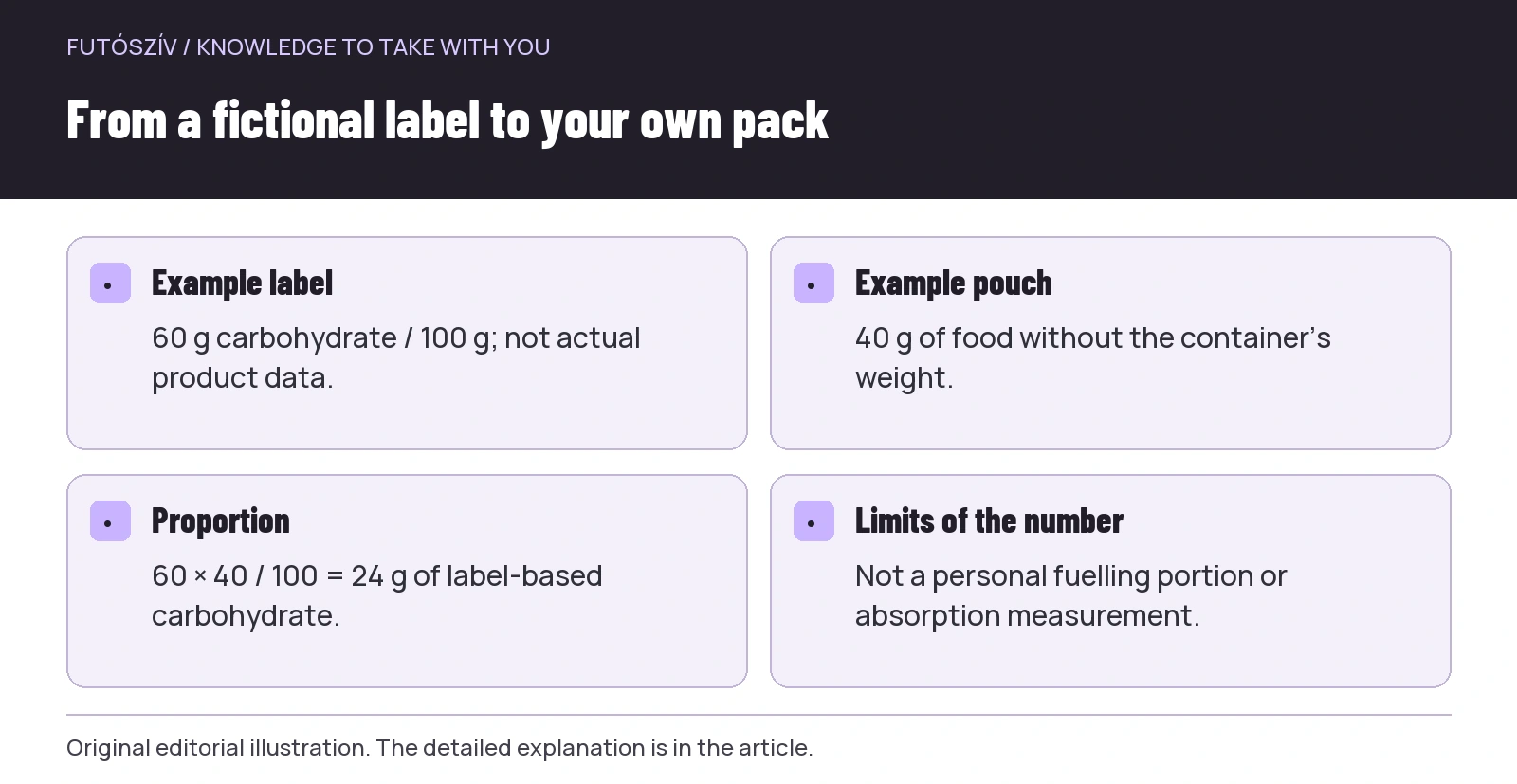 Enlarge diagram
Text version of the illustration
- Example label
- 60 g carbohydrate / 100 g; not actual product data.
- Example pouch
- 40 g of food without the container’s weight.
- Proportion
- 60 × 40 / 100 = 24 g of label-based carbohydrate.
- Limits of the number
- Not a personal fuelling portion or absorption measurement.
Dental considerations apply to fruit too
The NHS information recommends dried fruit as part of a meal rather than a snack between meals to reduce the risk of tooth decay. An individual plan for fuelling during sport and protecting teeth therefore need considering together. ‘Made from fruit’ does not mean dental considerations can be ignored when something is repeatedly eaten throughout the day.
If you regularly use sweet foods or drinks during sport, you can discuss prevention suited to you with your dentist alongside your personal fuelling plan. This article does not prescribe dental treatment or replace toothbrushing habits with a packaging trick. The point is that a food’s origin and how often it is consumed are separate questions. Convenient packaging alone does not establish the health suitability of a frequently repeated habit.
Record what you experienced separately
In a brief note about trying your own pack, use separate lines for the product name, portion size, ease of opening and how manageable the texture was. Do not confuse any physical symptoms with a fault in the bag. If the closure would not open, you can change the container. If consuming the food repeatedly causes problems, individual nutritional or medical help may be needed; do not try to diagnose yourself through repeated food challenges during exercise at home.
Your note applies only to that product and situation. Another temperature, pack, mixture or recipe may produce a different result. Do not turn it into a general ranking of dates, raisins or dried apples. Even if practical access works well, the sports-nutrition role still needs deciding separately. If a portion is hard to handle, you are not obliged to use the same food during running at any cost.
Emptying the running bag completes the process
At home, remove pouches and any crumbs, check the container’s condition and decide what to do with leftovers according to the product instructions and actual handling. Keep information linked to the original bag retrievable until the next use. Packaging forms a complete system when there is a clear task on returning as well as leaving. You can then choose for next time from clean, identifiable supplies suited to your own intended use.
Sources and further reading
- British Dietetic Association: Sport and exercise
- European Commission: Allergies – allergen labelling in the EU
- NHS: 5 A Day – what counts?
How Futószív articles are prepared: our editorial guidelines.