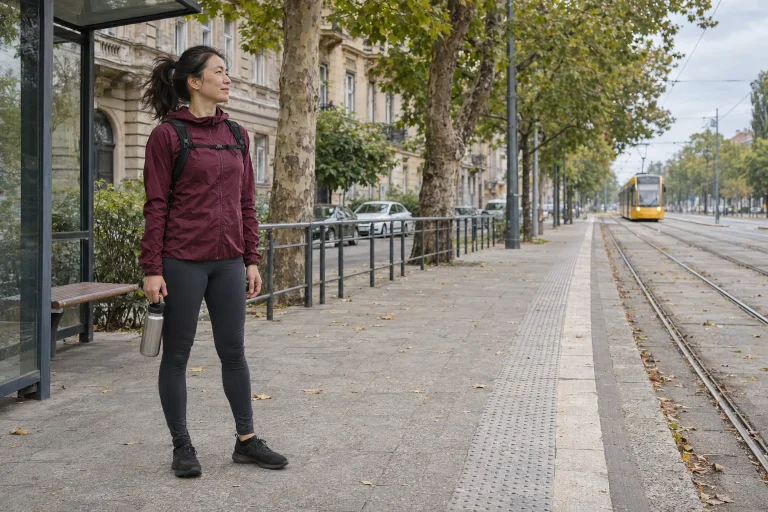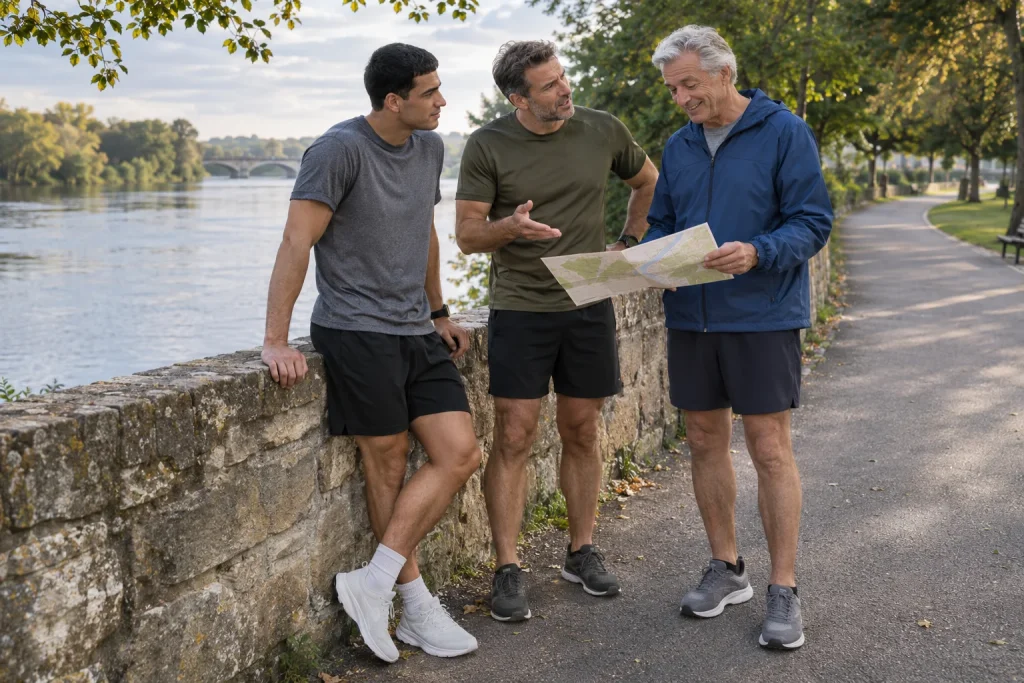
A shared run between friends in their twenties, forties and sixties is not automatically three separate programmes. Nor does ignoring every difference make it good. Age is only one piece of information: it does not establish route knowledge, chosen pace, available time or preferred way of moving with others. Good organisation starts with the actual people.
This article concerns outings among adult friends of different generations. Male friends can discuss differing needs without younger participants having to prove themselves or older ones justify themselves. We do not prescribe training loads by age. The people and numerical situations are fictional organisational examples.
Do not assign the fast and experienced roles in advance
A younger participant may be new to running, while an older one has years of racing experience. The reverse is equally possible. Birth year does not establish route knowledge, navigation practice or what someone wants from a social outing. If these matter for planning, ask about them directly.
‘Who knows this park?’ is more precise than ‘the old hand can lead’. ‘What kind of outing would you like today?’ is more useful than ‘this will definitely be easy for you’. Even a well-meant assumption can force someone into a detour: first dismantling your image of them before expressing their actual request. Simple questions save that unnecessary work.
Value experience without making it a permanent leadership obligation. A long-standing runner may come only for company and not want to plan everyone’s route. A younger person can organise too if they genuinely have the necessary information. Connect roles with specific accepted tasks.
Choose a shared purpose before a route
An outing can focus on conversation, learning the area or a particular challenge. If one person expects a meeting and another a targeted sporting task, merely starting together does not resolve the difference. First state which part you want to share, then adapt the format.
In a fictional example, three friends have not met for a long time. One has an hour, another wants a longer weekend outdoors and the third comes for conversation. An agreed shared loop followed by optional continuation may work. It only works when the common section suits everyone and the separate continuation is not a surprise afterwards.
Every need does not have to be met on the same day. Sometimes meeting after separate sporting tasks is best; another time, a shared walk and running on another day fit. Shared kilometres do not measure the relationship’s value. Choosing a programme is not a vote on who counts as a real runner.
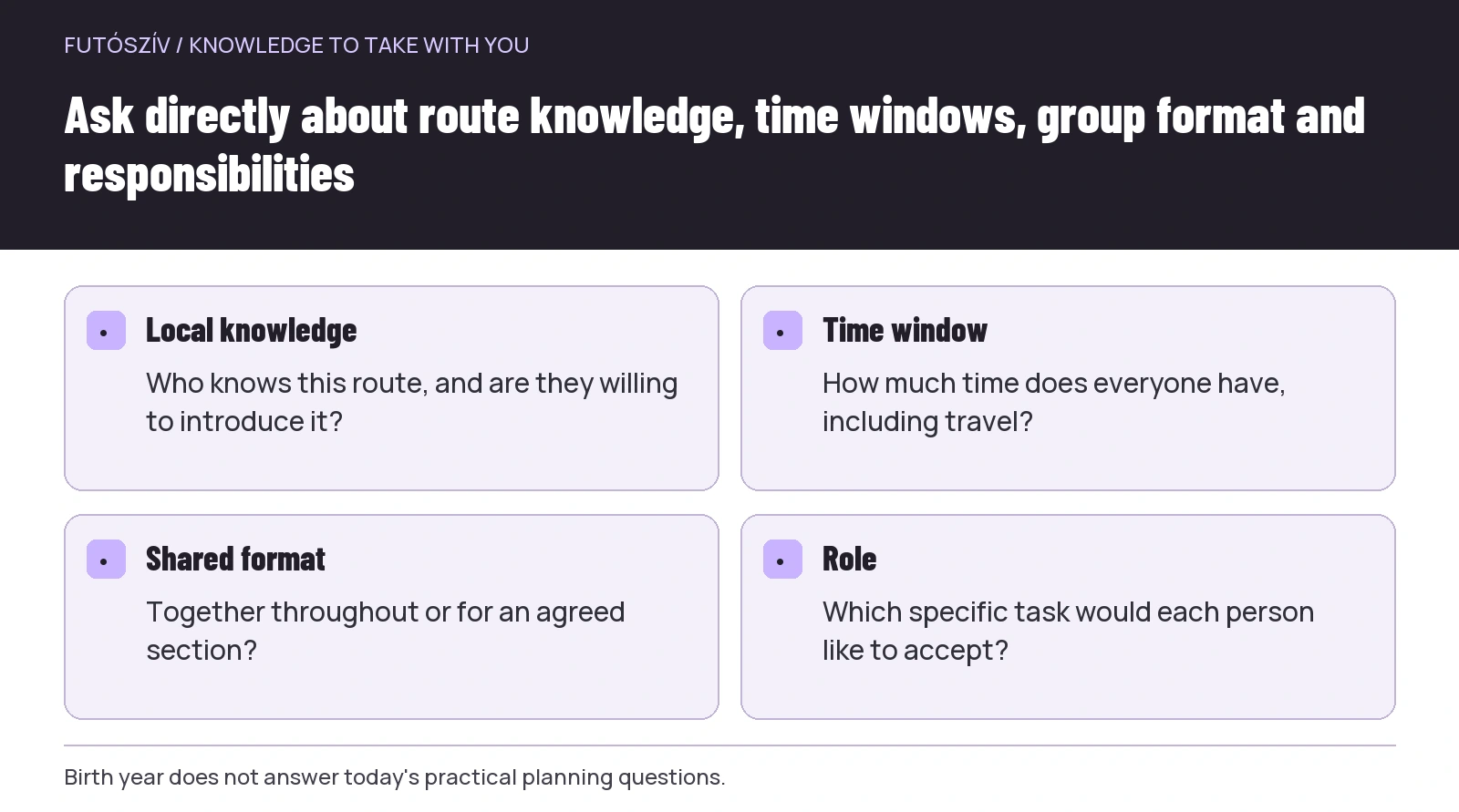 Enlarge diagram
Text version of the illustration
- Local knowledge
- Who knows this route, and are they willing to introduce it?
- Time window
- How much time does everyone have, including travel?
- Shared format
- Together throughout or for an agreed section?
- Role
- Which specific task would each person like to accept?
Filter routes using the actual questions
Alongside distance, consider access, surface, junctions, return options and time. Everyone can express their own needs. Do not infer from age who requires a bench, shorter option or more precise map. A specific request is more useful than a well-intentioned label.
| Planning question | Why ask everyone? |
|---|---|
| How much total time do you have including travel there and back? | Different work and family schedules are not visible from age. |
| Which surface and route would you like? | Local knowledge and the chosen activity are individual. |
| Would you stay together throughout or share one section? | The social part does not necessarily have the same purpose for everyone. |
| What is the shorter option and finishing point? | Changes do not have to be improvised. |
| Which information would you like beforehand? | People need different details to prepare independently. |
Send the route without relying solely on familiarity with one app. A map link can be accompanied by simple descriptions of the meeting place, finish and important junctions. This is not a special concession for older participants: anyone can encounter a new app or unfamiliar neighbourhood. Accessible information is a shared organisational quality.
Include group format alongside pace in the agreement
If everyone wants to stay together, follow that commitment in practice. If there will be several rhythms, discuss sections and meeting points. ‘We’ll wait’ alone does not explain what people do meanwhile, which route they follow or how they know when the group moves on. Waiting arrangements are part of the outing too.
A small location with a known loop may provide a common meeting point alongside different programmes. This does not suit every group, and local use rules still apply. Someone doing a personal task within the loop should not unintentionally pull others into following their pace. Keep the shared point and individual activity distinguishable.
Respect adults’ choices. If someone asks for a shorter option today, do not explain it through their age for them. Wanting a longer outing does not prove others should do the same either. The discussion is shared organisation, rather than a public assessment of one another’s abilities.
An age group is a competition category, not a personal description
Age can appear as a regulated classification in results. World Masters Athletics, for example, describes its masters categories from age thirty-five in five-year groups. This is a competition structure, rather than an instruction for choosing outings among friends. Other events may use different categories. World Masters Athletics: FAQ
Belonging to the thirty-five-to-thirty-nine group does not mean everyone has similar running histories, time or goals. The same applies to later categories. Do not turn a useful results classification into a hierarchy for everyday meetings. A friendly run need not imitate official age groups.
If entering together, each person should check their participation conditions and category with the organiser. A team name or shared travel does not override individual entry details. Discuss categories factually without demanding that anyone prove they are good enough ‘for their age’.
An age-adjusted figure does not resolve every comparison either
Age-adjusted performance measures exist, but have limits. parkrun’s own help describes age grading as an approximate comparison and notes that it does not account for differing weather or course surfaces. This is that system’s guidance, rather than a universal equalising formula for every run. parkrun Support: Age grading
After an outing with friends, another calculation need not decide who ‘really won’. If everyone is interested in a measure, discuss it with appropriate limitations. Anyone not wanting comparison need not supply data. Interpreting results cannot become a condition for belonging.
One percentage cannot encompass that day’s conditions and purpose. One person came for shared time, another wanted to explore a known section and another could attend only part. These commitments can feature in the account too. Meeting a personal goal is a different question from ranking the whole group.
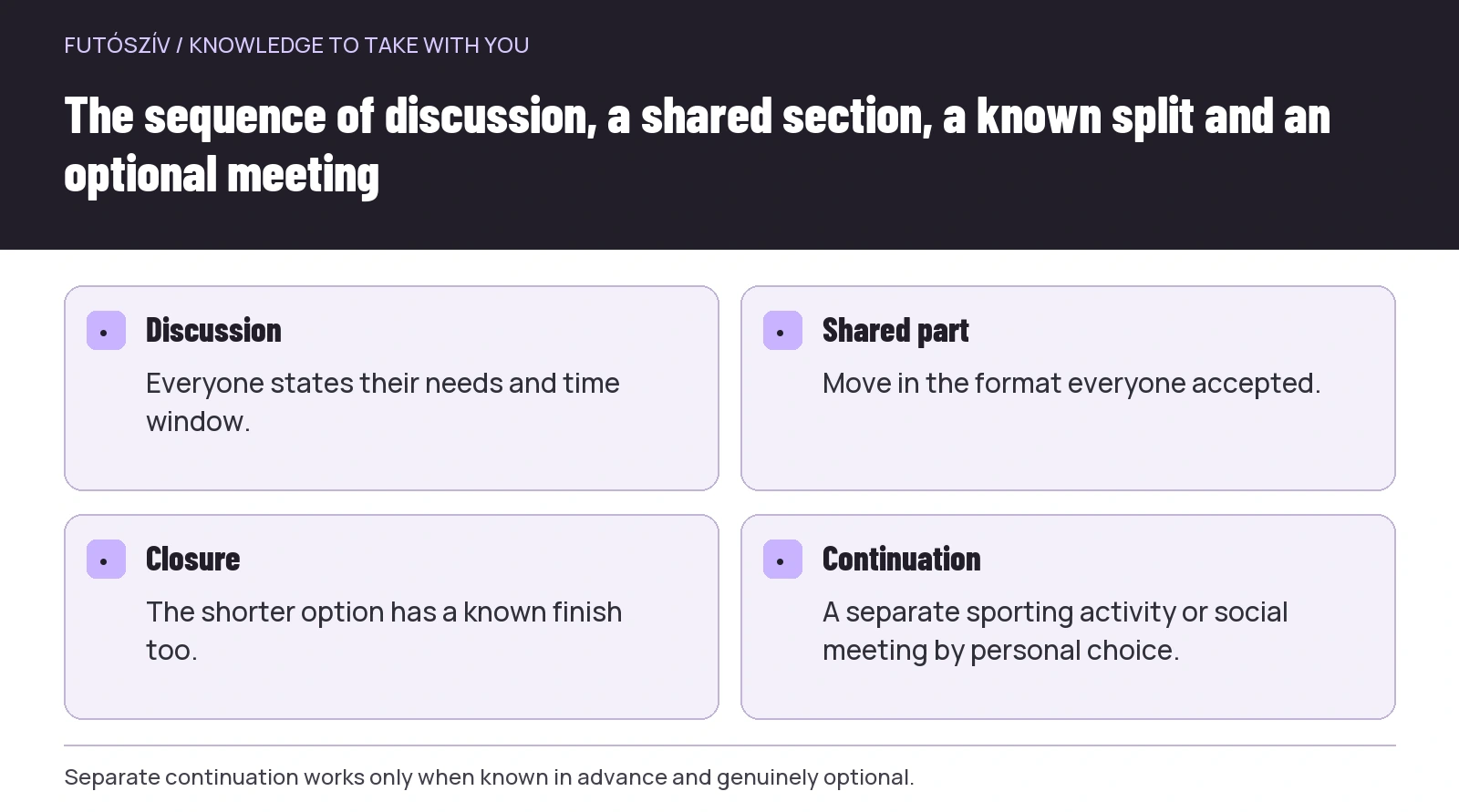 Enlarge diagram
Text version of the illustration
- Discussion
- Everyone states their needs and time window.
- Shared part
- Move in the format everyone accepted.
- Closure
- The shorter option has a known finish too.
- Continuation
- A separate sporting activity or social meeting by personal choice.
A joke is shared when the other person has a choice too
Generational teasing can be a mutually enjoyed part of friendship. Not every such remark needs prohibition. But if someone says an age- or result-related comment hurts, do not label that a lack of humour. ‘We always talk this way’ does not resolve the present situation.
Among male friends too, a simple sentence may suffice: ‘Let’s discuss today’s route rather than my age.’ The reply can be equally brief: ‘All right.’ There is no need for a long debate about who had the right to be sensitive. If comments repeat, discuss the specific behaviour separately before or after the activity.
Do not use an older friend’s experience only as a source of anecdotes, or a younger friend only for technical administration. Everyone chooses what to share and how to help. Ask with interest about a route, app or past race without expecting someone to represent an entire generation.
Rewriting a fictional invitation across three generations
First version: ‘On Sunday the young ones lead, the rest come as far as they can, then coffee.’ This assigns roles beforehand and says nothing about finishing together. Someone unwilling to run in the position assigned to their age must argue before joining. The actual arrangements remain unclear.
A more precise version: ‘On Sunday we’ll meet at the familiar park entrance. We’d like an agreed shared loop followed by optional continuation. Please say how much total time you have and which format you want for the shared part. Meeting at the café is agreed separately; nobody has to join the entire running programme.’ Add the actual location and time when organising.
Answers may reveal that two short sections with conversation between work better than one shared loop. Or that only a post-run meeting is accessible to everyone that day. Planning’s value is not preserving the original idea unchanged. The final invitation should describe something participants actually chose.
Do not automatically leave travel and finishing to one person
Old routines can make tasks permanent: the same person always drives, finds the place or waits for everyone. Occasionally ask whether the role remains manageable. A driving licence, local knowledge or apparent free time does not mean unlimited availability. Agree specific help separately.
If someone uses public transport, consider their return departure at the beginning. Do not ask them to ‘stay a little longer’ at the end when this would substantially delay getting home. Respecting time matters at every age. You do not need their personal reason to accept the agreed finish.
When splitting up, establish a known route and clear conclusion. Someone having run a great deal does not mean they know this neighbourhood. Check the actual conditions for navigation and contact rather than relying on the label experienced. Shared organisation is useful mutual information, rather than guardianship.
Build the next outing on one real lesson
After the run, a few short questions suffice: was the shared section’s length suitable; did everyone know when and where the outing ended; and which assumption should become a question next time? One morning does not require a grand theory of generational differences. Choose one improvement from the actual experience.
The meeting point may have been imprecise rather than age causing a difference. The route may have been enjoyable while leaving no time for coffee. These are practical details changeable in the next invitation. Labels about participants are harder to remove later, which is why using fewer initially helps.
A run connecting generations can work because everyone expresses needs and commitments for themselves. Age can remain an interesting biographical detail or part of a race classification. Design the shared route, pace format and finish around actual people. The meeting then becomes chosen time together rather than a test between age groups.
How Futószív articles are prepared: our editorial guidelines.