After a fuelling trial, a general feeling that something worked well or badly often remains, while details quickly become mixed. Notes help preserve what actually happened: which food you retrieved, when you used it, where the plan changed and which circumstances were unusual. No complicated app is needed. A short paper sheet or simple table works if fields are precise and uncertain information is not presented as a reliable measurement.
This article gives adult recreational runners a method for reading and recording data. It does not establish personal fuelling quantities or turn notes into a medical diagnosis. For recurring symptoms, illness or complex race preparation, follow your professional plan and treating professional’s guidance. The record aims to clarify specific questions and improve a repeatable practical system, not collect as many numbers as possible or create constant pressure to monitor eating.
Before recording, state the question you want answered
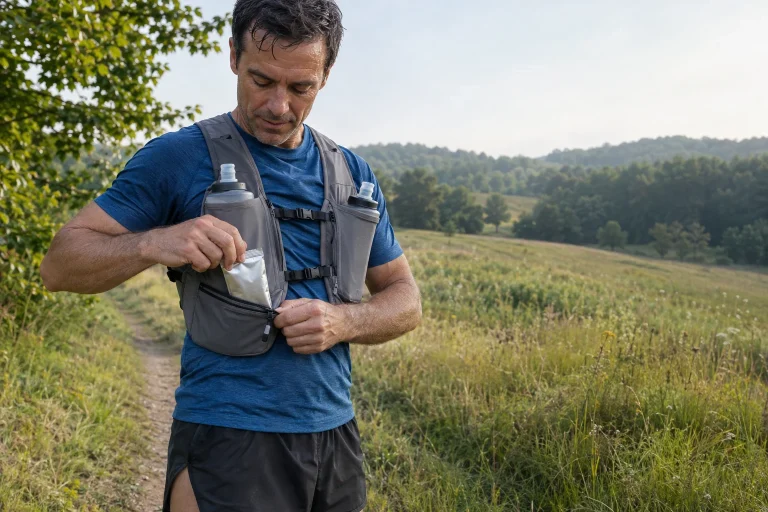
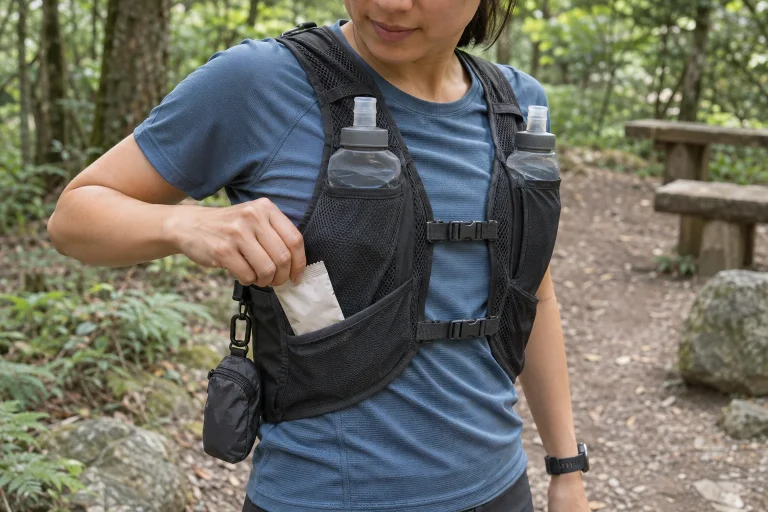
Name the trial question in one sentence. For example, you are investigating whether food in your plan can be reached in a new vest-pocket arrangement, or whether a verified water point can fit the route. Packaging handling and individual comfort are different questions. Separating them beforehand makes diary fields easier to choose. You need not record every detail of every run.
Alongside the question, name what should remain similar to before. A familiar route, usual type of session or unchanged product can help assess the specific adjustment. Conditions will never be entirely identical, so notes should preserve differences too. The aim is not to imitate a laboratory investigation but prevent overly broad conclusions. If many things changed, simply record that.
The Leicestershire Nutrition and Dietetic Services Food and Activity Diary treats timing, food and drink description, approximate quantity and circumstances separately. This is a general dietetic diary template, not a running fuelling prescription. The same data structure in your short sheet can help distinguish facts from comments. Choose as many fields as you can complete calmly and consistently for the specific purpose.
Give the run an identifiable reference
A brief personal name alongside the date, such as route and session type, is enough. Two similar weekend runs will then not become confused later. You can preserve the actual starting time and full session duration if relevant to your question. Avoid unnecessary sensitive personal data in the name. If later sharing the sheet with a professional or coach, the important content should be the running and eating arrangements.
You can identify route distance and watch-measured distance separately if they differ. Do not put data with different meanings into one field. Session duration may mean total elapsed time or moving time only, so label the choice clearly. This matters when comparing fuelling events: stops and bottle-filling time may form part of actual circumstances of use.
Use consistent file or sheet names. A simple date-based system remains searchable, while good run and new attempt quickly lose meaning. Link the label photograph and brief notes to the same occasion. The aim is to recognise several weeks later the exact run and product version behind the experience. Data need not be extensive to be organised.
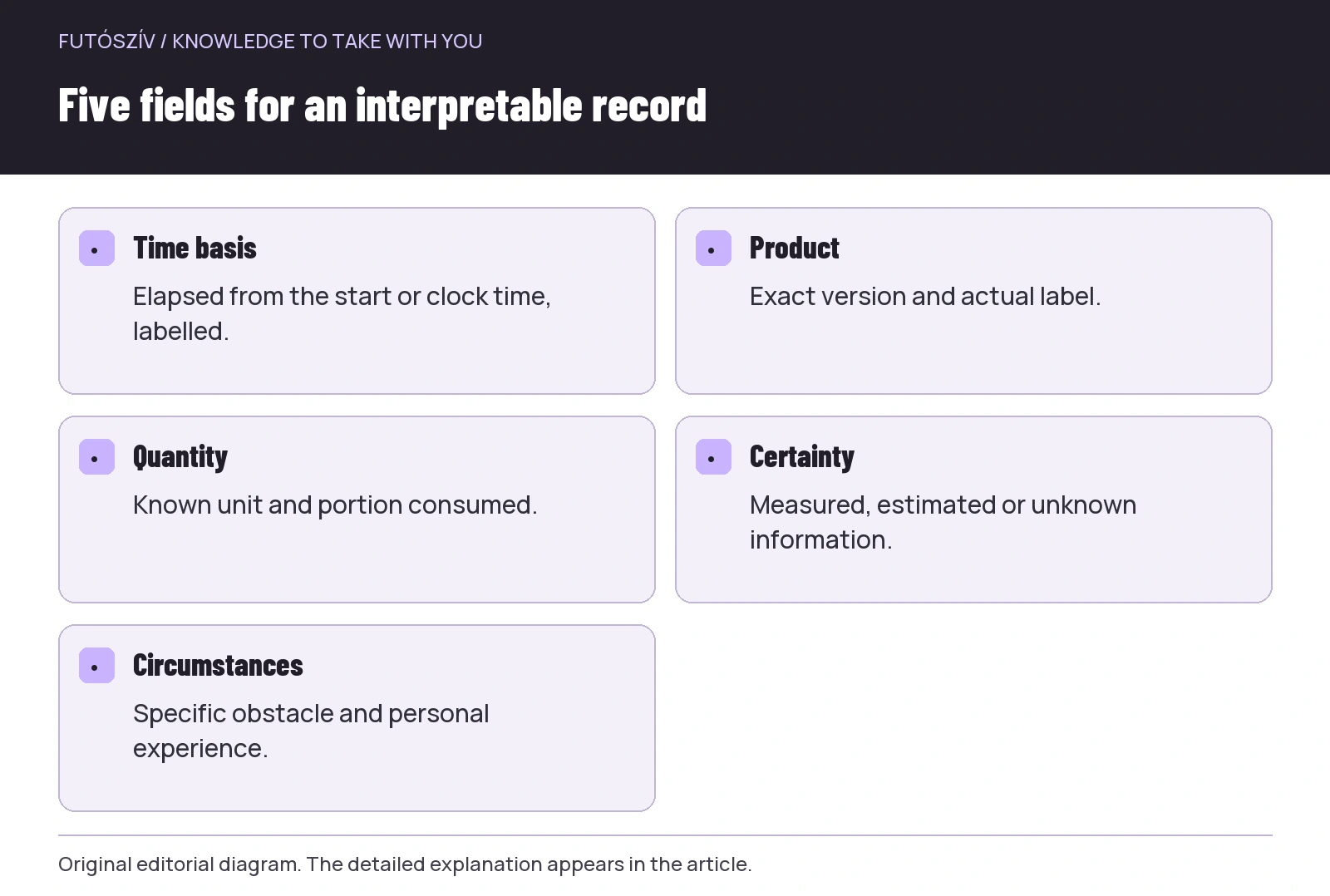 Enlarge diagram
Text version of the diagram
- Time basis
- Elapsed from the start or clock time, labelled.
- Product
- Exact version and actual label.
- Quantity
- Known unit and portion consumed.
- Certainty
- Measured, estimated or unknown information.
- Circumstances
- Specific obstacle and personal experience.
Clock time or time elapsed from the start?
Both work, but do not mix them without labels. Clock time connects to actual daily eating patterns, for example, while elapsed time relates to events within the run. Choose one primary form and keep the other in a separate field if needed. The number 35 alone is insufficient: does it mean thirty-five minutes after the start or the thirty-fifth minute of an hour? Unit and meaning together provide usable data.
If you can only approximately recall the time afterwards, mark it as an estimate. You need not fill an empty field with an invented value precise to the minute. Approximate information can help if its uncertainty is visible. Safety during running matters more than immediate phone use. If recording requires stopping, do so in a safe place, or record the necessary brief information later. The diary must not distract you from traffic and terrain.
Name the event precisely beside its time too. Did you take out the packet, start eating or finish? For a brief eating occasion this hardly matters, but a drink consumed over longer can produce a different time pattern. You need not break everything into seconds, but the chosen meaning should remain consistent. If a professional requests specific detail, agree the format and adapt your sheet accordingly.
Make the product name precise and preserve the label
Alongside the brand, include product family, flavour and important differences where appropriate. Do not summarise caffeinated and non-caffeinated packets or differing compositions under one general name. A label photograph can help if legible and actually taken of the packet you carried. A similar online picture is not always identical to the current local product. The precise source here is the actual packet, or the precisely identified version for a homemade recipe.
The NDNS food diary material published by Food Standards Scotland also discusses specific product descriptions and labels. This is a research data-collection template, not a prescribed diary length for runners. Use only the detail your question needs in your own brief notes. The aim is to identify the product or homemade recipe later without combining several differing versions into one row.
If a product contains several servings, package size and your consumed portion are separate information. One serving stated on a label is not automatically your actual use. Do not merge these in the record. If your personal plan uses composition calculations, link the appropriate label unit to the quantity actually known. Do not create an apparently precise nutrient total from uncertain use.
| Field | Usable entry | Why does it matter? |
|---|---|---|
| Time basis | Minutes from the start or clock time | The two timelines remain separate |
| Product | Exact version with a label photograph | Remains identifiable later |
| Quantity | Known unit and actual portion | A packet does not automatically become a consumed serving |
| Uncertainty | Estimated or unknown | The data’s limitation is visible |
| Comment | Specific circumstances and experience | Explanation stays separate from fact |
Zero and an unknown quantity are different
If you did not consume a planned food, actual use may be zero, with the reason noted alongside. If you ate some but cannot reliably identify the quantity, that is not zero but unknown or estimated information. Swapping the two gives a misleading summary. You can use a separate comment field for uncertainty. Do not later interpret an empty cell automatically as a missed eating occasion.
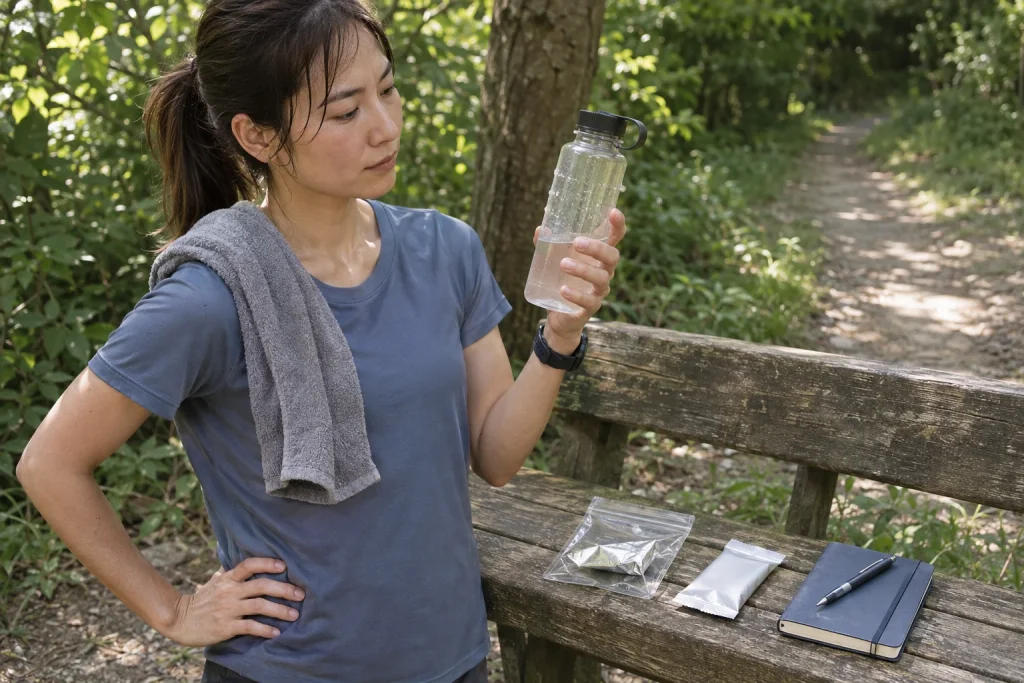
A bottle’s capacity is not the same as fluid consumed either. You may have refilled it, left some in it or spilled some. Estimating actual use would require knowing these details too. If information is insufficient, do not assert a definite quantity. The value of notes lies not in having a number in every cell, but in clearly separating observed and uncertain parts. This is particularly important for later professional assessment.
Counting opened packets can be a useful reminder but is not complete measurement. Contents may remain in a packet, and you may have used differing portions from a multi-serving food. From packaging condition, state as certain only what you actually know. A brief partly remaining or spilled, quantity unknown note helps more than copying the original plan’s precise figure into the actual-use row.
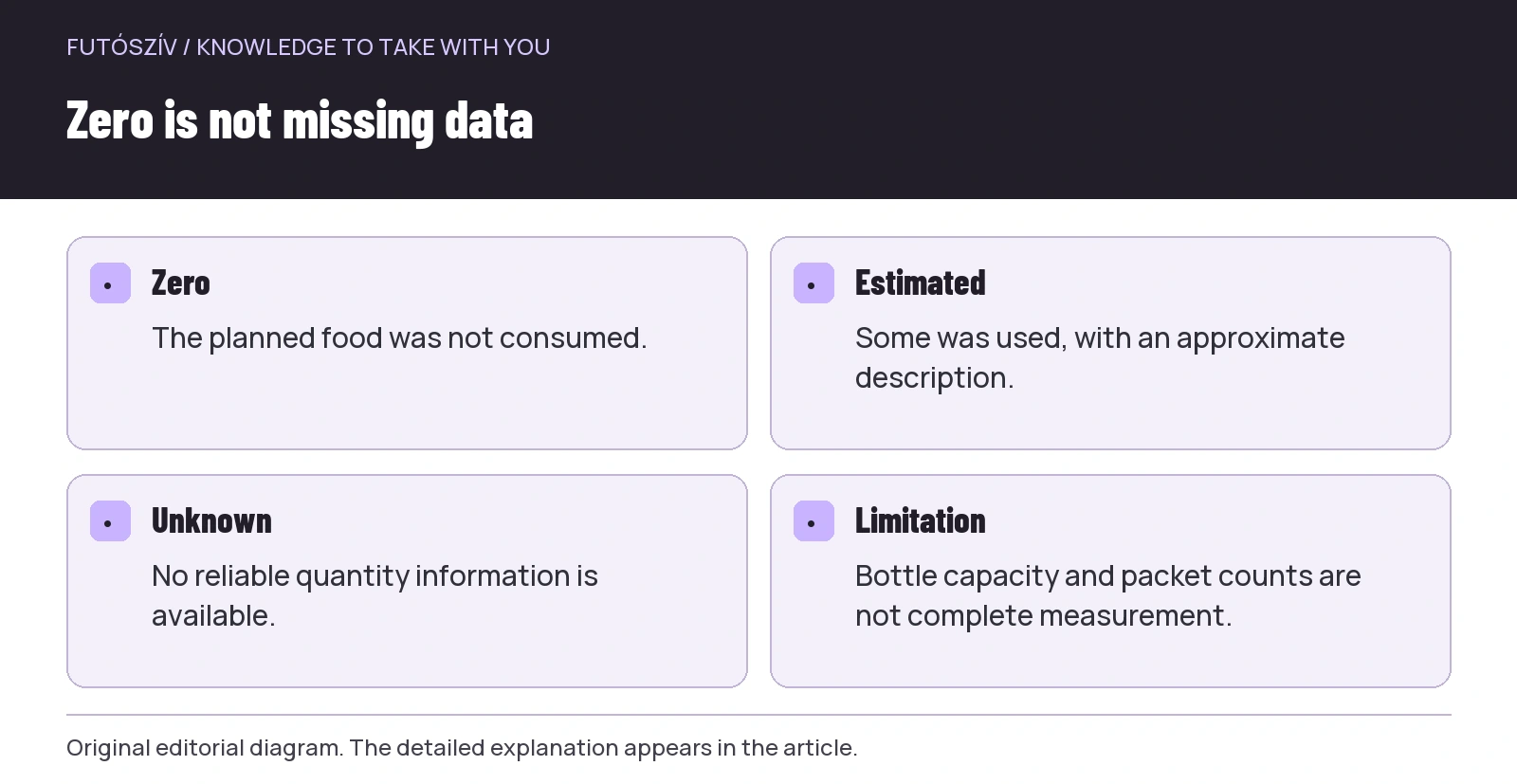 Enlarge diagram
Text version of the diagram
- Zero
- The planned food was not consumed.
- Estimated
- Some was used, with an approximate description.
- Unknown
- No reliable quantity information is available.
- Limitation
- Bottle capacity and packet counts are not complete measurement.
Describe circumstances briefly and in relation to the question
Session type, route character, weather and an unusual event can provide important background. You need not collect every figure displayed by watch and phone. Retain details relevant to the trial question. If observing opening, gloves or rain may be relevant. If an eating occasion was missed, a non-working water point or long stop may matter. A targeted description remains readable.
The Torbay and South Devon NHS diary template gives circumstances and feelings separate fields alongside food and quantity. The document was developed for a general healthcare programme; we do not transfer its weight-management purpose to runners. In your notes, circumstances have a place so you do not attribute every experience to a single product. Describing the situation supports a more precise question but does not establish a definite cause by itself.
Make your own experience specific and linked to time. Opening was difficult, I did not want the planned food at the serving point, or I felt troublesome fullness during a particular section are different observations. Bad fuelling compresses too many separate questions. If symptoms arise, necessary help and safe decisions matter more than completing the diary. Later notes can remain brief and honest.
Match summaries to the level of certainty
A simple table can total reliably known data, but mark estimates separately. Missing information must not disappear behind an average. If actual quantities are known for only one of two runs, comparing the two numbers is limited. Different session types or weather also mean you assessed different circumstances even with the same product. Before summarising, establish how comparable the occasions are.
Do not turn personal observations into a general brand ranking. Many factors may influence a faster run, and personal comfort is not identical for everyone. A precise conclusion concerns that version and those circumstances. The sheet remains useful: it may reveal consistently awkward pocket arrangements or a planned eating point repeatedly unavailable. Logistical improvement need not become medical or performance evidence to have value.
A one-page review for the next step
At the end, answer three questions. What part of the plan happened? Which specific obstacle appeared? What should be the single next adjustment or professional question to clarify? New packaging, another pocket or an appropriately accessible eating location is a concrete improvement. If the entire personal strategy is uncertain, the next step may be professional discussion rather than random product swaps. Notes are usable when you can name their question too.
You need not maintain this detail permanently for every run. Once the chosen question is clarified, close the record or revisit it less often. The method is a purpose-specific tool. If logging causes tension or intensifies compulsive monitoring around eating, discuss this with a professional and choose a more appropriate format together. Useful information is not the same as continuous self-monitoring.
A good fuelling-trial record ultimately contains a few clear details. You know which run it concerns, which product you used, what is certain and where uncertainty remains. Experience and explanation stay on separate lines, and the next step is specific. This organisation makes practical improvements or individual professional questions easier to develop than a table full of numbers but mixing units and circumstances.
Sources and further reading
- Leicestershire Nutrition and Dietetic Services: Food and Activity Diary
- Food Standards Scotland: NDNS Scotland Appendix E – Food and Drink Diary
- Torbay and South Devon NHS: 3-day Food Diary
How Futószív articles are prepared: our editorial guidelines.