Before a blister, there is often a signal worth stopping for
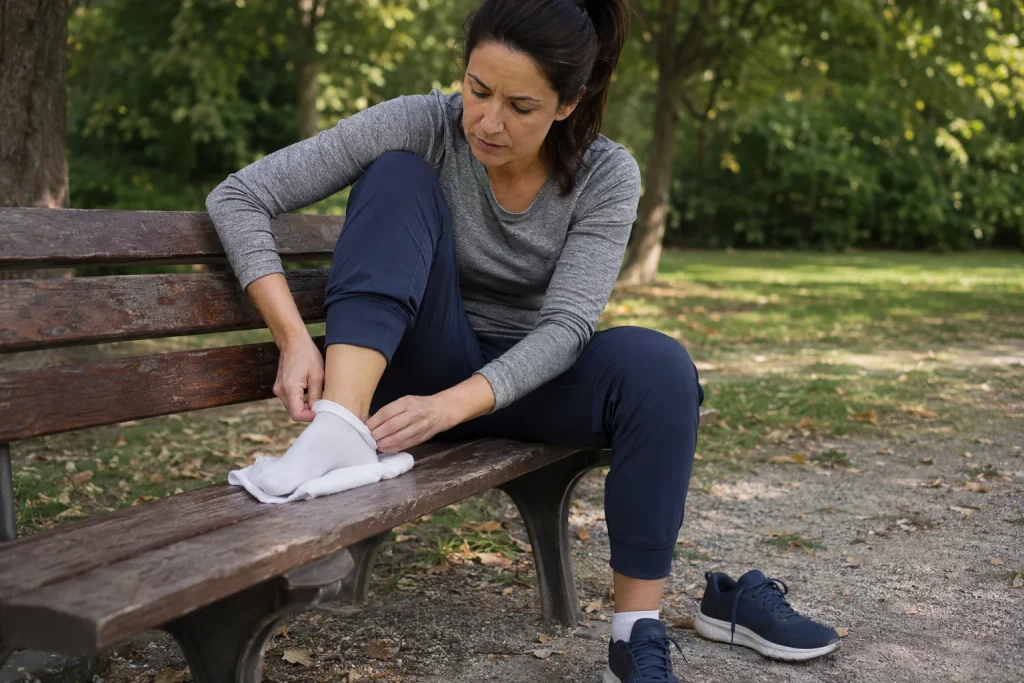
At first you feel only a warmer, rubbing spot at your heel or toe. There is no conspicuous blister yet, and it is easy to say it will disappear at the next kilometre. Stopping early, however, gives you more options: you can straighten your sock, check your shoe and shorten the run before further skin damage occurs.
The American Academy of Dermatology also advises stopping when pain, discomfort or redness appears, because continued friction can lead to a blister. This does not mean every sensation inside a shoe is dangerous. It means there is little point turning an unmistakably rubbing spot into a test of endurance.
Knowing your own shoe–sock–route combination is an important part of prevention. There is no universal promise that an expensive sock, dressing or exact shoe size will protect you in every situation. Gradual testing can identify a working combination; caring for a blister that has already developed is a separate task.
What can cause one, and why is shoe size not the only factor?
The NHS information lists friction among common causes of blisters, but burns and skin reactions can cause similar changes too. During running, the problem often affects skin touching a shoe or sock. If several blisters appear for no apparent reason or in an unusual location, look beyond running-kit faults.
A shoe may be tight, but it can also hold the foot too loosely. One may create pressure, the other allow movement. Sock seams, creases and moisture, sand inside the shoe and a changing foot position on a long descent may also contribute. Automatically buying an even larger shoe is therefore not always the best first step.
For a new problem, consider what changed: shoe, insole, sock, lacing, distance, terrain or weather. New circumstances may affect a previously successful shoe too. It did not do this before is an important observation, but does not establish that your skin should now tolerate the same contact unchanged.
Test shoes with the actual combination
During a trial, use the socks and insoles you intend to run with. Socks of a different thickness or a different insole alter the available space. Give toes, heel and the top of the foot separate attention: a comfortable shoe length while standing is not enough.
On a short run, check whether the heel slips, the sock creases, your foot moves forwards downhill, or you have to tighten the laces excessively for support. Tighter lacing is not the answer to every fit problem. Do not treat numbness, pressure or pain as a matter of getting used to the shoe.
Before buying, ask about trial and exchange conditions so that pressure to make the purchase work does not determine the first use. Shoes need not become the hardest task of running. If an item consistently causes symptoms, that is valuable information for your choice, not evidence that you run badly.
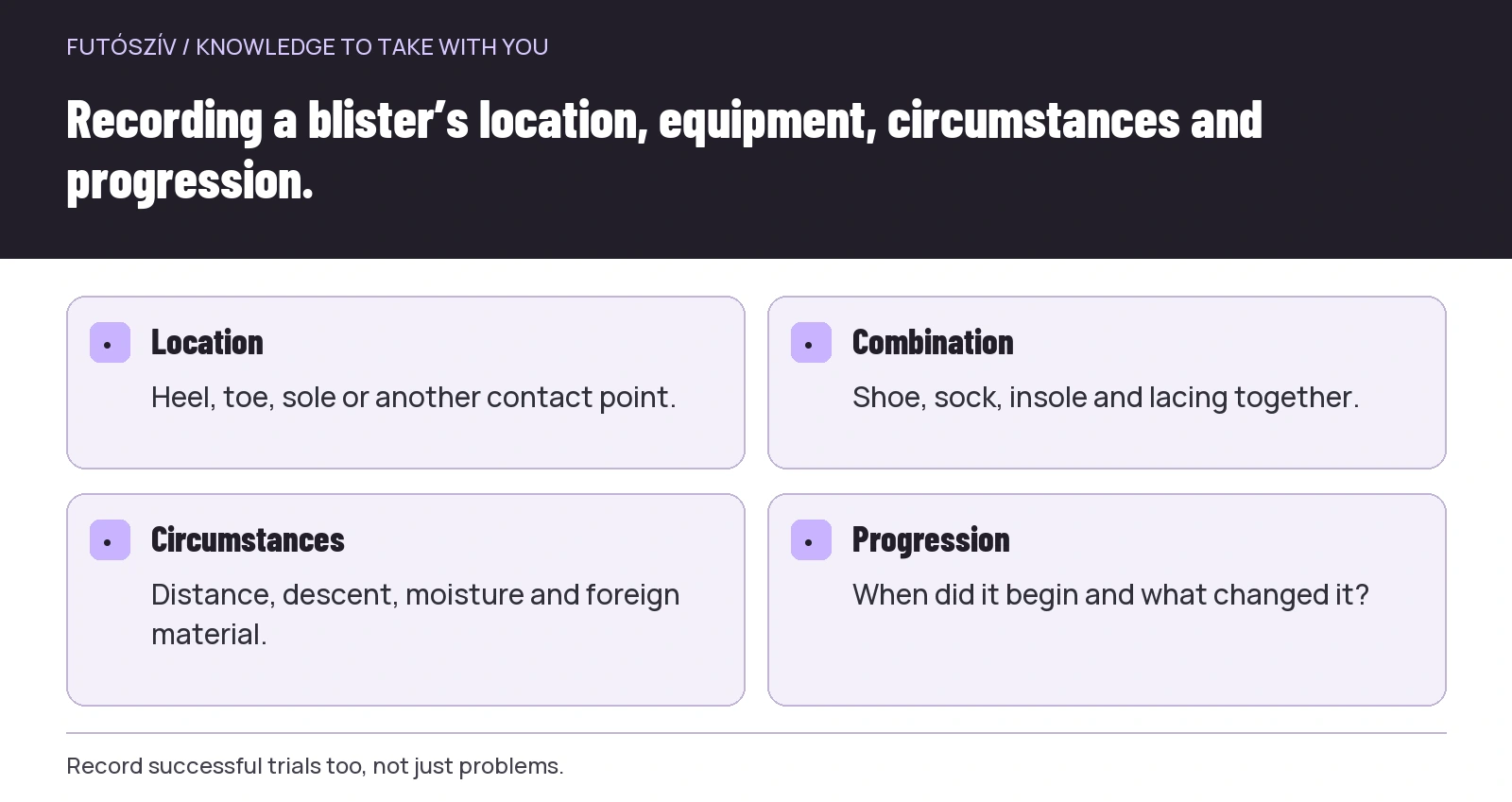 Enlarge diagram
Text version of the diagram
- Location
- Heel, toe, sole or another contact point.
- Combination
- Shoe, sock, insole and lacing together.
- Circumstances
- Distance, descent, moisture and foreign material.
- Progression
- When did it begin and what changed it?
Socks: judge how they work for you, not the label
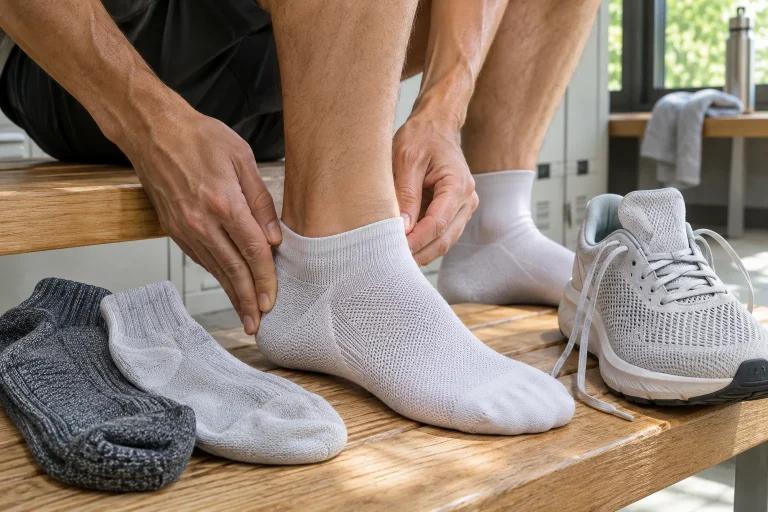
The AAD also highlights appropriate fit and moisture-managing socks. The words running sock alone do not tell you whether it behaves well with your shoes and foot shape. Notice seam positions, heel stability and whether creases remain around the toes.
Both thinner and thicker options can be comfortable in different circumstances. If trying two socks, account for the reduced space in the same shoe. This is an option to test, not a method prescribed for every runner. Adding another layer does not improve an excessively tight shoe.
For runs in rain or with stream crossings, a dry trial at home does not test the whole situation. An accessible spare pair can be practical on a longer hike or race when conditions and opportunities to stop permit. When changing socks, check for sand remaining in the shoe and the position of the new sock.
Tape and dressings: what do the specific studies say?
Trials have examined preventive paper tape use in ultrarunners. The earlier Pre-TAPED study did not find a clear protective effect with its particular method. A later randomised trial called Pre-TAPED II found a more favourable result for targeted taping of blister-prone areas.
The two results are not a simple vote for or against tape. Where and how it was applied, the comparison used and the race conditions studied all matter. A multiday desert ultramarathon is different from a short park run. The findings do not establish that every adhesive reliably prevents blisters on every skin type and location.
If trying preventive taping, test your own skin tolerance and removal too. Adhesive can irritate, and an edge that shifts may itself become troublesome. Do not first use a new solution over a large area during a long race. With diabetes, altered sensation, circulatory problems or damaged skin, seek individual professional advice about protection.
At a hot spot, stopping is the most useful piece of kit
If you feel a clearly rubbing spot during running, choose somewhere safe to stop. Check for a small stone or crease and adjust your sock and shoe. Do not try removing a shoe while balancing in traffic, and do not continue with the same problem simply because no blister is visible yet.
Once a painful lesion has developed, continuing may cause further friction. Shortening the distance or seeking help can be reasonable. On trails, consider your exit separately: how far is the return, what is the surface like, and can anyone help? Sticking to the planned destination does not improve damaged skin’s tolerance of loading.
At a race, you can request help at the medical point. Explain if you have diabetes, reduced sensation in your feet, previous wound-healing problems or an allergic reaction to adhesive. Individual circumstances can affect the significance of a visibly small blister.
Do not treat an existing blister as a DIY task
Both the NHS and the St John Ambulance first-aid information advise against bursting a blister yourself. An intact surface can provide protection, while intervening can introduce an infection risk. Have a professional assess a large, very painful or uncertain lesion instead.
Keep the area gently clean, and ask a pharmacist for advice when selecting an appropriate soft plaster or padded dressing. Not every dressing suits every location or condition. Follow the label’s instructions for application and removal too, rather than judging only how firmly it sticks.
If the blister bursts by itself, do not pull off the skin remaining over it. The NHS specifically emphasises this. Clean hands, gentle cleaning and protection matter more than tidying the injured area with scissors or filing. Seek help if you cannot care for it safely.
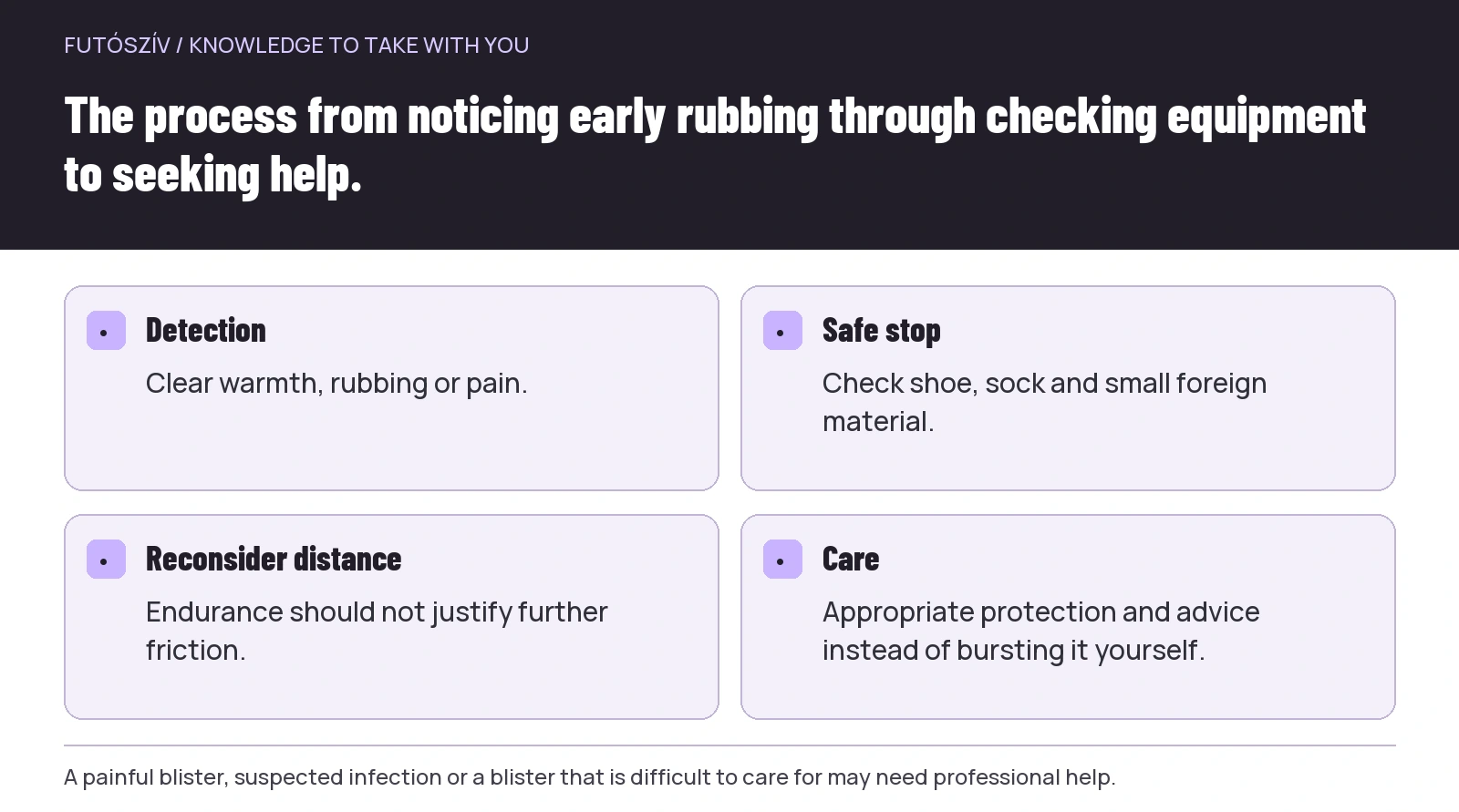 Enlarge diagram
Text version of the diagram
- Detection
- Clear warmth, rubbing or pain.
- Safe stop
- Check shoe, sock and small foreign material.
- Reconsider distance
- Endurance should not justify further friction.
- Care
- Appropriate protection and advice instead of bursting it yourself.
Which signs call for medical assessment?
A warm, increasingly painful or swollen area, pus and spreading inflammation may indicate infection. Fever or feeling generally unwell calls for prompt help. Redness may be less apparent on darker skin, so monitor changes in warmth, pain and swelling too.
The NHS also discusses very painful, recurring blisters, those in unusual places and multiple blisters without an apparent cause as situations requiring professional assessment. Shoe friction is only one possibility. Automatically placing every blister in the same category is unhelpful.
With reduced sensation or diabetes, do not rely solely on how painful the area feels. An individual foot-care plan and healthcare advice may be particularly important. If you have already received such guidance, it may override general kit advice for healthy runners.
Returning is not a test of the dressing’s strength
The NHS advises not using the shoe or equipment that caused the blister until it heals. A strongly adhering dressing does not automatically change the condition of the skin beneath it. If walking hurts, do not decide on the next run by wondering whether the dressing will hold.
Once everyday movement has settled and there is no suspected infection, address the original triggering situation before a later run. Different lacing, socks or shoes are useful only if they actually reduce the problem. Do not use improving skin as the first test surface in a long race.
After a lesion needing medical treatment or one that heals poorly, ask about the conditions for returning. There is no single clearance date precise to the day for every blister. Underlying illness, wound condition and loading at the affected location may all matter, so a general healing time online is not a personal plan.
Your own blister map may be more useful than another purchase
Draw a simple outline of your foot and mark the recurring location. Alongside it, note the shoes, socks, duration and route involved. Symptoms at the toes only on long descents suggest a different direction to investigate from rubbing at the heel on every short run.
Include successful trials on the map too. If a combination is comfortable on a short loop and then works under longer demands, you have a usable combination. There is no need to add a new technique before every run. Link changes to a problem and, where possible, make clear what changed.
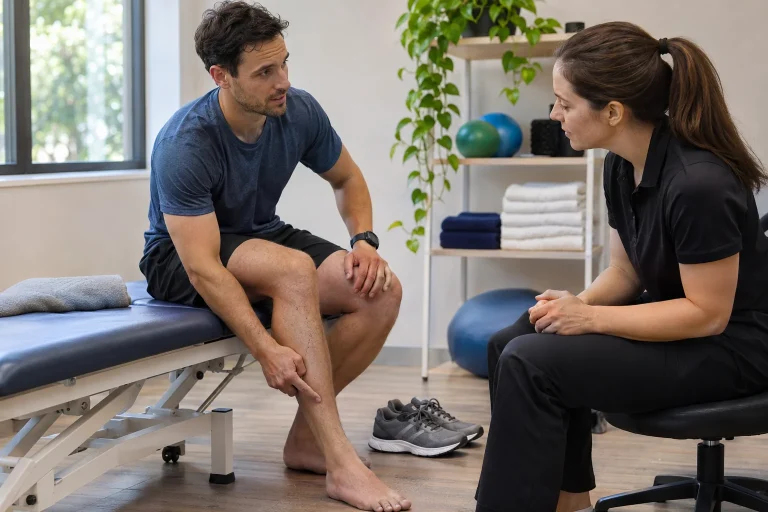
If you consult a professional, these few details can support the conversation. You do not need detailed laboratory measurements of your stride. The specific location, triggering circumstances and progression of the skin’s condition already provide a better starting point than saying that for some reason you always get blisters.
A short pre-race check
- Shoes, socks, insoles and lacing should have been tested as a combination.
- Leave no creases or small foreign material inside the shoes.
- Keep previously tested protection and spare socks accessible where you can actually use them.
- Know where to request medical help and how to shorten the route safely.
- With an active wound or suspected infection, address the health question before setting off.
The best blister strategy is often quiet: a sock that stays comfortable, a crease corrected in time and an early stop. Getting used to pain is not the aim. Seek kit and decision routines that allow your attention to return to the route and the pleasure of running.
Sources and further reading
- American Academy of Dermatology: How to prevent and treat blisters
- NHS: Blisters
- Pre-TAPED II: Paper Tape Prevents Foot Blisters, randomized trial, 2016
- Pre-TAPED: A prospective randomized blister prevention trial, 2014
- St John Ambulance: Blisters
How Futószív articles are prepared: our editorial guidelines.