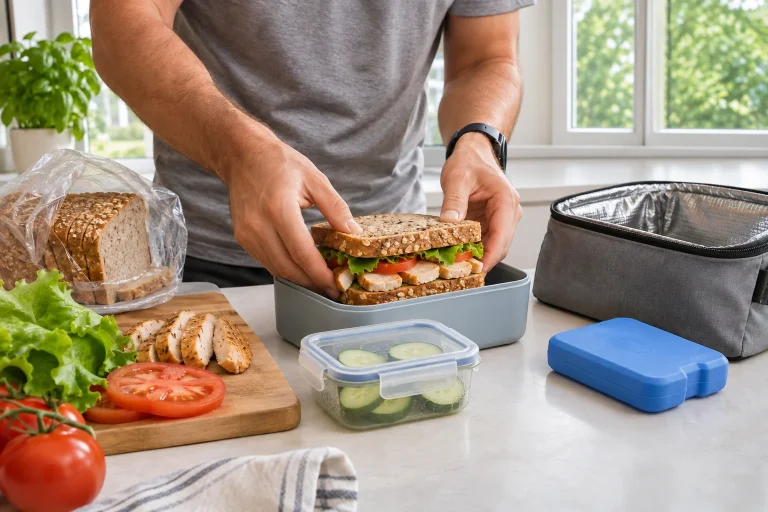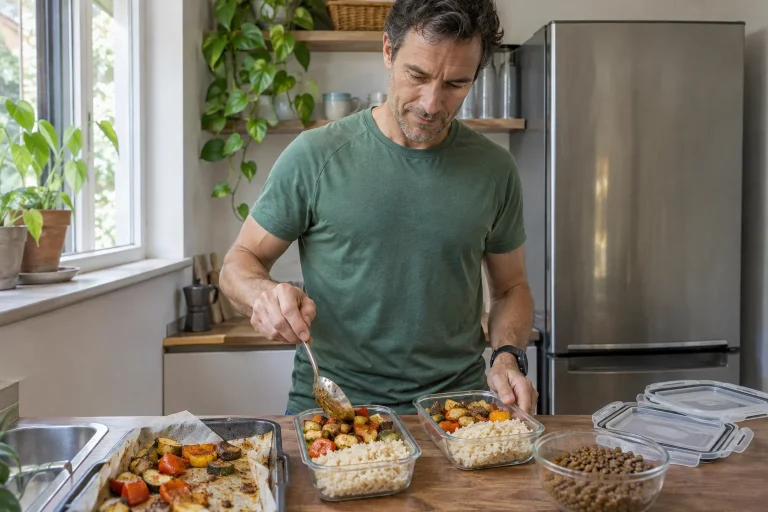
With a homemade snack, you can know exactly which ingredients you used and adjust the flavour to your preferences. Preparing it for running raises further questions, however. Is the recipe reproducible? Does it hold together in its wrapping? Can you store it safely throughout the journey? Does it fit your personal fuelling plan, or is it simply an everyday bake you enjoy? A recipe trial is useful when it makes these separate questions visible, rather than expecting the single word homemade to answer everything.
This guide provides adult recreational runners with a framework for kitchen preparation and packaging. It does not prescribe intake during running or personal nutrient targets. The public-health recipe presented is an everyday food idea, not a validated race fuel or the result of our own editorial testing. If you have an allergy, a medical condition or a prescribed diet, check every ingredient against your own guidance. Develop its use during running within a plan suited to your individual needs, with a sports dietitian if necessary.
First separate the recipe from its intended use
A successful bake is not automatically suitable for every long run. Its composition, your own quantity, timing and individual comfort all matter together. A recipe solves a kitchen task: how to make that food. A sports nutrition plan answers a different question: what role it should have for the particular exercise demands. The two need to fit together, rather than replace each other.
The British Dietetic Association’s sports nutrition guidance relates needs to exercise demands and individual circumstances. Start within this framework for homemade food too. A packaged product’s label and the calculated composition of your own recipe may provide information with different levels of certainty. If you lack reliable data on the contents of each piece, do not describe one piece as definitely equivalent to a particular sports product serving. Texture and size are not nutrient measurements.
The first kitchen trial may simply aim to familiarise you with the recipe’s flavour and handling. Testing it around running should follow only afterwards, if the food meets your own requirements. This avoids discovering during an important session that you dislike the texture or find the packaging awkward. Keeping the two steps separate preserves the accuracy of your notes: you know what you learned in the kitchen and what you learned in actual use.
A verified example recipe for a kitchen trial
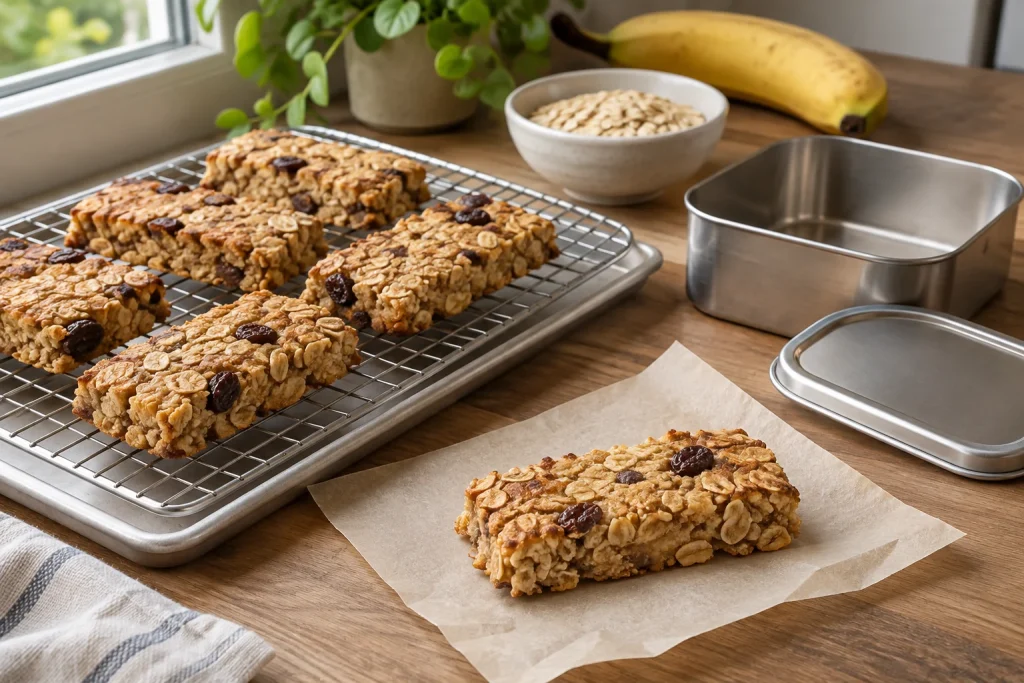
The NSW Government’s Super simple muesli bars recipe uses two ripe bananas, two cups of rolled oats, a quarter cup of sultanas, a teaspoon of vanilla extract and a teaspoon of cinnamon. The bananas are mashed and mixed with the other ingredients, then placed in an even layer in a baking-paper-lined tin. The source specifies an oven at two hundred degrees Celsius, or one hundred and eighty degrees fan-forced; twenty minutes of baking is followed by five minutes of resting, cutting into eight pieces and another fifteen minutes of baking. Check the detailed original recipe through the link.
This example is an everyday recipe shared by a local health organisation. Eight pieces is the kitchen yield, not eight running portions or a recommended consumption schedule during running. For cup measures, use a kitchen measuring tool appropriate to the recipe; an arbitrary large mug may give a different quantity. The size of the banana and type of oats can also affect the finished texture, so record the products and measuring method used in your own trial.
We do not provide a universal shelf life during running or nutrient values for this recipe. Safe handling and personal sports use require separate checks. If an ingredient is unsuitable for you, do not assume that any substitute will produce the same result and composition. A modified recipe is a new version whose preparation and storage also need reconsideration. Knowing the original source makes the starting point identifiable.
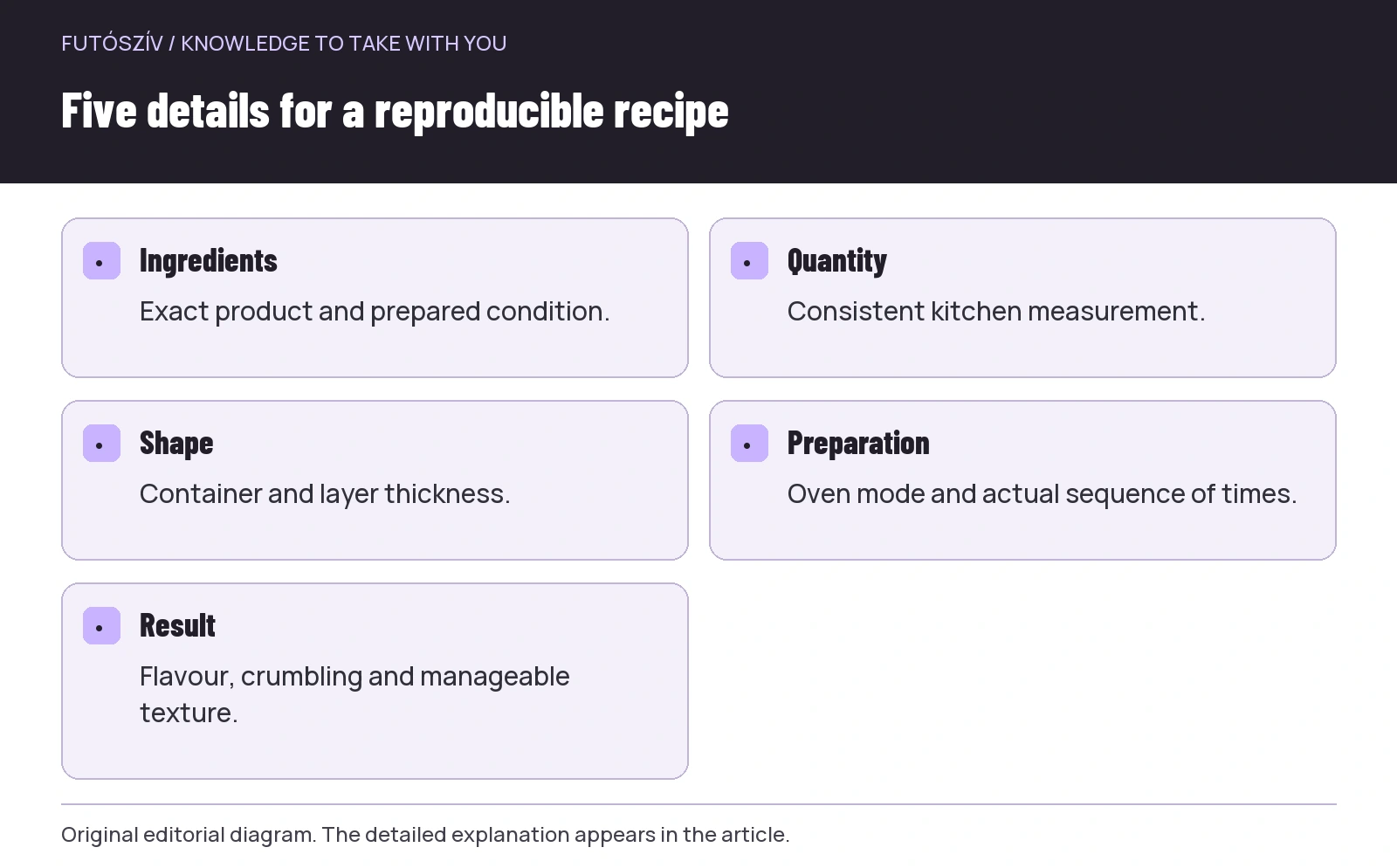 Enlarge diagram
Text version of the diagram
- Ingredients
- Exact product and prepared condition.
- Quantity
- Consistent kitchen measurement.
- Shape
- Container and layer thickness.
- Preparation
- Oven mode and actual sequence of times.
- Result
- Flavour, crumbling and manageable texture.
Put the important kitchen variables on the recipe card
Write down the precise ingredient version and kitchen quantity used. For fruit, clearly stating its peeled or prepared condition can help. Oven mode, tin dimensions and layer thickness also matter for reproducibility. The kitchen record is not a sports-dietetic dosing schedule: it preserves how that trial was made. A later change is interpretable when the initial version remains identifiable.
Record the actual times. When did it go into the oven, when did you take it out, and what was its structure like at the recipe’s finished stage? Follow the appliance instructions and recipe rather than trying to answer every safety question solely from the surface colour. If the food did not turn out as intended, change one important detail in the next trial. Many simultaneous substitutions make it difficult to tell what caused the difference.
Your card also has room for a brief description of flavour and texture. Was it too crumbly, too sticky, or pleasantly manageable for you? Do not turn the experience into a general judgement about all homemade foods. You are observing the specific result of a specific recipe. If you enjoy the snack in everyday meals but find it impractical for a running pack, it may still have a place in your diet at other times. There is no need to force every kitchen idea into the role of a race product.
Changing an ingredient may alter several properties
Flakes, dried fruit, seeds and other ingredients may produce different textures and compositions. Adding more elements does not automatically improve the result. For example, adding a new seed mixture to an earlier recipe makes it a different trial, even if the shape stays the same. Check allergen information for every new ingredient. One advantage of homemade food can be a transparent recipe; preserve that advantage by tracking changes precisely.
The NHS blueberry and banana muffins offer another example of similar fruit-and-grain ingredients producing a different form of food. The recipe has several ingredients and its own preparation sequence, so it cannot automatically be substituted into a bar recipe. Kitchen form, actual composition and personal purpose are separate pieces of information. The name muffin or bar alone does not tell you which fits your running plan.
If you want to adapt the recipe for dietary reasons, clarify appropriate substitutions with a dietitian where necessary. A version called gluten-free, dairy-free or another such term can only be treated that way when both its ingredients and preparation conditions are appropriate. Replacing the original recipe’s main ingredient does not establish that description. Personal safety requirements remain applicable alongside kitchen creativity.
| Recipe variable | Why record it? | What does it not establish? |
|---|---|---|
| Exact ingredient | A different product may give a different result | That all similarly named ingredients are identical |
| Measured quantity | Preserves a reproducible ratio | A personal running portion |
| Shape and thickness | Part of preparation | An automatic shelf life |
| Oven and timing | Makes the actual workflow identifiable | That every appliance works identically |
| Texture | Reveals a specific packaging question | A medical or sports-performance guarantee |
Pack it as you will actually use it
Choose food-safe packaging to suit the food’s texture. A tight pocket may squash a very soft snack, while a thin bag may not adequately protect a crumbly version. The container should be clean, and the food’s preparation, cooling and storage arrangements should remain consistent. Packaging provides separation and handling; by itself it does not ensure the required temperature or a safe sequence of times.
Try opening it while stationary, then in your actual running kit too. Can you reach the package, remove the part you need, and find somewhere for the opened wrapping? Important information should remain identifiable if you carry several foods. Keep the used portion separate from the part still intended for consumption. Paper, foil or small wrapping components must not be left on the route; arrange your own rubbish storage beforehand.
Do not regard cutting it into pieces suited to your quantity as precise nutrient dosing if you lack adequate information about distribution within the recipe. Dried fruit and other chunky ingredients may not be distributed evenly across every bite. Kitchen portioning may help handling and organising your plan, but it does not remove uncertainty in calculated values. If precise composition matters to your personal strategy, seek appropriate professional help.
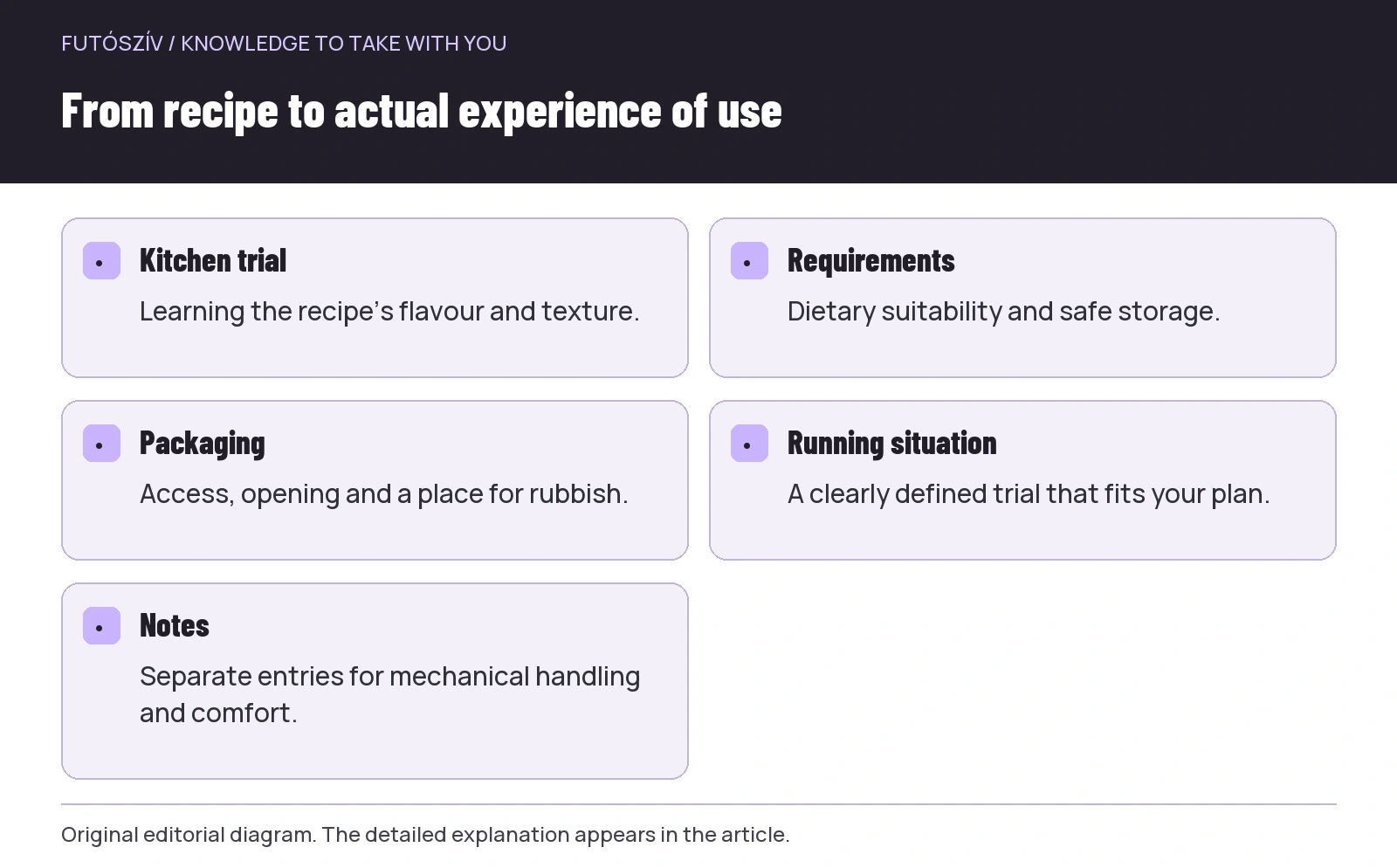 Enlarge diagram
Text version of the diagram
- Kitchen trial
- Learning the recipe’s flavour and texture.
- Requirements
- Dietary suitability and safe storage.
- Packaging
- Access, opening and a place for rubbish.
- Running situation
- A clearly defined trial that fits your plan.
- Notes
- Separate entries for mechanical handling and comfort.
Consider safe storage throughout the whole journey
Preparation, cooling, waiting, travel and carrying during running together make up the food’s history. Nébih’s shopping guidance also emphasises appropriate transport for foods requiring refrigeration. For homemade food, saying you are taking it on only a few hours of running is insufficient if it has already spent longer under other conditions. Match the actual whole journey to the particular food’s requirements.
Homemade does not automatically mean it keeps without refrigeration. Choose appropriate arrangements based on composition, preparation and storage. If the recipe lacks usable storage information, do not invent a universal several-day deadline from a surface that looks dry. Select food suitable for carrying during running according to your personal plan and safe-handling requirements. If those cannot be met, you need another solution.
Preparing a larger batch is convenient when safe later use is planned too. Freeze and thaw properly handled food that is still suitable for use according to official guidance appropriate to that recipe or food. Do not use this as an attempt to rescue food of uncertain age or improperly stored food. The label should clearly identify the recipe name, the preparation or storage date and important ingredients, without arbitrarily restarting its expiry period.
Keep few variables new in the running trial
If the food meets your own dietary and storage requirements, familiarise yourself with using it on an occasion that fits your existing training plan. Do not suddenly increase the demands of the run for a recipe trial. Familiar clothing, route and other fuelling elements make it easier to identify what was new. Eat in a safe place, stopping if necessary. There is no requirement to consume the new snack while moving on a technical section.
Separately describe your experience of accessing and opening the packaging, then your own comfort. Crumbling is a packaging or recipe-texture question, while a troublesome symptom may require a different kind of assessment. Do not merge the two into a single judgement that it did not work. Seek appropriate help for recurring symptoms rather than continuing to eliminate more ingredients on your own. Recording the exact recipe and actual circumstances of use can provide a useful basis for professional discussion.
Keep a successful version in its own role
A favourite homemade snack may have a place as an everyday snack, on a walk, or around running in a way that fits your personal plan. It need not become the same solution for every situation. Alongside the recipe card, note the conditions in which it was usable, the storage needed and which detail you actually tested. If you modify the recipe, update the version label too. Your own experience will then remain identifiable later.
A homemade running snack can be a manageable choice when a known recipe, safe handling and a personal nutritional purpose fit together. Kitchen creativity is accompanied by consistent notes and simple packaging arrangements. The number of ingredients or homemade origin alone does not define quality. The useful endpoint is food whose composition you know, which you can handle appropriately, and about which you have your own precisely bounded experience in the particular situation.
Sources and further reading
- NSW Government: Super simple muesli bars
- NHS: Blueberry and banana muffins
- British Dietetic Association: Sport and exercise
- Nébih: Shop wisely!
How Futószív articles are prepared: our editorial guidelines.