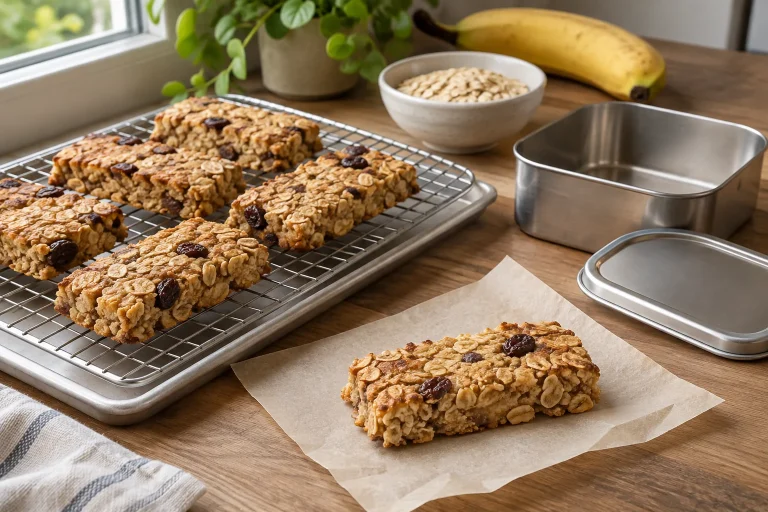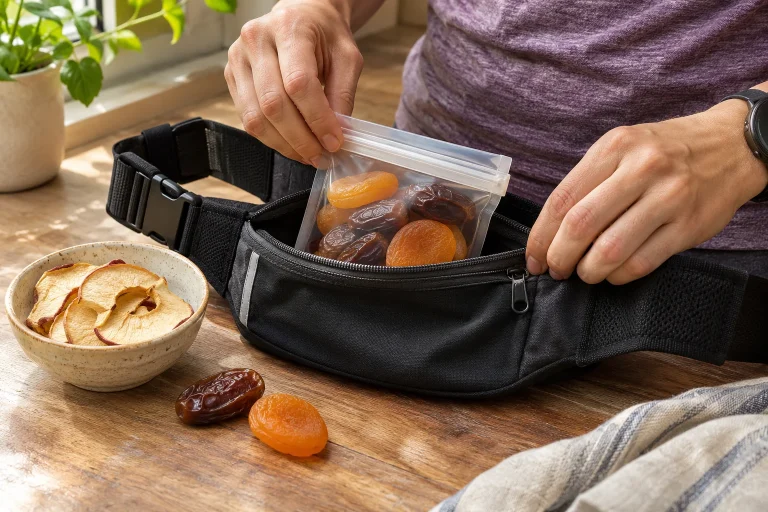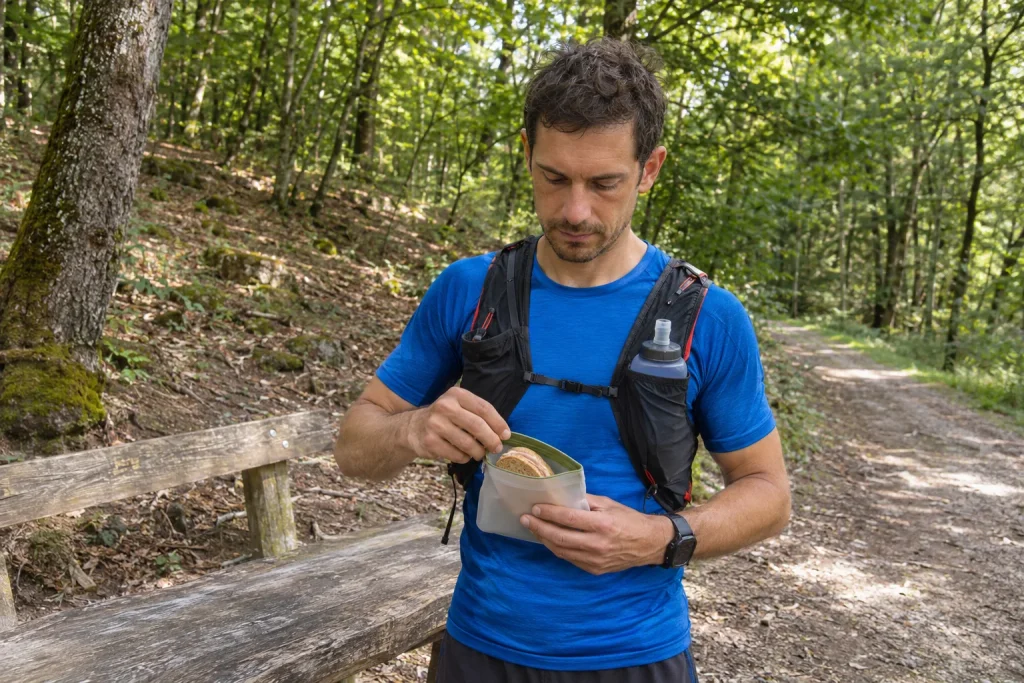
Solid food can have a place in a longer-run eating plan if it fits personal needs and the activity’s conditions. The question is then more than whether it tastes good in the kitchen. Can you retrieve it in running equipment? Does its texture remain as wanted? Does it crumble to powder in a pocket? Is there somewhere safe to eat calmly? Learning the format practically can help decide how it fits your plan and which organisational detail to change beforehand.
This article gives adult recreational runners an observation framework. It prescribes no identical food or amount for everyone and does not replace an individual sports nutrition plan for a long event. With a known allergy, illness or recurring symptoms, follow your own healthcare guidance. A handling trial is not an allergy test or forced endurance of discomfort. With appropriately chosen food, you want to learn how to use it calmly.
The individual plan and food format are separate decisions
First be clear about the food’s role during that run. Required composition, quantity and timing belong to the individual plan; format influences implementation. An easily packed bar does not automatically suit every load. Equally, food enjoyed at home is not practical on every route. Stating the two questions separately supports a more precise decision.
The Australian Institute of Sport material on sports and energy bars presents products with different compositions, textures and use situations. Solid food can provide portable energy, but specific nutritional content and individual tolerance matter. A sporty name is not personal certification of suitability. Your choice requires knowing exact ingredients and the whole fuelling plan.
Do not confuse an everyday snack with use during running. A sandwich or bar comfortably eaten at a table emerges from a running pocket under different conditions. Preparation and storage timing can differ too. The practical trial is therefore specific: this food, in this packaging, at this intended point of use. One occasion cannot reliably answer the broad question whether solid food suits you.
Four texture properties are worth distinguishing
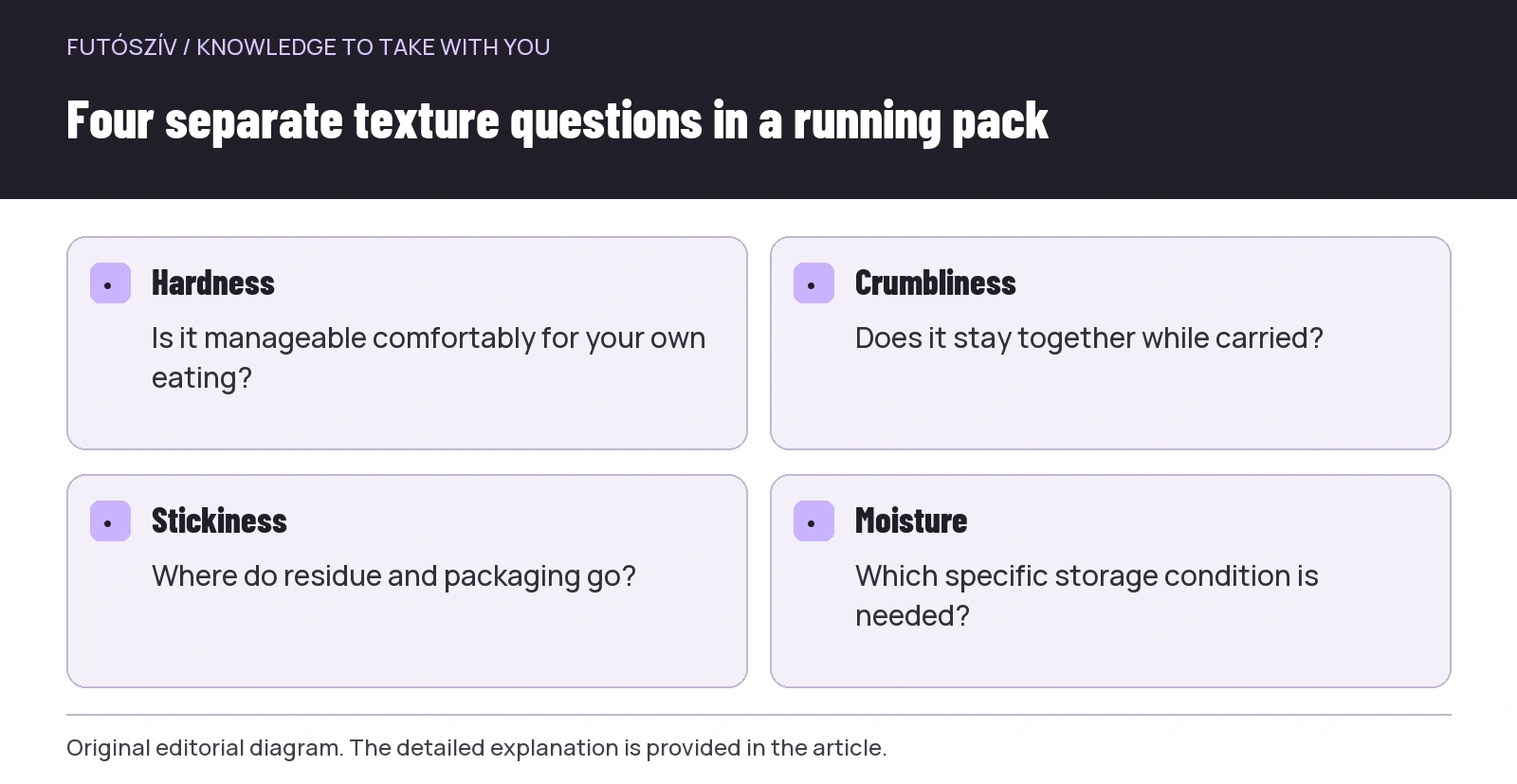
Hardness describes how easily you can comfortably bite or divide the food. Crumbliness concerns whether it stays together when taken from a pocket. Stickiness matters for residue on hands, packaging and equipment. Moisture can relate to storage conditions as well as texture. These are practical observation categories, rather than interchangeable nutrient indicators.
A softer food may be easy to divide while sticking strongly to its packaging. A drier bar may stay stable in a pocket but feel unpleasant to you in that eating situation. A crunchy version may crumble, while a coated one may behave differently under different conditions. Do not rate the whole food with one word. A precise property can suggest a specific kitchen or packaging adjustment.
Texture may change during the actual journey, so use the intended packing location while maintaining appropriate storage in the trial. You need not deliberately expose food to extreme temperatures. Always follow manufacturer storage instructions. Your task is to learn how the chosen format works in your equipment under permitted conditions. An apparently acceptable texture does not replace safe storage.
 Enlarge diagram
Text version of the diagram
- Hardness
- Is it manageable comfortably for your own eating?
- Crumbliness
- Does it stay together while carried?
- Stickiness
- Where do residue and packaging go?
- Moisture
- Which specific storage condition is needed?
Examine handling in the kitchen first
In a clean setting, check how packaging opens and what size pieces are comfortable to handle. If product instructions allow dividing it, try a form fitting your own eating plan. Do not mistake this for a general portion recommendation: personal needs determine quantity. The mechanical question is whether you can handle the chosen food safely and comfortably.
For homemade food, know the recipe’s exact ingredients and storage conditions. For packaged products, the label, after-opening instructions and intact packaging provide specific references. Allergen information matters with every version. Do not immediately combine tasting an unknown ingredient with a difficult mid-run trial. Flavour, dietary suitability and use can be clarified sequentially.
If repacking food yourself, use a container suitable for food and the intended use. Retain important product information, particularly when carrying several foods. Labelling should identify contents of each package. Plan a place for pieces created when opening foil or a pouch too. Homemade packaging offers an advantage only when the full use cycle remains clear.
| Texture question | What should you observe? | Possible next step |
|---|---|---|
| Hardness | Is it manageable comfortably for your own eating? | Choose another appropriate format or preparation |
| Crumbliness | Does it stay together in the pack? | A more protective food container |
| Stickiness | Where does residue go? | Review wrapping surfaces and waste storage |
| Moisture | What handling is needed? | Follow specific storage instructions |
A pack should be accessible as well as fit
Put the actual food into your running belt or vest, then adjust equipment according to the manufacturer. Can you retrieve it without other contents falling out? Does the container corner press against your body? Is the top graspable? An action appearing easy in an empty pocket becomes different when full. A dry packing rehearsal identifies access problems before movement.
Separate food from used clothing, shoes and other contamination sources. Opened packaging and food still to use should have different locations. If only part is eaten, handle the remainder according to specific instructions. Do not assume opened food can return to the same pocket indefinitely for later use. Clean hands and appropriate wrapping matter throughout.
Wear the clothing for the pocket trial too. Gloves, jacket and bottle position may affect food access. If retrieving it requires removing a layer or vest, treat that as a planned stopping task. Not every food has to be usable one-handed while moving. A safe, calm eating point can work well within a longer run too.
Adapt eating to the environment during running
For food needing chewing and more attention, choose somewhere safe and stop if needed. A steep descent, busy crossing or technical trail is not a suitable environment to study a new food format. Usability of your own fuelling plan includes when and where you can implement it comfortably. Maintaining pace must not take priority over safe eating and movement.
Organise fluids alongside your individual plan. Do not seek water randomly at the last moment for food that feels drier. Equally, do not prescribe yourself excessive drinking purely because of texture. Adapt food and drink together to your needs. If uncertain, clarify with a sports dietitian before running rather than improvising midway through a difficult section.
The AIS material on considerations for sports food use emphasises trying bars in training and considering individual tolerance. Mechanical convenience and digestive experience can be recorded separately. Good packaging does not make unsuitable ingredients appropriate for you, and a broken bar does not establish nutritional failure of the food format. Choose the next step for the particular difficulty.
Three food formats with different practical questions
With a packaged bar, learn opening the manufacturer’s pack, holding the food and storing the opened wrapper. Check the exact version: an energy bar, protein bar and another similar-looking food are not automatically products with the same purpose. Alongside prominent wording, ingredients and the full nutrition panel matter. Do not decide its role in your plan from packs standing beside one another on a shelf.
With everyday fruit, preparation, protection from crushing and waste storage may be the main questions. Cut fruit and a whole piece may require different handling. Plan appropriate washing and storage. Peel or other organic remains must not automatically go onto the route either; respect event waste rules and a clean environment. A simple format does not remove the whole use cycle.
With homemade bites, recipe consistency, safe preparation, storage time and packaging matter together. Homemade alone does not provide precise nutrient information or shelf life. If proportions change each time, texture and experience may change too. A short recipe card can record kitchen quantities and ingredients. This supports repeatability, rather than replacing individual sports nutrition dosing.
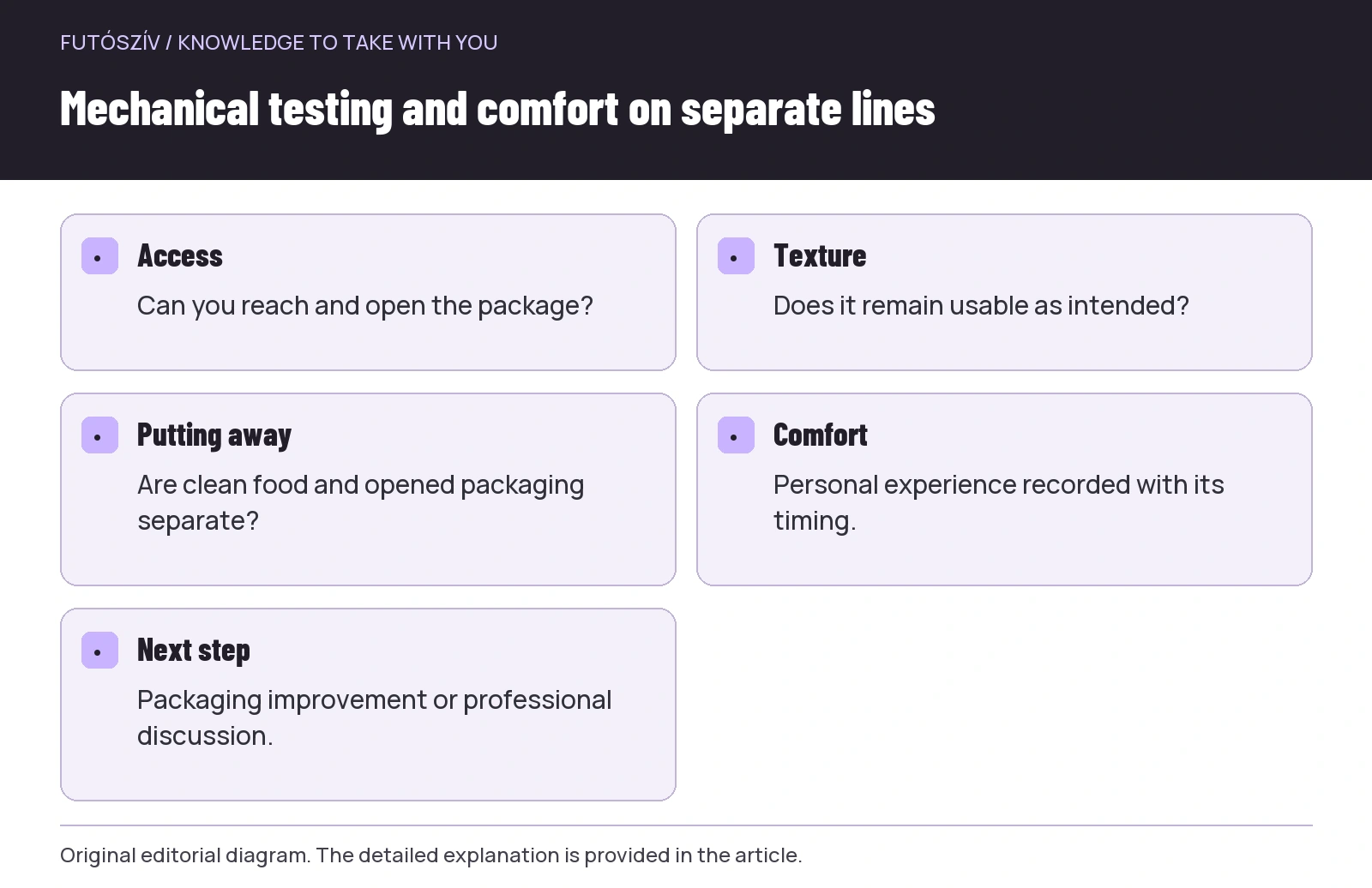 Enlarge diagram
Text version of the diagram
- Access
- Can you reach and open the package?
- Texture
- Does it remain usable as intended?
- Putting away
- Are clean food and opened packaging separate?
- Comfort
- Personal experience recorded with its timing.
- Next step
- Packaging improvement or professional discussion.
Food safety is not a texture test
The Nébih shopping guide discusses appropriate transport of products requiring refrigeration too. For your running bag, consider the entire journey: preparation, waiting, travel and carrying during running may all be involved. Plan chilled food only if appropriate conditions are possible. If not, choose another option suited to circumstances and your own plan.
A fresh-looking appearance, pleasant smell or still acceptable texture does not correct uncertain storage. Check intact packaging, date and instructions on the actual product. Handling opened food may differ from unopened. Know the real history, particularly for homemade food or combinations received from others. Safe handling is not a detail you can omit for running when convenient.
Put mechanics and comfort on separate lines of the trial sheet
Describe the exact food and place of use, then record retrieval, opening, texture and putting away separately. Follow with brief personal comfort, timing and running circumstances. “It did not work” can hide many different failures. “It crumbled, but I managed the meal in my plan” already identifies a specific packaging task for targeted improvement.
Do not create a general food ranking from one trial. Experience belongs to that combination, timing and load. With troublesome or recurring symptoms, do not continue with more independent exclusions. Bring accurate observations to an appropriate professional. Mechanical difficulties, however, may need a simpler container, more accessible pocket or planned stop. Separate treatment keeps the two kinds of question clearer.
Keep the version that works simply
Your card should identify the exact food, appropriate packaging, equipment location, required storage and planned eating place. If an element changes, check it as a new detail too. The goal is not constant testing but a usable selection within your individual plan. Solid food then becomes a deliberately prepared option whose flavour, handling and limits of personal experience you understand.
Sources and further reading
- Australian Institute of Sport: Sports bars
- Australian Institute of Sport: Sports bars – concerns and considerations
- Nébih: Vásároljunk okosan!
How Futószív articles are prepared: our editorial guidelines.