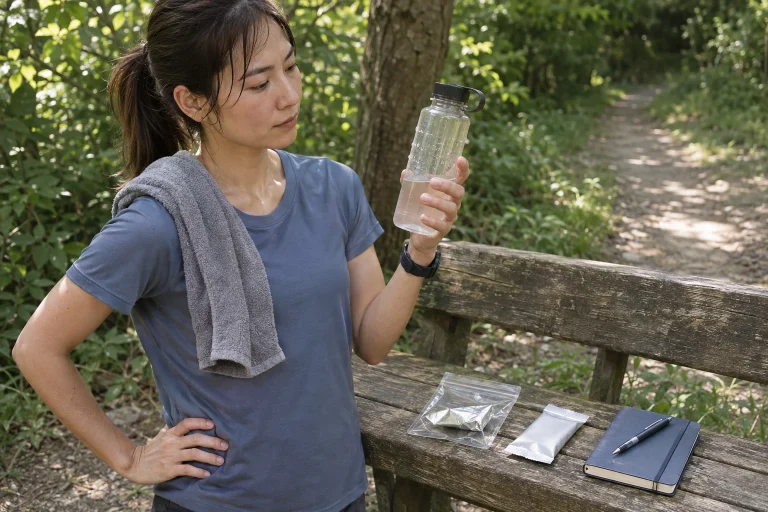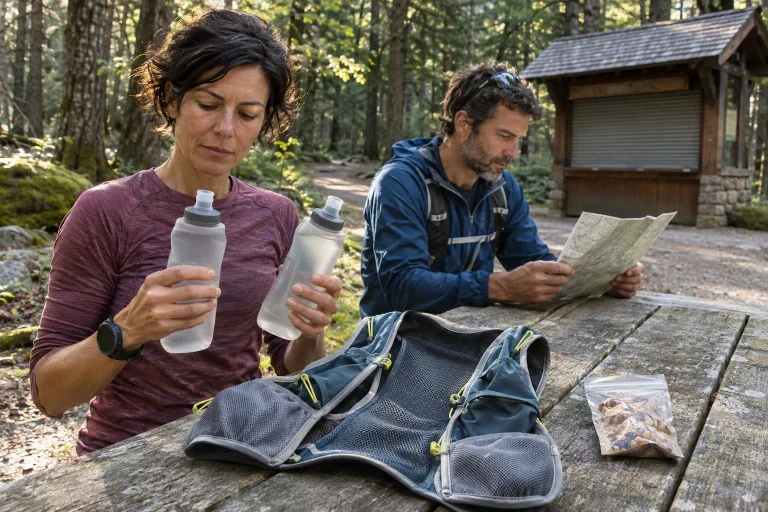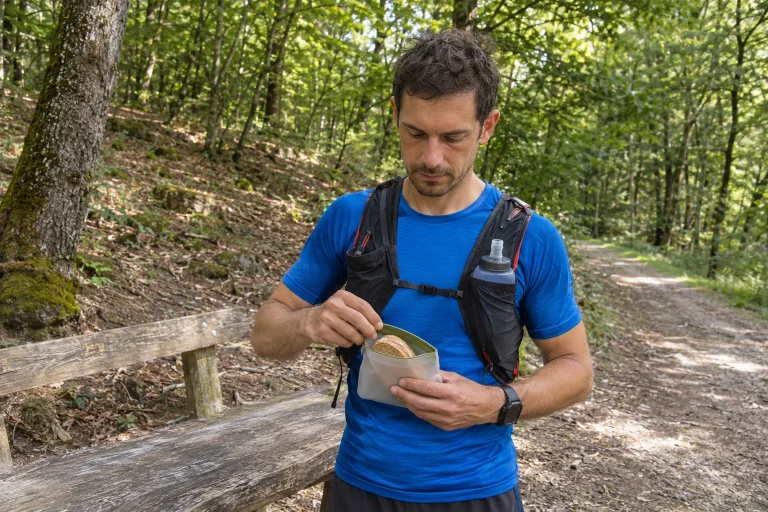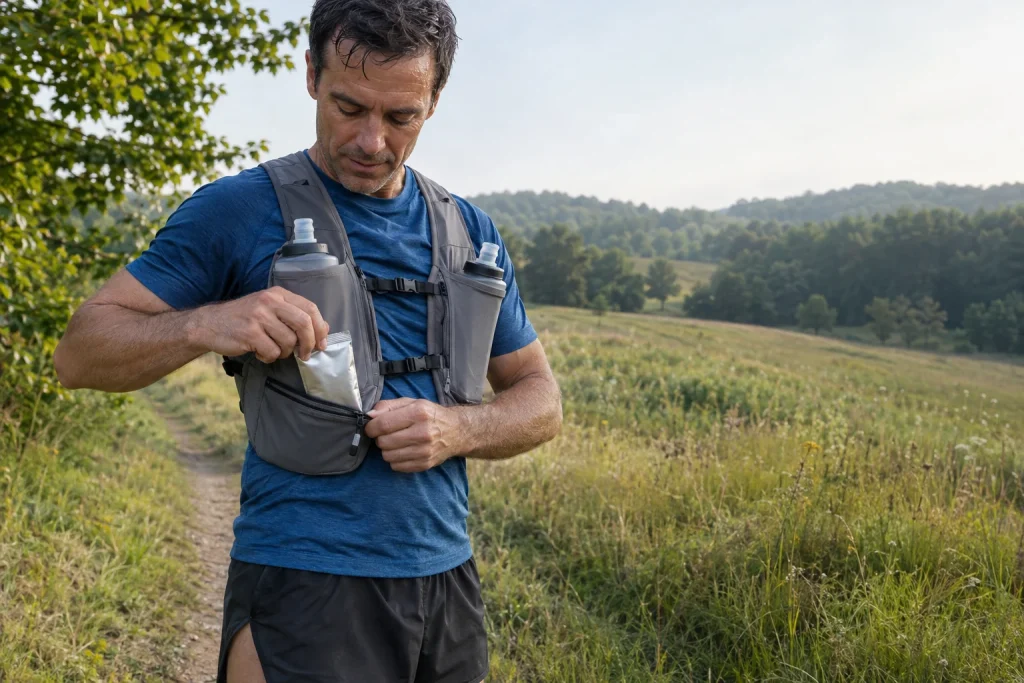
A fuelling rehearsal for a longer run can answer many small questions. Can you reach your vest pocket? Open the food? Find the right bottle? Does the planned water point actually work? At a race, details like these directly affect which parts of an individual plan happen in practice. A rehearsal therefore checks how you use the strategy as well as nutrition itself. The goal is a system learned in your own circumstances that you can practise.
This guide gives adult recreational runners a practical observation framework. It prescribes no carbohydrate, fluid or salt doses and recommends no extreme loading or eating experiments. Develop an individual plan for the longer event with a sports dietitian if needed. With a known condition, allergy or recurring gastrointestinal symptoms, follow your own healthcare guidance. The rehearsal does not replace investigation and is not a food-intolerance test.
First be clear what you want to try
Choose one main question. It may concern product access, usability of food in your own plan or planned supplies along the route. If you combine new food, a new vest and a new route every time, it becomes hard to say which part worked. A simple question allows a clear observation. For example, you are checking whether a gloved hand can safely retrieve the pack from the designated front pocket.
Describe the starting plan: session character, your own fuelling routine, exact product versions and available resupply. Record dosage or other individual details according to your professional plan. “Usual gel” is insufficient if you have several versions with different ingredients in the same product family. Put what actually goes into the pocket on the card, rather than a general advertising picture or a name recalled from memory.
The Australian Institute of Sport material on considerations for gel use emphasises trying the intended race product during training and assessing individual tolerance. Practice does not mean every session needs a sports gel. Personal goals, the particular load and overall nutrition plan together determine which option belongs in the rehearsal.
Fit the run into your existing training plan
Do not suddenly increase distance or intensity for a fuelling trial. Choose a session fitting preparation. If working with a coach, coordinate practical rehearsal details with them too. Nutrition plans and session goals connect, but every variable need not change simultaneously. A familiar training situation easier to assess can provide more useful information than an unusually difficult day.
Use a recognisable route and check necessary access points beforehand. Where can you stop, where is suitable drinking water available and where can you safely modify or finish the run? Do not automatically assume a fountain marked on a map works or its water is usable. Checked information and a backup solution are needed together. Unexpectedly unavailable supplies may justify changing the original plan.
On a loop or returning route, access to supplies may be easier to understand. This is an organisational format, not an individual distance recommendation. Handle your own bag in an appropriate place and conditions; do not leave food in uncertain storage. A safe running environment and genuinely accessible help matter more than completing every rehearsal detail alone and uninterrupted.
 Enlarge diagram
Text version of the diagram
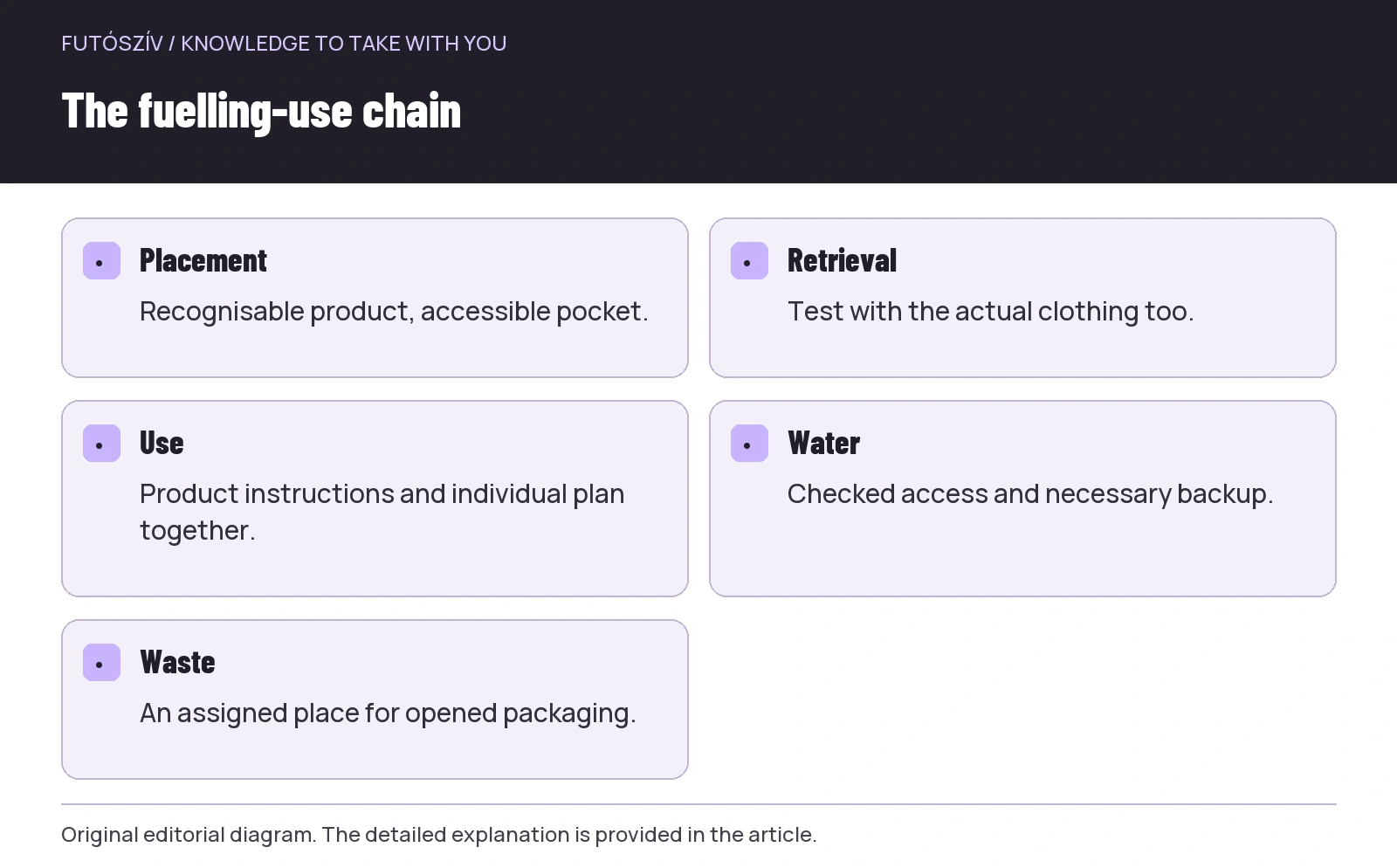
- Placement
- Recognisable product, accessible pocket.
- Retrieval
- Test with the actual clothing too.
- Use
- Product instructions and individual plan together.
- Water
- Checked access and necessary backup.
- Waste
- An assigned place for opened packaging.
Do a dry packing rehearsal before leaving
Fill the vest or belt as you intend to run with it, then practise retrieval somewhere calm. Know which pocket holds food to use and where opened packaging goes. Bottle contents should be identifiable too. If two identical containers hold different drinks, a short label can prevent mistakes. A dry rehearsal can identify access problems simply without also needing attention to terrain.
Consider clothing as well. Gloves, a rain jacket or a layer over the vest can cover a previously easy pocket. Opening packaging with cold hands and wet surfaces is a different task from doing it at a kitchen table. Test the actual combination intended for use according to manufacturer instructions. Do not modify packaging or equipment dangerously merely to make a movement quicker.
Before leaving, check product labels, intact packaging and storage conditions. Allergens and any caffeine belong to the exact version. Do not automatically regard a pack kept in reserve for a long time as usable. Organising your own supplies is part of the rehearsal too. Packaging left after use should have an assigned closable or otherwise manageable place so you do not need to find one during running.
Consider the food and water plans together
According to the AIS information on sports gels , products differ in composition and use, and many gels are intended to be consumed with water. Read the exact product’s instructions beforehand and organise fluids alongside your individual plan. The general product category does not replace the actual label. “I have gel” and “my complete fuelling is arranged” are not identical statements.
Allow time to access resupply too. Refilling a bottle involves removing or opening something, may require stopping and needs the pack rearranged afterwards. This process can also be practised somewhere safe. The goal is reliable use of your system rather than speed at all costs. On trails or in traffic, attention should primarily address movement safety.
Do not introduce every available sports drink and food format together during the trial. Know the full system’s composition to interpret experience afterwards. Work according to quantities and timing in your own plan, and clarify uncertainties with a sports dietitian. Combined use of drinks, food and any caffeine may need individual consideration. A product family’s popularity does not automatically answer questions about your combination.
| Rehearsal element | What should you check? | What experience do you gain? |
|---|---|---|
| Retrieval | An accessible pocket and identifiable pack | Does the packing order work? |
| Opening | With the actual product and clothing | What movement or stop is needed? |
| Water | A reliable source and individual plan | Is the entire access process arranged? |
| Waste | An assigned place | Does equipment stay organised? |
| Notes | Separate lines for planned and actual | Where did the system depart from the plan? |
Watch for safe execution during the run
If retrieval or opening needs more attention, stop somewhere safe. You need not turn the rehearsal into race-speed hand movements at all costs. A narrow trail, stairs, steep descent or road junction is not a suitable place to study packaging. Adapt where you use the product to movement conditions too. One outcome of a more comfortable system may be knowing beforehand when stopping is worthwhile.
Briefly observe whether you followed the planned order. Did the pack stay in the same pocket? Did an opened product slip among unused ones? Did you close the bottle properly again? These are specific, fixable questions. If equipment takes too much attention, simplify. A few familiar placement rules are often clearer than a complicated separate arrangement for every pack.
You can record a few observations about how you feel too, without scoring every minute. Link brief notes to planned times or natural route points. If troublesome symptoms or illness occur, necessary changes and help take priority over continuing the rehearsal. Its purpose is not proving anything can be forced through. Your body’s signals and route safety come before the original plan.
 Enlarge diagram
Text version of the diagram
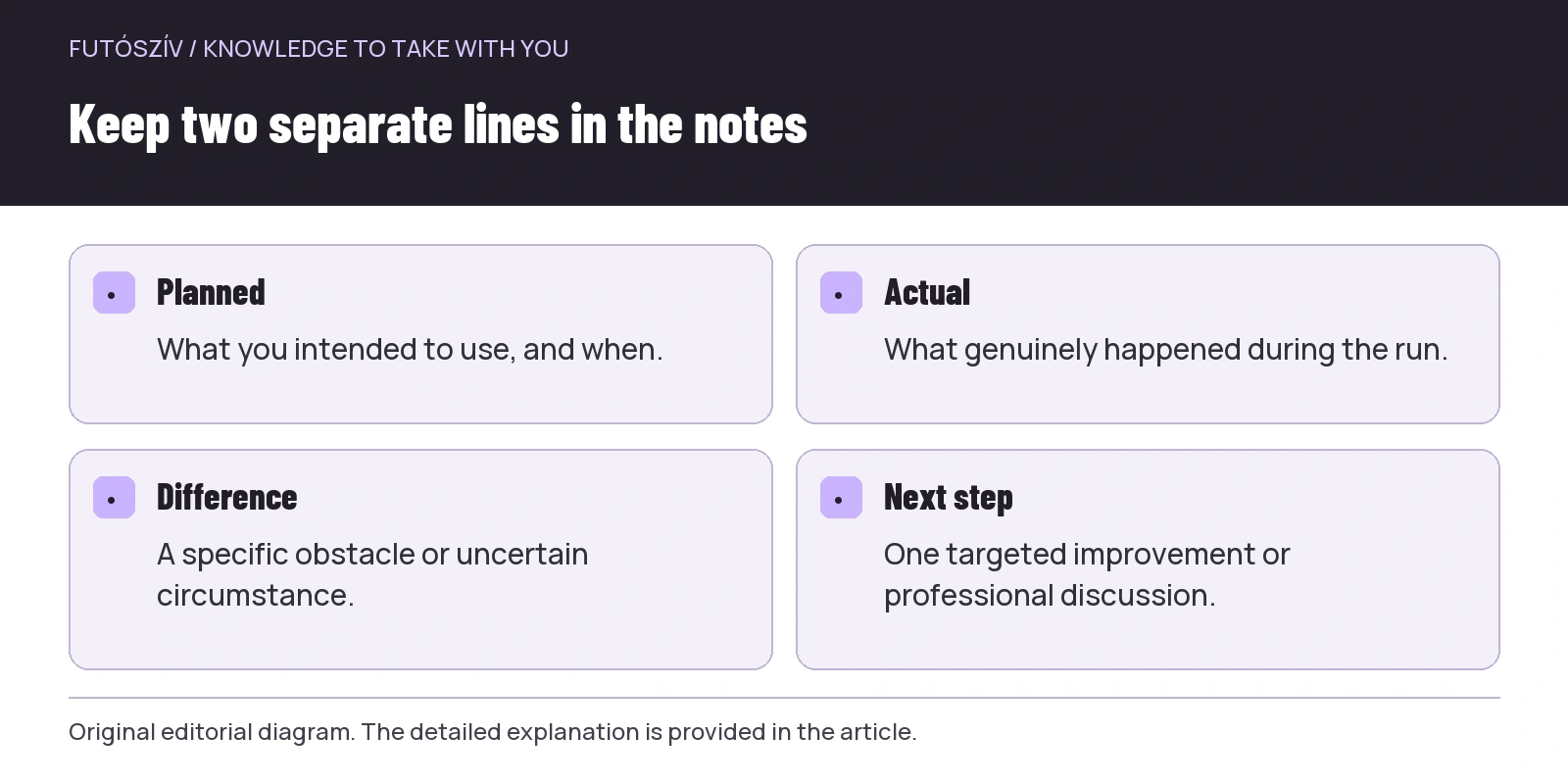
- Planned
- What you intended to use, and when.
- Actual
- What genuinely happened during the run.
- Difference
- A specific obstacle or uncertain circumstance.
- Next step
- One targeted improvement or professional discussion.
Separate what happened from the original idea
After running, first describe what actually happened. When and which product did you use, what stayed unopened and where did you modify things? Counting remaining packs can help, but do not enter a certain quantity if you can only guess. The planned sequence is not the actual one. The difference reveals where the system needs changing before next time.
Record kitchen or equipment difficulties separately from comfort experiences. Was food missed because the pack would not open or because you did not want it? Did water run out because a refill point failed or the plan omitted part of the route? A precise cause cannot always be described, but specific circumstances can be named. Mark uncertainty too, rather than hiding it behind a retrospective story that appears certain.
Do not turn one trial into a product ranking
A better running result alone does not establish a product’s superiority. Weather, route, previous load, rest and companions may influence the session too. Your experience is valuable but relates primarily to that specific combination and circumstances. “It was usable for me in this situation” is more precise than calling a product better for everyone. You are learning your own system, rather than creating an uncontrolled brand test.
The British Dietetic Association sports nutrition information relates needs to load and individual circumstances and recommends an appropriate professional for personal questions. Rehearsal notes can provide a good starting point. Show the full day and running schedule, exact product details and observed difficulty. A targeted question makes personal help easier than a general statement that fuelling does not work.
Choose one improvement for the next rehearsal
If the pocket was poorly placed, change packing first. If opening is difficult, the manufacturer’s method and a safe stopping point may be the next check. If the whole fuelling strategy is uncertain, a sports nutrition discussion is needed rather than another random product switch. Make the improvement specifically nameable. The next occasion can then genuinely answer whether the earlier obstacle was reduced.
A rehearsal is useful when your plan becomes clearer to use afterwards. You know what you carry, where to reach it, how to open it, where water is available and where waste goes. Observations need not become certain rules for every situation. Fewer unresolved details for the next run and more precise personal professional questions are enough. A well-practised system becomes useful through the connection between an appropriate plan and feasible actions, rather than the greatest number of products.
Sources and further reading
- Australian Institute of Sport: Sports gels
- Australian Institute of Sport: Sports gels – concerns and considerations
- British Dietetic Association: Sport and exercise
How Futószív articles are prepared: our editorial guidelines.