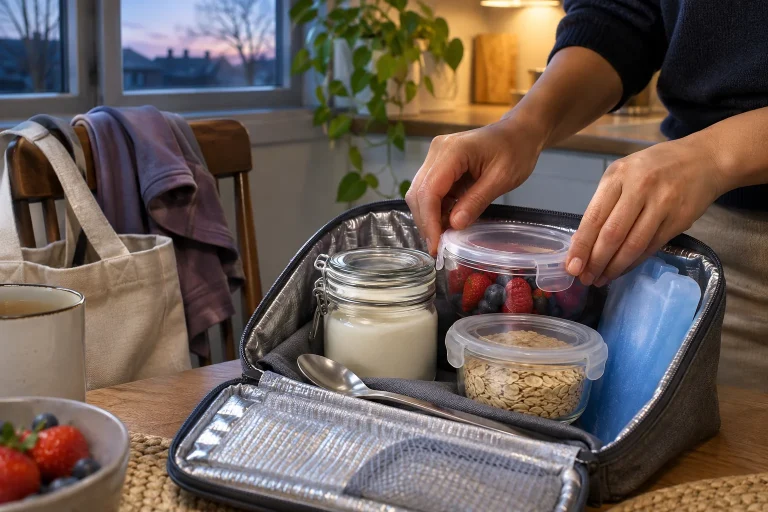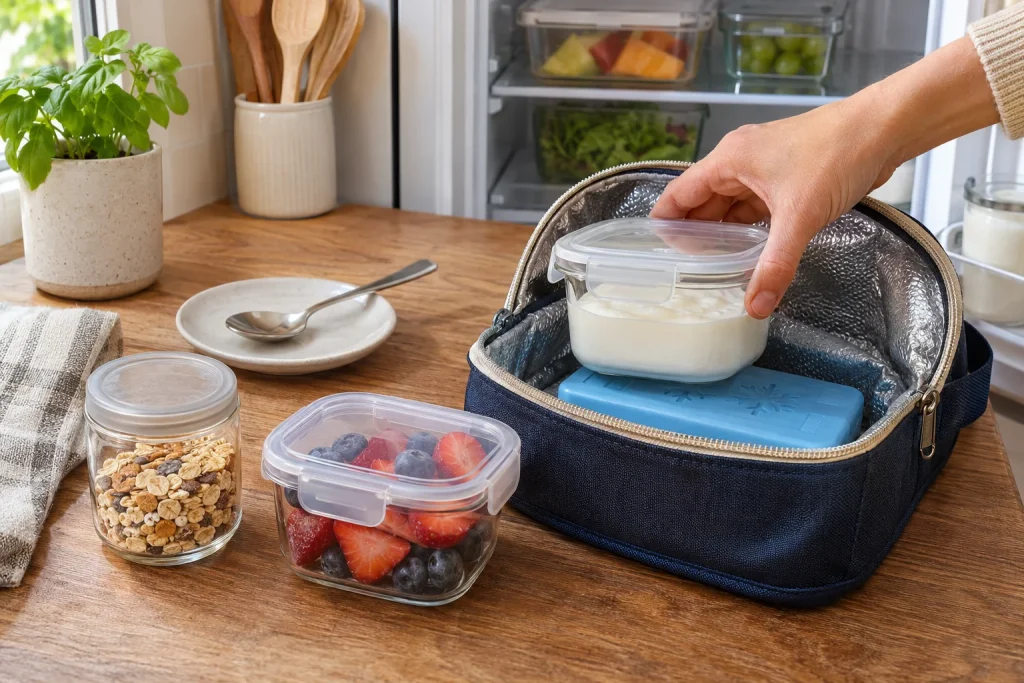
The appeal of a yogurt breakfast is its simplicity: it does not necessarily require cooking, it can be combined with many other ingredients, and it can be assembled at home or at work. A version that works well, however, depends on a few small decisions. What product have you bought? What instructions apply after opening? When will you add the fruit? Do you prefer your cereal topping soft or crunchy? Where will the food stay cold between leaving home and eating it? These questions are worth answering before you fill containers for an entire week.
This guide is intended to help organise everyday breakfasts. The examples are adaptable kitchen ideas; adjust quantities to your appetite, your day and your individual diet. If you have a milk allergy, another known allergy or a prescribed diet, choose every ingredient accordingly. Lactose-free does not mean milk-free: these are two different questions when shopping, too. Do not try to diagnose unexplained, recurring symptoms by repeatedly changing your breakfast.
First, identify what is going into the bowl
Plain yogurt, strained dairy products, flavoured desserts and plant-based alternatives may sit beside one another in the refrigerated aisle. Similar pots and a spoonable texture do not mean identical ingredients. Check the exact product description, ingredients list, allergen information and nutrition panel. Start comparisons using figures for the same quantity, then consider how much you use in your own meal. The size of the pot is not necessarily a personalised breakfast portion.
The NHS information on dairy products and their alternatives emphasises the role of the label and the differences in composition between products. With a plant-based version, fortification and the specific nutritional content also matter. The practical conclusion is straightforward: do not treat a new product replacing your usual dairy food as completely equivalent simply because of its name or colour. Fit your label-informed choice into your diet as a whole.
You can control flavouring separately, too. With a plain base, you might choose fruit you enjoy, cinnamon or another spice suitable for you. This does not automatically make every plain combination ideal, but it makes it easier to see what you have added. A pre-flavoured product can be convenient; here, too, decide on the basis of its actual composition and your own tastes. You do not need to turn a product category into a moral judgement to prepare breakfast thoughtfully.
Read the storage conditions alongside the date
Find the date on the packaging, the storage instructions and any directions for use after opening. These three pieces of information belong together. A date printed for the original sealed product does not mean that a large tub, once opened, can be kept until then regardless of how it is handled. If the manufacturer gives a separate time limit or condition after opening, take that into account as well. Write the opening date on your own label, rather than inventing a new expiry date.
The Food Standards Agency’s official fact checker explains that dairy products may carry either a use-by date or a best-before date. You cannot override a use-by limit with a sniff test: an apparently pleasant smell is not a certificate of safety. Storage is part of the decision, too. Refrigerating a pot again after it has been left warm for an uncertain period, and adding an attractive topping, will not resolve the problem.
The Food Standards Australia New Zealand information on date marking likewise distinguishes safety-related dates from quality-related dates and asks consumers to follow storage instructions. When shopping in Hungary, use the Hungarian label on the product sold locally as your specific guide. If the wording is illegible, the packaging is damaged or the product’s history is uncertain, do not invent a reassuring explanation during the morning rush.
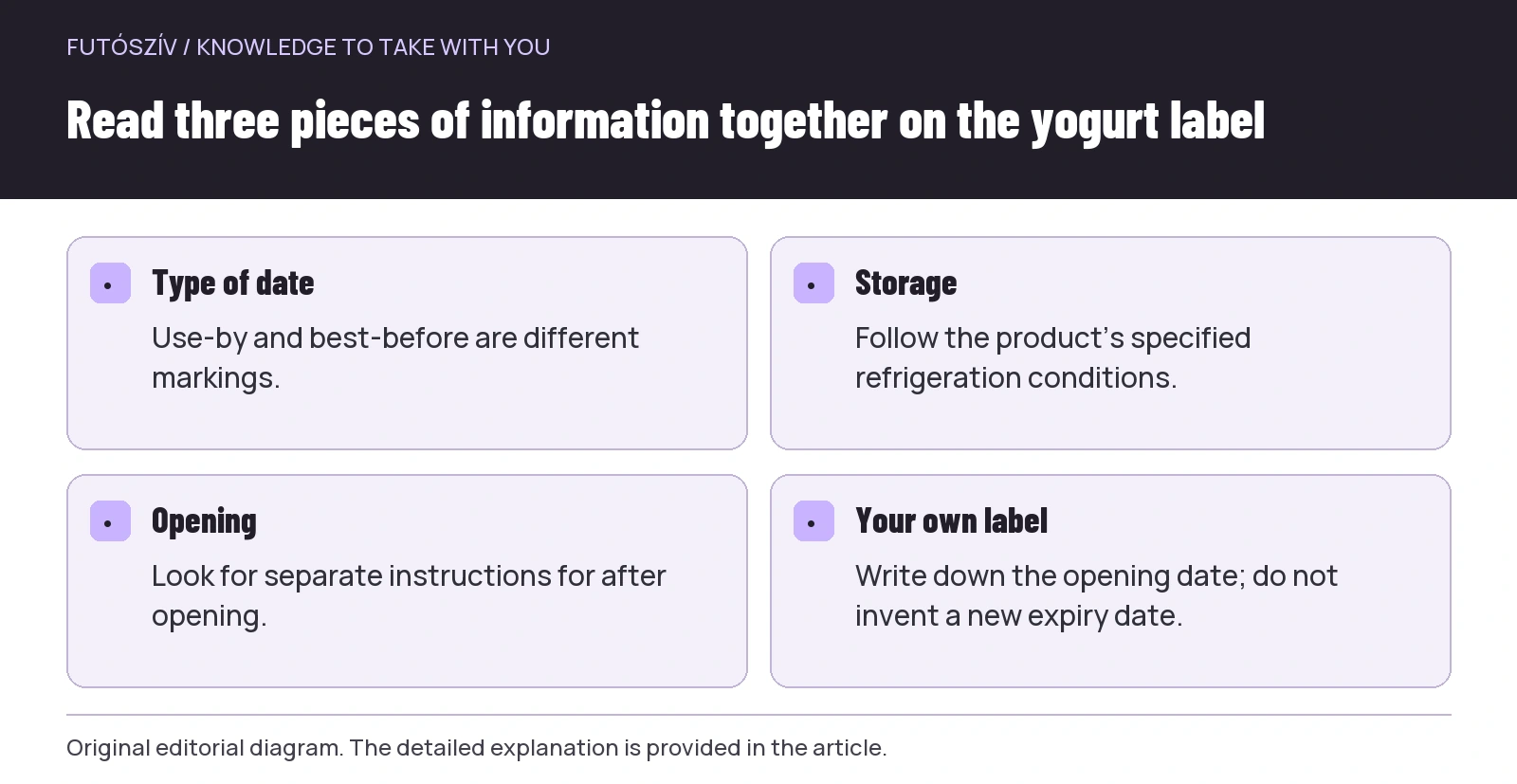 Enlarge diagram
Text version of the diagram
- Type of date
- Use-by and best-before are different markings.
- Storage
- Follow the product’s specified refrigeration conditions.
- Opening
- Look for separate instructions for after opening.
- Your own label
- Write down the opening date; do not invent a new expiry date.
A large tub and a small pot need different routines
You can portion a large container across several meals, but use clean utensils each time and return the remainder to storage as instructed. It is sensible to put the amount you need into a separate bowl or clean container and close the shared tub immediately. Do not put a spoon you have eaten with back into a base intended for others as well. This rule is particularly easy to follow when the serving spoon and eating spoon are already two separate items in the kitchen.
A small pot may involve less portioning, but it means more individual packages and more separate dates to track. After shopping, arrange the fridge so the items that need using first are visible. Do not let identical-looking pots hide one another in a deep storage box. Judge value for money by the amount you actually eat: the advantage of a larger pack can easily disappear if it regularly leaves a remainder of uncertain age.
In a shared household, a short label can prevent many misunderstandings. For example, an opening date together with the product name is clearer than a number on its own. If you transfer yogurt to your own container, keep the information from the original label as well. White bases sitting in the fridge can be hard to tell apart by sight. A label with the name also helps avoid mistakes involving allergens and different product variants.
Three container compartments can serve three separate purposes
The first section can hold the base that needs refrigeration, the second the properly prepared fruit, and the third the dry addition. This is not a compulsory packing format, but an option for planning texture. Cereal kept separately can stay dry until serving, while you can add the fruit’s juice to the base when you wish. Separation does not remove the need for refrigeration or, on its own, extend the ingredients’ safe usable life.
If you prefer a softer texture, a mixture prepared in advance may also work, with storage appropriate to the products. In that case, the cereal absorbs some of the liquid, giving breakfast a different texture from one mixed fresh. First try it on a single occasion with your own base. Notice whether it becomes too thick or pleasantly spoonable. There is no need to prepare five identical containers of a texture you do not yet know you will enjoy eating.
You can test a divided container’s seal with water before packing food, then clean and dry it appropriately. A lid that allows liquid to pass between compartments will not keep toppings separate inside your bag. For a runny base, choose a food-safe container genuinely suitable for that purpose. Plan where the spoon will go as well: carry it in a clean case or separate wrapping, and after eating, do not put the used utensil back in a compartment with clean food.
| The texture you want | What should you separate? | When should you assemble it? |
|---|---|---|
| Crunchy topping | Dry cereal from the base | Immediately before eating |
| Softer cereal base | Any optional crunchy garnish | During appropriately refrigerated preparation |
| A plain portion with less discolouration | Fruit that releases juice | Mix it in when serving |
| A shared base for several people | Each person’s own toppings | Individually, with clean utensils |
Four ideas using the same manageable base
For an apple-and-cereal version, prepare the washed fruit to suit the time you will serve it. You can choose the texture of oats or another suitable cereal addition alongside the yogurt separately. Mix cinnamon into a small portion first so it does not remain in one dry clump. If you dislike firm pieces of raw apple, choose another fruit you find pleasant. The aim is a satisfying breakfast you enjoy eating, rather than ticking off a compulsory fruit list.
For a banana combination, you can even take the fruit separately, whole, and prepare it when eating. This moves part of the chopping from the morning to serving time. Cereal or bread can be a separate part of the meal; everything does not have to fit into one pot. Add seeds, nuts or a nut or seed butter only if the ingredient is suitable for you and permitted in the shared setting concerned. Here, too, the label tells you more than a decorative picture.
For a savoury version, you can combine a plain base, washed and appropriately prepared vegetables, herbs you enjoy, and separately packed bread. Vegetables may release liquid, so it may be worth mixing in the salad-like portion only when eating. You can dip the bread or eat it separately. This also offers an alternative for people who do not enjoy sweet flavours in the morning. Ingredients that need refrigeration still require appropriate handling throughout the journey.
For a shared weekend breakfast, you can place several small additions on the table, but take out only the portion of the chilled base you intend to use. Provide separate clean utensils with the toppings. Family members can create different flavours and quantities in their own bowls from the same base. Decide how to handle leftover shared toppings according to their ingredients and the time they have spent on the table. Simplicity does not mean pouring every leftover back into its original packaging.
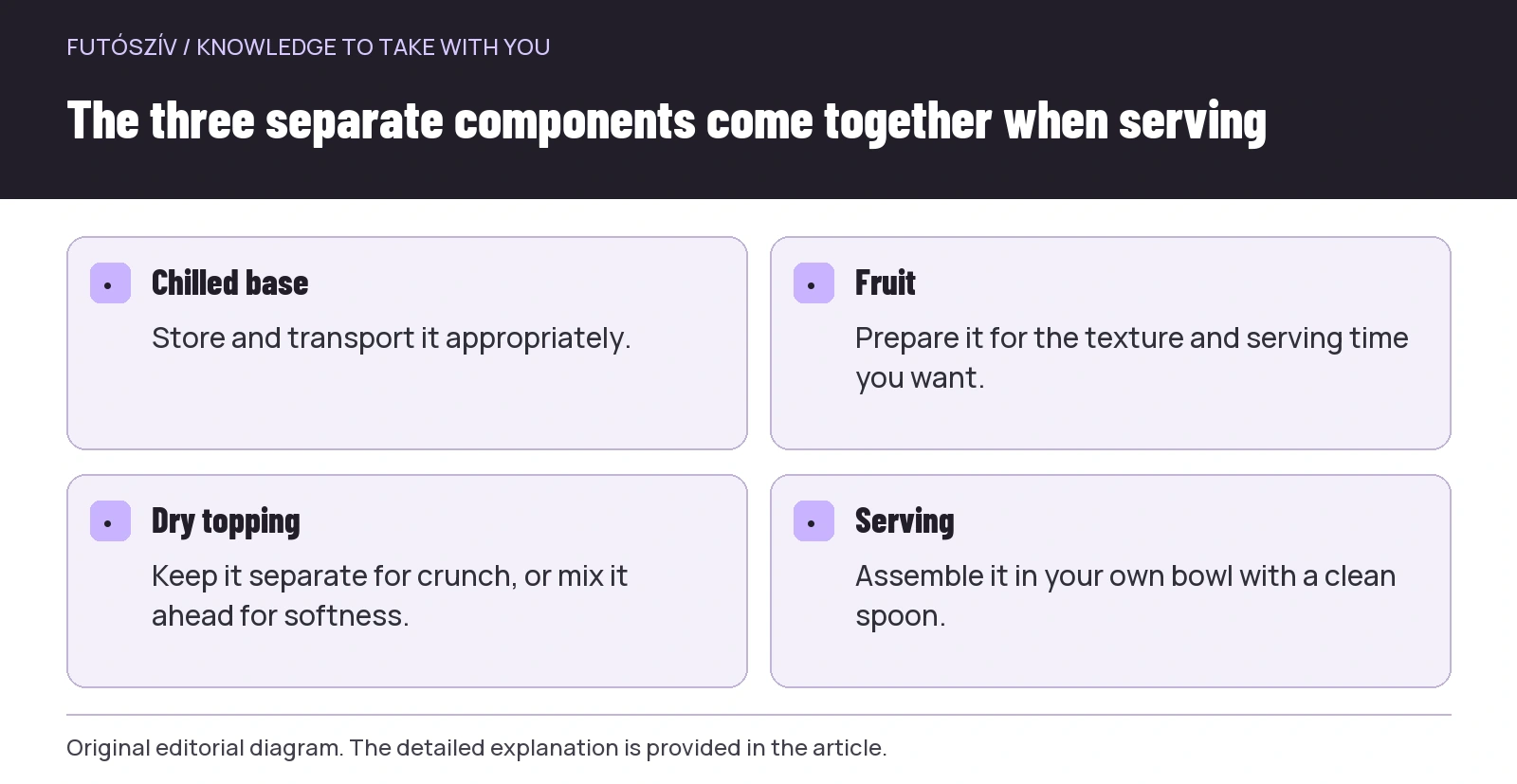 Enlarge diagram
Text version of the diagram
- Chilled base
- Store and transport it appropriately.
- Fruit
- Prepare it for the texture and serving time you want.
- Dry topping
- Keep it separate for crunch, or mix it ahead for softness.
- Serving
- Assemble it in your own bowl with a clean spoon.
Do not let a morning run interrupt the chilled food’s journey
If you take breakfast from home, map out its journey first. From fridge to bag, travel, workplace fridge and finally serving: every stage matters. If a run falls between the two locations, time in the bag may be longer than on an ordinary working day. Your method of keeping food cold needs to fit that journey. The fact that the food started cold does not, by itself, tell you what condition it will be in after the morning meeting.
Check whether the workplace fridge is actually accessible, whether it has appropriate space and when you can put the food inside. A bag left at reception, a sunny windowsill and a car are not refrigerated storage. If the planned refrigeration is unavailable, choose a different breakfast or buy the base somewhere suitable and assemble it there. In this situation, a good plan means changing the route. An extra layer of dry cereal cannot make up for an uncertain cold chain.
When planning around a run, try familiar choices first
If you want to eat a yogurt breakfast immediately before running, consider the whole combination, its timing and its quantity. Your comfort depends on more than the name of the yogurt: toppings, eating speed and the proximity of exercise are all part of the situation. Do not try a new bowl with many different additions for the first time on the morning of an important race. On a calmer day, it is easier to recognise which version fits your routine.
Change one thing during your breakfast rehearsal: for example, serve the cereal separately or mixed into the bowl, while preparing everything else as usual. This gives you useful experience of the food’s texture and the practicality of the plan. If symptoms occur, do not declare an entire food group at fault on the basis of one trial. Seek professional help for recurring or troublesome symptoms. Kitchen notes may provide useful information for that discussion, but cannot replace a diagnosis.
A workable breakfast routine in brief
Choose the base and check its label the evening before. Prepare a clean, securely closing container and keep the dry topping separate if that suits the texture you want. In the morning, pack the chilled component appropriately for the journey, and put it into suitable storage at work. When eating, assemble the parts in the order you prefer; afterwards, wash the container and spoon and let them dry properly. That way, the next occasion does not start with an uncertain leftover.
A short personal recipe card is enough for a combination that works: the exact product name, your preferred topping, cereal separate or mixed in, the container needed and where refrigeration will be available. If you replace one component, update only that part of the card. A useful yogurt breakfast is not defined by having the most toppings, but by being something you enjoy eating, handle appropriately and can fit into your actual morning. These few decisions are worth more than an impressive-looking pot whose transport you have not planned.
Sources and further reading
- NHS: Dairy and alternatives in your diet
- Food Standards Agency: Home food fact checker
- Food Standards Australia New Zealand: Use-by and best-before dates
How Futószív articles are prepared: our editorial guidelines.