A family waiting at the finish has its own programme too. For one person it is enthusiastic watching, for another prolonged standing; children may experience the same loud, crowded place quite differently. Supporting the runner remains enjoyable when everyone is not expected to stand continuously beside the barrier for the entire race.
Prepare an understandable waiting plan near the finish. Its centre is an actually accessible meeting place, a few optional activities and an agreement about reuniting after the finish. You need not fill the time with programmes: a usable break matters at least as much as spectacular cheering.
Separate the viewing place from the meeting point
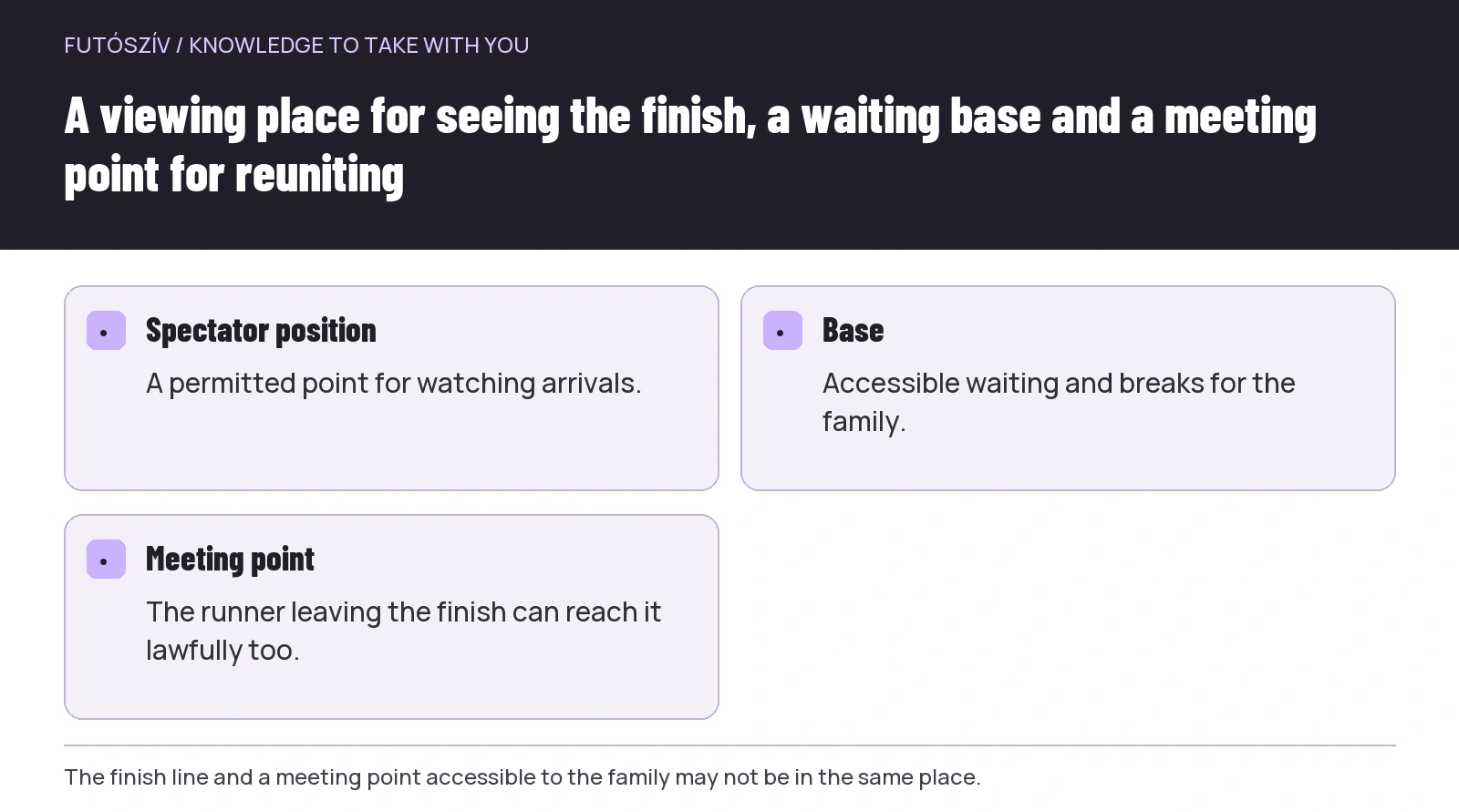
A spectator position beside the line and the family meeting point serve two functions. At the first, you want to see the runner arrive. At the second, you actually need to reunite after the organiser’s finish corridor and exit. They may be close, but do not assume access through the same entrance or from the same side.
The official London Marathon spectator guide uses a separate meeting area at its event and asks people to agree a point beforehand. Separating functions is useful for family planning. At a Hungarian race, the current spectator map and on-site routes determine where you can meet; London area names are not universal templates.
Describe the meeting as more than a vague idea. An official location name, unambiguous entrance or designated meeting-point sign helps. Check from which direction the runner can arrive after leaving the finish and how those waiting can reach it. A participant-only gate is not a suitable family base merely because it is close to the finish on the map.
Do not organise everyone’s attention around a single minute
The estimated finish is a window, not a scheduled family departure. Crossing the start, pace, weather and the runner’s decisions may change. Further organiser processes can follow finishing too. If everyone prepares for one predicted minute, normal variation can easily create unnecessary disappointment.
Agree beforehand during which period the runner would expect cheering and what the family can actually manage. Not everyone must remain at the barrier throughout. One adult might follow available official information while the others stay a little farther away, approaching the permitted spectator place only at the appropriate time.
Treat any tracking app as an aid. Displayed status does not replace organiser announcements, a preagreed plan with the runner or appropriate help if a real problem arises. Do not automatically infer the runner’s condition from technical delays. Explain simply to children that expected times can change, so you are preparing several activities.
 Enlarge diagram
Text version of the diagram
- Spectator position
- A permitted point for watching arrivals.
- Base
- Accessible waiting and breaks for the family.
- Meeting point
- The runner leaving the finish can reach it lawfully too.
Give waiting its own base
Find an accessible place where part of the family can stop calmly without having to push through dense crowds every time they return. Do not assume actual seating, shelter or a quieter area simply from the park or sports ground’s name. Event use, closures and weather can change familiar possibilities.
A simple toilet connection and identifiable exit are particularly useful. The base should not be a narrow passage, emergency access route or stop obstructing others. If entering the spectator area requires separate admission, check those conditions too. Not every spectacular event photo is taken from freely accessible space.
The official 2026 Mini London Marathon guide distinguished several on-site areas, including the possibility of a quieter space. This was a service at that particular past event, not standard provision expected at every race. If a place farther from noise matters for the family, ask the organiser specifically.
Offer three kinds of activity to choose from
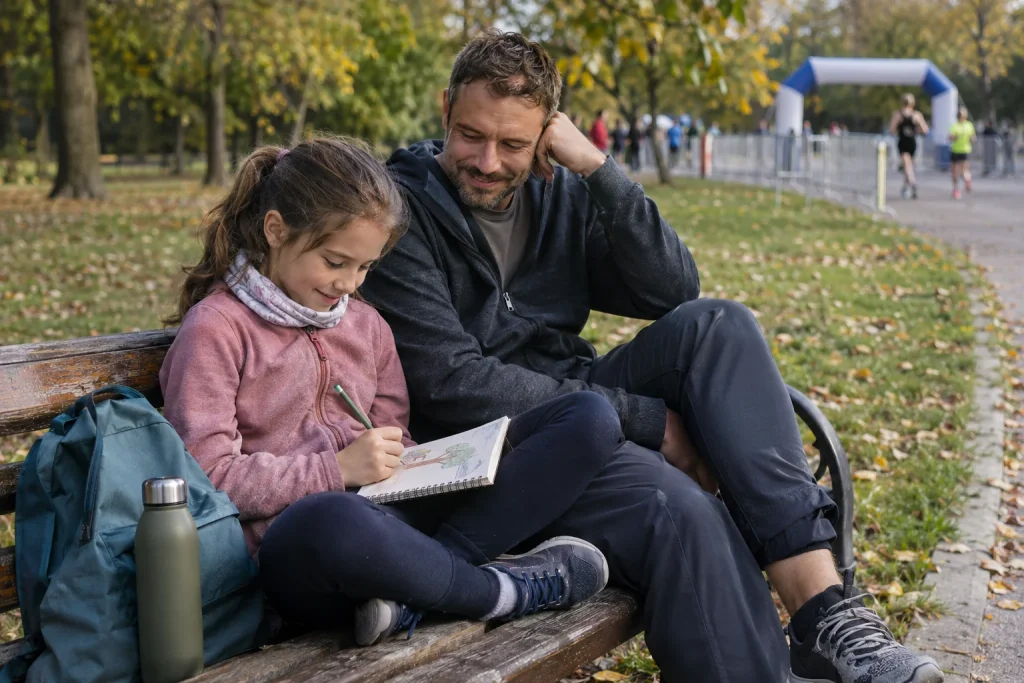
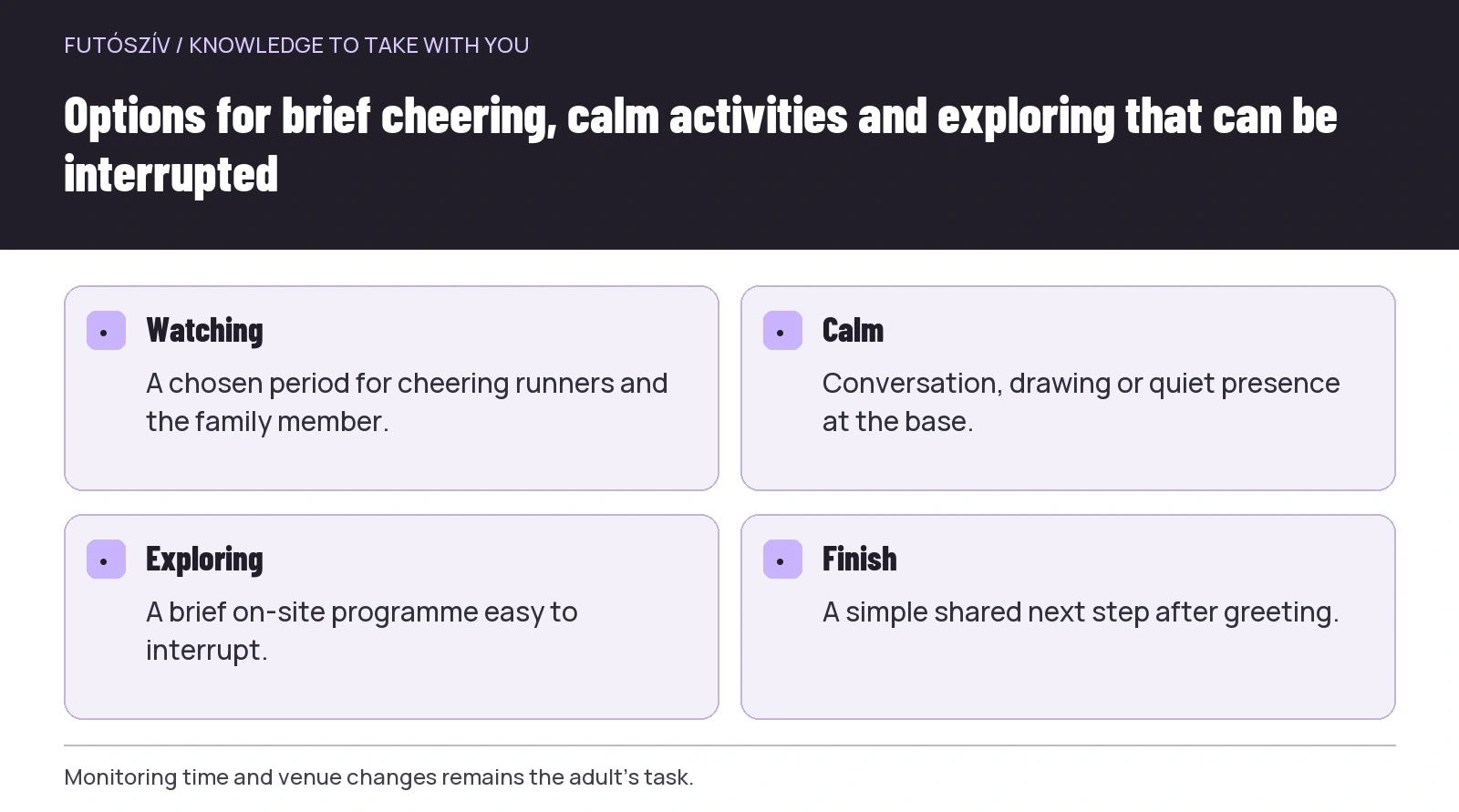
Include short periods of attentive watching, calm activity and something easily interrupted. Watching may mean observing runners arriving together for a while. Calm activity might be talking or drawing at the base. An interruptible option could be briefly exploring accessible event space without a long queue or distant detour making a return late.
Do not make the child a permanent finish monitor. If tasked with watching every moment for the family member, even a break may feel like missing out. An adult should monitor time and venue changes. A child can choose a shorter watching period without being a less supportive family member.
Keep drawing or other activities brought from home few and simple. There is no need to buy new equipment for one morning. Consider whether it fits the designated place, packs away easily and avoids scattering small objects near passers-by or the course. A family game should not turn event space into an obstacle course.
Brief original ideas adapted to the location
The examples below are not official event programmes and require no running task from children. Use them only where they do not disturb the event or others. They should be put aside at any time; the point is a chosen shared activity, not another compulsory achievement.
| Idea | How can it stay simple? | What should you consider? |
|---|---|---|
| Family welcome card | A drawing or sentence for the returning runner | No need to reach it onto the course |
| Favourite event detail | Everyone chooses a colour, sound or object they noticed | Do not make judging or photographing others a task |
| A story about the mascot | Take turns adding a short sentence | No loud performance is required |
| Looking at a map together | Find the base and exit | Orientation happens under adult supervision |
| Quiet observation | Those who wish watch finishers during a chosen period | It should not become continuous watch duty |
| A personal memory sheet | A word or drawing about part of the day | Sharing remains a separate decision |
If someone wants none of these, you need not immediately invent another programme for them. Quiet presence can have a place in shared waiting too. Do not treat children’s differing interests as something to solve through a uniform mood. Within one family, one person may watch runners while another prefers drawing.
Cheering should not occupy others’ space
Beside the course, consider arriving runners, other spectators and event staff. Bags, pushchairs, signs and coats should not extend onto the running route or block exits. Children should understand that seeing their family member is not a signal to cross barriers or step onto the course to approach.
The official London Marathon Events spectator advice asks people to keep the course clear, use designated crossings and respect other spectators’ space. These provide a useful starting point for general consideration too, but particular venue instructions always come from its organiser. Do not alter runners’ progress for a photograph.
With noisy devices, consider those immediately nearby. What is cheerful sound for your family may disturb another person. Encouragement does not require a whistle, bell or loudspeaker. If a child holds a sign, choose a place where it does not continuously block others’ views; its value is not how far above people it rises.
 Enlarge diagram
Text version of the diagram
- Watching
- A chosen period for cheering runners and the family member.
- Calm
- Conversation, drawing or quiet presence at the base.
- Exploring
- A brief on-site programme easy to interrupt.
- Finish
- A simple shared next step after greeting.
Missing a family member’s finish does not ruin the day
In a crowd, you may miss the runner, the photo may fail or the family may be heading elsewhere. Treat this as an acceptable possibility beforehand. The agreed meeting matters more than certainly catching one spectacular moment. A child should not feel responsible because you went to the toilet or took a break.
If the runner reaches the meeting point first, they should signal according to the preagreed contact and venue plan. Do not have every family member search in different directions. A new location becomes a shared plan when relevant adults actually agree, not merely when one sends a message. The adult staying with children should not arbitrarily redistribute supervision while searching.
Afterwards, do not make the story “we missed it because of you”. Discuss what happened on site and what to organise differently next time. Perhaps the viewing point was too narrow, the estimate sounded too precise or simply not every moment could be seen. These provide organising lessons, not a family fault-finding contest.
Consider those wanting to leave earlier too
Family spectators may have different time frames. An adult staying with a child need not commit to the whole day because the race is long. If agreeing on a shorter visit beforehand, the runner can expect the meeting accordingly. Support may take another form, such as setting off together before the start or welcoming them home.
Give family members leaving earlier a working route home and accessible belongings. Do not put every change of clothing or the only key in the later finisher’s stored bag. Event closures matter on the return journey too, so do not assume the usual stop or parking place is available. Follow current provider and organiser announcements.
Do not make the decision on site as a test of a child’s endurance. Explain beforehand how long you plan to stay and which situations would change it. The runner also benefits from expecting family participation everyone genuinely accepted rather than a tired welcoming committee obliged to smile.
Allow a simple transition after meeting
The finishing family member may want to talk immediately or first sort belongings, clothing and onward travel. After long waiting, the child may expect immediate attention. Both needs can be acknowledged: first greet one another, agree the next step and leave more time for the account later.
A shared photo should be optional and taken somewhere suitable. You need not stop directly at the finish exit or amid pedestrian traffic. If someone does not want to appear now, memories can be preserved differently. Do not delay people with fixed connections or other necessary tasks for a picture.
On the journey home, give spectators’ experiences room too. Ask what interested them, what was hard to find and what the base lacked. Alongside the runner’s account, this is the other side of the same family day. The next plan improves when spectators’ experiences are more than a footnote.
Three brief notes are enough for next time
Note which location actually worked, how much participation the family willingly accepted and which connection was awkward between viewing place, toilet, meeting point or exit. These are concrete observations. “We will be more patient next time” is too general for improving a venue or schedule.
If attending the next edition, use notes only as a starting point. Maps, admission conditions and services may change. Family interests and manageable time may differ too. A previous good experience does not make the same day compulsory every year.
Waiting at the finish becomes a manageable programme in its own right when cheering, breaks and differing family needs all have room. The finishing moment may matter, but need not carry the whole morning’s meaning alone. A known meeting and flexible, manageable presence often contribute more to a shared experience than chasing the perfect finish photo.
How Futószív articles are prepared: our editorial guidelines.