
If you feel unwell now, seek help first
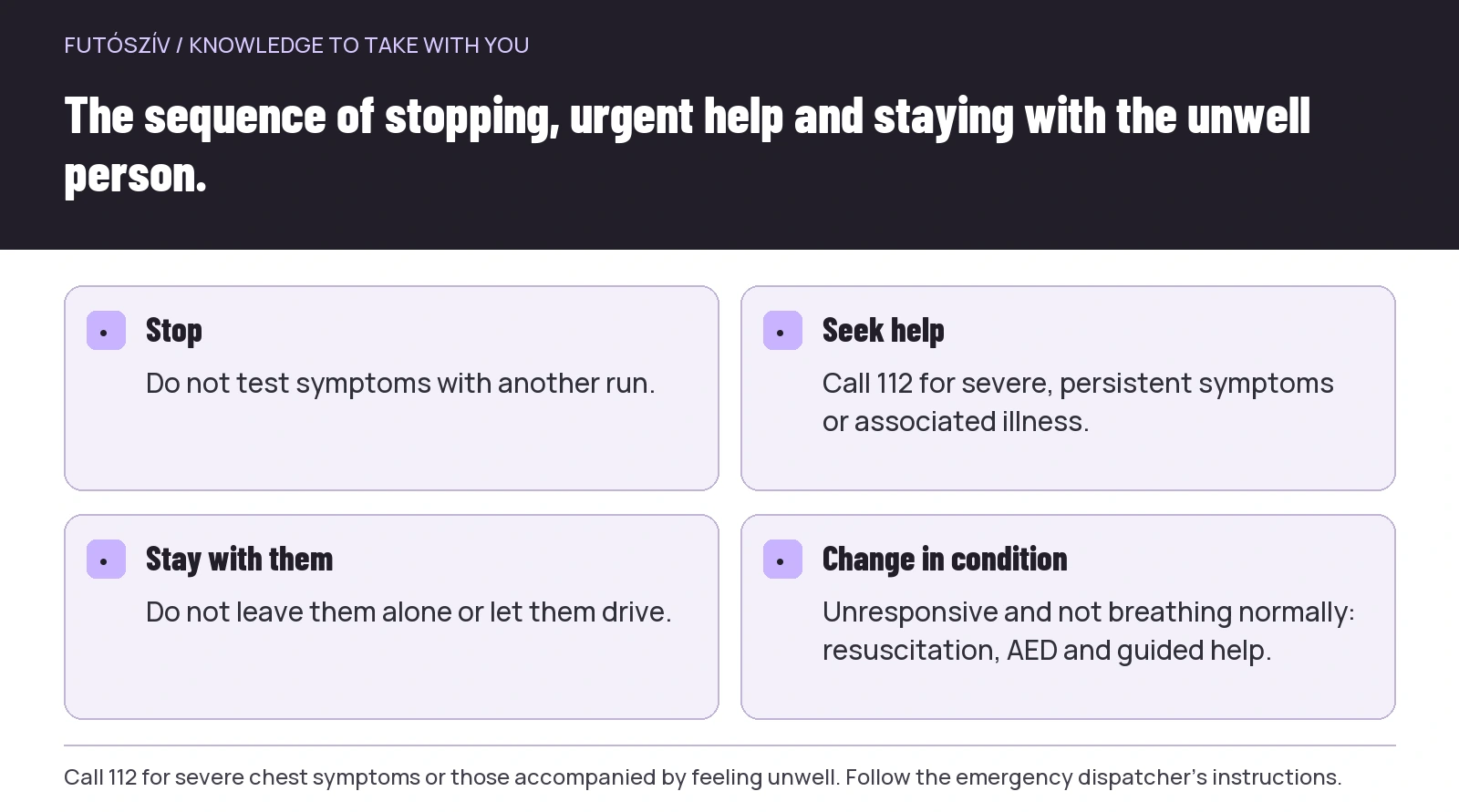
New chest pain or pressure while running: stop. With severe, persistent symptoms or symptoms accompanied by feeling unwell, breathing difficulty or fainting, call 112. Do not keep running or drive yourself to care. If your companion is unresponsive, call for help immediately; if they are not breathing normally, begin resuscitation under the emergency dispatcher’s guidance and use an AED if available.
The National Ambulance Service information considers severe pain, a feeling of suffocation, breathing difficulty and other alarming symptoms reasons to call an ambulance too. You need not determine on site exactly which disease causes the symptom. Calling emergency services connects the situation with appropriate help rather than trying to make a certain diagnosis on a running trail.
The detailed article below is for advance preparation and organising later questions. During current illness, do not read it through instead of acting. A running group should easily recall the first brief decision sequence: stop, seek urgent help where needed, stay with the companion and follow the dispatcher’s instructions.
Chest symptoms are not always one clearly defined stabbing pain
Symptoms may be pain, tightness, pressure or discomfort difficult to describe. The AHA/ACC chest-pain guideline also considers symptoms in shoulders, arms, neck, jaw, back or upper abdomen, and breathing difficulty and fatigue, as needing assessment in the appropriate context. The clinical recommendation emphasises rapid care for acute symptoms.
This does not mean every minor discomfort is certainly heart-related. Many causes exist, and examinations may be needed to distinguish them. As a runner, however, your task is not to rule out a serious possibility from one sign. “It must be a muscle”, “I am too young” or “I ran well yesterday” is not a test result.
Likewise, do not wait for symptoms to resemble a film scene exactly. Take a companion’s account seriously even if they do not say chest pain but describe strange pressure or feeling unusually unwell. Ask briefly, stop and seek help appropriate to severity.
Why is improvement with rest not reassuring on its own?
A symptom linked to exertion and easing after stopping should still be reported to the care provider. Improvement is not permission to accelerate again and test whether it returns. Repeated trials can delay assessment without providing a reliable home diagnosis. Running can end for that session even if many scheduled kilometres remain.
The NHS information on chest pain also recommends medical assessment for recurring symptoms or those passing quickly but causing concern. Sudden, persistent symptoms, radiating pain, sweating, feeling unwell or breathlessness require urgent help. In Hungary, use 112 in this situation, not the number on the UK page.
If symptoms have passed but urgency remains unclear, seek healthcare advice as soon as possible and explain the whole event. Do not wait until the next usual annual screening with a new exertional symptom. If it recurs, worsens or feeling unwell accompanies it, act according to the urgent situation again.
 Enlarge diagram
Text version of the diagram
- Stop
- Do not test symptoms with another run.
- Seek help
- Call 112 for severe, persistent symptoms or associated illness.
- Stay with them
- Do not leave them alone or let them drive.
- Change in condition
- Unresponsive and not breathing normally: resuscitation, AED and guided help.
What should you say on the phone?
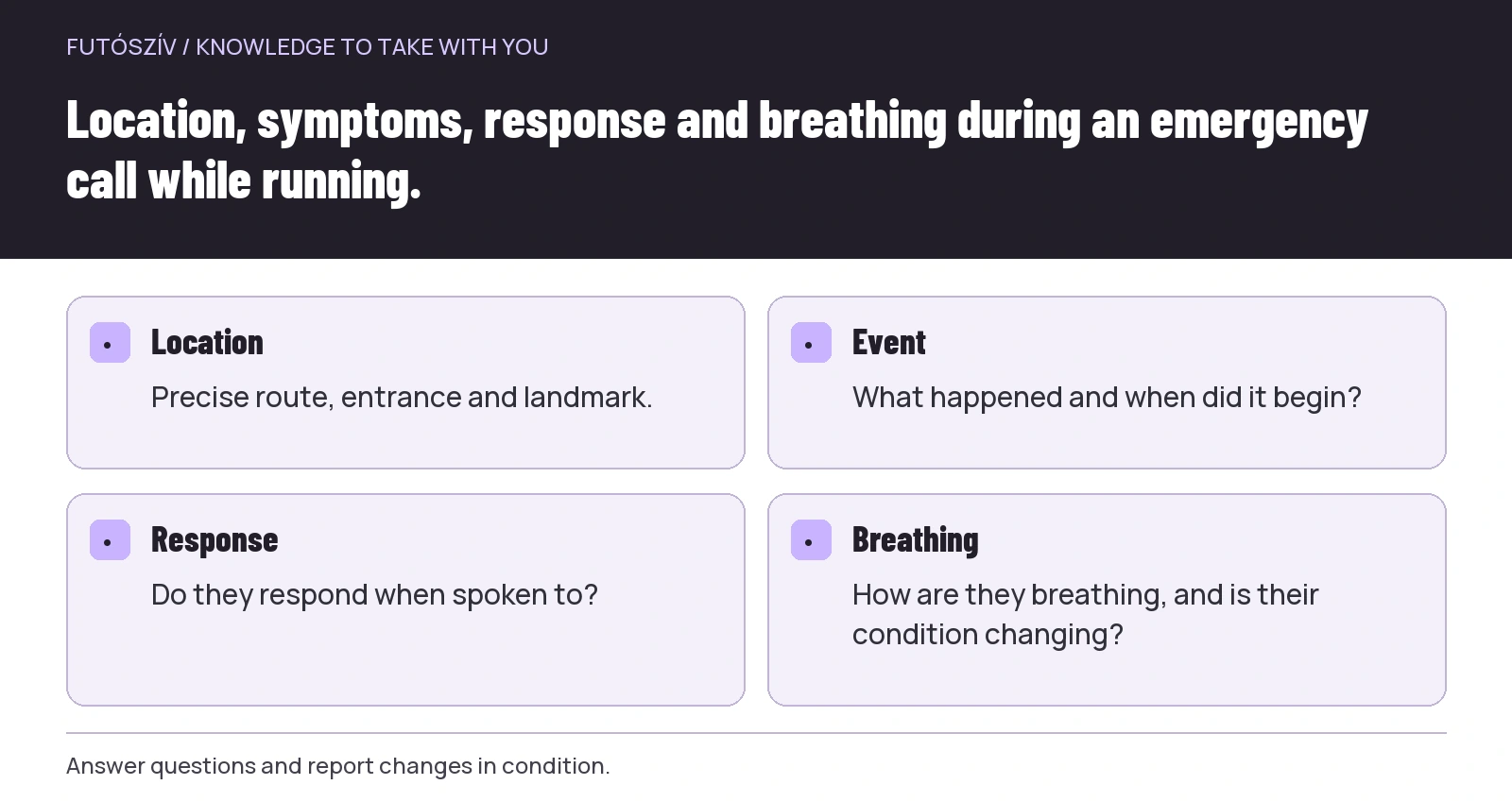
Explain that chest symptoms or illness occurred while running and give the precise location. A street, junction, park entrance, landmark and approach can all help. If you can share a geographical position, make it available, but do not assume an app automatically sent every detail. Answer the emergency dispatcher’s questions and hang up only as instructed.
Also explain whether the unwell person responds and how they breathe. Do not try to describe the condition with medical terms you are unsure of. “They respond when spoken to but have difficulty talking because of breathlessness” may help more than a diagnosis invented on site. Report changes during the conversation.
If several people are present, assign tasks clearly. Someone should stay with the unwell person and talk to the dispatcher; another can help the ambulance crew find the location if needed. Address a specific person rather than shouting “Someone call”. Organising aims to speed help, not have everyone offer different advice on site.
A running companion’s role is presence and cooperation
Do not leave an unwell person alone or send them home alone saying they only need rest. Help them avoid further exertion and follow the instructions received. If the location presents immediate danger, for example traffic, establish safety according to the situation. Do not add exertion through unnecessary walking.
Do not give medication prescribed to someone else or an unknown preparation. If the person has their own previously agreed emergency treatment plan, tell the dispatcher and follow appropriate professional instructions. This article gives no general medication dose for chest symptoms because the cause and personal contraindications are unknown.
Discretion belongs to helping too. Do not record the episode for social sharing or publicly request unnecessary health details. Give information useful to care to the appropriate person. Other group members can give helpers space and keep the access route clear.
If someone collapses: recognising normal breathing is crucial
According to the 2025 resuscitation guidance, help should be called early for an unresponsive person; abnormal breathing may indicate cardiac arrest. Occasional gasping breaths are not reassuring normal breathing. The Resuscitation Council UK guideline emphasises immediate resuscitation and using an AED as soon as possible in this situation.
In Hungary, call 112, put the phone on speaker if possible and follow guidance. If the person is unresponsive and not breathing normally, begin chest compressions. If you cannot or are unwilling to give rescue breaths, continuous chest compressions are still important help. Do not spend a long time searching smartwatch data or attempting a lay pulse check before acting.
If an AED arrives, switch it on and follow its voice instructions. You do not need to prove course completion before using it. Have someone else fetch it if possible while resuscitation continues. Nobody should touch the person during analysis or any shock; afterwards continue according to the device and dispatcher.
Practice provides what an article cannot
A description helps recall principles, but practical chest-compression technique is worth learning in training. The OMSZ page on what to do before the ambulance arrives also presents resuscitation basics. As a running group, arrange regular practical first-aid and resuscitation training including emergency calls and AED use.
Preparation does not require every runner to become a healthcare professional. It is enough to know which situations call for rapid help and how to cooperate with the dispatcher. Practice may reveal the difficulty of giving a precise location on an unnamed park path or dividing tasks without rushing.
Refresh knowledge periodically and practise with a local instructor according to current recommendations. First-aid knowledge does not authorise diagnosis but can support action in the first minutes. Uncertainty need not disappear completely before calling and beginning guided help.
 Enlarge diagram
Text version of the diagram
- Location
- Precise route, entrance and landmark.
- Event
- What happened and when did it begin?
- Response
- Do they respond when spoken to?
- Breathing
- How are they breathing, and is their condition changing?
A smartwatch does not rule out an urgent problem
A consumer device showing a normal heart rate or rhythm does not make new chest symptoms harmless. The clinical chest-pain guideline notes that even an initially normal clinical ECG does not alone exclude acute coronary syndrome. A limited wrist-device signal therefore particularly cannot provide decisive reassurance.
If you have saved information, show it to the care provider later, but saving data must not delay seeking help. A brief account of symptom onset and changes is often more important initial information. Do not set off again merely to obtain a clearer trace or better measurement.
An earlier sports-medical or cardiology examination is not a lifelong guarantee covering every new symptom either. Report when it happened and the findings, but current symptoms need separate assessment. Regular running may be a beneficial health habit without entitling you to dismiss warning signs automatically.
What should you organise afterwards for care?
Once urgent actions have taken place, prepare a brief timeline. When did symptoms begin, with which movement, how did they feel, where did they spread, what accompanied them and how long did they last? Describe what happened after stopping or receiving care too. The aim is not to choose your own diagnosis from a symptom list but to convey the story accurately.
Bring a medicine list and important information about known conditions if accessible. Mention recent infection and earlier similar episodes too. If you do not remember something, say so; do not turn uncertain information into a certain detail. A companion’s account may be particularly useful after illness or memory loss.
After care, ask about the next step: is review needed, which symptoms require help again and what personal activity framework applies until clarification? Read beyond the first line of discharge papers. If instructions are unclear, clarify before training again.
Do not let the entry calendar decide the return
Investigation and returning depend on what happened and what was found. There is no few-days-off-running recipe valid for every chest symptom. Do not override an examination or restriction prescribed by your clinician based on one morning of feeling well. If the cause is unclear, another test workout does not replace assessment.
Share the healthcare framework received with your coach, not merely “I am better now”. The weekly plan may include withdrawing from a start, choosing another goal or support outside sport. After a frightening event, uncertainty about returning is understandable and can also be discussed with professional help.
A community supports well when it does not treat decisions after illness as questions of heroism. A good running partner can stop, seek help and accept a changed plan. These skills belong to responsible running culture just as knowing the route and respecting the start time do.
Sources
- OMSZ: Who can call an ambulance and when?
- NHS: Chest pain
- AHA/ACC: Guideline for the evaluation and diagnosis of chest pain, 2021
- Resuscitation Council UK: Adult basic life support guidelines, 2025
- OMSZ: What to do until the ambulance arrives?
How Futószív articles are prepared: our editorial guidelines.