You do not need a finished diet and precise self-diagnosis before seeing a sports dietitian. One purpose of the consultation is precisely to clarify personal needs and workable solutions together. It helps, however, to explain where you get stuck, what you want to achieve and what makes everyday implementation difficult. A useful question goes beyond what to eat: it connects actual routines, running and personal circumstances. This article helps with preparation without giving a nutritional diagnosis, laboratory-test prescription or personalised diet.
Make the goal understandable, not answered in advance
Write one sentence explaining why you seek help. For example, you want to arrange eating on late-training days or adapt your diet to changed running demands. You need not declare beforehand how much of which nutrient is missing if this has not been assessed. The goal and presumed solution are different. Wanting to eat appropriately on days when going straight from work to training is an open, usable starting point; being certain you need a particular product may already begin with an unverified conclusion. Give the professional the situation and question.
If you have several topics, choose the first few most important. A debate about twenty online claims should not fill consultation time while your own scheduling obstacle recedes. Interesting background questions can also be discussed, but personal priorities should be clear. A useful first goal connects to an observable situation in which a next step can be chosen together. It does not require one ideal body shape or copying another runner’s diet. Your own circumstances are an appropriate subject for consultation.
When seeking a professional, ask about relevant experience
In Hungary, a starting point may be the Hungarian Dietetic Association’s National Directory of Dietitians. Check the particular professional’s qualification, stated specialism, sports nutrition experience and whether they offer a consultation suited to your question. Directory inclusion does not automatically mean personal suitability for every problem. Arrange current contacts, services and appointments directly. If your health requires cooperation with another provider, mention that beforehand too.
A useful initial question might be whether they work with recreational runners fitting meals around work or have experience combining your special diet with sport. You need not publish personal health details in a public comment. Use the appropriate, agreed contact channel. The BDA sports nutrition information also highlights individual help from an appropriate professional. UK information does not establish Hungarian care or qualification rules; it explains the background to the need for personal advice.
 Enlarge diagram
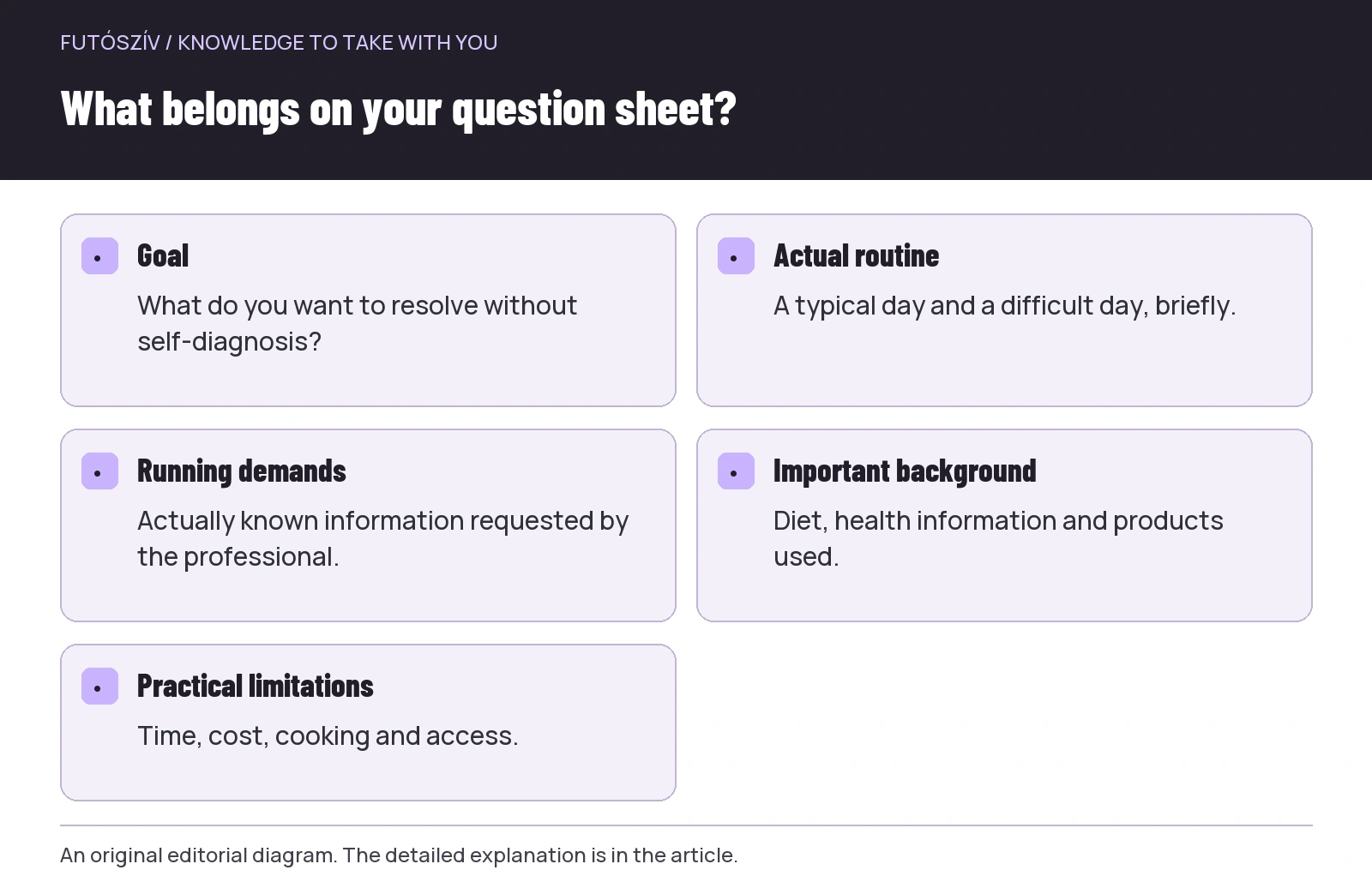
Text version of the diagram
- Goal
- What do you want to resolve without self-diagnosis?
- Actual routine
- A typical day and a difficult day, briefly.
- Running demands
- Actually known information requested by the professional.
- Important background
- Diet, health information and products used.
- Practical limitations
- Time, cost, cooking and access.
Show one usual and one difficult day from your routine
You need not recount the whole story of every day. Describe one genuinely typical day and one when eating regularly becomes difficult. Include starting work, travel, eating opportunities, training and arriving home. Precise on-site conditions matter: are a fridge, reheating, cooking time and a calm opportunity to eat available? Without these, a good paper plan can be hard to implement. Give the professional the real environment, not only a desired menu. The solution needs to fit where you actually live and run.
A specific sentence might be: I go directly from work to training, and my last proper opportunity to eat is much earlier; what personal solution can we develop? Another: I work changing shifts and cannot always follow a plan at identical times; how can it be organised flexibly? These are sample questions, not specific dietary answers. Assessing personal needs may require further information. The aim is for the professional to understand the situation and its practical limitation immediately rather than hear only the general fact that you do sport.
Describe running demands in detail suited to the goal
Ask which training information the consultation needs. Weekly rhythm, main session types, duration, race plans and recent changes may help according to the professional’s request. You do not automatically need to hand over access to your entire sports-watch account. Appropriate information and your description together can reveal the situation. Separate completed from planned training, and do not call every watch estimate a certain measurement. Nutritional needs are not determined by one displayed activity number.
If you also do other sports, physical work or substantial daily activity, mention this too. The whole week’s picture offers more than running kilometres alone. Sports nutrition goals may differ: appropriate everyday intake, event preparation, comfort or another personal question. Different details may be relevant to these. Do not try to calculate every measure beforehand. Good preparation means an orderly account of known information and indicated uncertainty, not replacing the professional’s work at home.
Health history and products: prepare a precise list
The Dietitians Australia consultation information includes personal history, goals, eating habits and lifestyle as parts of assessment. Before your own consultation, ask which existing documents they want. Share relevant results or known conditions through the appropriate channel. Do not automatically order new tests because of a general article. Necessary testing and medical assessment need addressing with the responsible healthcare professional.
You can make an accurate list of medicines and supplements, with product names and actual use as requested. This is not a call to begin a new preparation or change an existing one. The list should reflect real reported use, not use recommended online. Mark occasional consumption separately too. A label or product photo may help identification. For a sports product of unknown composition, do not enter assumed nutrient data; indicate what information is available and what is missing.
| General question | More precise version | What do you add? |
|---|---|---|
| What should I eat as a runner? | How can we fit eating to my specific working day and training rhythm? | Routine and personal goal. |
| Do I need a supplement? | Is any product justified in my situation, and which information should guide our decision? | Actual diet and product list. |
| Why is running sometimes uncomfortable? | This is what I experience in these situations; what further professional assessment is needed? | The issue and circumstances, without self-diagnosis. |
| I would like a diet plan. | Which plan fits my time, budget and favourite foods? | Conditions for implementation. |
| How soon will there be results? | What should we observe, when will we review and how will we adjust? | Follow-up clarified together. |
If a diary is requested, agree its purpose
Ask which period and details to record. A professional may request food notes, but you need not randomly calculate every calorie. Actual food, drink, circumstances and the requested quantity description can support assessment. Mark missing or estimated information rather than altering days to show a better picture. If recording is difficult or creates tension, say so and ask for another suitable format. Consultation seeks understanding of personal circumstances, not an advance demonstration of ideal eating.
Even without notes, prepare by describing typical routines and important eating patterns, then ask whether more detailed information is needed. Do not indefinitely postpone help because the perfect diary is missing. Purposeful information gathering can be developed with the professional. Similarly, a symptom log does not provide an independent diagnosis. Keep observation and suspected cause separate, and obtain appropriate healthcare assessment for persistent or concerning symptoms. A question can be good even without a ready explanation.
 Enlarge diagram
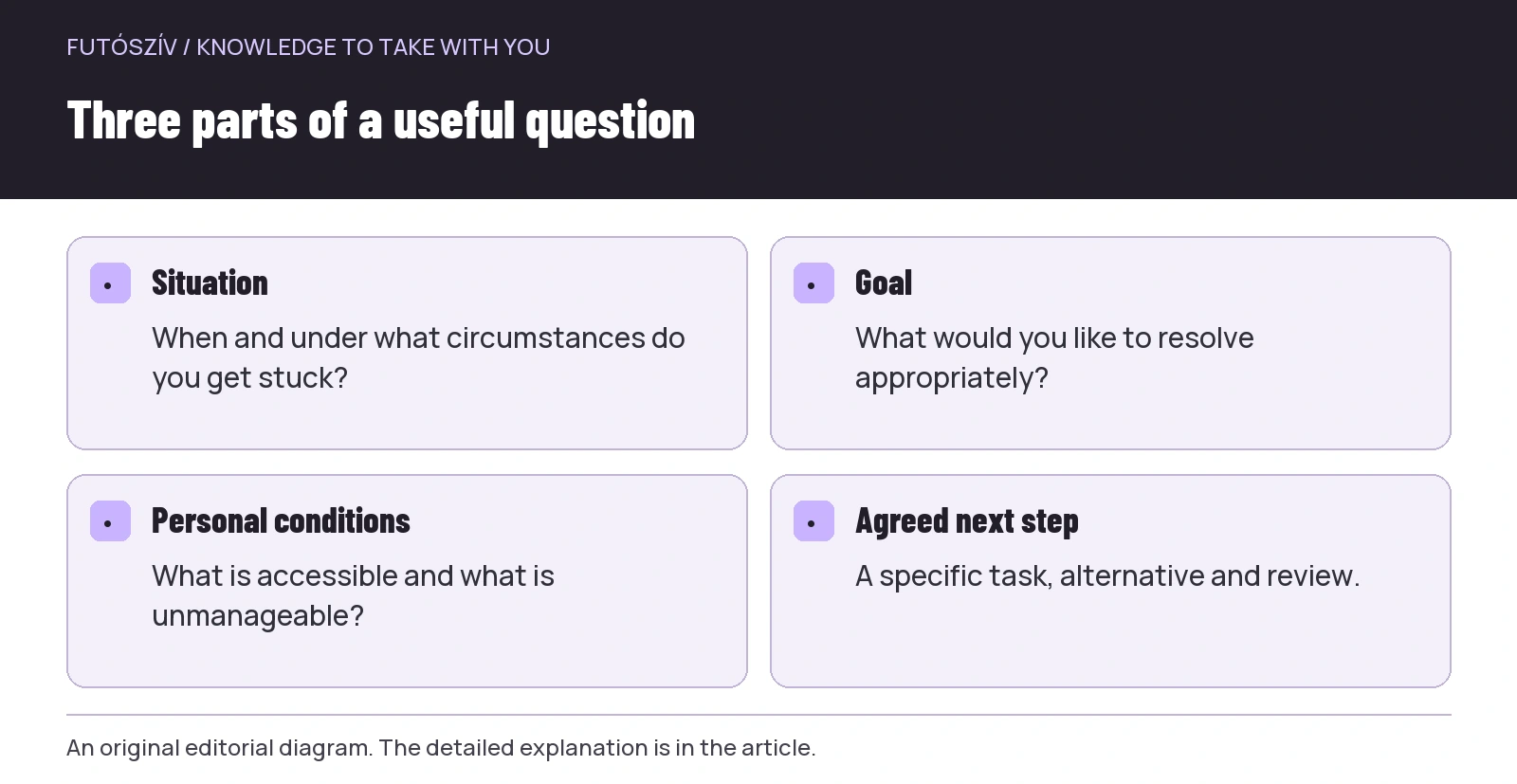
Text version of the diagram
- Situation
- When and under what circumstances do you get stuck?
- Goal
- What would you like to resolve appropriately?
- Personal conditions
- What is accessible and what is unmanageable?
- Agreed next step
- A specific task, alternative and review.
Mention cost, cooking time and tastes too
A workable plan needs to consider accessible food, cooking time and what you enjoy eating. These are not secondary details. A plan relying on ingredients or kitchen tasks that do not fit your life can be hard to follow. Useful questions include how the same need can be met with accessible foods you like, or which alternative to choose when cooking is unavailable. The specific answer may depend on personal assessment, not a general product list.
Family meals, cultural habits, ethical decisions and special diets may be relevant too. You need not replace the whole kitchen before a consultation can be productive. Existing proven solutions can provide a foundation. Explain where you want change and what you want to retain. The professional then has a clearer framework for cooperation. If a recommendation cannot be carried out, the next useful question is not how to force it on yourself but which other option appropriately serves the goal.
Make the next step clear by the end of the meeting
Ask what first change should actually be implemented and what awaits further assessment. Every nutrition question need not be settled at once. Separate personal goals, specific tasks and missing information in the plan. If you do not understand something, request an everyday example within your own routine. Clarify alternatives if food is unavailable or training time changes too. A good personal plan can provide an understandable framework not only for an ideal day but for real everyday deviations.
You can ask about follow-up this way: what should I observe, when will we review and when should I report earlier? An outcome is not necessarily one number, and professional assessment may depend on the personal goal. Clarify fees, duration, follow-up and how to send information with the particular provider. Time or funding examples from overseas information are not general Hungarian conditions. Knowing the practical framework helps you understand what to expect and which information to prepare next time.
A brief question sheet to bring along
One page can hold your goal, outlines of a typical and difficult day, important dietary or health background and three priority questions. Add existing information and uncertainty. Include which solutions do not fit your time or budget. The sheet need not become an official form. Its role is to keep the essentials visible during conversation. Afterwards, record the agreed next step and review time there too.
A useful sports nutrition question shows reality: I run within this routine, have these eating opportunities and background, and want to resolve this appropriately. The professional can give personal assessment and direction for that. You need not bring a perfect diet, certain self-diagnosis or copy of another runner’s numbers. Organised information and an open, specific question provide a much better foundation for a plan you can actually implement in your own life.
Sources and further reading
- MDOSZ: National Directory of Dietitians
- BDA: Sport and exercise nutrition
- Dietitians Australia: What to expect
How Futószív articles are prepared: our editorial guidelines.