Good air is one characteristic of a running route
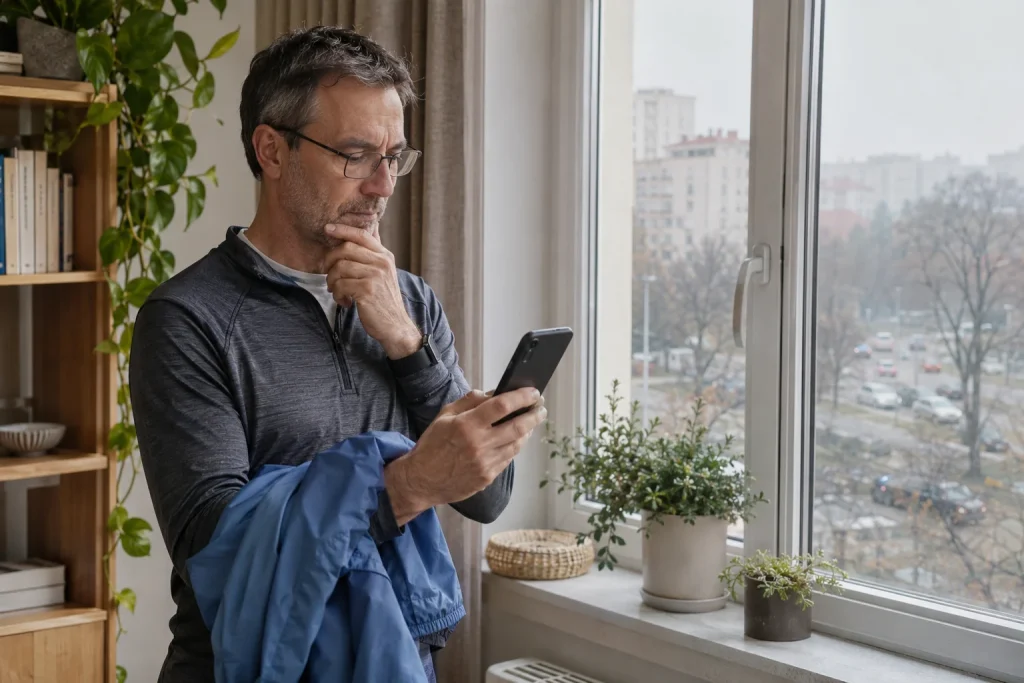
We often choose running routes by distance, elevation gain and surface. Air quality can be just as practical a consideration. Heavy traffic may pass beside a favourite loop, heating smoke may settle nearby in winter and a different pollutant may matter on a warm day. Pleasant temperatures or beautiful views do not replace air-quality information.
The question is rarely only whether to go out or stay indoors. You can change location, timing, duration and intensity, or choose another session. WHO generally continues to support regular physical activity while recommending changes to location and timing to reduce exposure. The summary on personal protective actions also considers health and local conditions important.
This article does not calculate a personal inhaled dose or promise a single running threshold valid for everyone. It provides an organising framework based on official local information, an individual health plan and that day’s options. This is particularly important with known heart or respiratory disease or previous symptoms linked to environmental conditions.
First examine what the information means
Hungary’s Air Hygiene Index attaches a health-risk interpretation to pollution data. Its four categories are acceptable, objectionable, unhealthy and dangerous. According to the NNGYK description, it considers particulate pollution, nitrogen dioxide and ozone data too. The methodology description also shows that it uses different averaging periods and aggregation.
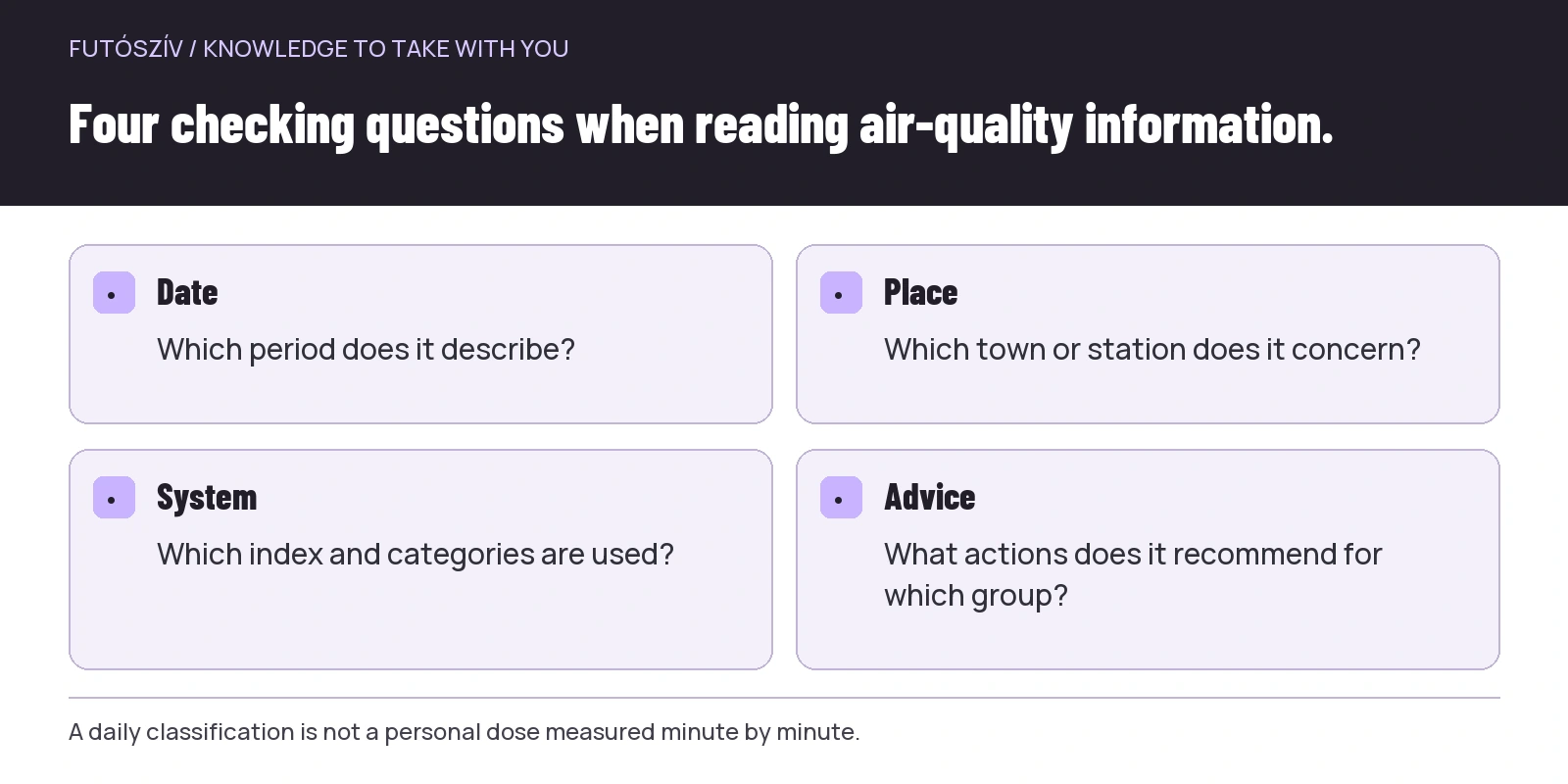
Such a daily classification is therefore not a personal measurement beside your ankle at that minute. Check the date, town and period the result describes. An older daily summary and a current station reading may answer different questions. This does not make the report worthless: know what you use it for and what you do not.
Open the current Air Hygiene Index on the original website rather than using a screenshot saved from a social post. If an app shows another country’s index, read the guidance attached to its categories. Two identical colours do not necessarily mean the same calculation system. The local advice text is often more useful than a number taken out of context.
Why does currently being on a run matter?
You move more air during exertion, so activity duration and intensity influence exposure alongside environmental concentration. For this reason, the EPA patient-counselling material discusses reducing the length or intensity of outdoor activity in unfavourable conditions. The guide to particle pollution also highlights avoiding the immediate surroundings of busy roads.
This does not mean a short walk and a long interval workout call for identical decisions. If the plan needs changing, first name its purpose precisely: a social meeting, light movement, a long endurance session or hard exertion. Not every goal has to be achieved in the same place on the same day.
Give the change a clear form. “I will be careful today” is hard to follow if you still begin the same long, intense programme. A different location or moving the hard workout, for example, is more usable according to official advice and your own health. In a good plan, modification is an accepted option rather than an accident.
 Enlarge diagram
Text version of the diagram
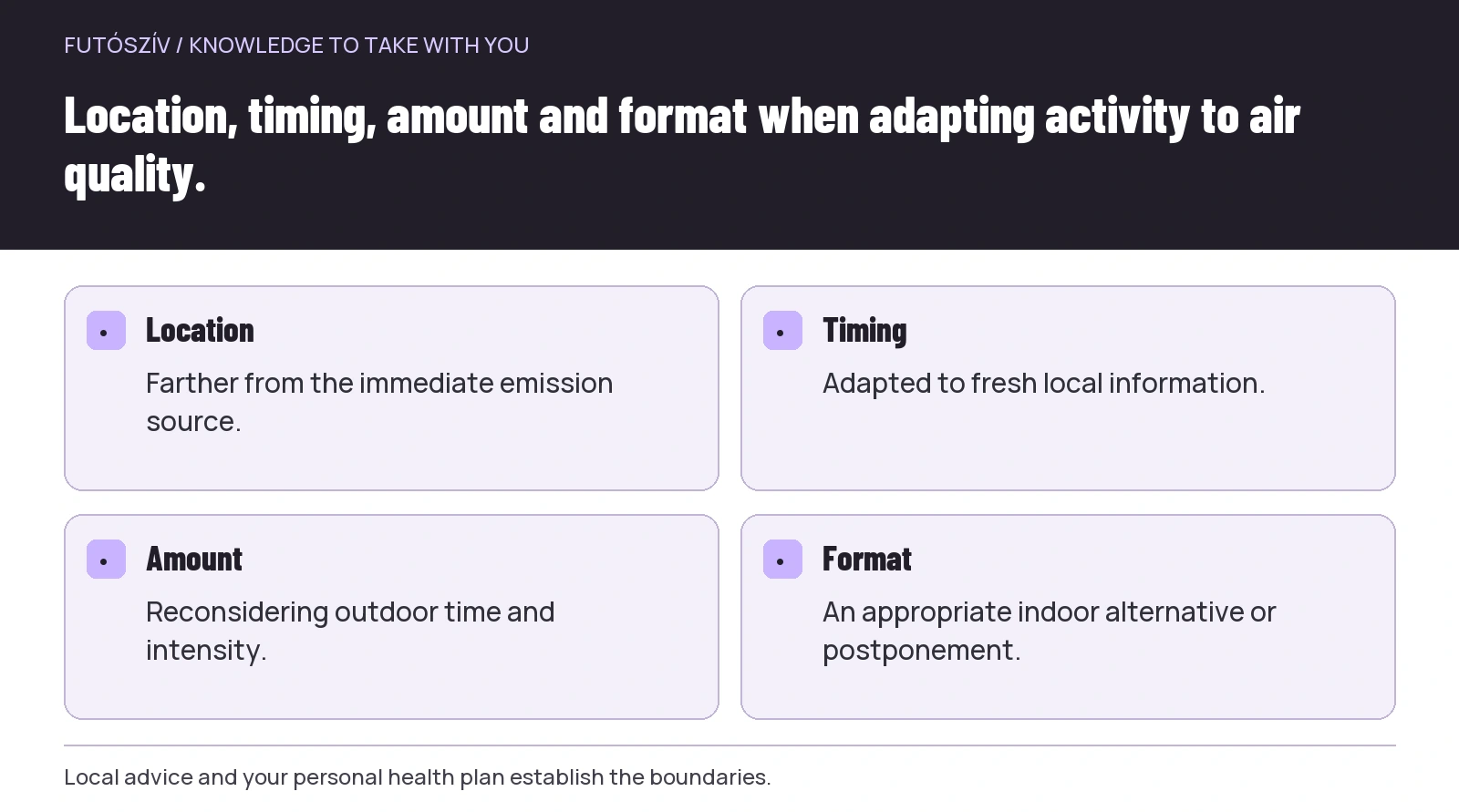
- Location
- Farther from the immediate emission source.
- Timing
- Adapted to fresh local information.
- Amount
- Reconsidering outdoor time and intensity.
- Format
- An appropriate indoor alternative or postponement.
Four levers for adapting a session
Place: if a genuinely accessible alternative exists, seek a route farther from immediate emission sources. You do not need to invent a precise distance from traffic applicable to every city. Even a brief detour through a side street may provide a different environment, but local wind and buildings mean no single street name can promise complete protection.
Time: check fresh local information and forecasts. Morning is not the most favourable time for every pollutant and settlement, just as a cooler evening is no automatic guarantee. Heat and ozone also need considering together. If there is no suitable window for moving the session, another day is a real choice too.
Amount and format: shortening outdoor time or choosing lighter activity may be options in some situations; in others, advice may be to avoid outdoor sport. Read which applies to you rather than selecting the sentence that sounds more favourable. The fourth option is indoors or postponement; arrange access to that beforehand too.
Indoors can be an alternative, but has conditions too
A gym or room at home is not better simply because it has a roof. Indoor sources, ventilation and the way outdoor air enters matter. WHO’s European report assesses indoor air cleaning among personal actions, but makes methods’ effects and feasibility conditional on circumstances. The 2024 report is not about one device as a universal solution.
If you regularly need an indoor alternative, ask the venue about air handling and conditions of use. Lower exposure is not self-evident on a treadmill beside a window. For activity at home, do not begin the thinking with a treadmill: other movement suited to your opportunities may be considered too. The goal is manageable activity in the situation, not pressure for another expensive purchase.
Where possible, try the indoor plan beforehand. Is there enough space, is the equipment usable, is accessible entry appropriate and does travel fit your time? A gym existing in theory but unreachable for you is not a real backup. Adapting to air quality must account for financial and transport limitations too.
A mask should not become clearance to start
Advice about protection against particles must not automatically be extended to every air pollutant. Face coverings and respirators differ, and fit and conditions of use matter too. A running scarf or loosely worn mask does not justify declaring the same hard session safe on an unfavourable day.
The WHO report examines respirators and face coverings separately too. If relying on such equipment for health reasons, seek personal advice and check its intended purpose. Do not choose from an online photograph or treat uncomfortable breathing as a compulsory training stimulus. Equipment does not replace avoiding the source and reconsidering exertion.
It also matters that personal protective actions do not solve the community problem. WHO prioritises reducing emissions over individual avoidance measures. As a runner, you can rightly expect usable information and a cleaner environment; the situation need not be understood as though managing every risk depended exclusively on your equipment choices.
With a known condition, establish your personal framework beforehand
People with heart and respiratory conditions, older people and some other groups may be more sensitive to particle pollution. The EPA guide discusses these separately. Ask your clinician in relation to your diagnosis when to change outdoor activity and what to do with particular symptoms. Fitness does not automatically erase considerations linked to an underlying condition.
With asthma, make air-quality decisions together with the action plan. Do not independently change medication doses to fit a prescribed workout into worse conditions. If symptoms recur despite usual treatment, report this in care. A log and specific route description can support the conversation.
Pregnancy, children’s sport and multiple conditions in older age likewise cannot be addressed through general advice written for an adult recreational runner. In family or group programmes, do not adapt everyone to the person with the greatest capacity. The shared route and cancellation option must be manageable for the others too.
 Enlarge diagram
Text version of the diagram
- Date
- Which period does it describe?
- Place
- Which town or station does it concern?
- System
- Which index and categories are used?
- Advice
- What actions does it recommend for which group?
Take symptoms seriously even when the display is reassuring
With new coughing, wheezing or chest tightness, reduce or stop exertion according to your condition and personal plan. Do not try another fast loop to prove the air was merely bad. An environmental explanation does not replace necessary medical assessment, especially for recurring or worsening symptoms.
Severe breathing difficulty, illness involving chest pain, fainting or another sudden severe symptom may require urgent help; in Hungary, call 112. A favourable air-quality app reading does not rule out an urgent illness. A running companion should stay with the unwell person, give the precise location and follow emergency-service instructions.
Afterwards, record where, when and under what exertion symptoms occurred, but a log is not made instead of seeking immediate help. A better reading the next day does not reliably explain yesterday’s illness either. Where necessary, discuss conditions for returning with a doctor rather than fitting them only to the next weather window.
How should a running group organise?
The shared run description should include an alternative location or clear channel for changes. It should not merely say everyone starts at their own risk while group pressure pushes towards the full programme. The organiser’s task is to follow fresh local recommendations, inform those affected in time and accept someone staying away for personal reasons.
A children’s group, beginners and participants with different health circumstances may not all need the same decision. Do not request a public diagnosis list, but allow people to indicate necessary adjustments. Healthcare decisions are not determined by event likes or how difficult finding another time may be.
If a hard session is missed, do not automatically move it immediately before the next difficult day. A workout changed because of air quality still belongs to the whole week’s load. Discuss whether its purpose remains in another form or it is simply omitted this time. Making up one omission must not outweigh a sensibly arranged week.
A brief checklist before departure
First open fresh local information: where, when and through which system was the air assessed? Then examine the advice applying to you, the weather and your own health. Finally choose the location and format. This order helps avoid searching for reassuring data after already deciding on the run.
Write down the backup decision too: what will change if conditions worsen before departure, and what happens if symptoms appear along the way? A route saved on the phone, a way home and an agreed signal with companions are simple but useful details. You do not need a complicated personal risk formula to have a workable alternative.
One improvement is enough for next week: for example, exploring a loop farther from traffic or arranging an accessible indoor option. The aim is to preserve regular activity under conditions in which air quality is a real decision factor too. A training plan is a living plan when it can respond to such circumstances.
Sources
- NNGYK: Explanation of the Air Hygiene Index
- NNGYK: Air Hygiene Index
- WHO: Air pollution, personal interventions and risk communication
- WHO Europe: Personal-level actions to reduce air pollution exposure
- US EPA: Frequent questions about particle pollution
How Futószív articles are prepared: our editorial guidelines.