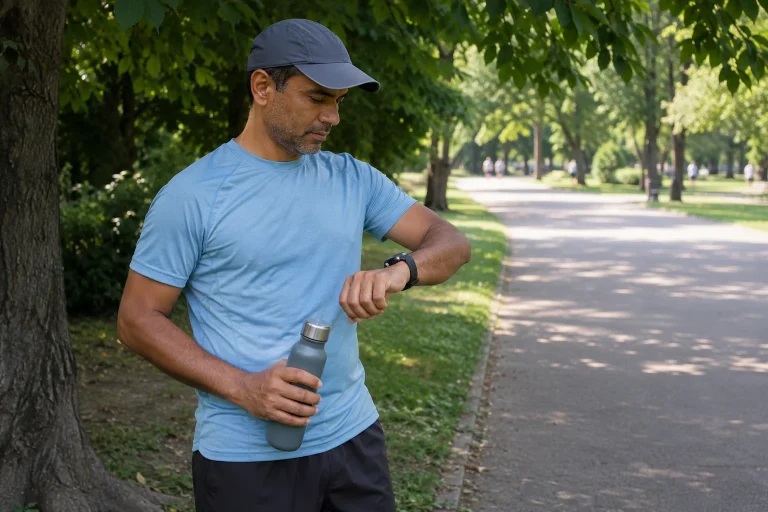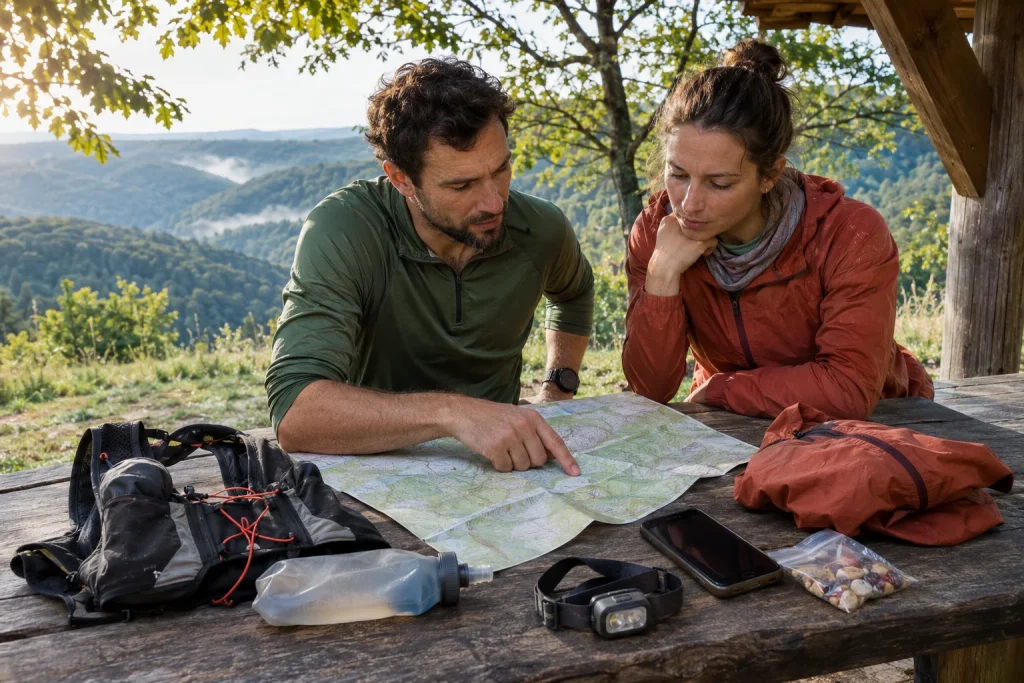
It is easy to imagine ultrarunning as kilometres beyond a marathon. In practice, the task is more complex: movement, environment, supplies and your own decisions need managing for longer. A flat looped event and a mountain race continuing into night can require very different skills at the same distance.
Before your first commitment, therefore, build a skills map as well as training mileage. What do you already know, what is new, and how will you learn it through appropriately sized, safe trials? A general guide is not permission to start, but a framework for a realistic next step from your own situation.
Choose the event’s character first
Alongside distance, record expected duration, elevation, terrain, spacing of aid stations and whether movement in darkness is needed. Without these, “a first ultra” is too broad a goal. An entry category does not describe how independently you will need to manage between points.
Read the organiser’s official route, rules and required experience or equipment. Check current details directly on the event’s platform. An old account or information for another distance with the same name may not apply.
More manageable logistics and familiar surroundings may help with a first goal, but do not automatically make the task simple. When choosing, identify which unknown factors you can resolve beforehand and where uncertainty remains too large.
Running history needs environmental experience alongside it
Previous long races can provide useful information about sustained movement. On mountain terrain, however, navigation, walking climbs and managing descents are separate tasks. A road-running result does not automatically prepare you for every technical route.
Begin the programme with weeks actually completed and identify new elements separately. If the run becomes longer, terrain harder and carrying equipment unfamiliar simultaneously, interpreting the experience becomes difficult. You can practise skills in smaller, manageable situations too.
Every trial need not produce the greatest possible fatigue. A short route-management or equipment-use session can be part of preparation. An independent skill becomes more reliable because you understand and can repeat it, not because you always perform it exhausted.
Sustained movement consists of several tasks
Running, walking, stopping, handling clothing and taking on supplies can together make up race time. Walking is not necessarily a mistake: on steep or difficult terrain it can be deliberate. Gain prior experience if you expect to need it.
Running-session length and structure depend on your background. No single long-run distance suits every ultra and person. Evaluate a major outing’s after-effects and the rest of the week too; the whole programme is not one weekend performance screenshot.
When practising sustained movement, record time as well as distance. With substantial climbing or technical terrain, pace describes less of the task. Time outside matters particularly for supplies and equipment.
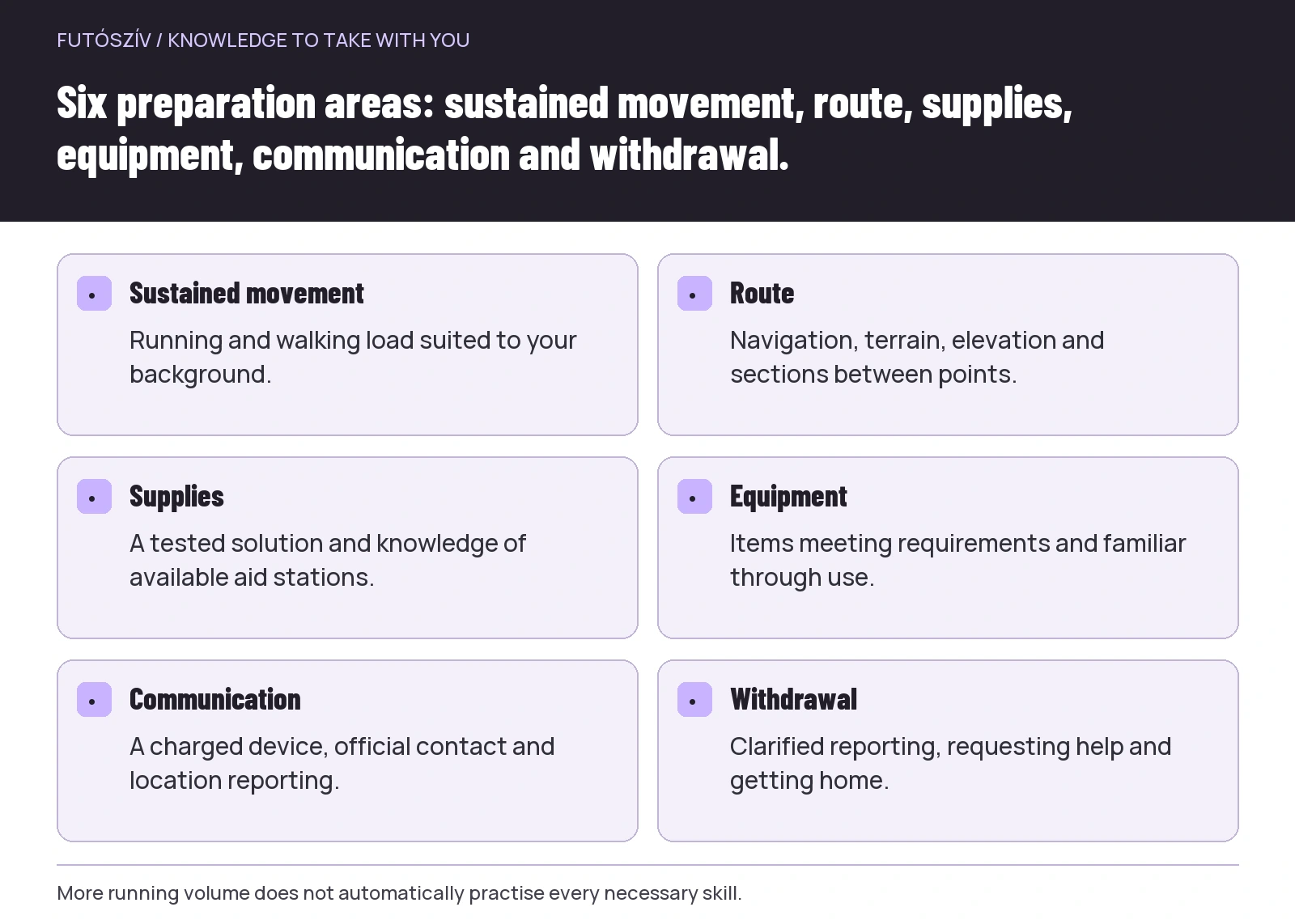 Enlarge diagram
Text version of the illustration
- Sustained movement
- Running and walking load suited to your background.
- Route
- Navigation, terrain, elevation and sections between points.
- Supplies
- A tested solution and knowledge of available aid stations.
- Equipment
- Items meeting requirements and familiar through use.
- Communication
- A charged device, official contact and location reporting.
- Withdrawal
- Clarified reporting, requesting help and getting home.
Use sections between points as planning units
A long route is more manageable when you know the section to the next official point: distance, elevation, expected difficulty and possible conditions. Do not estimate what comes next only from the whole race’s average. Two equally long sections can take substantially different times.
At each point, consider supplies and equipment needed for the next part too. Check available provision against organiser information. Do not assume your favourite food or drink will be there because it was familiar at another race.
Allow time for stops and uncertainty. A time-limit plan is more than the sum of moving time. If you stay longer at every point, include that in evaluation rather than letting it become a surprise on the final section.
Fuelling can be learnt, but has no universal recipe
Eating and drinking during sustained movement may require practice. A study with twenty-five endurance runners examined structured, repeated fuelling practice during exercise. Such a protocol is not a general instruction for every ultrarunner and does not justify independently forcing large quantities.
Your task is to gain experience with familiar solutions and handling them during appropriate training beforehand. Record environment, duration and digestive experience. Change few variables at once so feedback remains interpretable.
A sports dietitian and, where necessary, doctor can help with recurring symptoms, health conditions or uncertain fuelling plans. Do not treat another runner’s detailed refreshment table as an individual prescription. More food, fluid or supplements alone cannot guarantee a better race.
An equipment list and using equipment are different things
Buying compulsory equipment is insufficient. Know how to retrieve, put on and operate it in the situation it serves. Charging a headlamp, reaching clothing and using a phone are practical skills learnable through short trials too.
The official UTMB Mont-Blanc equipment information , for example, requires carrying compulsory equipment throughout and emphasises adapting the minimum list to individual circumstances. This is a specific event’s rule, not a list valid unchanged for every ultra. Always begin with your own race’s current requirements.
Trial the full setup too: what fits, rubs, rattles and can be reached without stopping or with a safe stop? Lightweight equipment helps only if it fulfils its function appropriately.
Do not let a dying phone teach you navigation
Know which route markings to expect and which official navigation data is available. If using a digital route, test handling and offline access beforehand. A downloaded file’s mere presence does not mean confident use on the ground.
When uncertain, stop somewhere safe and clarify the route. Blindly following the next runner should not be your only method. If the race communication arrangements call for requesting help, use the contact you learnt beforehand.
Practise during training in familiar, manageable surroundings and consider turning back too. Deliberately getting lost is not a necessary learning task. The aim is greater freedom of decision, not another risky situation.
Learn the organiser’s safety system
The ITRA safety and medical guide discusses communication, assistance and rescue logistics among other topics for organisers. As a runner, the practical task is learning your own event’s contact and help-request arrangements.
Save the officially supplied race contact and know which location information you can communicate. An organiser-specified identifier, point name or route section may help. Keep the phone usable, but do not assume identical coverage everywhere.
Agree permitted support locations and methods with companions in advance. Irregular or uncertain meetings can create organisational as well as sporting-fairness problems. A team helps well when it knows the same official plan.
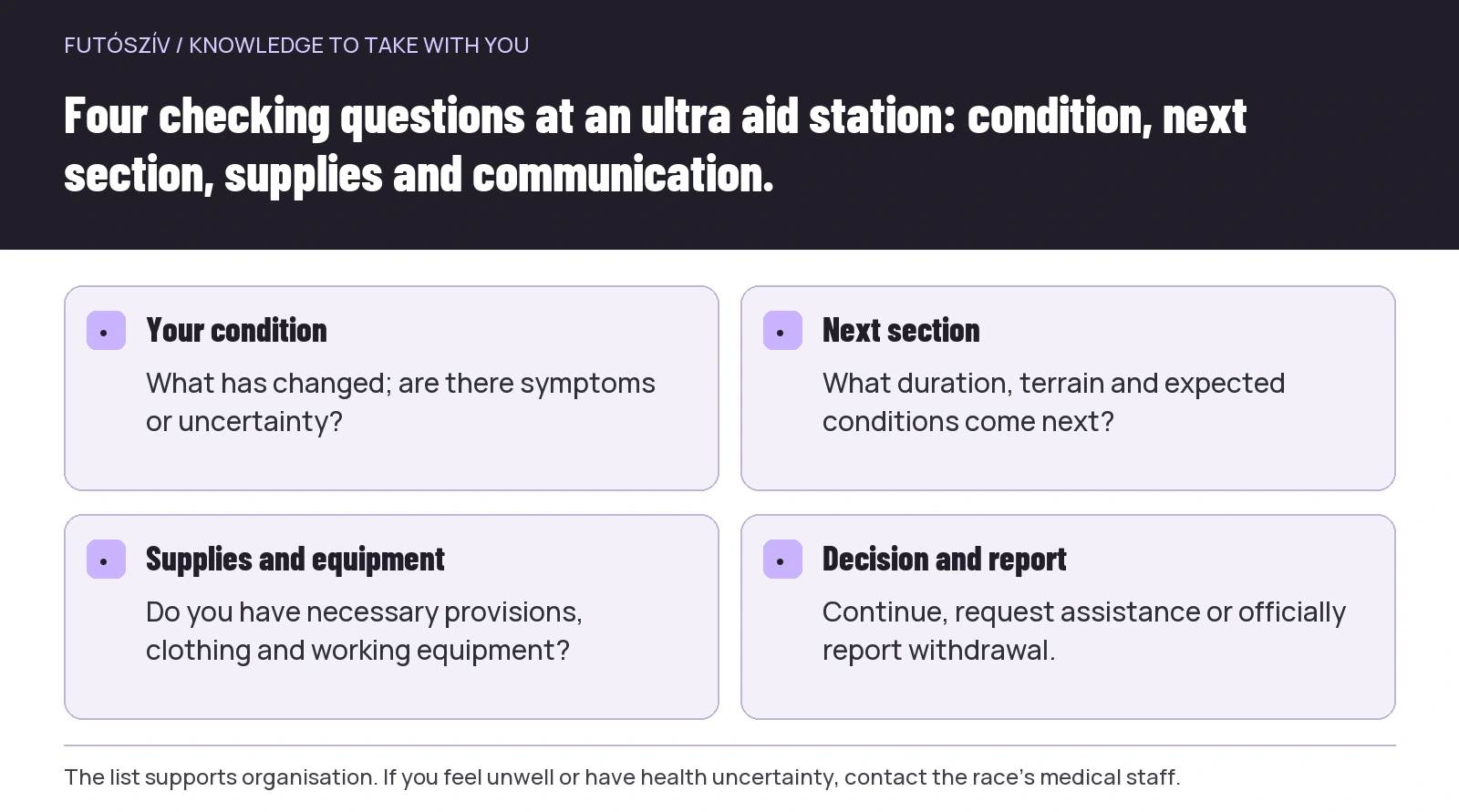 Enlarge diagram
Text version of the illustration
- Your condition
- What has changed; are there symptoms or uncertainty?
- Next section
- What duration, terrain and expected conditions come next?
- Supplies and equipment
- Do you have necessary provisions, clothing and working equipment?
- Decision and report
- Continue, request assistance or officially report withdrawal.
Medication should not be a race-strategy tool
For pain or new symptoms, automatically taking medication to enable continued progress should not be the solution. Medication use must fit your health situation and appropriate professional advice, not the need to reach the next checkpoint.
In a placebo-controlled ibuprofen study during an eighty-kilometre race, kidney-function outcomes were less favourable in the medication group, with substantial statistical uncertainty. The research does not calculate an individual risk applying to everyone, but does not support treating the drug as a harmless automatic race supplement.
The aim is not to develop a home diagnosis or treatment from this finding. Seek an appropriate healthcare professional for symptoms, feeling unwell or medication questions. Do not treat a recommendation to stop from race staff as a negotiation over your finishing time.
Plan withdrawal in advance
Read withdrawal arrangements while fresh: where to report, whom to notify, how transport works and companions’ responsibilities. Official notification matters so the organiser knows you have not disappeared from the route. Your event specifies the exact process.
Identify beforehand situations in which you will request help or not continue: new concerning symptoms, navigation uncertainty or failure of necessary equipment, for example. This is organisational preparation, not a complete medical decision list.
The desire to finish can be strong, especially after lengthy preparation. A previously clarified decision process can help you see beyond work already invested. Withdrawal may be the responsible outcome suited to the situation.
You need not separately prove fatigue
In ultra preparation, the hardest stories can easily become perceived norms. You still need not deliberately become sleep-deprived, exhausted or badly equipped to feel mentally strong. Practice aims at the appropriate skill, not the quantity of suffering.
If movement in darkness is expected, equipment handling and environmental tasks can be learnt during manageable, safely organised outings too. Decide the exact programme from background and surroundings. Consider transport after a late-evening run as well.
Persistently worsening sleep, well-being or exercise tolerance calls for reviewing the whole plan. Seek appropriate help with prolonged or concerning symptoms. A big goal does not make feeling constantly unwell necessary.
Evaluate skills at the end of preparation too
Ask more than how many kilometres accumulated. Can you reach important equipment? Do you know sections to the next point? Have you tried your chosen fuelling? Do you know how to report withdrawal? Identify missing experience precisely.
Not every gap can be filled in the final days. If the undertaking substantially exceeds the completed foundation or current situation, another distance or later start may be realistic. One more large trial cannot retrospectively organise the previous months.
An ultra becomes your own meaningful goal when you accept the decisions required alongside the distance. Readiness includes considering both continuing and stopping. A good plan offers more ways to manage the situation, rather than one route to the finish that must be followed at all costs.
Sources
- ITRA: Safety Guidelines – an organiser framework for safety, communication and rescue.
- Gut-training – a research protocol for specific structured fuelling practice.
- Ibuprofen versus placebo effect on acute kidney injury in ultramarathons – a randomised trial whose outcomes require interpretation with uncertainty.
- UTMB Mont-Blanc compulsory equipment information – an event-specific example; your own race’s current requirements take precedence.
How Futószív articles are prepared: our editorial guidelines.